


5 Prisoners Sought by US in Swap with Iran Are Freed, Arrive in Qatar

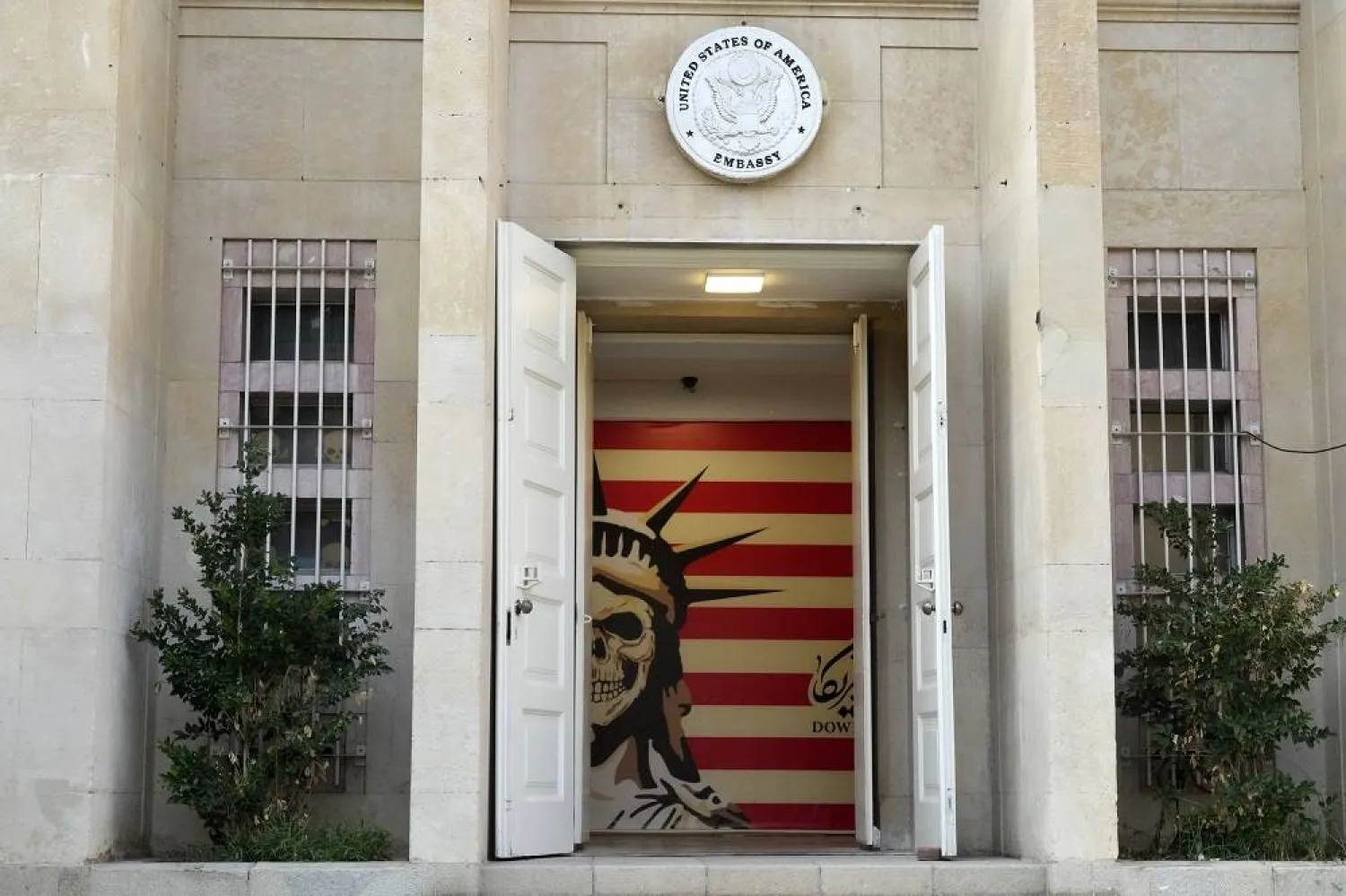
The entrance to the former US Embassy, which has been turned into an anti-American museum, is seen n Tehran, Iran, on Saturday, Aug. 19, 2023. (AP)
TT

5 Prisoners Sought by US in Swap with Iran Are Freed, Arrive in Qatar

The entrance to the former US Embassy, which has been turned into an anti-American museum, is seen n Tehran, Iran, on Saturday, Aug. 19, 2023. (AP)

Five prisoners sought by the US in a swap with Iran flew out of Tehran on Monday, officials said, part of a deal that saw nearly $6 billion in Iranian assets unfrozen.

Despite the deal, tensions are almost certain to remain high between the US and Iran, which are locked in various disputes, including over Tehran’s nuclear program. Iran says the program is peaceful, but it now enriches uranium closer than ever to weapons-grade levels.

The planned exchange has unfolded amid a major American military buildup in the Arabian Gulf, with the possibility of US troops boarding and guarding commercial ships in the Strait of Hormuz, through which 20% of all oil shipments pass.

President Joe Biden welcomed the news of the release in a statement, saying “five innocent Americans who were imprisoned in Iran are finally coming home.”

He urged Americans not to travel to Iran, and he demanded more information on what happened to Bob Levinson, an American who went missing years ago. Biden also announced sanctions on former Iranian President Mahmoud Ahmadinejad and the Iranian Ministry of Intelligence.

Two people, including a senior Biden administration official, said that the prisoners left Tehran on Monday. They spoke on condition of anonymity while the exchange was ongoing.

In addition to the five freed Americans, two US family members flew out, according to the Biden administration official.

Flight-tracking data showed a Qatar Airways flight take off from Tehran’s Mehrabad International Airport, which has been used for exchanges in the past. Several of the former prisoners could be seen climbing the stairs to the flight in video released by Iranian media. The plane later landed in Doha, Qatar.

Meanwhile, Nour News, a website believed to be close to Iran’s security apparatus, said two of the Iranian prisoners had arrived in Doha for the swap.

Earlier, Iranian Foreign Ministry spokesman Nasser Kanaani said that the exchange would take place Monday after nearly $6 billion in once-frozen Iranian assets reached Qatar.

“Fortunately Iran’s frozen assets in South Korea were released and God willing today the assets will start to be fully controlled by the government and the nation,” Kanaani said.

“On the subject of the prisoner swap, it will happen today and five prisoners, citizens of the Islamic Republic, will be released from the prisons in the US,” he added. “Five imprisoned citizens who were in Iran will be given to the US side.”

He said two of the Iranian prisoners will stay in the US.

Mohammad Reza Farzin, Iran’s Central Bank chief, later came on state television to acknowledge the receipt of over 5.5 billion euros — $5.9 billion — in accounts in Qatar. Months ago, Iran had anticipated getting as much as $7 billion.

The planned exchange comes ahead of the convening of world leaders at the UN General Assembly this week in New York, where Iran’s hard-line President Ebrahim Raisi will speak.

The deal has already opened US President Joe Biden to fresh criticism from Republicans and others who say that the administration is helping boost the Iranian economy at a time when Iran poses a growing threat to American troops and Mideast allies. That could have implications in his reelection campaign as well.

On the US side, Washington has said the planned swap includes Siamak Namazi, who was detained in 2015 and was later sentenced to 10 years in prison on spying charges; Emad Sharghi, a venture capitalist sentenced to 10 years; and Morad Tahbaz, a British-American conservationist of Iranian descent who was arrested in 2018 and also received a 10-year sentence. All of their charges have been widely criticized by their families, activists and the US government.

US officials have so far declined to identify the fourth and fifth prisoner.

The five prisoners Iran has said it seeks are mostly held over allegedly trying to export banned material to Iran, such as dual use electronics that can be used by a military.

The two that Nour News said were in Doha were: Mehrdad Ansari, an Iranian sentenced to 63 months in prison in 2021 for obtaining equipment that could be used in missiles, electronic warfare, nuclear weapons and other military gear, and Reza Sarhangpour Kafrani, an Iranian charged in 2021 over allegedly unlawfully exporting laboratory equipment to Iran.

The cash represents money South Korea owed Iran — but had not yet paid — for oil purchased before the US imposed sanctions on such transactions in 2019.

The US maintains that, once in Qatar, the money will be held in restricted accounts and will only be able to be used for humanitarian goods, such as medicine and food. Those transactions are currently allowed under American sanctions targeting Tehran over its advancing nuclear program.

Iranian government officials have largely concurred with that explanation, though some hard-liners have insisted, without providing evidence, that there would be no restrictions on how Tehran spends the money.

Iran and the US have a history of prisoner swaps dating back to the 1979 US Embassy takeover and hostage crisis following the revolution. Their most recent major exchange happened in 2016, when Iran came to a deal with world powers to restrict its nuclear program in return for an easing of sanctions.

The West accuses Iran of using foreign prisoners — including those with dual nationality — as bargaining chips, an allegation Tehran rejects.

Negotiations over a major prisoner swap faltered after then-President Donald Trump unilaterally withdrew America from the nuclear deal in 2018. From the following year on, a series of attacks and ship seizures attributed to Iran have raised tensions.

Meanwhile, Iran’s nuclear program now enriches closer than ever to weapons-grade levels. While the head of the United Nations’ nuclear watchdog has warned that Iran now has enough enriched uranium to produce “several” bombs, months more would likely be needed to build a weapon and potentially miniaturize it to put it on a missile — if Iran decided to pursue one.

Iran maintains its nuclear program is peaceful, and the US intelligence community has kept its assessment that Iran is not pursuing an atomic bomb.

Iran has taken steps in recent months to settle some issues with the International Atomic Energy Agency. But the advances in its program have led to fears of a wider regional conflagration as Israel, itself a nuclear power, has said it would not allow Tehran to develop the bomb. Israel bombed both Iraq and Syria to stop their nuclear programs, giving the threat more weight. It also is suspected in carrying out a series of killings targeting Iran’s nuclear scientists.

Iran also supplies Russia with the bomb-carrying drones Moscow uses to target sites in Ukraine in its war on Kyiv, which remains another major dispute between Tehran and Washington.



470-kilo WWII Bomb Removed in Belgrade

This handout photograph taken on December 28, 2025 and released by Serbia's Ministry of Interior shows a 470-kg World War II aerial bomb, dropped on Nazi-occupied Belgrade in 1944, found in a construction site in the Serbian capital before being removed by Serbian bomb disposal experts. (Photo by Handout / SERBIAN MINISTRY OF INTERIOR AFFAIRS / AFP)
TT

470-kilo WWII Bomb Removed in Belgrade

This handout photograph taken on December 28, 2025 and released by Serbia's Ministry of Interior shows a 470-kg World War II aerial bomb, dropped on Nazi-occupied Belgrade in 1944, found in a construction site in the Serbian capital before being removed by Serbian bomb disposal experts. (Photo by Handout / SERBIAN MINISTRY OF INTERIOR AFFAIRS / AFP)

A 470-kilogram (1,000-pound) World War II aerial bomb was safely removed on Sunday from a construction site in a central district of Serbia’s capital, Belgrade, police said.

The US-made AN-M44 bomb was used during Allied air raids on German positions during the liberation of Belgrade from Nazi occupation in 1944.

Ahead of the bomb’s removal, the site, which is near a residential area and a shopping mall, underwent detailed reconnaissance "to ensure safe conditions," AFP quoted police as saying.

Residents were also told to remove vehicles and leave their homes if possible.
The bomb was transported to an army arms training ground 180 km (110 miles) from Belgrade, where it will be destroyed in the coming days.

Several unexploded bombs dating back to past wars have been discovered in Serbia in recent years, all of which were safely removed without detonating.

In September 2024, a century-old artillery shell weighing nearly 300 kilograms (660 pounds) was cleared from a construction site near the Serbian parliament in Belgrade.

Earlier that year, in April, a large bomb from the 1999 NATO bombing campaign was found in Nis, southern Serbia.

In 2021, a 242-kilogram (530-pound) World War II bomb was also removed from a construction site in a Belgrade suburb.


Has Iran Built an Espionage Network in Israel?

People walk in the rain during stormy weather in the port of Tel Aviv, Israel, 27 December 2025.  EPA/ABIR SULTAN
People walk in the rain during stormy weather in the port of Tel Aviv, Israel, 27 December 2025. EPA/ABIR SULTAN
TT

Has Iran Built an Espionage Network in Israel?

People walk in the rain during stormy weather in the port of Tel Aviv, Israel, 27 December 2025.  EPA/ABIR SULTAN
People walk in the rain during stormy weather in the port of Tel Aviv, Israel, 27 December 2025. EPA/ABIR SULTAN

For the past year, Israel has arrested dozens of Israeli citizens on suspicion of spying for Iran, Yedioth Ahronoth has reported on.

The Hebrew newspaper revealed on Saturday that some of the recruits were asked to photograph sensitive facilities and to collect information including documentation of Israeli army bases, strategic sites and homes linked to senior Israeli officials.

The newspaper said that since September 2024, Israeli authorities have uncovered 35 serious Iranian espionage cases. In some, individuals acted alone; in others, they were part of organized cells, with a mission to sow chaos, burn vehicles and carry out failed assassination plots.

It said the youngest of their recruits is a 13-year-old boy from Tel Aviv. Others had served in the reserves and regular forces.

They leaked sensitive information, including documentation of sensitive military bases, strategic sites and homes linked to senior Israeli officials.

The recruits included Mordechai “Moti” Maman, 72, of Ashkelon. He entered Iran twice and discussed with the agents the possibility of carrying out terror attacks in Israel.

The Iranian handlers discussed with him the option of assassinating senior figures such as Prime Minister Benjamin Netanyahu, then-Defense Minister Yoav Gallant and then-Shin Bet chief Ronen Bar.

After Maman told them the level of security surrounding senior officials made such attacks impractical, the sides discussed alternative terror and espionage activities, including possible attacks on former Prime Minister Naftali Bennett or mayors. Maman was arrested in September 2024.

In October 2024, four cells were arrested, including a couple who had been in contact with Iranian agents since 2021 and groups of five to eight people on suspicion of conducting espionage for Iran.

One of the cases involved seven Israelis who immigrated from Azerbaijan, including a father and son, suspected of maintaining ties for two years with operatives from Iran.

As part of that relationship, the suspects photographed military bases that later became targets in Iran’s ballistic missile attack last year. Some of the group were caught surveilling a senior Israeli official and his son, allegedly as part of an assassination plan.

Authorities also uncovered another case in which seven people aged 19 to 23 from the Jerusalem neighborhood of Beit Safafa were arrested on suspicion of conducting espionage for Iran for several months. Their main assignment was to assassinate an Israeli nuclear scientist and a mayor.

In early 2025, another espionage case was uncovered, and an indictment was filed against an Israeli from Petah Tikva, on charges including contact with a foreign agent and passing information to the enemy.

According to the indictment, the recruit photographed the neighborhood of National Unity party leader Benny Gantz and a power station in Tel Aviv.

His handler contacted him via Telegram and offered payment through a digital wallet in exchange for carrying out security-related tasks. These included documenting security facilities, spraying political graffiti, arson attacks on vehicles and other acts.

During 2025, more than nine indictments have been filed against cells and individuals accused of spying for Iran, most of them Jews the newspaper said.
Investigations revealed that most of the spies had carried out various missions in exchange for payment.

The majority of the recruits had not travelled to Iran to complete their recruitment, but communicated with Iranians through social networks or during their presence in other countries.


Polls Open for Myanmar's 1st Election Since Military Seized Power

Myanmar voters line up to cast ballots during the first phase of general election at a polling station in Naypyitaw, the capital city of Myanmar, 28 December 2025. EPA/RUNGROJ YONGRIT
TT

Polls Open for Myanmar's 1st Election Since Military Seized Power

Myanmar voters line up to cast ballots during the first phase of general election at a polling station in Naypyitaw, the capital city of Myanmar, 28 December 2025. EPA/RUNGROJ YONGRIT

Voters went to the polls Sunday for the initial phase of Myanmar ’s first general election in five years, held under the supervision of its military government while a civil war rages throughout much of the country.

Final results will not be known until after two more rounds of voting are completed later in January. It is widely expected that Min Aung Hlaing, the general who has ruled the country with an iron hand since an army takeover in 2021, will then assume the presidency.

The military government has presented the vote as a return to electoral democracy, but its bid for legitimacy is marred by bans on formerly popular opposition parties and reports that soldiers have used threats to force voters to participate.

While more than 4,800 candidates from 57 parties are competing for seats in national and regional legislatures, only six are competing nationwide with the possibility to gain political clout in Parliament. The well-organized and funded Union Solidarity and Development Party, with its support from the military, is by far the strongest contender.

Voting is taking place in three phases, with Sunday’s first round being held in 102 of Myanmar’s 330 townships. The second phase will take place Jan. 11, and the third on Jan. 25. Final results are expected to be announced by February.

Critics call the election a sham to keep the army in power Critics charge that the election is designed to add a facade of legitimacy to military rule that began when the military ousted the elected government of Aung San Suu Kyi in February 2021. It blocked her National League for Democracy party from serving a second term despite winning a landslide victory in the 2020 election.

They argue that the results will lack legitimacy due to the exclusion of major parties and limits on freedom of speech and an atmosphere of repression.

The expected victory of the military-backed Union Solidarity and Development Party makes the nominal transition to civilian rule a chimera, say opponents of military rule and independent analysts.

“An election organized by a junta that continues to bomb civilians, jail political leaders, and criminalize all forms of dissent is not an election — it is a theater of the absurd performed at gunpoint,” Tom Andrews, the UN-appointed human rights expert for Myanmar, posted on X.

The United Nations also said Sunday that Myanmar needs free elections.

"It is critical that the future of Myanmar is determined through a free, fair, inclusive and credible process that reflects the will of its people," said the United Nations in Myanmar, adding the UN "stands in solidarity with the people of Myanmar and their democratic aspirations.”

Holding the election may provide an excuse for neighbors like China, India and Thailand to continue their support, claiming the election promotes stability.

Western nations have maintained sanctions against Myanmar’s ruling generals due to their anti-democratic actions and the brutal war against their opponents.

Suu Kyi, Myanmar’s 80-year-old former leader, and her party are not participating in the polls. She is serving a 27-year prison term on charges widely viewed as spurious and politically motivated. Her party, the National League for Democracy, was dissolved in 2023 after refusing to register under new military rules.

Other parties also refused to register or declined to run under conditions they deem unfair, and opposition groups have called for a voter boycott.