


Yemen's Presidential Leadership Calls for Support, Pressuring Houthis

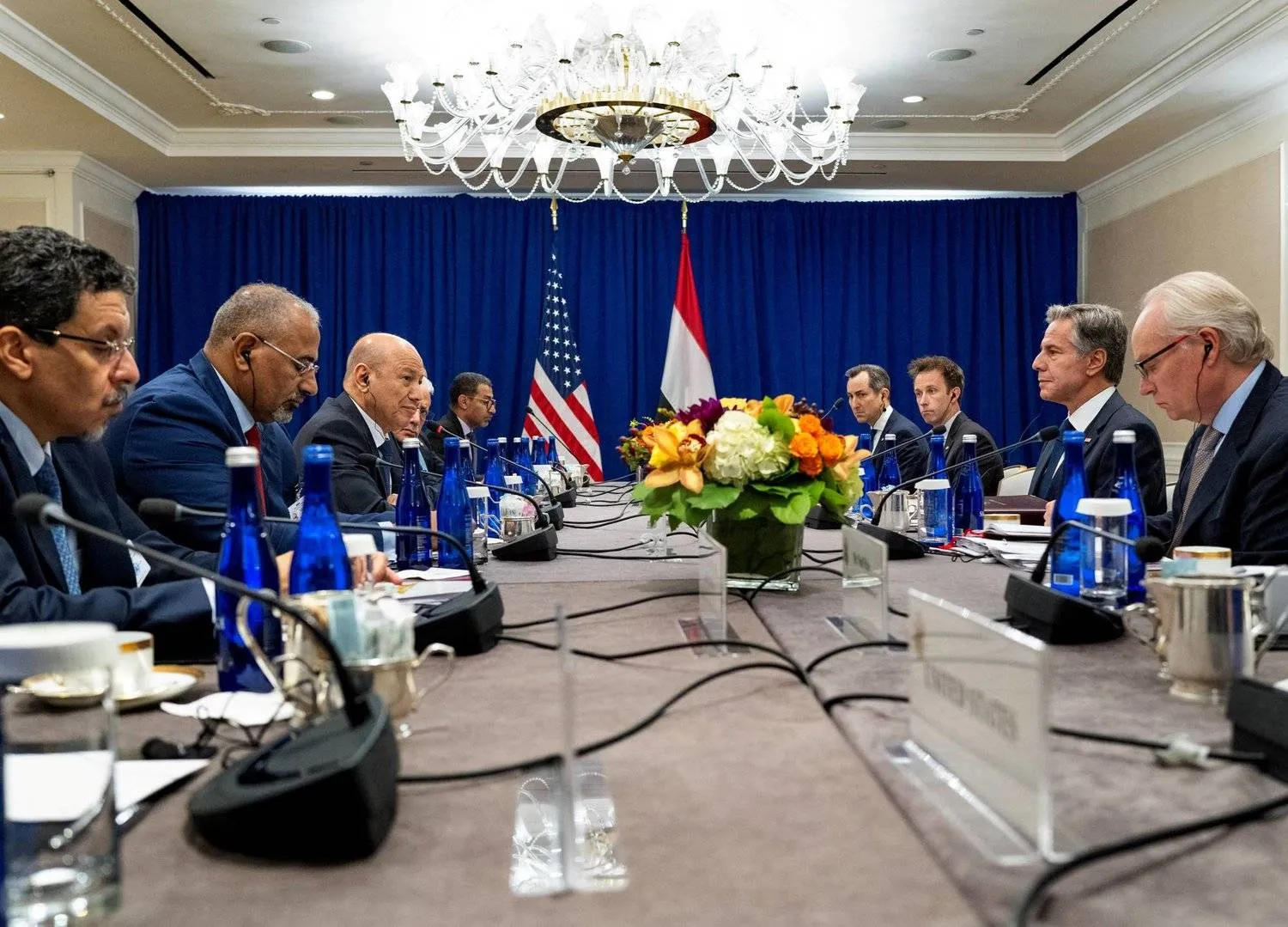
Yemeni Presidential Leadership Council (PLC) President Rashad al-Alimi, during his meeting with US Secretary of State Antony Blinken
TT

Yemen's Presidential Leadership Calls for Support, Pressuring Houthis

Yemeni Presidential Leadership Council (PLC) President Rashad al-Alimi, during his meeting with US Secretary of State Antony Blinken

Yemeni Presidential Leadership Council (PLC) President Rashad al-Alimi accused the Houthi group of obliterating decades of developments in the country since their coup.

Speaking at the Sustainable Development Goals Summit on the sidelines of the 78th UN General Assembly meetings in New York, Alimi urged the international community to push the Houthis toward peace.

The Yemeni official called for intensified pressure on the Houthis to end the politicization of humanitarian issues, asserting that this is as important as humanitarian aid.

He explained that Yemen is lagging in its development commitments due to the strains of war and a deepening humanitarian crisis that the Iran-backed Houthi militias continue exacerbating for the ninth consecutive year.

Alimi added that the war has shifted developmental priorities in Yemen, especially in light of the cessation of oil exports for an entire year following Houthi attacks on export ports and international shipping lanes.

Discussing sustainable development objectives, which involve widespread societal participation in decision-making, production, and employing technology for job creation and improving life quality, the Yemeni leader stressed that such discussions are now impossible in densely populated militia-controlled areas.

He blamed the Houthi group for barring life-saving vaccines from reaching their territories, leading to a resurgence of deadly diseases eradicated two decades ago.

- Destruction of achievements

Alimi discussed the impacts of the Houthi war and its dire consequences across various service, developmental, and humanitarian sectors.

Recently, he said millions of Yemeni students returned to school under extremely harsh conditions, adding that the governmental protection network that should be bolstering the education sector has collapsed.

He emphasized that the Houthis' actions have destroyed Yemen's economic achievements over the past decades.

- Diplomatic Initiatives

He held a series of meetings with UN and international officials in New York to shed light on the crisis in Yemen and pressure the Houthi rebels to embrace peace, according to official sources.

Alimi and PLC Vice President Aidrous al-Zubaidi met with the US Secretary of State, Anthony Blinken.

They discussed the evolving situation in Yemen and the commendable mediation efforts led by Saudi Arabia and Oman to renew the truce and initiate a comprehensive political process under the UN's auspices.

Alimi acknowledged the US humanitarian interventions to alleviate the hardships intensified by Houthi attacks on oil installations and international shipping routes.

Additionally, he met with the UN Under-Secretary-General, Vladimir Voronkov, and discussed the wide-ranging implications of the Houthi war.

State-owned Saba news agency reported that Alimi briefed the UN official on the escalating threats fuelled by the Houthi militias.

He highlighted the need for international support to rebuild the state institutions, law enforcement agencies, counterterrorism, and organized crime authorities and enhance their capability to counter security threats in coordination with regional allies and international partners.

Furthermore, Alimi met with the International Monetary Fund's (IMF) Managing Director, Kristalina Georgieva, addressing the economic and humanitarian situation in Yemen.

Yemen's official media reported that Alimi discussed with international officials the humanitarian consequences of the Houthi attacks on oil facilities and discussed the required international support for the Yemeni government to fulfill its obligations.

The head of Yemen's governing council expressed appreciation for the facilities provided by the IMF, notably its Special Drawing Rights (SDR).

He indicated his openness to various offers to mobilize global support alongside government reforms and measures in coordination with regional and international allies.

Alimi lauded the generous Saudi support for Yemen's state budget and its pivotal role in stabilizing Yemen's economic and service sectors.



Türkiye Calls Israel’s Recognition of Somaliland ‘Illegitimate’

This handout photograph taken and released by the Turkish presidential press service on December 30, 2025, shows Türkiye’s President Recep Tayyip Erdogan (R) and Somalia's President Hassan Sheikh Mohamud (L) shaking hands before their meeting in Istanbul. (Photo by Handout / Turkish Presidential Press Service / AFP)
TT

Türkiye Calls Israel’s Recognition of Somaliland ‘Illegitimate’

This handout photograph taken and released by the Turkish presidential press service on December 30, 2025, shows Türkiye’s President Recep Tayyip Erdogan (R) and Somalia's President Hassan Sheikh Mohamud (L) shaking hands before their meeting in Istanbul. (Photo by Handout / Turkish Presidential Press Service / AFP)

Türkiye’s president on Tuesday called Israel's recognition of Somaliland "illegitimate and unacceptable" as he hosted a visit by his Somali counterpart.

"Preserving the unity and integrity of Somalia in all circumstances holds special importance in our view. Israel's decision to recognize Somaliland is illegitimate and unacceptable," Turkish leader Recep Tayyip Erdogan said in a press conference alongside Somali President Hassan Sheikh Mohamud.

Israel sparked criticism last Friday when it said it was officially recognizing Somaliland -- a breakaway territory in Somalia's north.

The declaration was a first for the territory, which in 1991 had unilaterally declared secession from Somalia.

Israel's move has drawn widespread criticism from the African Union, Egypt and the European Union, which insist on war-torn Somalia's sovereignty.

Türkiye has frequently clashed with Israel over a range of issues, especially over the conflict in Gaza and Israeli obstruction of aid to the Palestinian territory.

Mohamud said Israeli Prime Minister Benjamin Netanyahu's "aggressive position, which also includes Somalia, is unacceptable".

He called Netanyahu's Somaliland declaration "a violation of international law" and "the start of insecurity and instability, especially for Somalia and the African region".


10 Countries Warn of ‘Catastrophic’ Gaza Situation

 Palestinians stand next to a tent set up on the rubble of buildings destroyed during Israeli air and ground operations in the Sheikh Radwan neighborhood, in Gaza City, Tuesday, Dec. 30, 2025. (AP)
Palestinians stand next to a tent set up on the rubble of buildings destroyed during Israeli air and ground operations in the Sheikh Radwan neighborhood, in Gaza City, Tuesday, Dec. 30, 2025. (AP)
TT

10 Countries Warn of ‘Catastrophic’ Gaza Situation

 Palestinians stand next to a tent set up on the rubble of buildings destroyed during Israeli air and ground operations in the Sheikh Radwan neighborhood, in Gaza City, Tuesday, Dec. 30, 2025. (AP)
Palestinians stand next to a tent set up on the rubble of buildings destroyed during Israeli air and ground operations in the Sheikh Radwan neighborhood, in Gaza City, Tuesday, Dec. 30, 2025. (AP)

The foreign ministers of 10 nations on Tuesday expressed "serious concerns" about a "renewed deterioration of the humanitarian situation" in Gaza, saying the situation was "catastrophic". 

"As winter draws in, civilians in Gaza are facing appalling conditions with heavy rainfall and temperatures dropping," the ministers of Britain, Canada, Denmark, Finland, France, Iceland, Japan, Norway, Sweden and Switzerland said in a joint statement released by the UK's Foreign Office. 

"1.3 million people still require urgent shelter support. More than half of health facilities are only partially functional and face shortages of essential medical equipment and supplies. The total collapse of sanitation infrastructure has left 740,000 people vulnerable to toxic flooding," the statement added. 

The ministers said they welcomed the progress that had been made to end the bloodshed in Gaza and secure the release of Israeli hostages. 

"However, we will not lose focus on the plight of civilians in Gaza," they said, calling on the government of Israel to take a string of "urgent and essential" steps. 

These included ensuring that international NGOs could operate in Gaza in a "sustained and predictable" way. 

"As 31 December approaches, many established international NGO partners are at risk of being de-registered because of the government of Israel's restrictive new requirements," the statement said. 

It also called for the UN and its partners to be able to continue their work in Gaza and for the lifting of "unreasonable restricts on imports considered to have a dual use". 

This included medical and shelter equipment. 

The foreign ministers also called for the opening of crossings to boost the flows of humanitarian aid into Gaza. 

While welcoming the partial opening of the Allenby crossing, they said other corridors for moving goods remained closed or severely restricted for humanitarian aid, including Rafah. 

"Bureaucratic customs processes and extensive screenings are causing delays, while commercial cargo is being allowed in more freely," the statement said. 

"The target of 4,200 trucks per week, including an allocation of 250 UN trucks per day, should be a floor not a ceiling. These targets should be lifted so we can be sure the vital supplies are getting in at the vast scale needed," it added. 


UN Condemns Israel's Moves against Agency for Palestinian Refugees

UNRWA center targeted by Israeli shelling in northern Gaza (DPA)
TT

UN Condemns Israel's Moves against Agency for Palestinian Refugees

UNRWA center targeted by Israeli shelling in northern Gaza (DPA)

The United Nations warned Tuesday that recent actions by Israel against the UN agency for Palestinian refugees risked depriving millions of people of basic services such as education and healthcare.

Israel's parliament passed new legislation on Monday formally stripping the United Nations Relief and Works Agency (UNRWA) of diplomatic immunity, and barring Israeli companies from providing water or electricity to the agency's institutions, AFP reported.

According to UNRWA, the legislation also grants the Israeli government the authority to expropriate the agency's properties in East Jerusalem, including its headquarters and main vocational training center.

UNRWA chief Philippe Lazzarini condemned the legislation as "outrageous", decrying it on social media as "part of an ongoing, systematic campaign to discredit UNRWA and thereby obstruct the core role that the agency plays providing human-development assistance and services to Palestine refugees".

Filippo Grandi, the outgoing head of the UN refugee agency, UNHCR, and a former UNRWA chief, also criticised the move as "very unfortunate".

In an interview with AFP, he highlighted that UNRWA, unlike other UN agencies, provides basic public services such as education and healthcare to the millions of registered Palestinian refugees it serves across Gaza and the West Bank, as well as in Lebanon, Jordan and Syria.

"If you deprive those people of those services... then you had better find a substitute," he said, warning: "I think it would be very difficult."

"At the moment, there is a great risk that millions of people will be deprived of basic services if UNRWA is further deprived of space to work, and resources to work."

Israel has been ratcheting up pressure on UNRWA over the past two years.

It has accused the agency of providing cover for Hamas militants, claiming that some UNRWA employees took part in the militant group's October 7, 2023 assault on Israel, which sparked the war in Gaza.

A series of UN-linked internal and external investigations found some "neutrality-related issues" at UNRWA, but stressed Israel had not provided conclusive evidence for its headline allegation.

Grandi criticised the torrent of accusations that have swirled around the agency.

"UNRWA is a very indispensable organization in the Middle East," he said.

"Contrary to much of the frankly baseless rhetoric that we have heard in the past couple of years, UNRWA is a force for peace and stability," he added.

"In a region in which you need every bit of stability and efforts towards peace, it would be really irresponsible to let such an important organization decline further."