


Axed: Rampant Logging Hits India's Batmakers for Six

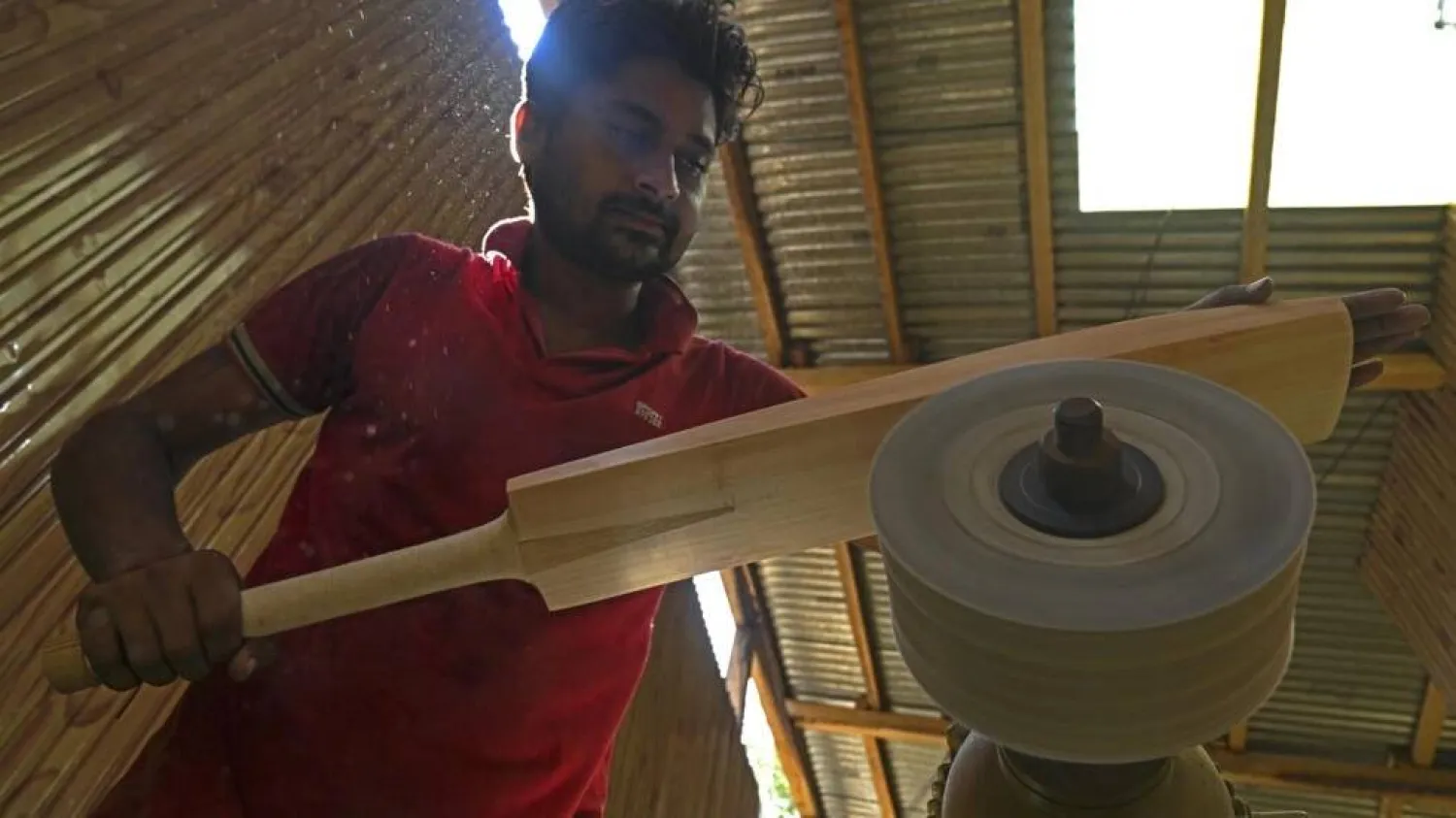
A worker crafts a Kashmiri willow wood cricket bat at a factory in Kashmir's Sangam village, on August 19, 2023. Tauseef MUSTAFA / AFP
TT

Axed: Rampant Logging Hits India's Batmakers for Six

A worker crafts a Kashmiri willow wood cricket bat at a factory in Kashmir's Sangam village, on August 19, 2023. Tauseef MUSTAFA / AFP

When the Cricket World Cup opens in India next month several players will carry Kashmiri willow wood bats, but manufacturers say over-exploitation of trees means their craft faces ruin.

Unchecked logging without replanting has reduced swathes of woodland to scrub in the disputed Indian-administered Himalayan territory, and bat manufacturers face a bleak future, said AFP.

"It's a case of culling all the time and no sowing," said Irfan Ali Shah, a senior official in the government's forest service.

Willow grows far more slowly than the more commercially viable poplar, and bat-makers warn the entire industry -- a major employer -- is at risk.

"We have started searching far-off corners of the valley, but there is not much good willow to be found anywhere for making the best quality bats," said Fawzul Kabiir, whose GR8 bats are International Cricket Council-approved and sold worldwide.

"If the government doesn't help plant again soon on a large scale... we will run out of raw material in three to five years," he told AFP.

Found from Europe to central Asia, water-loving white willows -- scientific name Salix alba -- are deciduous trees growing up to 30 meters (100 feet) tall.

Numbers expanded enormously during the 19th century under British colonial rule, when plantations were laid for firewood during the freezing mountain winter.

The ready supply of willow -- the wood favored by cricketers -- also sparked a craft in bats.

Tendulkar, Kohli and Waugh
Willow has criss-crossing fibers that give it strength and tiny air pockets that reduce vibrations, making the wood light but powerful enough to smash a ball for six.

International big hitters have traditionally preferred willow from England, but the same tree grows in Kashmir and every year the region now produces three million "clefts" -- the rough-cut blocks of wood ready for shaping.

It is the bulk of global supply and bat-maker Kabiir, 31, insists: "The best Kashmir willow bat is at least as good as English willow."

GR8 says its customers include cricketing greats from Indian heroes Sachin Tendulkar and Virat Kohli to Australia's Steve Waugh and South Africa's Graeme Smith and AB de Villiers.

Kashmir's bat-makers prospered over the decades as cricket's popularity grew -- demand surged after India's 1983 World Cup win and the sport now has more than a billion fans globally.

Today, the industry employs some 120,000 people across 400 workshops, according to manufacturers.

It is a key contributor to the economy of Kashmir, a Muslim-majority region claimed in full by both India and Pakistan but split between them, with the portion controlled by New Delhi roiled by a long-running insurgency.

- 'Near extermination' -

But supplies are vanishing fast.

Agricultural scientists at Sher-e-Kashmir University have warned female willow trees -- the most suitable for bat-making -- are facing "near extermination" in Kashmir.

Nearly a million trees were logged in the past decade as the government removed plantations sucking up water from the shrinking Wular lake, protected under the United Nations Ramsar convention.

Elsewhere, willows have been hacked down to make space for farmland and rice paddies.

Demand for timber from other industries, including plywood and pencils, has meant some have replaced willow with swifter-growing poplar.

"A willow tree matures in 30 years and poplar in half the time, and it fetches the same price," said Feroz Ahmed Reshi, whose family has supplied willow wood to bat-makers for generations. "This year, we planted 300 poplars and about five willows."

'Our SOS'
The government banned cleft exports to the rest of India or overseas 25 years ago in a bid to control logging and boost industry in Kashmir.

But the law is repeatedly flouted with some 100,000 clefts illegally sent elsewhere annually, a bat-makers association official said.

"Smuggling of our precious raw material has not stopped," the official said, speaking on condition of anonymity due to the sensitive nature of the topic.

Authorities used to plant willow on state land to maintain firewood supplies but stopped decades ago as electricity and gas became available for heating.

Shah, the forestry official, believes bat-makers must "plant their own willow on their own land" to replace each tree felled.

But private land is scarce in Kashmir, and prices have surged since New Delhi suspended the region's semi-autonomous status and imposed direct rule in 2019.

That allowed Indians from elsewhere to buy land in Kashmir for the first time, a policy denounced by critics as "settler colonialism".

GR8's factory and showroom are in the small town of Sangam, the center of the bat industry, where tourists snap up bats from lines of stores, spending anything from $12 to $180.

"This is our SOS to the government," owner Kabiir said. "We cannot do it alone."


'Large-scale' Avalanche Kills Two Skiers in French Alps

Members of the CRS Alpes Grenoble mountain rescue team prepare to board a Securite Civile helicopter (emergency management) after after an avalanche emergency response rescue mission in an off-piste area of the Ecrins massif, French Alps on January 29, 2026. (Photo by JEFF PACHOUD / AFP)
TT

'Large-scale' Avalanche Kills Two Skiers in French Alps

Members of the CRS Alpes Grenoble mountain rescue team prepare to board a Securite Civile helicopter (emergency management) after after an avalanche emergency response rescue mission in an off-piste area of the Ecrins massif, French Alps on January 29, 2026. (Photo by JEFF PACHOUD / AFP)

An avalanche has killed two off-piste ski tourers in the French Alps, a local prosecutor said on Sunday.

According to local rescue services, the two men died when an avalanche was triggered on Saturday afternoon near the village of Saint-Veran, known as the highest village in the French Alps.

The two victims-- one born in 1997 and the other in 1991 -- were part of a group of four unguided skiers when a "large-scale" avalanche swept down the north side of the Tete de Longet mountain peak, Gap prosecutor Marion Lozac'hmeur told AFP.

The other two skiers were unharmed, Lozac'hmeur added.

An autopsy has been ordered as part of an investigation into the cause of death, according to the prosecutor.

Avalanches have already claimed the lives of more than 20 skiers across the French, Swiss and Austrian Alps so far this season.


Olympic Tourists in Cortina Can Explore the Dolomites with the New ‘Uber Snowmobile’ Service

 The peaks of the Dolomites are seen from the Cortina Sliding Centre during the Milano Cortina 2026 Winter Olympic Games in Cortina d'Ampezzo on February 5, 2026. (AFP)
The peaks of the Dolomites are seen from the Cortina Sliding Centre during the Milano Cortina 2026 Winter Olympic Games in Cortina d'Ampezzo on February 5, 2026. (AFP)
TT

Olympic Tourists in Cortina Can Explore the Dolomites with the New ‘Uber Snowmobile’ Service

 The peaks of the Dolomites are seen from the Cortina Sliding Centre during the Milano Cortina 2026 Winter Olympic Games in Cortina d'Ampezzo on February 5, 2026. (AFP)
The peaks of the Dolomites are seen from the Cortina Sliding Centre during the Milano Cortina 2026 Winter Olympic Games in Cortina d'Ampezzo on February 5, 2026. (AFP)

The peaks of the Dolomites are seen from the Cortina Sliding Centre during the Milano Cortina 2026 Winter Olympic Games in Cortina d'Ampezzo on February 5, 2026. (AFP)

For one month starting on Saturday, Olympic spectators keen for a side trip to a UNESCO World Heritage Site can use Uber to reserve a ride on a snowmobile along the snow-covered road to the base of the Three Peaks of Lavaredo.

The dramatic, jagged limestone pinnacles stand just 23 kilometers (14.3 miles) from the Cortina venues where athletes are competing in the 2026 Winter Olympics and Paralympics.

One of the Olympic torchbearers, Giulia Baffetti, runs snowmobiling tours through Cortina-based winter activities outfit Snowdreamers. The company partnered with Uber, the official ride-hailing sponsor for the Games, to offer free tours on the weekends in February to people in town.

"Uber Snowmobile" tours, which can only be booked through Uber, include a ride in an Uber transfer bus for up to eight people from Cortina to the spot where riders mount their snowmobiles for departure. Tourgoers then follow the instructor, who leads the line of snowmobiles.

The first slots offered went fast, but Uber spokesperson Caspar Nixon said Friday that it planned to add more.

The three peaks are a magical place, Baffetti said, and this is a way for more people to experience it. Hikers and climbers flock there in the warmer months. In the winter, it’s a prime spot for cross-country skiing, snowshoeing and sledding. Snowmobiling is allowed in a limited area in order to protect the environment.

"We want to give an experience to the tourists, so they can feel the mountains in a different way," she said.

The Associated Press took the one-hour tour on Thursday, ahead of the Saturday launch, along with one other person. Helmets are essential, while heated handgrips are a most welcome feature. And that red button? Passengers can push it to stop the snowmobile if it veers off course or they feel unsafe.

The adrenaline-filled ride reaches speeds up to 40 kph (25 mph) when zooming past snow-covered trees, and drivers are instructed to slow when coming upon cross-country skiers and sledders. Deer and wolves are sometimes seen along the 7-kilometer (4.3-mile) route up to the base of the peaks.

Also visible on Thursday was the southernmost of the three Lavaredo peaks, rising sharply out of the fog. While the Dolomites are breathtaking from Cortina — and on Friday, the sun shone and the view was clear from town — they are even more impressive up close.

The route back includes a short loop around Lake Antorno. Before traversing all the ups and downs, the snowmobile instructor leading the tour offers a reminder about that red button.

Saher Deeb, an Israeli tourist, was along for the ride Thursday, one day after his 29th birthday. It was his first time on a snowmobile, and he was all smiles as he climbed off at the end.

"It was perfect," he said.


French Duo Finish Walking from France to Shanghai After 1.5 Years

 Performers throw molten iron to create sparks during a performance on the Bund promenade along the Huangpu river, ahead of the upcoming Lunar New Year of the Horse in Shanghai on February 2, 2026. (AFP)
Performers throw molten iron to create sparks during a performance on the Bund promenade along the Huangpu river, ahead of the upcoming Lunar New Year of the Horse in Shanghai on February 2, 2026. (AFP)
TT

French Duo Finish Walking from France to Shanghai After 1.5 Years

 Performers throw molten iron to create sparks during a performance on the Bund promenade along the Huangpu river, ahead of the upcoming Lunar New Year of the Horse in Shanghai on February 2, 2026. (AFP)
Performers throw molten iron to create sparks during a performance on the Bund promenade along the Huangpu river, ahead of the upcoming Lunar New Year of the Horse in Shanghai on February 2, 2026. (AFP)

Two French adventurers reached the end of an epic walk from France to Shanghai on Saturday, after nearly a year and a half crossing 16 countries almost entirely on foot.

Loic Voisot and Benjamin Humblot embraced as they stood by the river on the Bund promenade, the financial hub's distinctive skyline glittering in the background.

Voisot and Humblot set off from Annecy in September 2024.

"We were thinking about this moment almost every day for more than a year now, so it's a really strong feeling," Humblot said of reaching their destination.

Hanging out after work one day, the two friends realized they both yearned for a "great adventure".

They wanted to visit China -- but without flying, which they believe is too harmful to the environment.

A plan to set out on foot was hatched, and except for a stretch in Russia which was done by bus for safety reasons, 518 days and around 12,850 kilometers (7,980 miles) later they took the last steps to completing it.

Around 50 people gathered at the start point for the last 10km stretch of their odyssey, many local people who have been following them on social media.

Along the way their numbers swelled, as media, French residents of Shanghai and others joined.

"If your dreams are crazy, just take it step by step and sometimes you will not succeed, but sometimes you will," said Voisot.

Asked what he would do first now the walk was over, he joked: "Sleep a lot!"
