Trump Goes to Michigan to Rail Against Biden’s Electric Vehicle Push While GOP Rivals Debate 

Former US President and Republican presidential candidate Donald Trump looks on while his supporters cheer on the day he addresses auto workers as he skips the second GOP debate, in Clinton Township, Michigan, US, September 27, 2023. (Reuters)
TT

Trump Goes to Michigan to Rail Against Biden’s Electric Vehicle Push While GOP Rivals Debate 

Former US President and Republican presidential candidate Donald Trump looks on while his supporters cheer on the day he addresses auto workers as he skips the second GOP debate, in Clinton Township, Michigan, US, September 27, 2023. (Reuters)

As his Republican rivals sparred onstage in California at their second primary debate, Donald Trump was in battleground Michigan Wednesday night working to win over blue-collar voters by lambasting President Joe Biden and his push for electric cars in the midst of an autoworkers’ strike.

“I will not allow under any circumstances the American automobile industry to die,” Trump said at Drake Enterprises, a non-unionized auto parts supplier in Clinton Township, about a half-hour outside Detroit.

The Republican front-runner's trip came a day after Biden became the first sitting president in US history to walk a picket line as he joined United Auto Workers in Detroit. The dueling appearances had the feel of the opening salvo of the 2024 general election, which increasingly looks like a rematch between Trump and Biden, even though primary voting won’t begin until next year.

Trump’s decision to skip another debate comes as he maintains a commanding lead in the GOP primary, even as he faces four separate criminal indictments in four different states.

Trump, in his speech, tried to cast Biden as hostile to the auto industry and workers, using extreme rhetoric to claim the industry was “being assassinated.” He insisted Biden’s embrace of electric vehicles — a key component of his clean-energy agenda — would ultimately lead to lost jobs, amplifying the concerns of some autoworkers who worry that electric cars require fewer people to manufacture and that there is no guarantee factories that produce them will be unionized.

“He’s selling you out to China, he’s selling you out to the environmental extremists and the radical left,” Trump told his crowd, flanked by American flags and pallets of auto parts.

He also downplayed the strike as the UAW pushes for higher wages, shorter work weeks and assurances from the country’s top automakers that new electric vehicle jobs will be unionized. While Trump said he supported the workers and hoped they would get a good deal, he also said no deal would matter if proposed pollution limits take effect.

“You’re all on the picket lines and everything, but it doesn’t make a damn bit of difference what you get, because in two years you’re all going to be out of business,” he said.

While Trump has cast himself as pro-worker, he has clashed repeatedly with union leadership and tried to turn union members against their leaders. In a recent campaign video, Trump urged autoworkers not to pay union dues and claimed their leaders have “got some deals going for themselves.”

Just hours before Trump’s visit, the UAW posted a video on its Facebook page protesting factory closures by Detroit’s automakers that included 2017 footage of Trump telling a northern Ohio crowd that auto jobs would be coming back. Two years later, General Motors closed a huge assembly plant in Lordstown, Ohio, costing thousands of jobs.

Still, Trump repeatedly urged the union to endorse him, at one point directly appealing to UAW President Shawn Fain.

While the union has withheld its support for Biden after endorsing him in 2020, Fain appeared at Biden’s side during his visit Tuesday and has repeatedly criticized Trump.

“I don’t think he cares about working-class people. I think he cares about the billionaire class, he cares about the corporate interests. I think he’s just trying to pander to people and say what they want to hear, and it’s a shame,” Fain said this week.

Biden's re-election campaign, in a statement, called Trump's speech “a pathetic, recycled attempt to feign support for working Americans.”

Drake Enterprises, where Trump spoke, makes automotive and heavy-duty truck components, including gear shift levers for semi-trucks, said its president Nathan Stemple. He said a shift to electric cars would cripple his business.

While Trump aides had said the audience would include several hundred current and former UAW members, as well as members of plumbers and pipefitters unions, it also included many non-union workers who support the former president. Some said they had been invited by people who did business with Drake; others said they had simply arrived at the factory Wednesday afternoon and been allowed to attend.

Tony Duronio, 64, a longtime Trump supporter and real estate broker who lives in Clinton Township, said he received an invitation from a group called Autoworkers for Trump. Duronio praised the economy during Trump's time in office and echoed the former president's criticism of electric vehicles: “Nobody wants ‘em,” he said — and applauded Trump’s decision to skip the debate.

“He’s the frontrunner. He doesn’t have any competition," he said. “Look, if it ain’t him, I may stay home ’cause the rest are no different than Biden.”

Trump briefly mentioned the debate happening 2,000 miles away at the Ronald Reagan presidential library, calling his GOP rivals “job candidates.”

“They’ll do anything,” he said. “Secretary of something. They even say VP, does anybody see any VP in the group? I don’t think so.”

The former president has tried to use the strike to drive a wedge between Biden and union workers, a constituency that helped pave the way for his surprise 2016 victory. Trump in that election won over voters in Democratic strongholds like Michigan, Wisconsin and Pennsylvania, fundamentally reshaping voting alliances as he railed against global trade deals and vowed to resurrect dying manufacturing towns.

But Biden won those states back in 2020 as he emphasized his working-class roots and commitment to organized labor. He often calls himself the “ most pro-union president” in US history and argues the investments his administration is making in green energy and electric vehicle manufacturing will ensure the future of the industry unfolds in the US.

There’s disagreement in the auto industry over whether the shift to EVs will cost union jobs. Some executives say that because electric vehicles require fewer moving parts, companies will need 30% to 40% fewer workers to assemble them. But others say EVs will require comparable labor.

The Trump campaign has vigorously defended his record as pro-worker, but union leaders say his first term was far from worker-friendly — citing unfavorable rulings from the nation’s top labor board and the US Supreme Court, as well as unfulfilled promises of automotive jobs and the closure of the Ohio GM plant.

Along the picket line, workers have been split. Adrian Mitchell, who works at the GM parts warehouse that Biden visited, said he believes Biden would be better for the middle class than a second Trump term. Still, Mitchell said workers are worried the transition to electric cars may cost them jobs.

It was a different scene at Trump's event, filled with MAGA hats and pro-Trump signs.

“Let’s put it this way: There’s nothing I don’t like about Trump,” said Johnny Pentowski, who was a member of the Teamsters Union before he retired as a truck driver earlier this year.

Pentowski, 72, who lives in Eastpointe Michigan, accused union leaders of failing to listen to their members and shared Trump’s skepticism of EVs.

“You take away fossil fuels from a country, you’re taking away its lifeblood,” he said. “Windmills and solars don’t do it.”

The UAW’s targeted strikes against the Big Three automakers — General Motors, Stellantis and Ford — began at midnight Sept. 14 and have since expanded to 38 parts distribution centers in 20 states.

The union is asking for 36% raises in general pay over four years and has also demanded a 32-hour week with 40 hours of pay and a return of cost-of-living pay raises, among other benefits. It also wants to be allowed to represent workers at 10 electric vehicle battery factories, most of which are being built by joint ventures between automakers and South Korean battery makers.

While Biden has not implemented an electric vehicle mandate, he has set a goal that half of all new vehicle sales be electric by 2030. His administration has also proposed stiff new automobile pollution limits that would require up to two-thirds of new vehicles sold in the US to be electric by 2032, a nearly tenfold increase over current electric vehicle sales. That proposal is not final.


Nearly 1,500 Migrants Arrive in Canary Islands in One Day

Rescued migrants disembark from a Spanish Maritime Rescue Service vessel with assistance from emergency workers and Civil Guard officers at the port of La Restinga in El Pinar on the island of El Hierro, Canary Islands, Spain, 14 November 2026. EPA/GELMERT FINOL
TT

Nearly 1,500 Migrants Arrive in Canary Islands in One Day

Rescued migrants disembark from a Spanish Maritime Rescue Service vessel with assistance from emergency workers and Civil Guard officers at the port of La Restinga in El Pinar on the island of El Hierro, Canary Islands, Spain, 14 November 2026. EPA/GELMERT FINOL

Almost 1,500 migrants arrived in Spain's Canary Islands on Saturday, the highest number in a single day since 2020, the EFE news agency reported on Sunday, citing the maritime rescue service.

A total of 1,488 people in 14 boats were rescued by the Spanish coastguard, EFE reported, continuing a surge of arrivals from West African countries to the Spanish archipelago since October.

The previous one-day record was the 1,461 people rescued in waters off the Canary Islands on November 7, 2020, maritime rescue services said ⁠on Sunday, according to Reuters.

While migrant ⁠arrivals have declined so far this year compared with the same period last year, the sharp increase last month placed additional pressure on reception and emergency services on some of the Canary Islands, particularly the smaller and less densely populated ones.

One boat on ⁠Saturday was carrying 240 people, including 12 women and 36 children, authorities said. The rescued migrants were taken to El Hierro, one of the smallest Canary Islands. Most of the people were from Senegal, Gambia and Guinea Conakry.

Twelve boats arrived in El Hierro, plus one in Gran Canaria and another in Tenerife.

Spain's Territorial Policy Minister Angel Victor Torres will visit El Hierro on Sunday to discuss the surge in migrant arrivals.

The Atlantic ⁠route ⁠from West Africa to the Canary Islands is one of the world's deadliest migration crossings. Thousands of migrants attempt the journey each year in overcrowded boats, seeking to reach Spanish territory despite rough seas, strong currents and long distances.

Arrivals tend to pick up in the autumn months, when sea conditions along the route are generally calmer and more favorable for crossings.

Migrant arrivals to the Canary Islands between January and October 31 were down 5.5% from the same period last year, government data show.


Iranian Lawmaker: A Nuclear Bomb is a ‘Public Demand’

Satellite imagery from Jun 9th, 2025 via Airbus/Bulletin, shows a truck at Iran’s Isfahan underground complex carrying 18 sealed containers (AP)
TT

Iranian Lawmaker: A Nuclear Bomb is a ‘Public Demand’

Satellite imagery from Jun 9th, 2025 via Airbus/Bulletin, shows a truck at Iran’s Isfahan underground complex carrying 18 sealed containers (AP)

Iranian lawmaker Hosseinali Haji Deligani said on Saturday that building a nuclear bomb has become a public demand, just days before a meeting of the International Atomic Energy Agency’s Board of Governors to discuss Iran.

“Today, one of the people's demands is that Iran, in addition to its faith and missiles, must build and possess a nuclear bomb,” said Haji Deligani, the deputy head of the Article 90 Commission in the Iranian Parliament, according to Fars news agency.

He argued that Tehran should possess nuclear weapons regardless of whether it intends to use them.

“We must have this capability. Whether it is used or not is a separate matter,” the lawmaker noted.

He said, “based on current assessments, the enemy would not launch a nuclear attack on Iran because of the country’s vast size and the significant repercussions of such an attack.”

The Article 90 Commission of Iran's parliament is mandated to receive, investigate, and respond to written complaints regarding the performance of the legislative, executive, and judicial branches.

Iran has made no official decision to change its nuclear doctrine despite growing calls from lawmakers and members of the public to reconsider its position if war resumes.

Iranian Foreign Ministry spokesperson Esmaeil Baghaei said on Monday that Tehran had not suspended its obligations under its safeguards agreement with the International Atomic Energy Agency (IAEA).

Speaking to reporters, Baghaei said Iran remained a party to the Treaty on the Non-Proliferation of Nuclear Weapons (NPT) and continued to uphold both the treaty and its safeguards agreement. He said the country had demonstrated its adherence to those commitments.

Grossi’s Report

Haji Deligani’s statements came one day after the UN’s nuclear watchdog said it cannot confirm that Tehran hasn’t diverted nuclear material away from peaceful purposes.

In a confidential report on Iran seen by media outlets on Friday, the UN’s nuclear watchdog said because of a lack of cooperation from Iran, it “is not able to conclude that there has been no diversion of declared nuclear material from peaceful nuclear activities in Iran.”

IAEA said it is “increasingly concerned” about a uranium-enrichment plant at Isfahan that Iran declared to it last year but has still not let the watchdog inspect.”

“It is more than a year since the Agency lost continuity of knowledge in relation to the previously declared inventories of LEU (low-enriched uranium) and HEU (highly enriched ⁠uranium) enriched up to 60% U-235 at the declared nuclear facilities affected by the attacks of June 2025,” IAEA Director General Rafael Grossi wrote in his last report on Iran.

He added that Iran needs to allow inspectors back in “with the utmost urgency.”

Inspectors have yet to return to nuclear sites the United States and Israel bombed in June 2025.

Until those attacks, the IAEA estimates Iran had 440.9 kg of uranium enriched to up to 60% purity, a short step from the roughly 90% of weapons-grade uranium. That is enough material, if enriched further, for 10 nuclear weapons, according to an IAEA yardstick, and Iran also had material enriched to lower levels.

“The director general encourages Iran to consider technical and gradual measures by which conditions are achieved that allow for the return of agency inspectors to Iran,” the report said.

But Iran told the IAEA that discussions on restarting inspections in the country cannot resume amid “a series of persistent, explicit, and public threats by the President of the United States of America.”

Criticizing legal and technical basis of IAEA’s reports, Iran Mission to UN Office in Vienna said normal execution of safeguards cannot resume under the abnormal condition created by attacks on Iran’s safeguarded nuclear sites.

In a message posted on its X account on Saturday, the Iranian mission also criticized Grossi’s reporting, arguing that the Board’s decisions have been adopted through an abuse of process and that the US-Israeli attacks on Iran have disrupted inspections and forced the withdrawal of the IAEA’s inspectors.

“The United States removed aggression from bias resolutions, but its consequences cannot be erased from reality,” the statement added.

An Unavoidable Necessity

Last Thursday, Iran’s Assembly of Experts called for considering the country’s withdrawal from the Nuclear Non-Proliferation Treaty (NPT), alongside a review of Iran’s defense doctrine and the establishment of what it described as necessary deterrence.

In a statement carried by Iranian media, the Assembly said that reviewing withdrawal from the NPT, revising the country’s defense doctrine and establishing the necessary deterrence had become an “unavoidable necessity” and a “public and national demand.”

Two weeks ago, Mohsen Araki, a member of the Assembly of Experts and the Expediency Discernment Council, said Iran should reconsider its membership in the Nuclear Non-Proliferation Treaty. He also noted that the country had suffered setbacks without gaining comparable benefits.

“The Islamic Republic has suffered considerable harm and setbacks over the years because of its membership in and continued adherence to this treaty, while gaining no commensurate benefit from that membership,” said Araki.


IRGC Media: Technical Modifications to Allow Iran Develop Missiles that Reach US

People visit the Revolutionary Guard Corps (IRGC) Aerospace Force Museum in Tehran, Iran, November 4, 2026. Majid Asgaripour/WANA (West Asia News Agency) via REUTERS
TT

IRGC Media: Technical Modifications to Allow Iran Develop Missiles that Reach US

People visit the Revolutionary Guard Corps (IRGC) Aerospace Force Museum in Tehran, Iran, November 4, 2026. Majid Asgaripour/WANA (West Asia News Agency) via REUTERS

Iran on Saturday said it could introduce technical modifications to its long-range missiles, enabling them to reach US territory.

Tasnim News agency, the Revolutionary Guard Corps (IRGC) affiliated media outlet, said modifications to the Khorramshahr-4’s warhead could increase its range to 3,000 or 4,000 kilometers by reducing the weight of its warhead to 1,500-kilogram instead of 2,000.

It said a modified version of the missile would reach US bases and those of its allies in eastern and southeastern Europe, as well as central Europe.

Also, the news agency said Iran would develop an intercontinental ballistic missile with a range of approximately 10,000 kilometers to reach the US East Coast, including areas near Washington and New York, and more than 13,000 kilometers to cover the entire US territory.

Tasnim noted that such modification “is possible at present” using the IRGC’s satellite launch vehicles, including the Qased, Zuljanah and Qaem systems, constructing underground “missile cities,” and developing a warhead capable of withstanding re-entry into the Earth's orbit.

Opened Lock

Last week, Supreme Leader Mojtaba Khamenei issued an order to respond to threats of any scale or type with an “immediate and effective response without geographical restrictions.”

Khamenei issued the directives during his first publicly announced meeting with senior military commanders since taking office.

Tasnim on Saturday admitted that former Leader Ali Khamenei had restricted the range of ballistic missiles manufactured in the country to 2,000 kilometers.

It said by “abusing our patience,” Iran’s “enemies unlocked a key aspect of its offensive capabilities.”

Last week, Iran’s Revolutionary Guard Corps spokesman General Hossein Mohebbi confirmed the removal of the 2,000-kilometer range restriction.

“That restriction has been lifted for us,” he declared, without specifying a new range or whether Iran possessed missiles exceeding the previous limit. He promised to demonstrate those capabilities “in practice.”

In August 2025, Iranian lawmaker Amir Hayat-Moqaddam told local media that Tehran has been developing long-range strike capabilities for two decades. He warned that “perhaps our next missile will hit Washington directly. We can target America from the sea.”

Also, Iranian lawmaker Kamran Ghazanfari claimed in early November that Iran developed intercontinental ballistic missiles capable of hitting Europe and the United States.

People visit the Revolutionary Guard Corps (IRGC) Aerospace Force Museum in Tehran, Iran, November 4, 2026. Majid Asgaripour/WANA (West Asia News Agency) via REUTERS

Stealth Cruise Missile

Meanwhile, Iranian state television displayed an inspection of a strategic missile facility belonging to the IRGC.

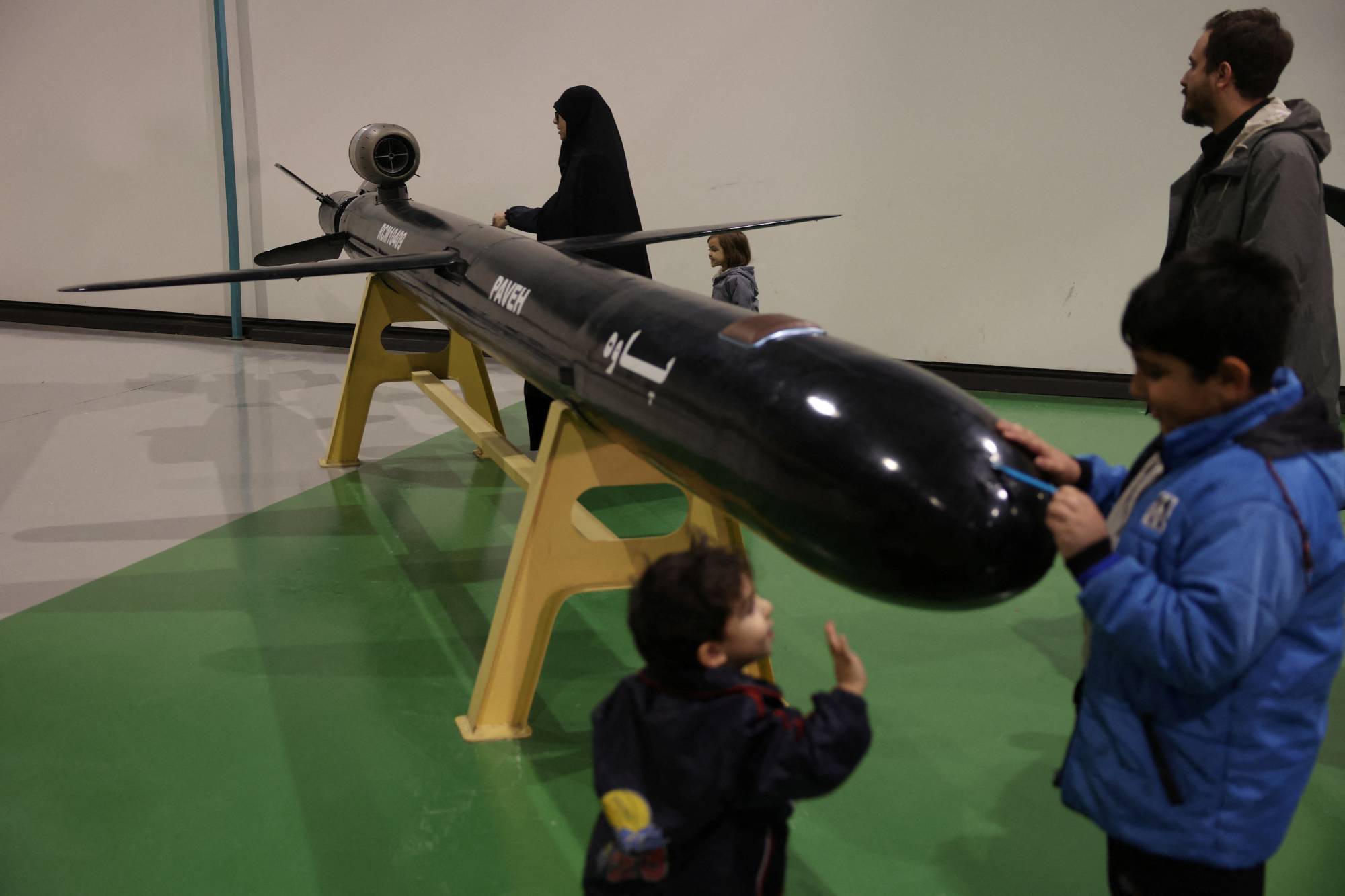
It aired footage on Tuesday describing the underground complex as a new “missile city.”

A military analyst said on his page that the Guards’ missile unit had “quietly” unveiled two new missiles, but that “their unveiling is significant” to those who “monitor and analyze.”

He described the first one as Iran’s “first stealth cruise missile,” noting that its jet engine—which had been mounted externally on previous cruise missiles, making them easier to detect—is now housed inside the body.

The second, he said, is a ballistic missile that combines the warhead of the “Fattah” hypersonic missile with the “Khyber Shikan 2” missile, explaining that the range of the “Fattah” has increased from about 1,400 kilometers to nearly 2,000 kilometers.

Iranian state television aired footage on Tuesday of Armed Forces Chief of Staff Maj. Gen. Ali Abdollahi during his inspection of a strategic missile facility belonging to the IRGC.

It reported the unveiling of new weapons, including a “surprise” missile, without disclosing its name, range or specifications. Iranian media revealed neither the facility’s location nor the date of the visit.

Treats Expand to Europe

Meanwhile, Iran’s hardline newspaper Kayhan said on Wednesday that Tehran would expand threats against US bases beyond the region, including facilities in Europe and neighboring countries if a new war resumes.

“By removing the geographical limits on threats, the enemy should hear the roar of new missiles at US bases thousands of kilometers away in Germany, Britain, Albania, Greece, Cyprus and some neighboring countries,” said the newspaper, which is published under the supervision of the supreme leader’s representative.

Despite claiming it restricts its missile range, Iran in March reportedly tried and failed to hit the joint US-UK base at Diego Garcia, in the Indian Ocean, some 4,000 kilometers away from Iran.

No War No Peace State

US President Donald Trump has told senior advisers in recent days that he may hold off on attacking Iran if the US faces no new provocations, according to three people familiar with the matter.

Trump has alternated between threats of escalating the war with new strikes and winding down hostilities, and current and former officials say he does not appear to have made up his mind about how to resolve the unpopular conflict, which he launched in February with Israel.

But in meetings with his national security advisers and after a series of intelligence briefings, Trump said he was considering holding off on strikes, said the people, who, like others interviewed for this story, spoke on condition of anonymity.

He has also indicated sympathy for allies in the region who have asked him not to return to a full-fledged war.

At the same time, the US military is ready to escalate if needed, three more people ⁠familiar with US planning said.

A third aircraft carrier is moving into the Middle East in the coming days to replace one of the two currently operating in the region, but all three carriers could stay if needed, the people said.

Trump could opt to bomb Iran's underground nuclear facilities, one of the people familiar with Trump's calls with several leaders said. But the US has already struck those facilities, and it is unclear whether further strikes would be successful.
US intelligence agencies have ⁠assessed that renewed strikes would not significantly shift Iran’s demands in negotiations, two US officials said.