


Q&A: SAG-AFTRA President Fran Drescher Reacts to Hollywood Studios Breaking off Negotiations

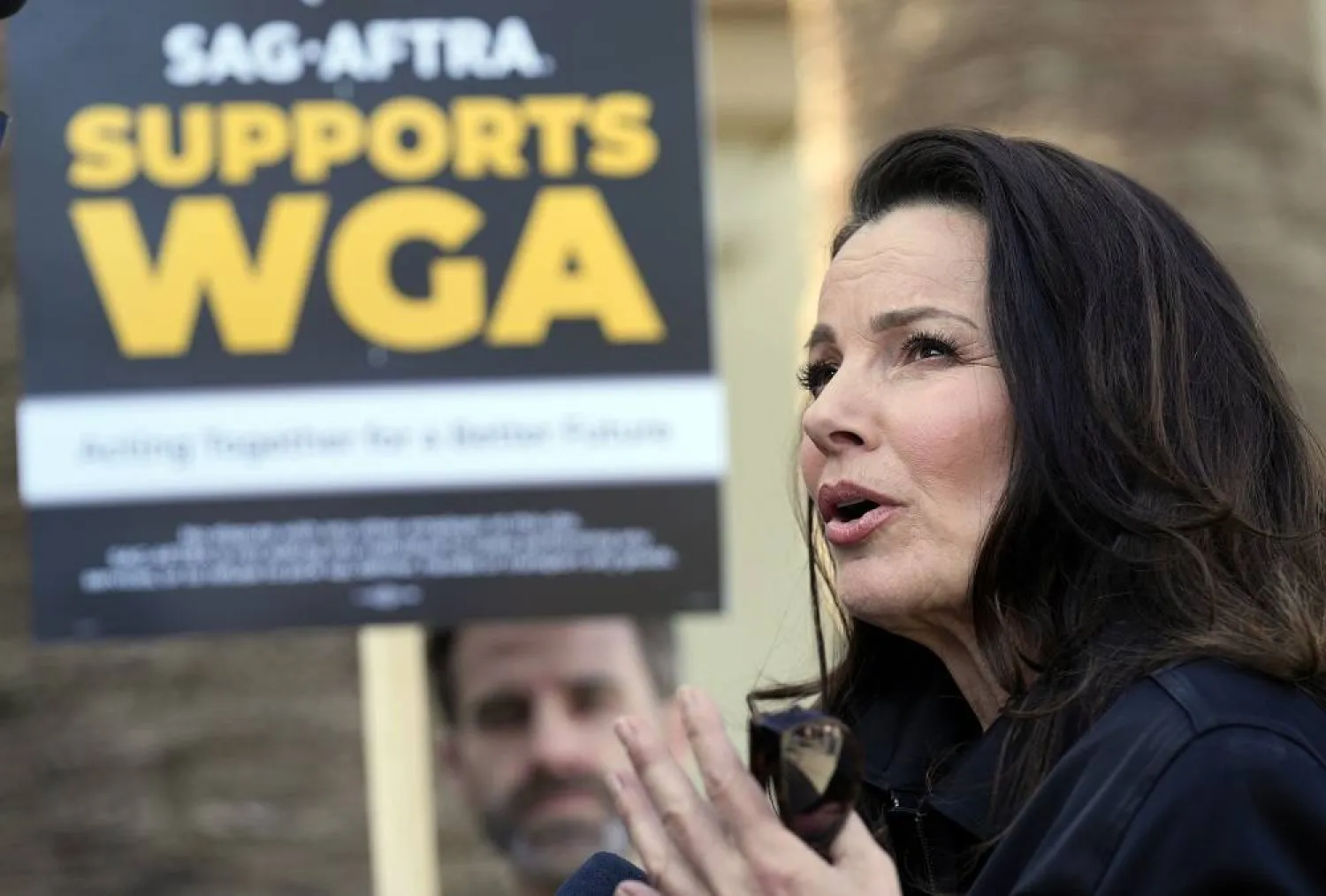
Fran Drescher, president of SAG-AFTRA, is interviewed at a Writers Guild of America rally outside Paramount Pictures studio on May 8, 2023, in Los Angeles. (AP)
TT

Q&A: SAG-AFTRA President Fran Drescher Reacts to Hollywood Studios Breaking off Negotiations

Fran Drescher, president of SAG-AFTRA, is interviewed at a Writers Guild of America rally outside Paramount Pictures studio on May 8, 2023, in Los Angeles. (AP)

Fran Drescher has steered the actors guild through its monthslong strike. On the heels of Hollywood studios abruptly breaking off talks with the Screen Actors Guild-American Federation of Television and Radio Artists this week, the actor and union president says she's baffled and disappointed.

The Alliance of Motion Picture and Television Producers announced Wednesday that they had suspended contract negotiations, saying the gap between the two sides was too great to make continuing worth it and characterizing their offer as good as the one that recently ended the writers strike. Drescher told The Associated Press in a Thursday interview that she did not understand why negotiations collapsed but that her union's resolve has not weakened.

The interview has been edited for clarity and brevity.

AP: Can you talk about what happened in your negotiations with the AMPTP?

DRESCHER: They had given us a proposal package. We worked for like 36 hours on it. We brought it back to them. We walked them through it and they left and then called a few hours later and said, “We’re breaking negotiations.” So it’s not only baffling but wholly disappointing and counterproductive.

I’ve never really met people that actually don’t understand what negotiations mean. Why are you walking away from the table? To what end do you hope that that will accomplish anything?

And actually, my members are more pumped up than ever. They feel so insulted by this, so degraded by this and dishonored by this that it’s like, “Fran, do not cave. Remain strong. Hold onto your resolve because this can’t be for nothing.”

AP: Can you talk about the mood of the conversations before they broke off? Was there a sense that talks would be smoother after the studios reached a deal with the Writers Guild of America?

DRESCHER: With the writers guild also, they broke negotiations with that too. So now that a contract has been agreed upon, everybody’s all warm and fuzzy. But at the time, I think it was very contentious. They don’t like to give away ice in winter.

So I’ve never really dealt with this kind of affront, of indignation and a need to get their own way. I think that they’re very used to getting their own way. I think that the idea that we want to go into a pocket to compensate for the lack of income that we cannot get for our working members in a streaming model is just so repugnant to them. And they just feel like, “Who are we to want to get compensated the way we used to be? Who are we to think that we deserve to make an honest wage that meets inflation? Who are we to challenge them in any way? We should be so lucky to get whatever they want because they’re the bosses.”

And I keep pointing out to them that that kind of business practice is unsustainable nowadays. It was maybe something that people bought into in the 20th century. But that “dog eat dog, the bottom line is the bottom line,” it just doesn’t pan out. And we can’t think that way anymore. You can’t go into a whole new business and not question how this is going to impact the foundational contributors to your business. And that’s exactly what they did. And now they’re like annoyed at us for pointing out the problem.

It’s really like an alternate universe. I can’t even believe it. And I keep trying to put it into a global context that they have a responsibility to workers. They’re leaders in the industry. They should set the example for industries around the world. This is their opportunity as well to raise the bar on how employers deal with workers. How they thank them, how they include them, how they treat them like people.

AP: This will officially be the longest strike in your guild’s history next week. What are your thoughts on how we got here?

DRESCHER: Well, I think it’s indicative of the fact that they stopped talking to us back on July 12 and didn’t come back until less than 10 days ago. You know, we’ve only met with them a couple of times. Monday, half a day Wednesday, half a day Friday. That was what they were available for. Then this past week, it was Monday and a half a day on Wednesday. And then “Bye bye.”

I don’t even know what they’re thinking. But I did say to them, “With all due respect, we have been waiting for you to come back.” We wanted to avert a strike. We extended an unprecedented extension and we called them in the eleventh hour. ... They don’t really want to negotiate. They just want us to like what they want us to like. They don’t want us to have a mind. They don’t want us to have a thought. They don’t want us to have feelings or complain that we can’t make a living and we can’t support our families and we’re having problems paying the rent.

They don’t want to hear about it because they keep giving us this huge inflated number of how much they’re spending on production and how much they’re paying out to our union in salary. But it’s all divided up amongst so many thousands of people that it doesn’t add up to anything except for our highest paying earners, which I have zero problem with. And we’re fighting for them as well with AI. They’re very concerned about their likeness, their essence of being. The thing that makes them a star is going to be ripped off, going to be turned into something that’s hardly even recognizable.

AP: So, what now?

DRESCHER: Well, they called and said, “We’re walking away. We’re breaking negotiations.” Now, we’re in the midst of a serious negotiating committee meeting. Everybody went out on the picket lines today (Thursday). The resolve is very strong.

So I think that they think that we’re going to cower, but that’s never going to happen because this is a crossroads and we must stay on course.




How the Coveted Bronze BAFTA Mask Trophies Are Made

Completed British Academy Film Awards masks at the FSE Foundry in Braintree, England on Tuesday, Feb. 10, 2026. (AP)
TT

How the Coveted Bronze BAFTA Mask Trophies Are Made

Completed British Academy Film Awards masks at the FSE Foundry in Braintree, England on Tuesday, Feb. 10, 2026. (AP)

Those winning a prize at the upcoming British Academy Film Awards will bag a coveted bronze mask trophy — and get a bit of an arm workout taking it home.

Along with the honor of being named the best of the year in the industry, winners at the BAFTA ceremony on Feb. 22 will be awarded one of the dozens of the 3-kilogram (6.6-pound) prizes.

This year the cast and crew of “One Battle After Another,” “Sinners,” “Hamnet,” “Marty Supreme,” and “Sentimental Value” are in the running for the trophies at the EE BAFTA ceremony, to be held at London's Royal Festival Hall.

As with many things in show business, all that glitters is not gold. The BAFTA masks are made of phosphor bronze, polished to a mirror finish that will reflect the happy face of its new owner.

Craftsmen at the AATi Foundry in Braintree, about 50 miles (80 kilometers) northeast of London, use a sandcasting technique to make about 350 bronze trophies each year for all the BAFTA ceremonies — covering the film, television and gaming industries.

They are created in batches, and making one from start to finish takes around a week, the foundry's director Hugh Bisset said Tuesday.

The process starts with a pattern by the tooling team, often out of timber or 3D printing. That tool moves to the molding team which uses sand to make two recessed impressions of the mask, one each side. They are then closed together, ready for molten hot bronze — up to 1,200 degrees Celsius (2,192 Fahrenheit) — to be poured into it.

The metal takes about three or four hours to cool down, when it can then be removed from the sand. The masks' surfaces look dull and a bit rough around the edges at this stage, but after fettling, threading and polishing they are ready to be assembled before being checked over extremely carefully.

Bisset says it’s important that the masks are shiny and have no polish left on them.

“The thing I’m always conscious of is that these amazing actors and actresses, they pick up their awards and my big concern is that a smudge of polish will end up over their lovely, beautiful white dress,” he said. “There’s lots of things we need to think about.”

Bisset reckons the diligence and care that his skilled team puts into the making of the masks reflects the hard work of the winning filmmakers and movie stars.

While it’s still unknown if favorites Jessie Buckley, Timothée Chalamet and Teyana Taylor will get the glory on Sunday, whoever does win will take home something worth more than its heavy weight in bronze.

“There’s a lot of metal in it,” but each mask also has “a lot of time and love being put into it,” Bisset said.


Britney Spears Sells Rights to Music Catalogue

FILE PHOTO: Singer Britney Spears arrives at the 2016 MTV Video Music Awards in New York, US, August 28, 2016.  REUTERS/Eduardo Munoz/File Photo/File Photo
FILE PHOTO: Singer Britney Spears arrives at the 2016 MTV Video Music Awards in New York, US, August 28, 2016. REUTERS/Eduardo Munoz/File Photo/File Photo
TT

Britney Spears Sells Rights to Music Catalogue

FILE PHOTO: Singer Britney Spears arrives at the 2016 MTV Video Music Awards in New York, US, August 28, 2016.  REUTERS/Eduardo Munoz/File Photo/File Photo
FILE PHOTO: Singer Britney Spears arrives at the 2016 MTV Video Music Awards in New York, US, August 28, 2016. REUTERS/Eduardo Munoz/File Photo/File Photo

Pop star ‌Britney Spears has sold her rights to her music catalogue to independent music publisher Primary Wave, the ​latest artist to strike a deal for her work.

Entertainment site TMZ, citing legal documents it had obtained, first reported the news, saying the "Oops!... I Did It Again" and "Toxic" singer had signed the deal on December 30.

According to Reuters, it quoted sources as saying it ‌was "in the ‌ballpark" of Canadian singer Justin ​Bieber's ‌reported $200 ⁠million ​agreement to sell ⁠his music rights to Hipgnosis in 2023.

A person familiar with the situation said news of the Spears and Primary Wave deal was accurate. No further details were given.

Primary Wave, which is home to artists ⁠including Whitney Houston, Prince and Stevie ‌Nicks, did not ‌immediately respond to a request for ​comment. Spears has ‌not commented publicly.

The 44-year-old, one of ‌the most successful pop artists of all time, has topped charts around the world, starting off with "...Baby One More Time" in 1998. The ‌deal includes her songs such as "(You Drive Me) Crazy", "Circus", "Gimme More" and "I'm a Slave ⁠4 ⁠U", TMZ said.

Spears' ninth and last studio album, "Glory", came out in 2016.

In 2021, she was released from a 13-year court-ordered conservatorship set up and controlled by her father, Jamie Spears. The arrangement had governed Spears' personal life, career and $60 million estate from 2008 until it was terminated in November 2021.

Spears follows artists such as Sting, ​Bruce Springsteen and Justin ​Timberlake who have struck deals to cash in on their work.


Glitzy Oscar Nominees Luncheon Back One Year After LA Fires 

Brazilian actor Wagner Moura arrives to The Hollywood Reporter's Nominees Night held at the Chateau Marmont in Los Angeles, on February 10, 2026. (AFP)
TT

Glitzy Oscar Nominees Luncheon Back One Year After LA Fires 

Brazilian actor Wagner Moura arrives to The Hollywood Reporter's Nominees Night held at the Chateau Marmont in Los Angeles, on February 10, 2026. (AFP)

Hollywood stars embraced at this year's Oscars nominee lunch, the glamorous pre-show gathering that was canceled amid last year's devastating Los Angeles wildfires.

Timothee Chalamet, nominated for best actor in "Marty Supreme," flashed a smile while fellow Best Actor contenders Micahel B. Jordan and Ethan Hawke also flitted around the annual luncheon in Beverly Hills.

Mexican director Guillermo del Toro chatted with his tablemates as Wagner Moura, the Brazilian star of "The Secret Agent," enthusiastically embraced Stellan Skarsgard and Oliver Laxe -- the latter of whom has his film "Sirat" up for best international feature film.

Academy of Motion Picture Arts and Sciences President Lynette Howell Taylor praised the diversity of this year's nominees.

"Ballots were cast from 88 countries and regions," the British producer said, adding that "the mission of the Academy is to amplify your art, movies and your voices."

The more than 200 nominees enjoyed a buzzy afternoon, all the more energetic after last year's lunch was canceled as huge fires razed whole communities around Los Angeles. That year the lunch was replaced with a smaller dinner at the Academy's museum.

"This is a recognition of Brazilian cinema, and of the cinema of our region," Moura told AFP.

Nearby, "The Secret Agent" director Kleber Mendonca Filho joked he was feeling animated -- "like a generator."

Skarsgard said that the impact of international films is growing, as evidenced by his historic nomination for Best Supporting Actor for Norwegian film "Sentimental Value."

Foreign films and their stars typically notch nominations in the international categories, but Skarsgard is competing against nominees from US blockbusters, including Benicio del Toro in "One Battle After Another" and Delroy Lindo in "Sinners."

Benicio del Toro meanwhile told AFP he was doubly thrilled after watching fellow Puerto Rican Bad Bunny perform at the Super Bowl halftime show over the weekend.

"I got goosebumps," he told AFP, adding: "It was beautiful."

The luncheon's other legendary del Toro, the director Guillermo, meanwhile said he was "calm."

While his "Frankenstein" is nominated for Best Picture, del Toro himself is off the hook for Best Director, which he said took the pressure off him and meant he could focus on promoting his team.

"I'm happy because nine nominations don't happen every day," he said.

Lanky heartthrob Jacob Elordi, up for best supporting actor, offered a similarly toned down vibe at an impromptu photo shoot.

"I'm chilling," he said. "It's all good."