


Martin Scorsese Is Still Curious — and Still Awed by the Possibilities of Cinema

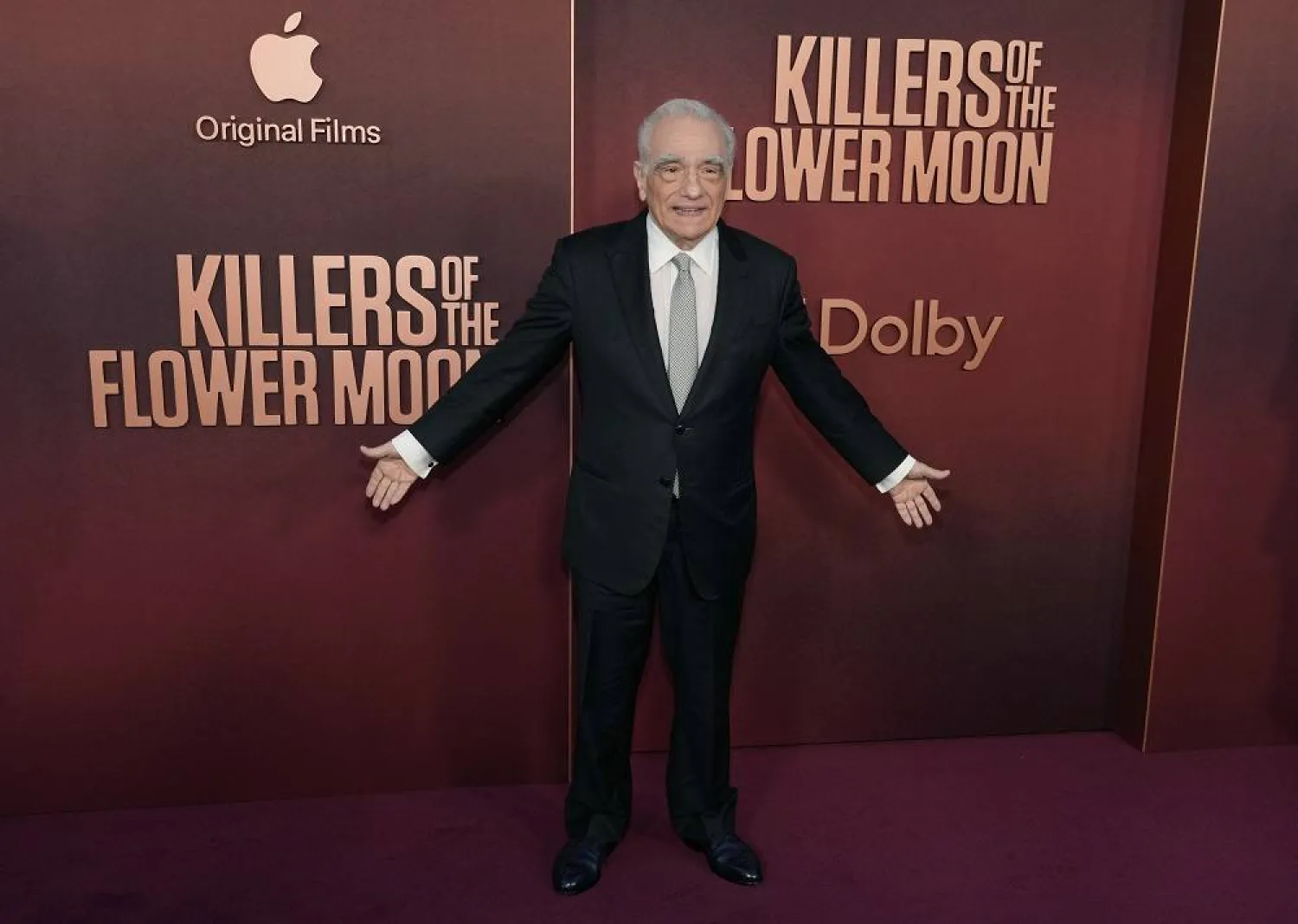
 Martin Scorsese, director and co-writer of "Killers of the Flower Moon," poses at the Los Angeles premiere of the film, Monday, Oct. 16, 2023, at the Dolby Theater. (AP)
Martin Scorsese, director and co-writer of "Killers of the Flower Moon," poses at the Los Angeles premiere of the film, Monday, Oct. 16, 2023, at the Dolby Theater. (AP)
TT

Martin Scorsese Is Still Curious — and Still Awed by the Possibilities of Cinema

 Martin Scorsese, director and co-writer of "Killers of the Flower Moon," poses at the Los Angeles premiere of the film, Monday, Oct. 16, 2023, at the Dolby Theater. (AP)
Martin Scorsese, director and co-writer of "Killers of the Flower Moon," poses at the Los Angeles premiere of the film, Monday, Oct. 16, 2023, at the Dolby Theater. (AP)

A moment from years ago keeps replaying in Martin Scorsese ’s mind.

When Akira Kurosawa was given an honorary Academy Award in 1990, the then 80-year-old Japanese filmmaker of "Seven Samurai" and "Ikiru," in his brief, humble speech, said he hadn’t yet grasped the full essence of cinema.

It struck Scorsese, then in post-production on "Goodfellas," as a curious thing for such a master filmmaker to say. It wasn’t until Scorsese also turned 80 that he began to comprehend Kurosawa's words. Even now, Scorsese says he’s just realizing the possibilities of cinema.

"I’ve lived long enough to be his age and I think I understand now," Scorsese said in a recent interview. "Because there is no limit. The limit is in yourself. These are just tools, the lights and the camera and that stuff. How much further can you explore who you are?"

Scorsese’s lifelong exploration has seemingly only grown deeper and more self-examining with time. In recent years, his films have swelled in scale and ambition as he’s plumbed the nature of faith ("Silence") and loss ("The Irishman").

His latest, "Killers of the Flower Moon," about the systematic killing of Osage Nation members for their oil-rich land in the 1920s, is in many ways far outside Scorsese's own experience. But as a story of trust and betrayal — the film is centered on the loving yet treacherous relationship between Mollie Brown (Lily Gladstone), a member of a larger Osage family, and Ernest Burkhart (Leonardo DiCaprio), a WWI veteran who comes to work for his corrupt uncle (Robert De Niro) — it’s a profoundly personal film that maps some of the themes of Scorsese’s gangster films onto American history.

More than the back-room dealings of "Casino," the bloody rampages of "Gangs of New York" or the financial swindling of "The Wolf of Wall Street," "Killers of the Flower Moon" is the story of a crime wave. It’s a disturbingly insidious one, where greed and violence infiltrate the most intimate relationships — a genocide in the home. All of which, to Scorsese, harkens back to the tough guys and the weak-willed go-alongs he witnessed in his childhood growing up on Elizabeth Street in New York.

"That’s been my whole life, dealing with who we are," says Scorsese. "I found that this story lent itself to that exploration further."

"Killers of the Flower Moon," a $200-million, 206-minute epic produced by Apple that's in theaters Friday, is an audacious big swing by Scorsese to continue his kind of ambitious, personal filmmaking on the largest scale at a time when such grand, big-screen statements are a rarity.

Scorsese considers "Killers of the Flower Moon" "an internal spectacle." The Oklahoma-set film, adapted from David Grann’s 2017 bestseller, might be called his first Western. But while developing Grann’s book, which chronicles the Osage murders and the birth of the FBI, Scorsese came to the realization that centering the film on federal investigator Tom White was a familiar type of Western.

"I realized: ‘You don’t do that. Your Westerns are the Westerns you saw in the late ’40s and early ’50s, that’s it. Peckinpah finished that. ‘Wild Bunch,’ that’s the end. Now they’re different," he says. "It represented a certain time in who we were as a nation and a certain time in the world – and the end of the studio system. It was a genre. That folklore is gone."

Scorsese, after conversations with Leonardo DiCaprio, pivoted to the story of Ernest and Mollie and a perspective closer to Osage Nation. Consultations with the tribe continued and expanded to include accurately capturing language, traditional clothing and customs.

"It’s historical that Indigenous Peoples can tell their story at this level. That’s never happened before as far as I know," says Geoffrey Standing Bear, Principal Chief of Osage Nation. "It took somebody who could know that we’ve been betrayed for hundreds of years. He wrote a story about betrayal of trust."

"Killers of the Flower Moon" for Scorsese grew out of a period of reflection and reevaluation during the pandemic. COVID-19, he says, was "a gamechanger." For a filmmaker whose time is so intensely scheduled, the break was in some ways a relief, and it allowed him a chance to reconsider what he wants to dedicate himself to. For him, preparing a film is a meditative process.

"I don’t use a computer because I tried a couple times and I got very distracted. I get distracted as it is," Scorsese says. "I’ve got films, I’ve got books, I’ve got people. I’ve only begun this year to read emails. Emails, they scare me. It says ‘CC’ and there are a thousand names. Who are these people?"

Scorsese is laughing when he says this, surely aware that he’s playing up his image as a member of the old guard. (A moment later he adds that voicemail "is interesting to do at times.") Yet he’s also keen enough with technology to digitally de-age De Niro and make cameos in his daughter Francesca's TikTok videos.

Scorsese has for years been the preeminent conscience of cinema, passionately arguing for the place of personal filmmaking in an era of moviegoing where films can be devalued as "content," theater screens are monopolized by Marvel and big-screen vision can be shrunk down on streaming platforms.

"I’m trying to keep alive the sense that cinema is an artform," Scorsese says. "The next generation may not see it that way because as children and younger people, they’re exposed to films that are wonderful entertainment, beautifully made, but are purely diversionary. I think cinema can enrich your life."

"As I’m leaving, I’m trying to say: Remember, this can really be something beautiful in your life."

That mission includes spearheading extensive restoration work with the Film Foundation along with a regular output of documentaries in between features. Scorsese and his longtime editor Thelma Schoonmaker are currently producing a documentary on Michael Powell and Emeric Pressburger.

Cinema, he says, may be the preeminent 20th century artform, but something else will belong to the 21st century. Now, Scorsese says, "the visual image could be done by anything by anybody anytime anywhere."

"The possibilities are infinite on all levels. And that’s exciting," Scorsese says. "But at the same time, the more choices, the more difficult it is."

The pressure of time is weighing more heavily on Scorsese, too. He has, he’s said, maybe two more feature films left in him. Currently in the mix are an adaptation of Grann’s latest book, the 18th century shipwreck tale "The Wager, " and an adaptation of Marilynne Robinson’s "Home."

"He’s uncompromising. He just does what he feels he really wants to look into," says Rodrigo Prieto, Scorsese’s cinematographer on "Flower Moon," as well as his last three feature films.

"You can feel that it’s a personal exploration of his own psyche," adds Prieto. "In doing that, he allows growth for everybody, in a way, to really look into these characters who might be doing things we might find very objectionable. I can’t think of many other filmmakers who attempt at such a level of empathy and understanding."

Yet Scorsese says he often feels like he’s in a race to accomplish what he can with the time he has left. Increasingly, he's prioritizing what’s worth it. Some things are easier for him to give up.

"Would I like to do more? Yeah. Would I like to go to everybody’s parties and dinner parties and things? Yeah, but you know what? I think I know enough people," Scorsese says with a laugh. "Would I like to go see the ancient Greek ruins? Yes. Go back to Sicily? Yes. Go back to Naples again? Yes. North Africa? Yes. But I don’t have to."

Time for Scorsese may be waning but curiosity is as abundant as ever. Recent reading for him includes a new translation of Alessandro Manzoni’s "The Betrothed." Some old favorites he can’t help but keep revisiting. "Out of the Past" — a movie he first saw as 6-year-old — he watched again a few weeks ago. ("Whenever it’s on, I have to stop and watch it.") Vittorio De Sica’s "Golden Naples" was another recent rewatch.

"If I’m curious about something, I think I’ll find a way – if I hold out, if I hold up – to try to make something about it on film," he says. "My curiosity is still there."

So too is his continued astonishment at cinema and its capacity to transfix. Sometimes, Scorsese can hardly believe it. The other day he watched the Val Lewton-produced 1945 horror film "The Isle of the Dead," with Boris Karloff.

"Really? How many more times am I going to see that?" Scorsese says, laughing at himself. "It’s their looks and their faces and the way (Karloff) moves. When I first saw it as a child, a young teenager, I was terrified by the film and the silences of it. The sense of contamination. I still get stuck on it."



Rescue Dog Yuri Steals Cannes Spotlight with Palm Dog’s Top Prize

Director Dominga Sotomayor Castillo pets the dog named Apocalypse who receives the Palm Dog award on-behalf of the dog named Yuri, winner of the award for his best canine performance in the film "La Perra" (La Chienne) presented at the Quinzaine des Cineastes (Directors' Fortnight), during the 79th Cannes Film Festival in Cannes, France, May 22, 2026. (Reuters)
TT

Rescue Dog Yuri Steals Cannes Spotlight with Palm Dog’s Top Prize

Director Dominga Sotomayor Castillo pets the dog named Apocalypse who receives the Palm Dog award on-behalf of the dog named Yuri, winner of the award for his best canine performance in the film "La Perra" (La Chienne) presented at the Quinzaine des Cineastes (Directors' Fortnight), during the 79th Cannes Film Festival in Cannes, France, May 22, 2026. (Reuters)

Cannes may be best known for its A-list stars, but Yuri the rescue dog stole the spotlight on Friday, winning the most anticipated unofficial award of the festival, the Palm Dog, for her performance in Chilean drama "La Perra."

Judges praised Yuri's naturalistic performance and her central contribution to the plot when picking the pooch, whose prize was a red collar emblazoned with "Palm Dog" on it.

Director Dominga Sotomayor Castillo took to the stage overlooking the clear blue waters of ‌the French Riviera ‌with another rescue dog named Apocalypse, who humbly ‌accepted ⁠the prize on Yuri's ⁠behalf, to claps and barks of approval.

The Palm Dog, a play on the festival's top prize, the Palme d'Or, has evolved from a cheeky sideshow event to a genuinely coveted prize since film journalist Toby Rose started it in 2001.

NATURALISTIC PERFORMANCE

"La Perra," which premiered in the Directors' Fortnight independent sidebar, revolves around a woman living on a remote Chilean island who impulsively ⁠adopts a puppy named Yuri.

"It's not a dog ‌doing lots of tricks. But it (the ‌film) really shows the bond and how this woman's life improves once Yuri, the ‌dog, comes into it," judge and film journalist Wendy Mitchell, wearing a ‌hat decorated with small plush dogs, told Reuters.

Another judge, Anna Smith, film critic, broadcaster and host of "Girls On Film" podcast, said the depiction of Yuri in the film was also key in their decision.

"As a jury member, I'm always ‌looking for a story where the dog is absolutely essential to the narrative," said Smith, who was similarly decked ⁠out in ⁠a dog-themed outfit.

Yuri beat six other competitors to take the top prize.

Another rescue dog, Lola, took the Grand Jury Prize for her role in the Birmingham-set drama about the lives of five friends, "I See Buildings Fall Like Lightning," that also premiered in the Directors' Fortnight sidebar.

"We are very strict in our criteria and what is a Palm Dog winning performance. The dogs over the years have been unbelievable," organizer Rose told Reuters after the award.

Past winners include Messi, the Border collie from Justine Triet's "Anatomy of a Fall," who converted his star power into a French TV show, as well as Uggie, a Jack Russell who helped launch a wider craze for the breed with "The Artist" in 2011.


'Fired and Festive': 'Late Show' Host Stephen Colbert Bows Out

CBS has said its decision to cancel "The Late Show," hosted by Stephen Colbert, was purely financial. Rich Fury / GETTY IMAGES NORTH AMERICA/AFP/File
TT

'Fired and Festive': 'Late Show' Host Stephen Colbert Bows Out

CBS has said its decision to cancel "The Late Show," hosted by Stephen Colbert, was purely financial. Rich Fury / GETTY IMAGES NORTH AMERICA/AFP/File

"The Late Show" frontman Stephen Colbert will host the final edition of the 33-year-old US cultural institution on Thursday night, after it was cancelled by CBS as the network courted President Donald Trump.

The show, which Colbert has hosted since 2015, was axed after he mocked the broadcaster for a $16 million settlement with Trump for allegedly "maliciously" editing an interview with his Democratic election rival Kamala Harris.

Colbert called it a "big fat bribe."

CBS has insisted the decision to cancel "The Late Show with Stephen Colbert," the ratings leader in the time slot, was purely financial -- and that it was a coincidence the move came as CBS parent company Paramount lobbied for government approval of its $8.4 billion merger with Skydance Media.

Around that time CBS brought in Bari Weiss, a right-wing journalist without significant TV experience, to run its news division, AFP reported.

In the weeks leading to Thursday's curtain call, 62-year-old Colbert has at times cut a subdued figure, lacking some of his usual cheerful flair.

"Sometimes you only truly know how much you love something when you get a sense you might be losing it," Colbert said while accepting an Emmy award last year.

Colbert was clearly moved when he was joined in his studio by fellow late night hosts Jimmy Fallon, Jimmy Kimmel, Seth Meyers and John Oliver, who paid tribute in the penultimate week.

Kimmel was briefly taken off the air in September 2025 by his network ABC after complaints about a remark he made over the killing of conservative activist Charlie Kirk.

Trump has repeatedly attacked media and press freedom since returning to office, using lawsuits and regulatory threats to retaliate for unflattering news coverage and jokes.

The US president has long been a fierce critic of late-night talk show hosts and their jabs at him. Trump has called Colbert a "pathetic trainwreck" who should be "put to sleep."

One late night host who did not join the gathering of funnymen who pillory the US president night after night was Greg Gutfeld, host of "Gutfeld!" on Fox News -- the network popular with conservatives.

Asked in November about both the cancellation and Kimmel's suspension, Gutfeld said, "Why did it take so long?"

- 'Can't take a man's voice' -

Colbert made his name playing a fictitious version of himself, embodying the type of conservative blowhard beloved by Fox News viewers -- and derided by the left.

He first played the sharp-suited but dim-witted character on "The Daily Show with Jon Stewart" before getting a spin-off, "The Colbert Report."

Colbert ascended to the pinnacle of US late-night TV when he was named host of the CBS flagship, shedding the character and employing his own voice.

In the weeks leading to Thursday, Colbert auctioned off a raft of props and costumes featured on the show, as well as pieces of set including a giant illuminated sign. Proceeds will go to World Central Kitchen.

Colbert has been coy about his next steps but announced he will be a writer on a forthcoming "Lord of the Rings" movie -- as well as lying down and taking a breather.

Details of the last broadcast were scant, with show insiders tight-lipped when contacted by AFP.

One guest has eluded Colbert: the pope. The host, a devout Catholic, has called the pontiff his "white whale."

While an impromptu trip to New York seems unlikely, Pope Leo XIV's public schedule is clear on May 21.

Colbert's fellow late-night hosts were all due to air re-runs Thursday out of respect for Colbert's swansong.

And the theme of the after-party? "Fired and festive!"

Ahead of the final show, Colbert brought back former "Late Show" host David Letterman who steered the ship from 1993 until 2015.

The pair ascended to the roof of the show's Ed Sullivan Theater to throw furniture at a giant logo of CBS, describing it as "wanton destruction of CBS property."

"You can take a man's show," said Letterman. "You can't take a man's voice."


Havana-born Star Andy Garcia Says Cubans Dream of Change

US actor Andy Garcia poses during a photocall of the film "Diamond" at the 79th edition of the Cannes Film Festival in Cannes, southern France on May 20, 2026. (Photo by Valery HACHE / AFP)
TT

Havana-born Star Andy Garcia Says Cubans Dream of Change

US actor Andy Garcia poses during a photocall of the film "Diamond" at the 79th edition of the Cannes Film Festival in Cannes, southern France on May 20, 2026. (Photo by Valery HACHE / AFP)

Havana-born Hollywood star Andy Garcia told AFP that the overwhelming majority of Cubans would support an intervention to overthrow their government as he presented his directorial debut at the Cannes Film Festival.

The star of films "The Godfather Part III" and "Ocean's Eleven" said he still woke up every morning dreaming of a Cuba "free from repression" after 67 years of communist rule on the island.

"Nobody wants war, but absolute repression and suffering of the people in that country is not the alternative, that's not something to embrace," he said during an interview on Tuesday to promote his film noir "Diamond" which features an A-list cast.

"If you were to ask the Cuban people, not the Cuban government... would they want us (the United States), France, anybody, to intervene and save them? You would get a unanimous 90 percent people saying, 'Please come and invade our country and get rid of these people'," Garcia said.

US President Donald Trump has imposed an oil blockade on Cuba, aggravating the impoverished island's worst economic and energy crisis in decades, while making repeated threats that the US might forcibly topple the government.

In Cuba, young people have told AFP privately they favor a US intervention, seeing it as the only chance to transform the island's fortunes, despite fears it would lead to bloodshed.

But older Cubans tend to reject the threats, pointing to over six decades of tensions between Havana and Washington that never bubbled over into open conflict, despite coming perilously close to a nuclear confrontation in 1962.

Garcia, 70, left Cuba as a child and his film "Diamond" serves as a sort of "love letter" to his adopted hometown Los Angeles where he has lived for most of his life.

His first turn behind the camera is a project 20 years in the making, based on an idea which started out as a homework project for his daughter.

It grew into a film about fedora-wearing and hard-drinking private detective Joe Diamond who is stuck in the past while trying to crack a case about a billionaire's death in contemporary Los Angeles.

Garcia's actor friends Bill Murray and Dustin Hoffman agreed to play roles as a barman and coroner, while the rest of the cast includes "The Whale" star Brendan Fraser as a detective, with Rosemarie DeWitt and Vicky Krieps the female leads.

Garcia said he had learned from many industry legends over his career, including "The Godfather" director Francis Ford Coppola who handed him his first major break in a once-stellar career that has stalled in recent decades.

"I always wanted to make movies, not just be in them," Garcia told AFP.

Reviews were mostly positive about his first effort, with Deadline calling it a "wonderfully atmospheric, nostalgic and entertaining contemporary noir". The Wrap said "at times it betrays its amateur beginnings with clunky plotting."