



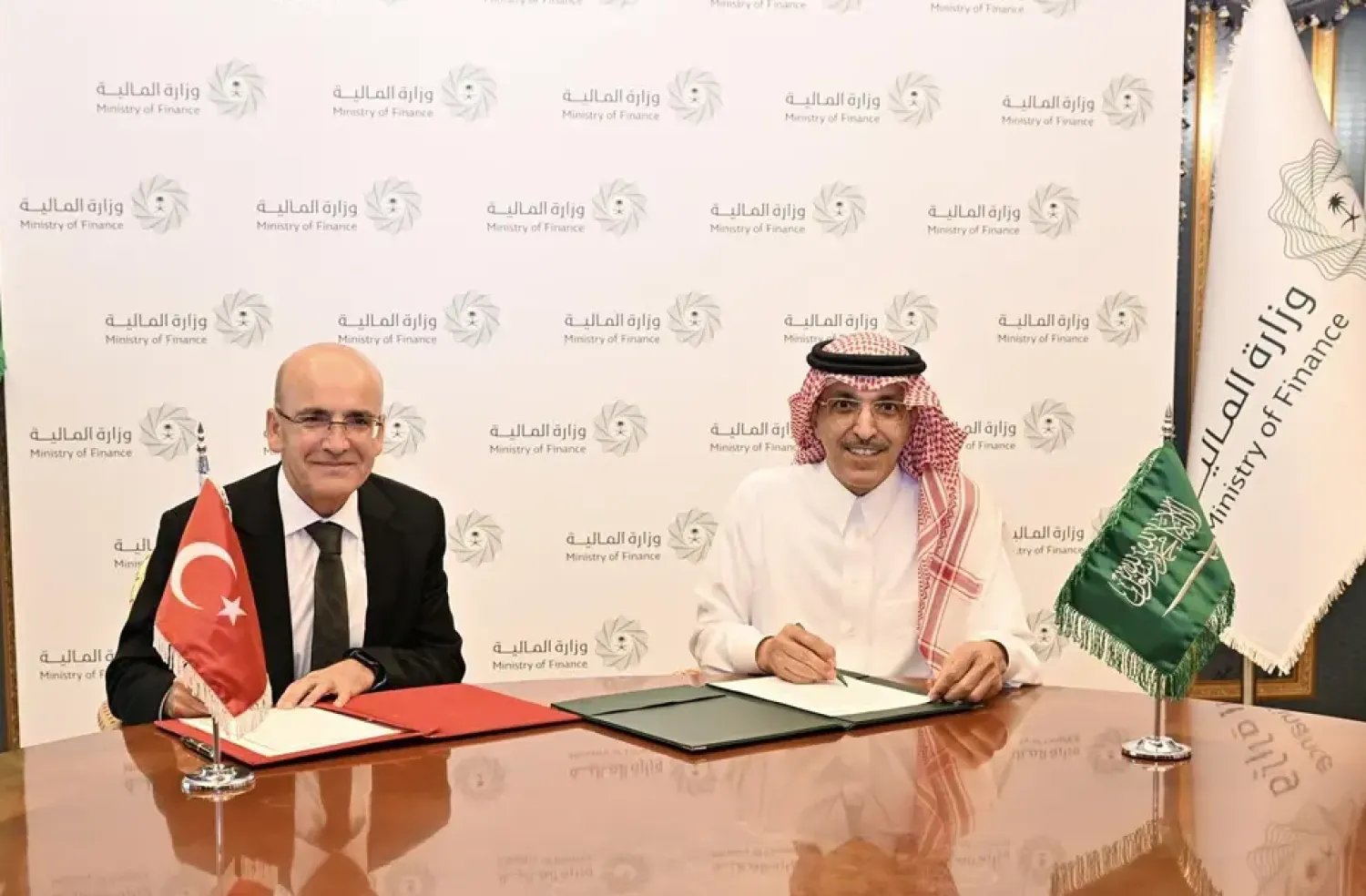

Saudi Finance Minister Mohammed al-Jadaan has signed a Memorandum of Understanding (MoU) with Türkiye's Minister of Finance and Treasury Mehmet Simsek to enhance cooperation in the fiscal field.
The MoU was signed on Thursday on the sidelines of the Future Investment Initiative Forum (FII) in Riyadh.
It focuses on solidifying bilateral relations and enhancing cooperation in the financial sector development and public finance through encouraging opportunities and exchanging expertise in related topics.
Jadaan said the MoU reflects the strong historical relations between Saudi Arabia and Türkiye, noting the opportunities to strengthen bilateral economic ties and develop more effective partnerships.
For his part, Simsek confirmed that he witnessed "fruitful discussions" with investors in Riyadh, indicating the deal covers climate change related to fiscal policies, public-private partnerships, national fiscal policies, strengthening bilateral relations, and improving international coordination and cooperation.
Earlier, the Turkish minister met with Saudi Investment Minister Khalid al-Falih and discussed with him potential investment opportunities between the two countries.
Last July, Türkiye and Saudi Arabia signed agreements in direct investment, defense industries, energy, defense, and communications as part of Turkish President Recep Tayyip Erdogan's visit to Saudi Arabia.
Meanwhile, Türkiye's Central Bank raised the one-week policy repo rate, adopted as a basic benchmark for interest rates, by 500 basis points to 35 percent, as expected on Thursday.
The bank's policy committee repeated that it was ready to raise rates further to curb inflation for the fifth time since last June.
The central bank said it "decided to continue the monetary tightening process to establish the disinflation course as soon as possible, to anchor inflation expectations, and to control the deterioration in pricing behavior."
Inflation in Türkiye continued to rise for the third month last September, reaching 61.53 percent annually.
The market participants survey for October showed that inflation is expected to reach 68 percent this year.
The bank said inflation readings were above expectations in the third quarter, with the strong course of domestic demand, the stickiness of services inflation, and the deterioration in expectations putting upward pressure on inflation.
The statement continued that these factors evaluated that the underlying trend in monthly inflation will decline.
Through the monetary tightening process, the committee is determined to establish the disinflation course 2024 in line with the report.
The bank noted that price stability could be achieved through foreign direct investment, stable course of external financing conditions, continued increase in foreign exchange reserves, rebalancing in demand on current account balance, and increased domestic and foreign demand for Turkish lira-denominated assets.
The policy rate will be determined to create monetary and financial conditions necessary to ensure a decline in the underlying trend of inflation and to reach the 5 percent inflation target in the medium term.
Experts believe the recent interest hike would be the last in 2023 and the first quarter in 2024.
They indicated that the Central Bank will keep the key interest rate at 35 percent in the period leading up to the local elections scheduled for March 31.


