


Attacks on US Forces Risk Conflict with Iran

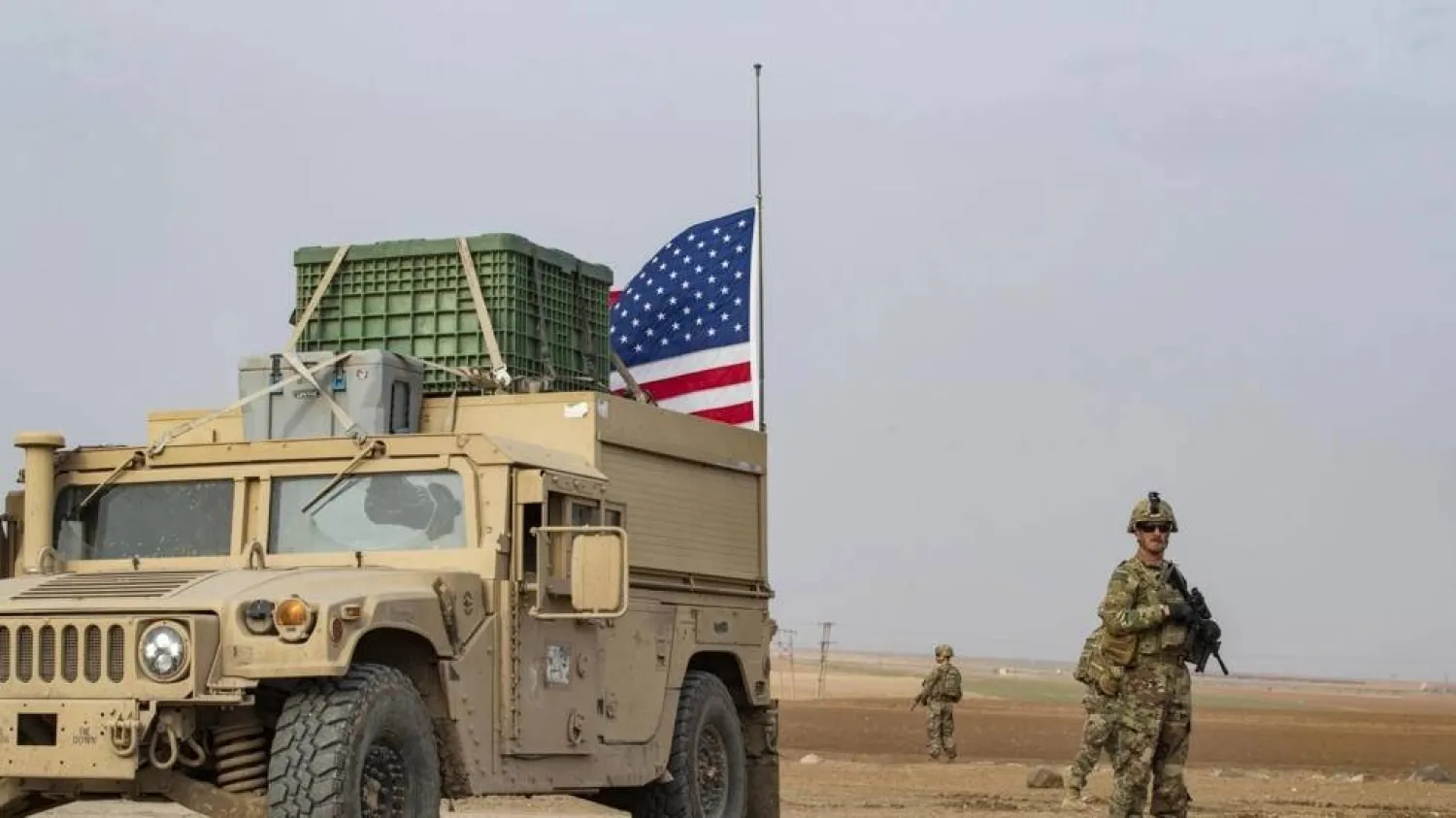
US forces in Syria's northeastern Hasakeh province on December 15, 2022. Delil SOULEIMAN / AFP/File
TT

Attacks on US Forces Risk Conflict with Iran

US forces in Syria's northeastern Hasakeh province on December 15, 2022. Delil SOULEIMAN / AFP/File

Repeated attacks on American troops in the Middle East risk drawing the United States into a conflict with Iran even as Washington strives to prevent fighting between Israel and Hamas from spiraling into a regional war.

The United States has blamed the spike in rocket and drone attacks -- at least 14 in Iraq and nine in Syria since October 17 -- on Iran-backed forces, and carried out strikes last week in Syria on sites the Pentagon said were linked to Tehran, AFP reported.

Washington has massive firepower at its disposal but its military response to the attacks has so far been limited to those strikes -- which the Pentagon said did not appear to have caused casualties -- in a potential bid to head off a broader conflict.

"We are concerned about all elements of Iran's threat network increasing their attacks in a way that risks miscalculation, or tipping the region into war," a senior US defense official said Monday.

"Everybody loses in a regional war, which is why we're working through partners, with allies, working the phone lines, increasing posture to make clear our desire to prevent regional conflict," the official said.

Washington says the attacks on its troops are separate from the current Israel-Hamas conflict that began earlier this month when the militant group carried out a shock cross-border attack from Gaza that Israeli officials say killed more than 1,400 people.

But Iran said Monday that the attacks on US forces are the result of "wrong American policies" including support for Israel, whose retaliatory bombardment has killed more than 8,300 people, according to the Gaza health ministry.

'Seeking to hold back'

There are roughly 2,500 American troops in Iraq and some 900 in Syria as part of efforts to prevent a resurgence of the ISIS group, which once held significant territory in both countries.

The damage from the recent attacks on those forces has been limited so far -- 21 American personnel suffered minor injuries and a contractor died of a cardiac event while sheltering during a false alarm -- but there is significant potential for things to get worse.

"There is substantial risk for US-Iran escalation due to spillover from the Israel-Hamas war," either at Tehran's direction or because its proxies decide to on their own, said Jeffrey Martini, a senior defense researcher at RAND.

Iran has proxy forces in both Iraq and Syria that have repeatedly targeted American troops in the past -- something that had stopped prior to recent events due to Washington reaching "an informal understanding with Iran on reducing regional tensions," Martini said.

Jon Alterman, director of the Middle East Program at the Center for Strategic and International Studies, said the current situation differs from past spates of attacks because "all of Iran's proxies seem to be getting into the act simultaneously," increasing "the likelihood of something going wrong."

The United States has repeatedly said it wants to keep the Israel-Hamas war from becoming a broader conflict and has bolstered its forces in the region -- including with one carrier strike group that is there and another in transit -- as part of its deterrence efforts.

"Washington is seeking to hold back while simultaneously making clear that it doesn't need to," Alterman said of its response to the attacks on its troops, noting that deterrence "requires both the capability and willingness to inflict much more damage, while deciding not to do so."

"The challenge, from a US perspective, is if you never inflict that damage, your adversary doubts your willingness, but if you do inflict that damage, you can get trapped in an escalatory spiral."



Top Trump Iran Negotiator Says Visits US Aircraft Carrier in Middle East

US Special Envoy Steve Witkoff delivers a press conference upon the signing of the declaration on deploying post-ceasefire force in Ukraine, during the so-called "Coalition of the Willing" summit, at the Elysee Palace in Paris, France, January 6, 2026. (Reuters)
TT

Top Trump Iran Negotiator Says Visits US Aircraft Carrier in Middle East

US Special Envoy Steve Witkoff delivers a press conference upon the signing of the declaration on deploying post-ceasefire force in Ukraine, during the so-called "Coalition of the Willing" summit, at the Elysee Palace in Paris, France, January 6, 2026. (Reuters)

US President Donald Trump's lead Iran negotiator Steve Witkoff on Saturday said he visited the USS Abraham Lincoln aircraft carrier currently in the Arabian Sea, with Washington and Tehran due to hold further talks soon.

"Today, Adm. Brad Cooper, Commander of US Naval Forces Central Command, Jared Kushner, and I met with the brave sailors and Marines aboard the USS Abraham Lincoln, her strike group, and Carrier Air Wing 9 who are keeping us safe and upholding President Trump's message of peace through strength," said Witkoff in a social media post.

Iranian Foreign Minister Abbas Araghchi said on Saturday he hoped talks with the United States would resume soon, while reiterating Tehran's red lines and warning against any American attack.


Israel’s Netanyahu Expected to Meet Trump in US on Wednesday and Discuss Iran

Israeli Prime Minister Benjamin Netanyahu delivers a speech during a special session to mark the 77th anniversary of the Knesset's establishment and the 60th anniversary of the dedication of the current building at the Knesset, the Israeli parliament, in Jerusalem, 02 February 2026. (EPA)
TT

Israel’s Netanyahu Expected to Meet Trump in US on Wednesday and Discuss Iran

Israeli Prime Minister Benjamin Netanyahu delivers a speech during a special session to mark the 77th anniversary of the Knesset's establishment and the 60th anniversary of the dedication of the current building at the Knesset, the Israeli parliament, in Jerusalem, 02 February 2026. (EPA)

Israeli Prime Minister Benjamin Netanyahu is expected to meet US President Donald Trump on Wednesday in Washington, where they will discuss negotiations with Iran, Netanyahu's office said on Saturday.

Iranian and US officials held indirect nuclear ‌talks in the ‌Omani capital ‌Muscat ⁠on Friday. ‌Both sides said more talks were expected to be held again soon.

A regional diplomat briefed by Tehran on the talks told Reuters Iran insisted ⁠on its "right to enrich uranium" ‌during the negotiations with ‍the US, ‍and that Tehran's missile capabilities ‍were not raised in the discussions.

Iranian officials have ruled out putting Iran's missiles - one of the largest such arsenals in the region - up ⁠for discussion, and have said Tehran wants recognition of its right to enrich uranium.

"The Prime Minister believes that any negotiations must include limiting ballistic missiles and halting support for the Iranian axis," Netanyahu's office said in a ‌statement.


Italy FM Rules Out Joining Trump’s ‘Board of Peace’

Italy's Minister for Foreign Affairs Antonio Tajani speaks to the press during the EPP Leaders’ meeting, in Zagreb, Croatia, 30 January 2026. (EPA)
TT

Italy FM Rules Out Joining Trump’s ‘Board of Peace’

Italy's Minister for Foreign Affairs Antonio Tajani speaks to the press during the EPP Leaders’ meeting, in Zagreb, Croatia, 30 January 2026. (EPA)

Italy will not take part in US President Donald Trump's "Board of Peace", Italian Foreign Minister Antonio Tajani said Saturday, citing "insurmountable" constitutional issues.

Trump launched his "Board of Peace" at the World Economic Forum in Davos in January and some 19 countries have signed its founding charter.

But Italy's constitution bars the country from joining an organization led by a single foreign leader.

Prime Minister Giorgia Meloni, a Trump ally, last month noted "constitutional problems" with joining, but suggested Trump could perhaps reopen the framework "to meet the needs not only of Italy, but also of other European countries".

Tajani appeared Saturday to rule that out.

"We cannot participate in the Board of Peace because there is a constitutional limit," he told the ANSA news agency.

"This is insurmountable from a legal standpoint," he said, the day after meeting US Secretary of State Marco Rubio and US Vice President JD Vance at the Olympics in Milan.

Although originally meant to oversee Gaza's rebuilding, the board's charter does not limit its role to the Palestinian territory and appears to want to rival the United Nations.