


First Evacuations from Gaza as Refugee Camp Struck Again

Palestinian health ministry ambulances cross the gate to enter the Rafah border crossing in the southern Gaza Strip before crossing into Egypt on November 1, 2023. (AFP)
TT

First Evacuations from Gaza as Refugee Camp Struck Again

Palestinian health ministry ambulances cross the gate to enter the Rafah border crossing in the southern Gaza Strip before crossing into Egypt on November 1, 2023. (AFP)

Hundreds of injured residents and foreigners escaped Gaza to Egypt Wednesday, the first evacuations from the war-torn Palestinian territory pounded by Israeli warplanes in retaliation for an unprecedented Hamas attack.  

The brief glimmer of hope sparked by the temporary opening of the Rafah border crossing was quickly snuffed out as a fresh strike pulverized buildings in Gaza's biggest refugee camp for a second consecutive day, killing dozens according to the Palestinian health ministry.  

Israeli Prime Minister Benjamin Netanyahu vowed to "continue until victory" over Hamas, whose brutal October 7 attack sparked the latest conflict, the deadliest in decades of unrest between the two sides.

AFP reporters at Gaza's southern border saw ambulances whisking away the wounded to Egyptian field hospitals, including one young boy with heavy bandaging around his stomach.

Whole families, struggling to carry their worldly possessions, rushed through the heavily fortified crossing towards Egypt, which said it admitted 335 foreigners or dual nationals and 76 seriously wounded and sick people.

Jordanian citizen Umm Saleh Hussein said water and electricity shortages were "the least" of the hardships Gazans were facing.

"There were bigger problems such as the bombardment. We were afraid. Many families were martyred," she told AFP.

A first group of mostly women and children arrived in Egypt, with TV images showing parents with pushchairs and elderly people clambering off a bus.  

"It's enough. We've endured enough humiliation," said Gaza resident Rafik al-Hilou, accompanying relatives including children aged one and four hoping to cross into Egypt.  

"We lack the most basic human needs. No internet, no phones, no means of communication, not even water. For the past four days, we haven't been able to feed this child a piece of bread. What are you waiting for?"  

'Slaughtered and killed'

AFPTV images from Wednesday's strike on the Jabalia camp showed extensive damage and rescuers clawing through rubble to extract blood-stained casualties.  

Dozens were killed and wounded, according to the Hamas-run health ministry, which came a day after Israeli jets hit the camp, killing at least 47 people, according to an AFP count.  

Rescuers said "whole families" had died, but casualty details could not be immediately confirmed. Israel's military did not comment.  

UN chief Antonio Guterres condemned Israel's strikes on the Gaza refugee camp.  

"The secretary-general is appalled over the escalating violence in Gaza, including the killing of Palestinians, including women and children in Israeli air strikes in residential areas of the densely populated Jabalia refugee camp," spokesman Stephane Dujarric said.  

Israel said Tuesday's raid was a successful hit on top Hamas commander Ibrahim Biari, but the large death toll drew a chorus of international condemnation in the region and as far afield as Bolivia, which severed diplomatic ties in protest.

Jordan recalled its ambassador to Israel "to condemn the Israeli war that is killing innocent people in Gaza".  

Hamas said seven of the 240 hostages it is holding, including three foreign passport holders, had died in Tuesday's bombing, a claim impossible to verify.  

The group's leader Ismail Haniyeh accused Israel of committing "barbaric massacres against unarmed civilians", saying it was covering its own "defeats."  

Israel has relentlessly pounded Gaza in retribution for the worst attack in the country's history, when Hamas gunmen stormed across the border, killing 1,400 people, mostly civilians, according to Israeli officials.  

AFP reporters saw more tanks pour over the border into northern Gaza, as Israel stepped up its ground incursion launched late last week. Its bombing campaign has killed 8,796 people, according to Hamas-run Gaza's health ministry.  

Israel said 15 soldiers died in ground fighting in Gaza on Tuesday, bringing to 330 the number killed since October 7.

AFP images showed tearful Israeli women in uniform hugging each other for comfort at the funeral of one of the troops killed.  

"People were just slaughtered and killed everywhere," said 21-year-old Israeli Maya Keyy, from one of the communities torn apart by the Hamas attack.  

"As Jews we need to fight for our own existence... it's like it's a war that will never end."  

'No hope in Gaza'  

The situation in Gaza remained desperate, with food, fuel and medicine for the 2.4 million residents all running short, according to aid groups.  

Palestinian residents told AFP they had evacuated from northern Gaza, as demanded by Israel, but were still under threat.

"We've been told people are evacuating from Gaza City towards the central area of the strip beyond the valley, so we headed there," Amen al-Aqluk said.  

"After 20 days, we were bombarded. Three of our kids lost their lives and we all got injured.  

"There is no hope in the Gaza Strip. It is not safe anymore here. When the border opens, everybody will leave and emigrate. We encounter death everyday, 24 hours a day."  

With fears mounting of a regional war, US President Joe Biden called for "urgent mechanisms" to dial down tensions and said top diplomat Antony Blinken would embark on another Middle East tour from Friday.  

Türkiye and Iran called for a regional conference to prevent a conflagration, as Israel faces a daily barrage of aerial attacks from Hamas and other Iran-backed groups around the Middle East, including Yemen's Houthi militias.  

In the north, Israel has traded near-daily fire with Lebanon's Iran-backed Hezbollah movement.  

And the families of hostages kidnapped by Hamas have endured an unbearable wait for news of relatives thought to be held in the labyrinth of tunnels deep below Gaza.  

Ayelet Sella, whose seven cousins were kidnapped from one of the kibbutz communities raided by Hamas gunmen, said she could find "no rest" until her loved ones are returned.  

"We have no more tears, our eyes are dry, we are empty three weeks on," said Sella, speaking to AFP at the Great Synagogue in Paris. "I only ask for one thing, that they come back."


European Nations Decry ‘Increasing Settler Terror’ in West Bank

Israeli soldiers take position as Israeli settlers barricade themselves in Joseph's Tomb in Nablus, March 17, 2026. (EPA)
TT

European Nations Decry ‘Increasing Settler Terror’ in West Bank

Israeli soldiers take position as Israeli settlers barricade themselves in Joseph's Tomb in Nablus, March 17, 2026. (EPA)

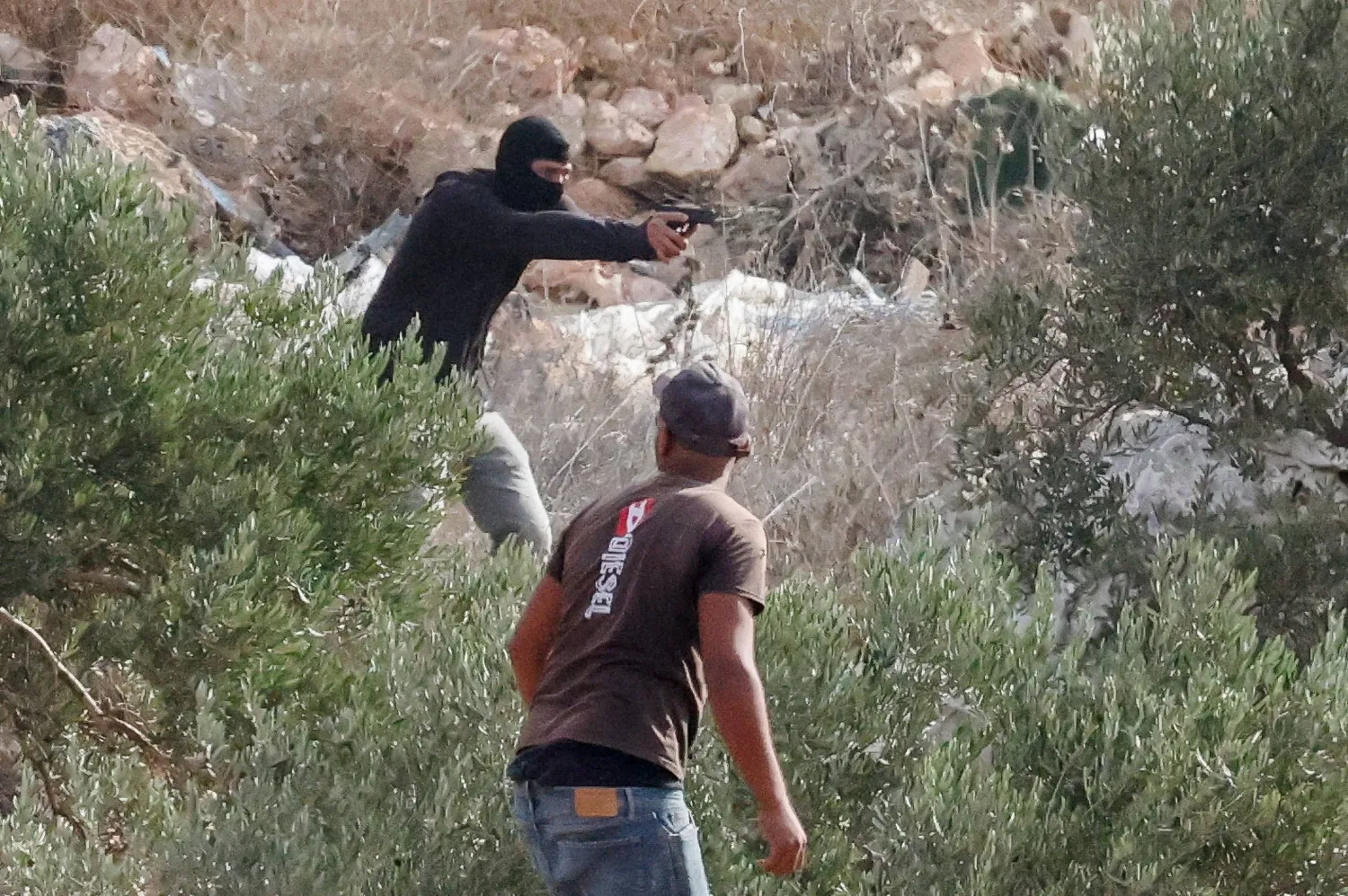
Diplomats from 13 European countries and Canada on Saturday slammed growing "terror" by settlers against Palestinians in the Israeli-occupied West Bank, after a surge in deadly attacks.

Since the start of March, six Palestinians have been shot dead in settler attacks in the West Bank, according to a tally of data from the Ramallah-based health ministry.

"We strongly condemn increasing settler terror and violence by the Israeli security forces inflicted upon Palestinian communities," said a joint statement from the diplomatic missions of countries including France, Spain and Britain.

"We are especially appalled by the killings of Palestinians over these past weeks. This violence by settler militias, aimed at taking over land and creating a coercive environment, forcing Palestinians to leave their homes, must end."

The statement called on the Israeli authorities to "prevent and prosecute the lethal violence, raids and attacks".

Israel's military chief Lieutenant General Eyal Zamir on Wednesday criticized the increase in settler attacks in the West Bank, calling it "morally and ethically unacceptable".

Alongside roughly three million Palestinians, more than 500,000 Israelis live in settlements and outposts in the West Bank, which are illegal under international law.

While most Israeli settlers do not engage in violence, a small but militant fringe has been linked to attacks on Palestinians.

More broadly, violence in the West Bank, which Israel has occupied since 1967, has risen sharply since the October 7, 2023, Hamas attack on Israel triggered the Gaza war.

It has continued despite the ceasefire and spiked since the start of the war against Iran.

According to an AFP tally based on Palestinian health ministry figures, Israeli troops or settlers have killed at least 1,050 Palestinians -- many of them gunmen, but also scores of civilians -- in the West Bank since the start of the Gaza war.

Israeli troops last week shot dead two children and their parents in a car, Palestinian authorities said. The Israeli military and police said soldiers opened fire on a vehicle over a perceived safety threat, killing four people inside.

Official Israeli figures say 45 Israelis, including soldiers and civilians, have also been killed in Palestinian attacks or during Israeli military operations.


Jordan Says 240 Missiles, Drones Fired at Kingdom Since Start of Middle East War

 Streaks of fire and light cross the night sky as an Israeli interceptor strikes an Iranian missile amid the US-Israeli conflict with Iran, over Tel Aviv, Israel, March 18, 2026. (Reuters)
Streaks of fire and light cross the night sky as an Israeli interceptor strikes an Iranian missile amid the US-Israeli conflict with Iran, over Tel Aviv, Israel, March 18, 2026. (Reuters)
TT

Jordan Says 240 Missiles, Drones Fired at Kingdom Since Start of Middle East War

 Streaks of fire and light cross the night sky as an Israeli interceptor strikes an Iranian missile amid the US-Israeli conflict with Iran, over Tel Aviv, Israel, March 18, 2026. (Reuters)
Streaks of fire and light cross the night sky as an Israeli interceptor strikes an Iranian missile amid the US-Israeli conflict with Iran, over Tel Aviv, Israel, March 18, 2026. (Reuters)

The Jordanian army said on Saturday that 240 missiles and drones had targeted the kingdom since the Middle East war began last month, most of which were intercepted.

"The total number of missiles and drones fired towards the kingdom since the start of the war has reached 240," the army said in a statement.

"The Royal Air Force successfully intercepted and destroyed 222 missiles and drones, while 18 missiles and drones were not intercepted by the air defenses," it added.

The military's media office, meanwhile, said 36 missiles and drones had targeted the kingdom over the past week.

"Fourteen missiles and 21 drones were intercepted and destroyed, while defenses were unable to thwart one attack," it added.

Since the United States and Israel launched strikes on Iran on February 28, the Islamic republic has struck countries across the region, including Jordan.

Iran has targeted US interests in the region, but attacks have also hit civilian infrastructure.

Jordan has recorded no deaths since the start of the war, with health authorities previously reporting 29 injured, all of whom have since been discharged from hospital.


From Gaza to Lebanon, Doctor Races Against Time to Treat War-Wounded Children

British-Palestinian plastic and reconstructive surgeon Ghassan Abou-Sittah poses during a photo session in the Lebanese capital Beirut on March 19, 2026. (AFP)
TT

From Gaza to Lebanon, Doctor Races Against Time to Treat War-Wounded Children

British-Palestinian plastic and reconstructive surgeon Ghassan Abou-Sittah poses during a photo session in the Lebanese capital Beirut on March 19, 2026. (AFP)

During almost three weeks of war in Lebanon, British-Palestinian doctor Ghassan Abu-Sittah has had no respite, telling AFP he has been working "against the clock" to save children wounded in Israeli bombardment.

At the American University of Beirut Medical Center, one of the capital's main hospitals, his pediatric intensive care unit has been receiving critical cases from across the country and desperate parents praying for their children's survival.

This week, Israeli strikes hit densely populated central Beirut areas not far from the hospital, with three badly wounded children pulled from the rubble.

Among them was an 11-year-old girl who had "metal shrapnel in her abdomen, and partial amputation of the foot", said Abu-Sittah, a plastic surgeon specializing in conflict injuries.

"She's now in a stable condition," added the doctor, who lives near the hospital and rushes there for emergencies.

Israeli strikes have pummeled Lebanon since Hezbollah fired rockets into Israel on March 2 to avenge the killing of Iran's supreme leader Ali Khamenei in Israeli-US attacks.

Lebanese authorities say that 118 children have been killed and 370 others wounded.

Abu-Sittah said he had seen "partial limb amputations, brain injuries, shrapnel in the face, shrapnel in the eye, penetrating abdominal shrapnel, a lot of fractures, a lot of broken bones, a lot of soft tissue damage... and all of this in one child."

Such wounds mean "lots of surgeries", he added, dark rings under his eyes.

- War an 'endemic disease' -

He recalled three sisters who were brought to the hospital around a fortnight ago.

"Their injuries are so bad, I have to take them to the operating room every 48 hours... to get rid of more of the dead tissue and clean the wounds so that at some stage, they're ready for the reconstructive surgery," he said.

Born in Kuwait to a Palestinian refugee father from Gaza and a Lebanese mother, Abu-Sittah has dedicated his life to treating wounded civilians in the region.

War is the "endemic disease" of the Middle East, said Abu-Sittah.

But "you never get used to" children suffering, he said.

"A child should never become faceless, they never become numbers."

His first experience of conflict was as a medical student in 1991 after the withdrawal of Iraqi troops from Kuwait during the first Gulf War, and treating the wounded would soon become his mission.

He graduated in the United Kingdom and over the decades has worked repeatedly in Gaza and Lebanon, as well as in Iraq and Yemen.

After Palestinian group Hamas's October 7, 2023 attack on Israel sparked war in Gaza, Abu-Sittah spent more than a month in the Palestinian territory.

Lebanon this time is "a kind of small version of Gaza", Abu-Sittah said.

While the death toll in Lebanon is far lower, health facilities and workers in the country have paid a heavy price, with the health ministry saying 40 health workers have been killed and 119 wounded.

- Ongoing care -

Abu-Sittah said four hospitals in Beirut's southern suburbs had been forced to evacuate, "one of which has a big intensive care unit for children", amid persistent Israeli bombardment of the area.

He said some badly wounded children have died because they were not transferred in time from parts of the country where health facilities are less equipped than those in Beirut.

"The Israelis are targeting the ambulances, and so moving kids from one hospital in Nabatieh or in the Bekaa is very dangerous," he said, referring to a city in south Lebanon and to east Lebanon's Bekaa valley area.

"It can only happen during the day, and it takes a long time," he added.

The Israeli military has accused Hezbollah of using ambulances "for military purposes", an accusation Lebanon's health ministry has described as "a justification" for crimes "against humanity".

In 2024, the doctor created the Ghassan Abu-Sittah Children's Fund, which aims to provide medical care in Gaza and Lebanon and ongoing support to wounded children after they leave hospital.

Abu-Sittah said his youngest patient in Lebanon now was a four-year-old boy whose parents and three siblings were killed, and who will need major long-term physical and psychological support after suffering a head wound and an amputated foot.

"Who's going to look after them when they go home?" Abu-Sittah said.

Many wounded children "come from poor backgrounds who don't have the means to manage all of this", he added.

"It's not just the body that's destroyed, it's the family unit that's destroyed."