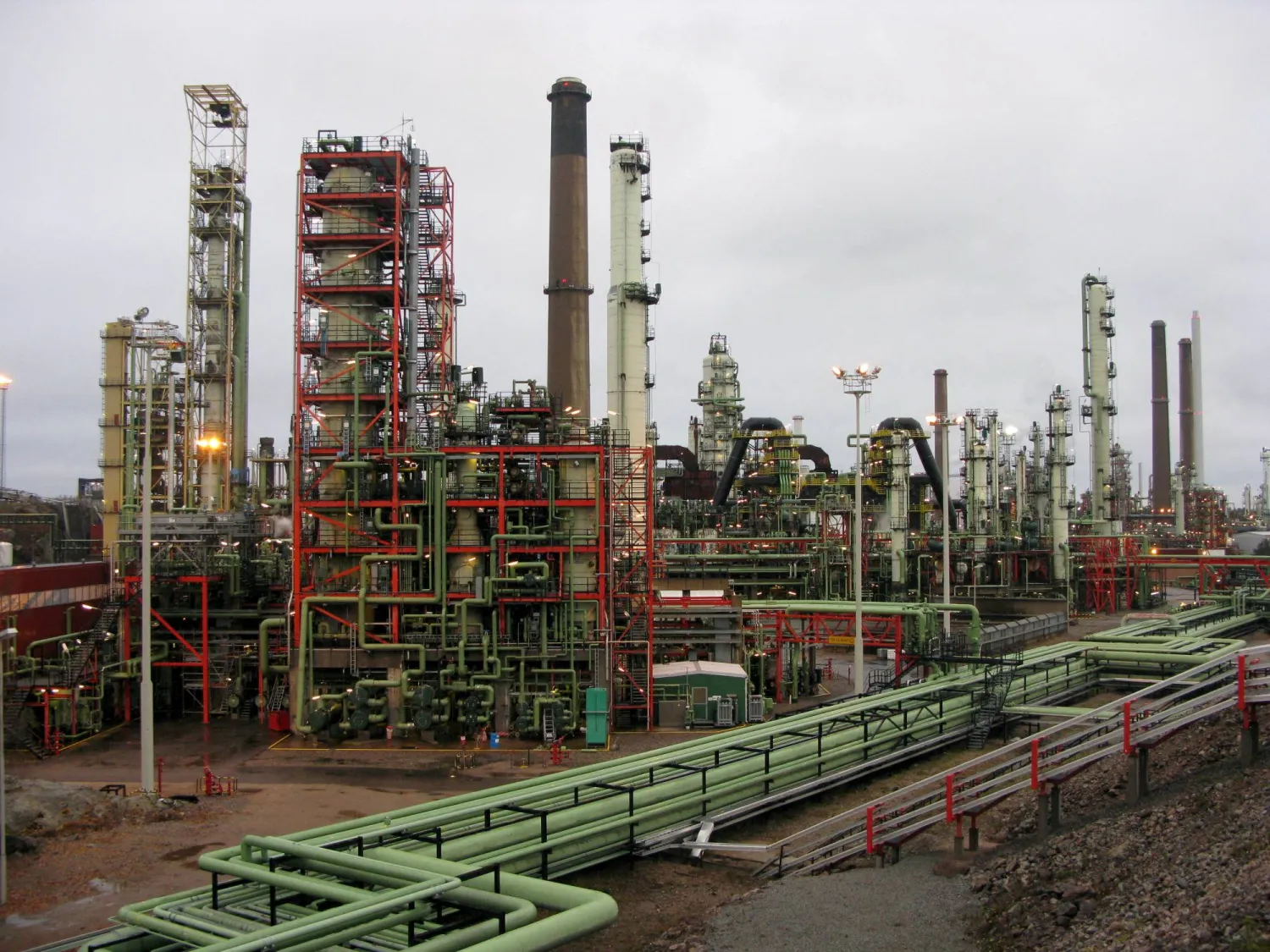
Oil Up Ahead of Fed Meet as Middle East Conflict Rages

FILE PHOTO: General view of Neste's oil refinery, with a total refining capacity of about 13.5 million tons per year, in Porvoo, southern Finland, November 17, 2015.REUTERS/Jussi Rosendahl/File Photo
TT

Oil Up Ahead of Fed Meet as Middle East Conflict Rages

FILE PHOTO: General view of Neste's oil refinery, with a total refining capacity of about 13.5 million tons per year, in Porvoo, southern Finland, November 17, 2015.REUTERS/Jussi Rosendahl/File Photo

Oil prices rose more than 1% on Wednesday ahead of the keenly watched meeting of the US central bank for clues on interest rate policy, while the conflict in the Middle East remains in focus.

Brent January crude futures were up about 1.1%, or 90 cents, to $85.92 a barrel by 1042 GMT. US West Texas Intermediate crude futures also gained 1.1%, or 90 cents, to $81.92 a barrel, Reuters reported.

"Crude prices are steadying ahead of a key issuance update by the Treasury and FOMC rate decision," said OANDA analyst Edward Moya, referring to the Federal Open Market Committee that sets the direction of US monetary policy.

The Fed, which will end its meeting on Wednesday, is widely expected to hold rates steady.

In Europe, October inflation in the Euro zone was at its lowest level in two years, a Eurostat flash reading showed, leading to expectations the European Central Bank is unlikely to hike interest rates soon. The Bank of England is expected to meet on Thursday.

Interest rate hikes aimed at taming inflation can slow economic growth and dampen oil demand.

In China - the world's largest oil importer - factory activity unexpectedly contracted in October, a private survey showed on Wednesday, adding to downbeat official figures from a day earlier and raising questions over its fragile economic recovery.

"Geopolitical risks remain and that seems to be offsetting some of the record production levels that are coming from the US," added Moya.
Crude oil inventories in the US rose by about 1.3 million barrels last week, while fuel stockpiles fell by about 360,000 barrels, according to market sources citing American Petroleum Institute figures on Tuesday.


IMF: Any Slowdown in AI-driven Growth Would be Factor for Central Banks

IMF Managing Director Kristalina Georgieva speaks during the Annual Meetings Plenary at the Annual Meetings of the International Monetary Fund (IMF) and the World Bank Group (WBG) at the Queen Sirikit National Convention Center (QSNCC) in Bangkok on October 16, 2026. (Photo by Lillian SUWANRUMPHA / AFP)
TT

IMF: Any Slowdown in AI-driven Growth Would be Factor for Central Banks

IMF Managing Director Kristalina Georgieva speaks during the Annual Meetings Plenary at the Annual Meetings of the International Monetary Fund (IMF) and the World Bank Group (WBG) at the Queen Sirikit National Convention Center (QSNCC) in Bangkok on October 16, 2026. (Photo by Lillian SUWANRUMPHA / AFP)

Central bankers around the world would need to consider any slowdown in AI-driven growth as they assess steps in their fight against inflation, International Monetary Fund Managing Director Kristalina Georgieva said on Friday.

Georgieva said concerns about dependence on the AI investment boom and high valuations were impacting markets around the world.

"Things are going up and down, and this is likely to continue," she told an audience at IMF headquarters in Washington, adding that the volatility would complicate the job of central banks at a time when risks to price stability had been growing.

A steep rout in technology stocks on Thursday rippled through markets on fears that ⁠the Democrats' victory ⁠in the US midterm elections would increase regulatory scrutiny of AI and slow the data center build-out, sending investors to the safety of bonds.

The political jitters are hitting an AI trade already on shaky footing due to worry about return on massive spending on AI-related infrastructure, with the meltdown spurring margin calls and spooking retail investors and hedge ⁠funds alike.

Georgieva said the AI investment boom was lifting growth in some countries, helping to offset a negative oil-supply shock triggered by the war in the Middle East, but it was also adding to inflationary pressures and financial stability concerns.

The IMF last month flagged significant growth and financial stability risks from a potential ending of the AI investment boom, among other factors, including a prolonged Middle East war. At the time, it warned that a steep drop in AI investment could lead to a sharp fall in asset prices, ultimately cutting global GDP ⁠by 1.1% ⁠by 2028, including a 1.8% drop in US output.

Georgieva did not repeat the downside forecast on Friday, but acknowledged the recent market volatility.

"Should there be a slowdown in the AI-driven growth impulse, it would need to be factored in as central banks assess the necessary steps in the fight against stubborn inflation," she said.

Democrats are planning to unleash a flood of new legislation targeting artificial intelligence systems and data-center development when they take control of the US Congress in January, Reuters reported on Friday, citing congressional aides and advocates.

That would mark a sharp shift from the Republican-led Congress, where lawmakers largely focused on promoting AI development and declined to pass legislation restricting the technology.


World Food Prices Dip in October, but Remain Higher Than a Year Ago

A worker carries loaves of bread for sale at a bakery in the capital city of Cairo, Egypt November 4, 2026. (Reuters)
TT

World Food Prices Dip in October, but Remain Higher Than a Year Ago

A worker carries loaves of bread for sale at a bakery in the capital city of Cairo, Egypt November 4, 2026. (Reuters)

World food prices edged lower in October as weaker import demand contributed to monthly declines in cereal, dairy and meat prices, but were still nearly 6% higher than a year earlier, the United Nations' Food and Agriculture Organization said on Friday.

The FAO Food Price Index, which tracks monthly changes in international prices for a basket of food commodities, ‌averaged 133.9 points ‌in October, down from a revised ‌135.6 ⁠in September.

The index ⁠was 5.9% higher than a year earlier, but remained 16.4% below its March 2022 peak.

FAO's cereal price index fell 4.5% from September and was 12.6% lower than a year ago, as wheat and maize quotations declined. Wheat prices eased on weak import demand ⁠and improved production prospects, especially in Argentina.

"Expectations of ‌easing constraints on Black ‌Sea export flows added to the downward pressure on prices, ‌although continued disruptions to Black Sea logistics limited the decline," ‌FAO said in a statement.

Maize prices also eased after reaching a three-year high in September, pressured by the US harvest, expectations of ample supplies in South America and renewed ‌prospects of easing tensions in the Black Sea region.

Vegetable oil prices edged up 0.3%, ⁠as ⁠higher soybean and sunflower oil prices more than offset a fall in rapeseed oil prices.

Sugar prices rose 6.6%, their fourth straight monthly increase, to the highest level since December 2024, after rainfall disrupted harvesting in Brazil. They were now 28.8% above a year ago.

The dairy index fell 1.1%, as lower butter and cheese prices linked to ample supplies and subdued demand outweighed gains in milk powder.

The meat index declined 1.2%, while still slightly above its year-earlier level, as ovine and bovine meat prices fell.


Copper Falls, Set for Worst Week Since March on AI Rout

Copper at the Aurubis copper smelting and refining plant in Hamburg, Germany. (Reuters)
TT

Copper Falls, Set for Worst Week Since March on AI Rout

Copper at the Aurubis copper smelting and refining plant in Hamburg, Germany. (Reuters)

Copper dropped on Friday and was set for its biggest weekly drop in London since March, as a rout in technology stocks battered markets.

Benchmark three-month copper on the London Metal Exchange was down 1.3% at $13,663 a metric ton by 0700 GMT. That placed it on track to fall 3.44% in the week, Reuters said.

The most-traded copper contract on the Shanghai Futures Exchange fell 1.08% to 106,830 yuan ($16,018.17) a ton.

The weakness reflects worries over AI investment, ‌with copper increasingly ‌influenced by "sentiment towards data center expansion," said ‌Craig ⁠Lang, principal analyst ⁠at CRU.

Technology shares were battered after Democratic wins in the US midterms fueled concerns that new regulatory oversight could cap the AI buildout.

On the other hand, supply constraints cushioned copper's decline.

"I would be cautious about calling this a sustained correction, given ongoing mine supply challenges and exceptionally tight ⁠metal availability outside the US," Lang said.

Copper stocks ‌in SHFE-monitored warehouses <CU-STX-SGH> fell by ‌over 24% this week to just 33,848 tons — the lowest ‌in almost three years. The closely watched Yangshan copper ‌premium <SMM-CUYP-CN>, a gauge of appetite for imports into key consumer China, increased to $210 a ton on Thursday, matching its record high.

Smelters in the country are facing a double squeeze of negative treatment ‌charges and lower sulfuric acid prices.

Meanwhile, warehouse inventories outside the US have been drawn ⁠down as ⁠material was pulled into the country ahead of a potential tariff on imports of refined copper.

"These physical constraints should provide some support against weaker investor sentiment," Lang said.

Among LME metals, aluminium lost 0.54%, zinc lost 1.42%, lead lost 0.45%, nickel dipped 0.23% and tin gained 0.83%.

On the SHFE, aluminium nudged down only 0.04%, zinc lost 1.35%, lead was little changed, down only 0.03%, nickel rose 2.14% and tin dropped 3.45%.

SHFE inventories were down across the board this week, led by sharp drops in aluminium <AL-STX-SGH> and lead <PB-STX-SGH>.