

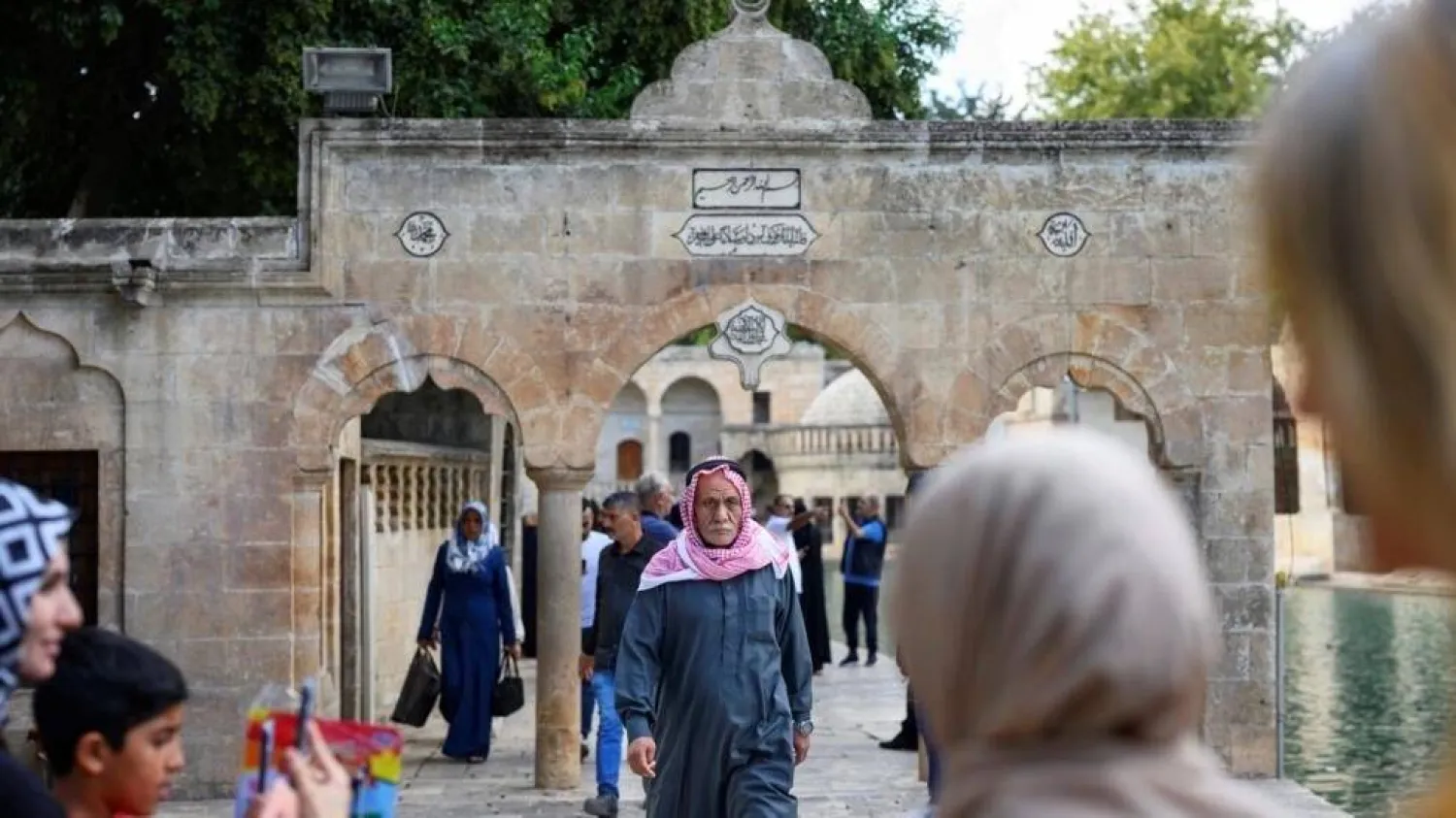

Battling Public Mood, Türkiye Quietly Assimilates Syrians

Polls show most Turks blaming Syrian migrants for their own economic problems. Yasin AKGUL / AFP
TT

Battling Public Mood, Türkiye Quietly Assimilates Syrians

Polls show most Turks blaming Syrian migrants for their own economic problems. Yasin AKGUL / AFP

Like millions of other Syrians fleeing war, Mahmud Abdi came to Türkiye hoping to return once the bloodshed ebbed.

Almost a decade later, the 30-year-old carpenter is looking to open his own workshop in the southeastern Turkish city of Sanliurfa, where a quarter of the two million inhabitants are Syrian, said AFP.

"I've learned to handle new machines," said Abdi, who fled ISIS's short-lived "caliphate" in Syria's Raqqa. "After my course, I'm going to work for a furniture maker."

Abdi's new ambitions pose a political problem for Türkiye, which still views most of its nearly 3.5 million Syrians as "guests" receiving "temporary protection".

Syrian refugees became a hot-button issue during this year's presidential election, held amid an economic crisis that fanned anti-migrant flames.

But with the European Union's help, Türkiye is quietly setting up integration-through-work programs -- even if few officials publicly admit that many Syrians are probably here to stay.

"Employment plays a key role in ensuring harmony" between locals and the Syrians, said Metin Baydilli, mayor of Sanliurfa's Karakopru district.

That harmony was violently broken in the capital Ankara in 2021, when Turkish nationalists went on a rampage, attacking Syrian businesses and homes following the death of a teen in a street fight involving Syrians.

Other, less violent incidents have become painfully common in recent years.

Against this backdrop, the EU stepped up financial support, hoping Türkiye can continue accepting refugees who might otherwise end up in Europe.

The sides signed a landmark deal in 2016, with Brussels releasing nearly 10 billion euros since 2011 for schools, healthcare, and training programs such as Abdi's furniture-making course.

Political problem

"The word 'integration' is not used by Turkish officials," Nikolaus Meyer-Landrut, the European Union's ambassador to Türkiye, said during a visit to Sanliurfa last month. "But in reality, a lot is being done for integration, even if the prospects of a return are being kept alive for political reasons."

President Recep Tayyip Erdogan prided himself on Türkiye becoming the welcoming home for millions fleeing hardship in places such as Syria.

But polls show the overwhelming majority of Turks prefer to see the Syrians go back.

Heading into last May's vote, Erdogan announced plans to build hundreds of thousands of housing units for Türkiye’s migrants in areas of northern Syria under Ankara's indirect control.

With the 27-nation EU divided over how to handle refugees and migrants, Türkiye’s continued willingness to house Syrians in return for financial support is particularly important for Brussels.

"It's going better than you might think" though integrating "such a large number of people into a struggling economy is bound to be difficult," the EU's Meyer-Landrut said.

Sanliurfa's agricultural-based economy is struggling to cope with the new arrivals. The local unemployment rate is 15 percent, well above the official national average of 9.2 percent.

The situation is quite different in neighboring industrial Gaziantep, where Syrians have become the driving force behind the labor-starved textile sector.

Dividing lines

"To offer employment to Syrian refugees, we need to increase investment in Sanliurfa," said Yunus Colak, who heads the local development agency. Integration is hampered by the legal status of the refugees.

Only 17,557 Syrians have registered jobs in Sanliurfa, according to officials. The rest are employed illegally and often poorly paid, undercutting the local labor market.

A 2021 report by Economic Policy Research Foundation showed 48 percent of Türkiye’s Syrians working illegally, and 41 percent being underpaid.

The picture looks brighter in Türkiye’s public schools, which now teach 800,000 Syrian children.

Bunyamin Abdullah, 11, is learning Turkish in a specialized class supported by EU funding.

"My mother doesn't speak Turkish. I help her when she goes shopping," he says.

The additional classes opened with European support are soothing the anger of parents who blame Syrian children for overcrowded schools.

But in the streets of Sanliurfa, invisible dividing lines run between the Syrians and the city's Turkish, Kurdish and Arab inhabitants.

"There are neighborhoods nicknamed Raqqa or Damascus. In my grandson's school, out of 27 pupils, only three are Turkish, the rest are Syrians," said car salesman Mustafa Aslan.

"Their culture is very different from ours. We don't want them here," he said.


Nigeria's President to Make a Sate Visit to the UK in March

Nigeria’s President Bola Tinubu gives a joint statement with Brazil’s President Luiz Inacio Lula da Silva, at the Planalto presidential palace, in Brasilia, Brazil, Aug. 25, 2025. (AP Photo/Eraldo Peres, File)
TT

Nigeria's President to Make a Sate Visit to the UK in March

Nigeria’s President Bola Tinubu gives a joint statement with Brazil’s President Luiz Inacio Lula da Silva, at the Planalto presidential palace, in Brasilia, Brazil, Aug. 25, 2025. (AP Photo/Eraldo Peres, File)

Nigeria’s president is set to make a state visit to the UK in March, the first such trip by a Nigerian leader in almost four decades, Britain’s Buckingham Palace said Sunday.

Officials said President Bola Tinubu and first lady Oluremi Tinubu will travel to the UK on March 18 and 19, The AP news reported.

King Charles III and Queen Camilla will host them at Windsor Castle. Full details of the visit are expected at a later date.

Charles visited Nigeria, a Commonwealth country, four times from 1990 to 2018 before he became king. He previously received Tinubu at Buckingham Palace in September 2024.m

Previous state visits by a Nigerian leader took place in 1973, 1981 and 1989.

A state visit usually starts with an official reception hosted by the king and includes a carriage procession and a state banquet.

Last year Charles hosted state visits for world leaders including US President Donald Trump, French President Emmanuel Macron and German President Frank-Walter Steinmeier.


Iran Strikes Hard Line on US Talks, Saying Tehran's Power Comes From Saying 'No'

Traffic moves through a street in Tehran on February 7, 2026. (Photo by ATTA KENARE / AFP)
TT

Iran Strikes Hard Line on US Talks, Saying Tehran's Power Comes From Saying 'No'

Traffic moves through a street in Tehran on February 7, 2026. (Photo by ATTA KENARE / AFP)

Iran's top diplomat insisted Sunday that Tehran's strength came from its ability to “say no to the great powers," striking a maximalist position just after negotiations with the United States over its nuclear program and in the wake of nationwide protests.

Foreign Minister Abbas Araghchi, speaking to diplomats at a summit in Tehran, signaled that Iran would stick to its position that it must be able to enrich uranium — a major point of contention with President Donald Trump, who bombed Iranian atomic sites in June during the 12-day Iran-Israel war.

Iran will never surrender the right to enrich uranium, even if war "is imposed on us,” he noted.

"Iran has paid a very heavy price for its peaceful nuclear program and for uranium enrichment." 

Israeli Prime Minister Benjamin Netanyahu is expected to travel to Washington this week, with Iran expected to be the major subject of discussion, his office said.

While Iranian President Masoud Pezeshkian praised the talks Friday in Oman with the Americans as “a step forward,” Araghchi's remarks show the challenge ahead. Already, the US moved the aircraft carrier USS Abraham Lincoln, ships and warplanes to the Middle East to pressure Iran into an agreement and have the firepower necessary to strike the Islamic Republic should Trump choose to do so, according to The AP news.

“I believe the secret of the Islamic Republic of Iran’s power lies in its ability to stand against bullying, domination and pressures from others," Araghchi said.

"They fear our atomic bomb, while we are not pursuing an atomic bomb. Our atomic bomb is the power to say no to the great powers. The secret of the Islamic Republic’s power is in the power to say no to the powers.”

‘Atomic bomb’ as rhetorical device Araghchi's choice to explicitly use an “atomic bomb” as a rhetorical device likely wasn't accidental. While Iran has long maintained its nuclear program is peaceful, the West and the International Atomic Energy Agency say Tehran had an organized military program to seek the bomb up until 2003.

Iran had been enriching uranium up to 60% purity, a short, technical step to weapons-grade levels of 90%, the only non-weapons state to do so. Iranian officials in recent years had also been increasingly threatening that Tehran could seek the bomb, even while its diplomats have pointed to Iranian Supreme Leader Ali Khamenei’s preachings as a binding fatwa, or religious edict, that Iran wouldn’t build one.

Pezeshkian, who ordered Araghchi to pursue talks with the Americans after likely getting Khamenei's blessing, also wrote on X on Sunday about the talks.

“The Iran-US talks, held through the follow-up efforts of friendly governments in the region, were a step forward,” the president wrote. “Dialogue has always been our strategy for peaceful resolution. ... The Iranian nation has always responded to respect with respect, but it does not tolerate the language of force.”

It remains unclear when and where, or if, there will be a second round of talks. Trump, after the talks Friday, offered few details but said: “Iran looks like they want to make a deal very badly — as they should.”

Aircraft carrier in the Arabian Sea During Friday's talks, US Navy Adm. Brad Cooper, the head of the American military's Central Command, was in Oman. Cooper's presence was apparently an intentional reminder to Iran about US military power in the region. Cooper later accompanied US special envoy Steve Witkoff and Jared Kushner, Trump's son-in-law, to the Lincoln out in the Arabian Sea after the indirect negotiations.

Araghchi appeared to be taking the threat of an American military strike seriously, as many worried Iranians have in recent weeks. He noted that after multiple rounds of talks last year, the US “attacked us in the midst of negotiations."

“If you take a step back (in negotiations), it is not clear up to where it will go,” Araghchi said.


Russia: Man Suspected of Shooting Top General Detained in Dubai

An investigator works outside a residential building where the assassination attempt on Russian Lieutenant General Vladimir Alexeyev took place in Moscow, Russia February 6, 2026. REUTERS/Anastasia Barashkova
TT

Russia: Man Suspected of Shooting Top General Detained in Dubai

An investigator works outside a residential building where the assassination attempt on Russian Lieutenant General Vladimir Alexeyev took place in Moscow, Russia February 6, 2026. REUTERS/Anastasia Barashkova

Russia's Federal Security Service (FSB) said on Sunday that the man suspected of shooting top Russian military intelligence officer Vladimir Alexeyev in Moscow has been detained in Dubai and handed over to Russia.

Lieutenant General Vladimir Alexeyev, deputy head of the GRU, ⁠Russia's military intelligence arm, was shot several times in an apartment block in Moscow on Friday, investigators said. He underwent surgery after the shooting, Russian media ⁠said.

The FSB said a Russian citizen named Lyubomir Korba was detained in Dubai on suspicion of carrying out the shooting.

Russian Foreign Minister Sergei Lavrov accused Ukraine of being behind the assassination attempt, which he said was designed to sabotage peace talks. ⁠Ukraine said it had nothing to do with the shooting.

Alexeyev's boss, Admiral Igor Kostyukov, the head of the GRU, has been leading Russia's delegation in negotiations with Ukraine in Abu Dhabi on security-related aspects of a potential peace deal.
