


‘One War for Another’: Ukrainian Refugees Return from Israel

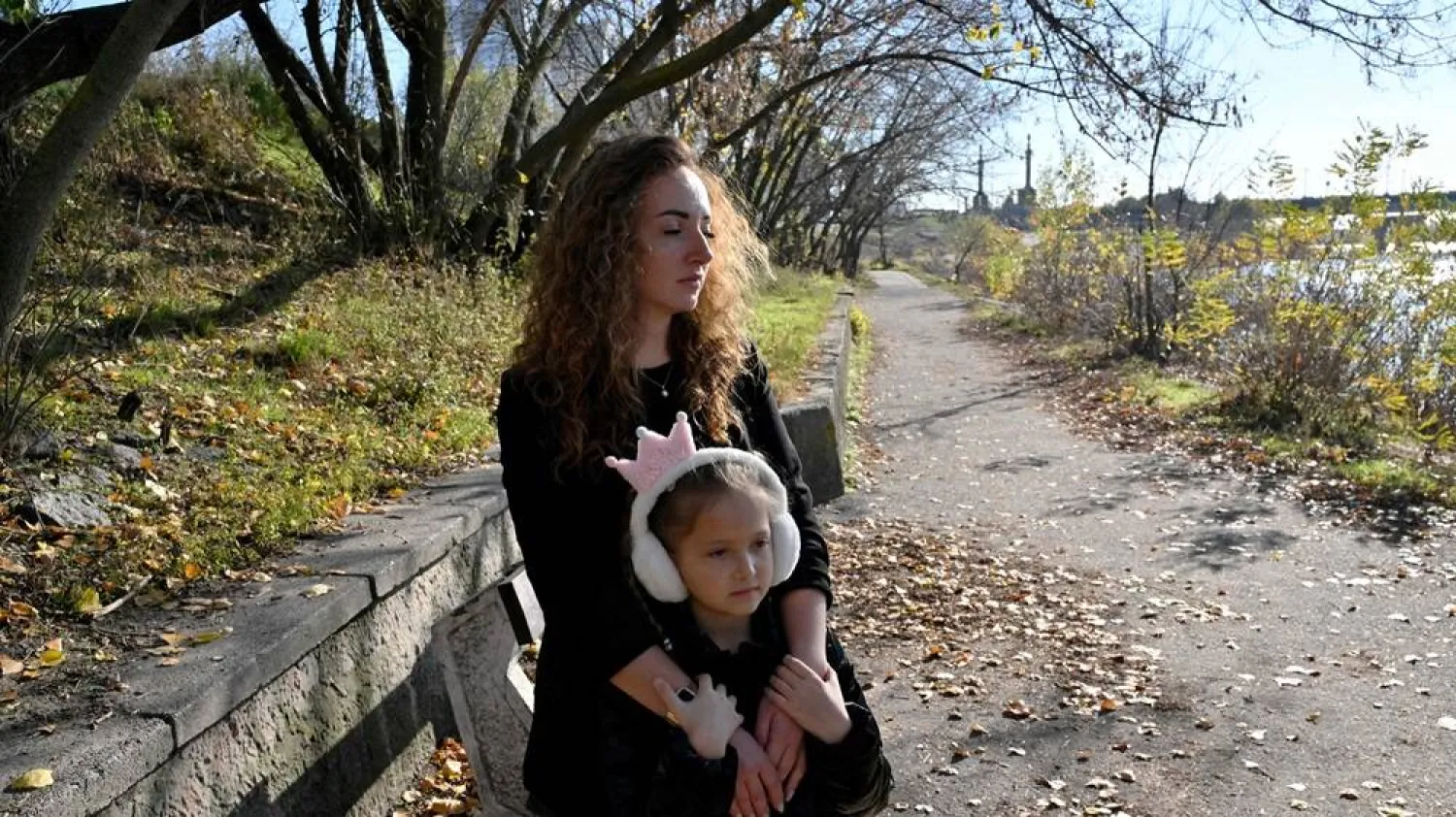
 Anna Lyashko, 28, and her daughter Diana, 8, walk in a park near Dnipro river in Kyiv on November 3, 2023, amid the Russian invasion of Ukraine. (AFP)
Anna Lyashko, 28, and her daughter Diana, 8, walk in a park near Dnipro river in Kyiv on November 3, 2023, amid the Russian invasion of Ukraine. (AFP)
TT

‘One War for Another’: Ukrainian Refugees Return from Israel

 Anna Lyashko, 28, and her daughter Diana, 8, walk in a park near Dnipro river in Kyiv on November 3, 2023, amid the Russian invasion of Ukraine. (AFP)
Anna Lyashko, 28, and her daughter Diana, 8, walk in a park near Dnipro river in Kyiv on November 3, 2023, amid the Russian invasion of Ukraine. (AFP)

Tetiana Kocheva fled her home in Ukraine's northeastern city of Kharkiv after Russia invaded last year, taking refuge in Israel's coastal town of Ashkelon, near Gaza.

Her husband had worked in Israel in the past, and she thought taking their three children there -- away from Russian attacks -- would guarantee living in peace.

But then came October 7, when Hamas attacked Israel, leading to a war that has since killed thousands.

Like several thousand other Ukrainian refugees, Kocheva fled war for a second time.

"If I am killed then at least it's on my native land," the 39-year-old said.

When Russia attacked Ukraine in February 2022, Kocheva spent ten days hiding in a basement in Kharkiv, which almost fell to the Russian army.

Five months into the invasion, the family left for Israel.

They began a new life in Ashkelon, some 10 kilometers (six miles) from Gaza.

During the surprise attack by Hamas -- which killed some 1,200 people -- she felt she needed to leave.

"My hands started to shake and I had the same feeling that I did when it all started in our country," she said.

Israel then launched a military campaign in the Gaza Strip. Palestinian militant group Hamas has said over 11,000 have since died.

'I needed to come home'

Kocheva slept in a shelter again, recalling endless sirens and explosions.

Then she decided she had to flee.

"When it intensified... I started to panic," she said.

"I got scared, I realized that I needed to come home."

The family was evacuated to central Israel, where they stayed several days, before going back to Kharkiv.

War is still a feature of life in Kharkiv -- while being firmly under Ukrainian control, the city is regularly hit by Russian attacks. Sirens are still a regular part of life.

But for Kocheva, it was a relief to be back.

"I walk here, it's my native land, my flag, I don't know how to express it, I am happy," she said.

Kyiv has said that some 4,000 Ukrainians have left Israel since the Hamas attack.

'Exactly the same feeling'

In the capital Kyiv, Anna Lyashko and her eight-year-old daughter Diana were also back from Israel.

They had fled to Israel in the first weeks of Russia's invasion. in March last year.

They had been living close to areas of the Kyiv region that fell to Russian forces early in their attack, living without "electricity, water or communication", the 28-year-old mother said.

"My daughter was very scared and I decided to leave," the 28-year-old said.

She decided to take her daughter to Israel, where she had a relative.

But when hostilities started in Israel last month, it brought her back to the day Russia invaded Ukraine.

"My first feelings were the same as 24th of February (2022) in Ukraine," she said.

"Someone called me in the morning and said 'Anna, war has started', it was exactly the same feeling I had in Ukraine."

She said her daughter had "fear in her eyes" and that she "understood that I could not stay".

They flew out of Tel Aviv a week later, with the help of the Ukrainian embassy.

As her daughter played in fallen leaves in a Kyiv park, Lyashko said the pair were also happily home, reunited with family.

'Kyiv calmer than Israel'

Sitting in her office on the opposite side of the Dnipro River in Kyiv, Oksana Sokolovska said she thought Israel would be "the safest country in the world" when she fled Russia's invasion there.

Like many women with children, the 39-year-old lawyer left Ukraine with her three children at the start of the war last year.

"I had no right to risk their lives," she said.

As she spoke Hebrew, she chose Israel as their destination and they settled in Rishon LeTsiyon, near Tel Aviv.

But she, too, spent October 7 in a shelter with her children.

"Massive bombing started," she said.

Once again, she took a quick decision to leave Israel.

"It is difficult to leave one war for another," she told AFP.

But Sokolovska was nonetheless "happy to be home."

"Right now in Kyiv, the situation is calmer than in Israel," she said, almost two years into the Russian invasion.

"It is the only reason why I came back."


Respiratory Virus Claims Lives in Gaza amid Limited Capacity for Testing

A Palestinian man carries the body of his three-month-old daughter on Tuesday after she died from the cold in Gaza City. (AFP)
TT

Respiratory Virus Claims Lives in Gaza amid Limited Capacity for Testing

A Palestinian man carries the body of his three-month-old daughter on Tuesday after she died from the cold in Gaza City. (AFP)

Gaza resident Yusra al-Hajjar, 32, went through harrowing moments after she was shocked by a sharp rise in the temperature of her five-month-old infant, Nidal, prompting her to rush him to a clinic at the Al-Shifa Medical Complex in Gaza City as his condition worsened.

Initial medical examinations failed to determine the exact cause of the infant’s illness, forcing the medical team to resort to basic measures such as intravenous fluids and fever-reducing medication in an attempt to control the symptoms.

The treatment was temporarily successful, and the baby’s condition improved after several hours.

“We left the clinic in a better condition, but less than a day later, we brought him back after a new deterioration,” al-Hajjar told Asharq Al-Awsat.

“As of this morning, Tuesday, five days have passed since my baby fell ill. I am still trying basic methods, such as cooling his forehead with cold water and giving him some medication to reduce the fever and stop the vomiting and weakness, while doctors have been unable to determine the cause,” she added.

The infant’s case is not the only one. Residents of Gaza have been struggling in recent weeks with what medical officials describe as a widespread outbreak of identical symptoms, particularly among the elderly and children, according to Mohammed Abu Salmiya, director of the Al-Shifa Medical Complex.

Abu Salmiya said that for nearly a month, new deaths have been recorded on an almost daily basis due to the spread of what he described as a dangerous and deadly virus.

He said the virus causes severe pneumonia, leading to fatalities primarily among vulnerable patients with weakened immune systems, and secondarily among individuals with stronger immunity, including some young people whose deaths were recorded in recent days.

No capacity for testing

Abu Salmiya said Gaza’s health system lacks even the most basic laboratory capabilities needed to identify the virus, suggesting it could be a new COVID variant spreading in the world.

Earlier on Tuesday, a seven-month-old infant, Shaza Abu Jarrad, died due to extreme cold and a lack of adequate shelter and heating, raising the number of child deaths from similar conditions to about 10.

Abu Salmiya said the current cold weather has fueled the spread of the virus, contributing to a high number of deaths amid the harsh living conditions in Gaza following the Israeli war.

He said there is a direct link between the war and weakened immunity among Gaza’s population, who have endured repeated bouts of hunger, alongside water contamination.

He added that this comes amid severe shortages of medicines and medical supplies, leaving health authorities unable to mount an effective and rapid response to the current health crisis.

The United Nations Relief and Works Agency for Palestine Refugees, UNRWA, said in a post on X that despite the collapse of Gaza’s health system, it continues to provide primary health care to thousands of people every day, but faces an acute shortage of medicines.

UNRWA accused Israel of preventing its aid supplies stuck in warehouses in Jordan and Egypt from entering Gaza since March 2 last year, stressing the urgent need to allow its assistance into the territory.

It said harsh winter conditions are compounding the suffering of families in Gaza who have been exhausted by war and repeated displacement, calling for large-scale access for humanitarian aid.

Mahmoud Bassal, spokesman for Gaza’s Civil Defense, warned of a rise in deaths, particularly among young children, due to the severe cold wave coinciding with the deterioration of humanitarian conditions in the enclave.

He said field and health conditions are extremely harsh, especially for infants, the sick, and the elderly, as most families live in dilapidated tents that offer little protection from the cold, rain, and other environmental conditions.


Khartoum Markets Back to Life but 'Nothing Like Before'

Men walk along a street past destroyed high-rise building, as efforts to restore the city's infrastructure resumes after nearly three years of devastation caused by war, in the Sudanese capital Khartoum on January 17, 2025. (AFP)
TT

Khartoum Markets Back to Life but 'Nothing Like Before'

Men walk along a street past destroyed high-rise building, as efforts to restore the city's infrastructure resumes after nearly three years of devastation caused by war, in the Sudanese capital Khartoum on January 17, 2025. (AFP)

The hustle and bustle of buyers and sellers has returned to Khartoum's central market, but "it's nothing like before," fruit vendor Hashim Mohamed told AFP, streets away from where war first broke out nearly three years ago.

On April 15, 2023, central Khartoum awoke to battles between the Sudanese army and the paramilitary Rapid Support Forces, who had been allies since 2021, when they ousted civilians from a short-lived transitional government.

Their war has since killed tens of thousands and displaced millions. In greater Khartoum alone, nearly 4 million people -- around half the population -- fled the city when the RSF took over.

Hashim Mohamed did not.

"I had to work discreetly, because there were regular attacks" on businesses, said the fruit seller, who has worked in the sprawling market for 50 years.

Like him, those who stayed in the city report living in constant fear of assaults and robberies from fighters roaming the streets.

Last March, army forces led an offensive through the capital, pushing paramilitary fighters out and revealing the vast looting and destruction left behind.

"The market's not what it used to be, but it's much better than when the RSF was here," said market vendor Adam Haddad, resting in the shade of an awning.

In the market's narrow, dusty alleyways, fruits and vegetables are piled high, on makeshift stalls or tarps spread on the ground.

- Two jobs to survive -

Khartoum, where entire neighborhoods were once under siege, is no longer threatened by the mass starvation that stalks battlefield cities and displacement camps elsewhere in Sudan.

But with the economy a shambles, a good living is still hard to provide.

"People complain about prices, they say it's too expensive. You can find everything, but the costs keep going up: supplies, labor, transportation," said Mohamed.

Sudan has known only triple-digit annual inflation for years. Figures for 2024 stood at 151 percent -- down from a 2021 peak of 358.

The currency has also collapsed, going from trading at 570 Sudanese pounds to the US dollar before the war to 3,500 in 2026, according to the black market rate.

One Sudanese teacher, who only a few years ago could provide comfortably for his two children, told AFP he could no longer pay his rent with a monthly salary of 250,000 Sudanese pounds ($71).

To feed his family, pay for school, and cover healthcare, he "works in the market or anywhere" on his days off.

"You have to have another job to pay for the bare minimum of basic needs," he said, asking for anonymity to protect his privacy.

For Adam Haddad, the road to recovery will be a long one.

"We don't have enough resources or workers or liquidity going through the market," he said, adding that reliable electricity was still a problem.

"The government is striving to restore everything, and God willing, in the near future, the power will return and Khartoum will become what it once was."


Trump Heads into Davos Storm, with an Eye on Home

FILE - President Donald Trump is illuminated by a camera flash as he gestures while walking across the South Lawn of the White House, Nov. 2, 2025, in Washington, after returning from a trip to Florida. (AP Photo/Mark Schiefelbein, File)
TT

Trump Heads into Davos Storm, with an Eye on Home

FILE - President Donald Trump is illuminated by a camera flash as he gestures while walking across the South Lawn of the White House, Nov. 2, 2025, in Washington, after returning from a trip to Florida. (AP Photo/Mark Schiefelbein, File)

Donald Trump returns to the Davos ski resort next week after unleashing yet another avalanche on the global order. But for the US president, his main audience is back home.

Trump's first appearance in six years at the gathering of the world's political and global elite comes amid a spiraling crisis over his quest to acquire Greenland.

Fellow leaders at the mountain retreat will also be eager to talk about other shocks from his first year back in power, from tariffs to Venezuela, Ukraine, Gaza and Iran.

Yet for the Republican president, his keynote speech among the Swiss peaks will largely be aimed at the United States.

US voters are angered by the cost of living despite Trump's promises of a "golden age," and his party could be facing a kicking in crucial midterm elections in November.

That means Trump will spend at least part of his time in luxurious Davos talking about US housing.

A White House official told AFP that Trump would "unveil initiatives to drive down housing costs" and "tout his economic agenda that has propelled the United States to lead the world in economic growth."

The 79-year-old is expected to announce plans allowing prospective homebuyers to dip into their retirement accounts for down payments.

Billionaire Trump is keenly aware that affordability has become his Achilles' heel in his second term. A CNN poll last week found that 58 percent of Americans believe his first year back in the White House has been a failure, particularly on the economy.

Trump's supporters are also increasingly uneasy about the "America First" president's seemingly relentless focus on foreign policy since his return to the Oval Office.

But as he flies into the snowy retreat, Trump will find it impossible to avoid the global storm of events that he has stirred since January 20, 2025.

Trump will be alongside many of the leaders of the same European NATO allies that he has just threatened with tariffs if they don't back his extraordinary quest to take control of Greenland from Denmark.

Those threats have once again called into question the transatlantic alliance that has in many ways underpinned the western economic order celebrated at Davos.

- 'Economic stagnation' -

So have the broader tariffs Trump announced early in his second term, and he is set to add to the pressure on Europe in his speech.

Trump will "emphasize that the United States and Europe must leave behind economic stagnation and the policies that caused it," the White House official said.

The Ukraine war will also be on the cards.

Ukrainian President Volodymyr Zelensky is hoping for a meeting with Trump to sign new security guarantees for a hoped-for ceasefire deal with Russia, as are G7 leaders.

But while the largest-ever US Davos delegation includes Secretary of State Marco Rubio, special envoy Steve Witkoff and son-in-law Jared Kushner, who have all played key roles on Ukraine, no meeting is assured.

"No bilateral meetings have been scheduled for Davos at this time," the White House told AFP.

Trump is meanwhile reportedly considering a first meeting of the so-called "Board of Peace" for war-torn Gaza at Davos, after announcing its first members in recent days.

Questions are also swirling about the future of oil-rich Venezuela following the US military operation to topple its leader Nicolas Maduro, part of Trump's assertive new approach to his country's "backyard."

But Trump may also pause to enjoy his time in the scenic spot he called "beautiful Davos" in his video speech to the meeting a year ago.

The forum has always been an odd fit for the former New York property tycoon and reality TV star, whose brand of populism has long scorned globalist elites.

But at the same time, Trump relishes the company of the rich and successful.

His first Davos appearance in 2018 met occasional boos but he made a forceful return in 2020 when he dismissed the "prophets of doom" on climate and the economy.

A year later he was out of power. Now, Trump returns as a more powerful president than ever, at home and abroad.
