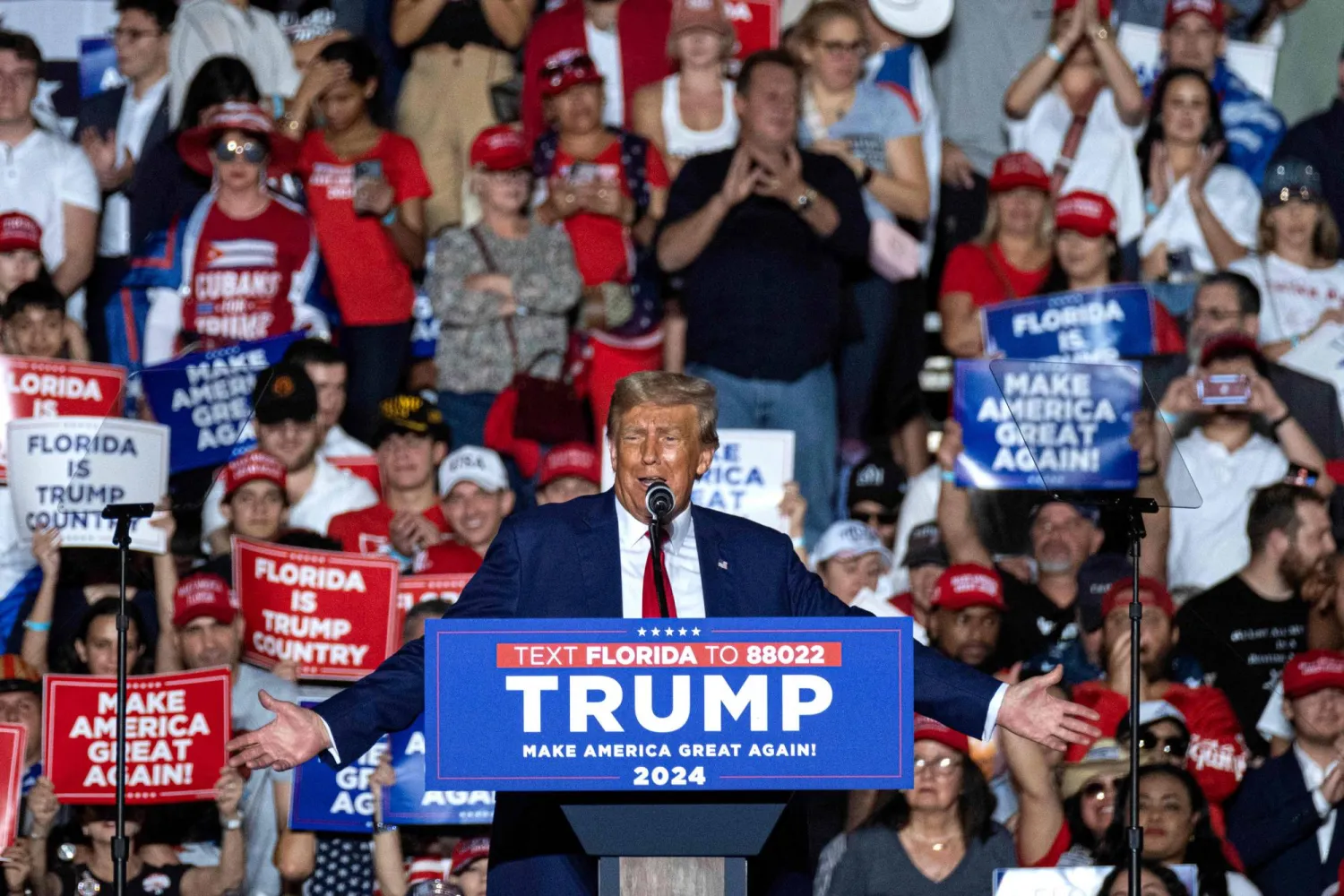
Trump's Plans if He Returns to the White House Include Deportation Raids, Tariffs and Mass Firings

Former US President and 2024 Republican Presidential hopeful Donald Trump speaks during a rally at Ted Hendricks Stadium at Henry Milander Park in Hialeah, Florida, on November 8, 2023. (Photo by Ricardo ARDUENGO / AFP)
TT

Trump's Plans if He Returns to the White House Include Deportation Raids, Tariffs and Mass Firings

Former US President and 2024 Republican Presidential hopeful Donald Trump speaks during a rally at Ted Hendricks Stadium at Henry Milander Park in Hialeah, Florida, on November 8, 2023. (Photo by Ricardo ARDUENGO / AFP)

A mass deportation operation. A new Muslim ban. Tariffs on all imported goods and "freedom cities" built on federal land.
Much of the 2024 presidential campaign has been dominated by the myriad investigations into former President Donald Trump and the subsequent charges against him. But with less than a year until Election Day, Trump is dominating the race for the Republican nomination and has already laid out a sweeping set of policy goals should he win a second term.
His ideas, and even the issues he focuses on most, are wildly different from President Joe Biden's proposals. If implemented, Trump's plans would represent a dramatic government overhaul arguably more consequential than that of his first term. His presidency, especially the early days, was marked by chaos, infighting and a wave of hastily written executive orders that were quickly overturned by the courts.
Some of his current ideas would probably end up in court or impeded by Congress. But Trump's campaign and allied groups are assembling policy books with detailed plans.
A look at his agenda:
DISMANTLING THE ‘DEEP STATE’ Trump would try to strip tens of thousands of career employees of their civil service protections. That way, they could be fired as he seeks to "totally obliterate the deep state."
He would try to accomplish that by reissuing a 2020 executive order known as “Schedule F.” That would allow him to reclassify masses of employees, with a particular focus, he has said, on “corrupt bureaucrats who have weaponized our justice system” and “corrupt actors in our national security and intelligence apparatus.” Given his anger at the FBI and federal prosecutors pursuing criminal cases against him, Trump probably would target people linked to those prosecutions for retribution.
Beyond the firings, he wants to crack down on government officials who leak to reporters. He also wants to require that federal employees pass a new civil service test.
THE US-MEXICO BORDER Trump has pledged to “immediately stop the invasion of our southern border” and end illegal immigration.
As part of that plan, he says he would immediately direct US Immigration and Customs Enforcement to undertake the largest domestic deportation operation in American history. He would target people who are legally living in the United States but harbor “jihadist sympathies" and revoke the student visas of those who espouse anti-American and antisemitic views.
In a bid to secure the US-Mexico border, Trump says he will move thousands of troops currently stationed overseas and shift federal agents, including those at the Drug Enforcement Administration and FBI, to immigration enforcement. He also wants to build more of the border wall.
Trump wants to reimpose his travel ban that originally targeted seven Muslim-majority countries and expand it to “keep radical Islamic terrorists out of the country.” In the wake of the Hamas attack on Israel, he has pledged to put in place “ideological screening” for immigrants. His aim: bar “dangerous lunatics, haters, bigots, and maniacs”.
To deter migrants, he has said he would end birthright citizenship, using an executive order that would introduce a legally untested interpretation of the 14th Amendment. The order would prevent federal agencies from granting automatic citizenship to the children of people who are in the US illegally. It would require that at least one parent be a US citizen or lawful permanent resident for their children to be eligible for passports, Social Security numbers and other benefits.
TRADE Trump says he will institute a system of tariffs of perhaps 10% on most foreign goods. Penalties would increase if trade partners manipulate their currencies or engage in other unfair trading practices.
He will urge that Congress pass a “Trump Reciprocal Trade Act," giving the president authority to impose a reciprocal tariff on any country that imposes one on the US.
Much of the agenda focuses on China. Trump has proposed a four-year plan to phase out Chinese imports of essential goods, including electronics, steel and pharmaceuticals. He wants to ban Chinese companies from owning vital US infrastructure in sectors such as energy, technology and agriculture, and says he will force Chinese owners to sell any holdings “that jeopardize America’s national security.”
FOREIGN POLICY Trump claims that even before he is inaugurated, he will have settled the war between Russia and Ukraine. That includes, he says, ending the “endless flow of American treasure to Ukraine” and asking European allies to reimburse the US for the cost of rebuilding stockpiles.
It is unclear whether he would insist that Russia withdraw from territory in Ukraine it seized in the war that it launched in February 2022.
Trump has said he will stand with Israel in its war with Hamas and support Israel's efforts to “destroy” the militant group. He says he will continue to “fundamentally reevaluate” NATO’s purpose and mission.
TRANSGENDER RIGHTS Trump says he will ask Congress to pass a bill establishing that “only two genders,” as determined at birth, are recognized by the United States.
As part of his crackdown on gender-affirming care, he will declare that hospitals and health care providers that offer transitional hormones or surgery no longer meet federal health and safety standards and will be blocked from receiving federal funds, including Medicaid and Medicare dollars.
He would push Congress to prohibit hormonal or surgical intervention for transgender minors in all 50 states.
Doctors typically guide kids toward therapy before medical intervention. At that point, hormone treatments such as puberty blockers are far more common than surgery. They have been available in the US for more than a decade and are standard treatments backed by major doctors’ organizations, including the American Medical Association.
ENERGY Trump's goal, he says, is for the US to have the lowest-cost energy and electricity of any nation in the world, including China.
Under the mantra “DRILL, BABY, DRILL,” he says he would ramp up oil drilling on public lands and offer tax breaks to oil, gas, and coal producers. He would roll back Biden administration efforts to encourage the adoption of electric cars and reverse proposed new pollution limits that would require at least 54% of new vehicles sold in the US to be electric by 2030.
And again, he says, he will exit the Paris Climate Accords, end wind subsidies and eliminate regulations imposed and proposed by the Biden admiration targeting incandescent lightbulbs, gas stoves, dishwashers and shower heads.
EDUCATION Trump has pledged to terminate the Department of Education, but he also wants to exert enormous influence over local school districts and colleges.
He would push the federal government to give funding preference to states and school districts that abolish teacher tenure, adopt merit pay to reward good teachers and allow the direct election of school principals by parents.
He has said he would cut funding for any school that has a vaccine or mask mandate and will promote prayer in public schools.
Trump also wants a say in school curricula, vowing to fight for “patriotic education." He says that under his administration, schools will “teach students to love their country, not to hate their country like they’re taught right now" and will promote “the nuclear family” including “the roles of mothers and fathers" and the “things that make men and women different and unique.”
To protect students, he says he will support school districts that allow trained teachers to carry concealed weapons. He would provide federal funding so schools can hire veterans, retired police officers, and other trained gun owners as armed school guards.
HOMELESSNESS Trump wants to force the homeless off city streets by building tent cities on large open parcels of inexpensive land. At the same time, he says he will work with states to ban urban camping, giving violators the choice between being arrested or receiving treatment.
He also wants to bring back large mental institutions to reinstitutionalize those who are “severely mentally ill” or "dangerously deranged."
PUBLIC SAFETY Trump would again push to send the National Guard to cities such as Chicago that are struggling with violence. He would use the federal government's funding and prosecution authorities to strong-arm local governments.
He says he will require local law enforcement agencies that receive Justice Department grants to use controversial policing measures such as stop-and-frisk. As a deterrent, he says local police should be empowered to shoot suspected shoplifters in the act. “Very simply, if you rob a store, you can fully expect to be shot as you are leaving that store,” he said in one recent speech.
Trump has called for the death penalty for drug smugglers and those who traffic women and children. He has also pledged a federal takeover of the nation's capital, calling Washington a “dirty, crime-ridden death trap" unbefitting of the country.



Turkish, Greek Leaders Voice Desire to Resolve Issues After Talks

In this photo released by the Turkish Presidency, Türkiye’s President Recep Tayyip Erdogan, right, and Greece's Prime Minister Kyriakos Mitsotakis, shake hands during their meeting in Ankara, Türkiye, Wednesday, Feb. 11, 2026. (Turkish Presidency via AP)
TT

Turkish, Greek Leaders Voice Desire to Resolve Issues After Talks

In this photo released by the Turkish Presidency, Türkiye’s President Recep Tayyip Erdogan, right, and Greece's Prime Minister Kyriakos Mitsotakis, shake hands during their meeting in Ankara, Türkiye, Wednesday, Feb. 11, 2026. (Turkish Presidency via AP)

The leaders of Türkiye and Greece voiced their desire to resolve longstanding maritime disputes hobbling ties during discussions in Ankara on Wednesday, as the NATO allies and historic rivals try to build on warming relations.

The neighbors have been at odds over a range of issues for decades, primarily maritime boundaries and rights in the Aegean, an area widely believed to hold energy resources and with key implications for airspace and military activity.

Following years of heightened tensions, a 2023 declaration on friendly relations prompted a thaw in rhetoric, though their maritime issues have remained unresolved and the two sides still disagree over ‌regional matters.

Speaking at ‌a press conference in Ankara with Greek Prime Minister Kyriakos Mitsotakis, ‌Turkish ⁠President Recep Tayyip Erdogan said ⁠they had discussed their issues in the Aegean and eastern Mediterranean "in an open and sincere way" during the talks.

"While the issues may be thorny, they are not unsolvable on the basis of international law. I saw that we were in agreement with my friend Kyriakos," Erdogan said.

He added that the two countries would continue working to achieve their goal of reaching $10 billion in bilateral trade.

Mitsotakis said he hoped circumstances would allow the sides to solve a dispute on ⁠the demarcation of maritime and exclusive economic zones in the Aegean ‌and eastern Mediterranean.

'IF NOT NOW, WHEN?'

"It is time to ‌remove any substantial and formal threats to our relations, if not now, when?" Mitsotakis said.

"Destiny has ‌appointed us to live in the same neighborhood. We cannot change geography, but we can ‌make it an ally, choosing convergence, dialogue and trust in international law... to build a future of peace, progress and prosperity for our people."

Despite the positive tone, Greece's foreign minister earlier said Athens planned to extend its territorial waters further, including potentially in the Aegean.

Shortly after, Ankara said it had issued ‌a maritime notice urging Greece to coordinate research activities in areas of the Aegean that Türkiye considers part of its continental shelf.

In ⁠1995, Türkiye’s parliament ⁠declared a casus belli — a cause for war — should Greece unilaterally extend its territorial waters beyond six nautical miles in the Aegean, a stance Athens says violates international maritime law. Greece says it wants only to discuss demarcation of maritime zones.

Mitsotakis also said the flows of migrants in the Aegean Sea had decreased by almost 60% last year due to cooperation between the two countries, adding this should be strengthened.

Fifteen migrants died in a shipwreck off the Greek island of Chios last week after their boat collided with a Greek coastguard vessel and sank in the Aegean Sea off the Turkish coast.

Türkiye is a transit country for migrants seeking to reach the European Union via Greece. Ankara says the EU has not fully delivered on commitments under a 2016 migration deal and Athens wants Türkiye to do more to curb irregular crossings.


US Energy Secretary in Venezuela for Oil Talks

Handout picture released by the US Embassy in Venezuela showing US Secretary of Energy Chris Wright (2-R) walking next to the new head of the United States diplomatic mission for Venezuela, Laura Dogu (2-L), upon his arrival at Maiquetia International Airport in Maiquetia, La Guaira state, Venezuela, on February 11, 2026. (Handout / US Embassy in Venezuela / AFP)
TT

US Energy Secretary in Venezuela for Oil Talks

Handout picture released by the US Embassy in Venezuela showing US Secretary of Energy Chris Wright (2-R) walking next to the new head of the United States diplomatic mission for Venezuela, Laura Dogu (2-L), upon his arrival at Maiquetia International Airport in Maiquetia, La Guaira state, Venezuela, on February 11, 2026. (Handout / US Embassy in Venezuela / AFP)

US Energy Secretary Chris Wright arrived in Venezuela on Wednesday for talks with acting president Delcy Rodriguez and oil industry executives on harnessing the country's vast crude reserves.

Wright is the highest-ranking official in the administration of US President Donald Trump to travel to Venezuela since US special forces seized and overthrew longtime socialist leader Nicolas Maduro on January 3.

Trump has backed Maduro's former deputy Rodriguez to succeed the ousted leader, on condition that she abide by US demands, including granting the United States access to Venezuelan oil and ease state repression.

Welcoming Wright to Venezuela on X, the US embassy in the country said: "Your visit is key to advancing @POTUS's (Trump's) vision of a prosperous Venezuela."

It added that "the US private sector will be essential to boost the oil sector, modernize the electric grid, and unlock Venezuela's enormous potential."

A photo posted by the embassy showed Wright on the tarmac at Maiquetia International Airport, which serves the capital Caracas, together with the new US charge d'affaires in Venezuela, Laura Dogu.

Venezuela sits on about a fifth of the world's oil reserves and was once a major crude supplier to the United States.

But it produced only around one percent of the world's total crude output in 2024, according to OPEC, due to years of under-investment, mismanagement and US sanctions.

Washington eased sanctions on Venezuelan oil last month after Rodriguez's administration passed a law throwing open the sector to private investment.

Trump wants US oil majors to rapidly rebuild the sector and boost output by millions of barrels a day.


Trump Meets Netanyahu, with US-Iran Nuclear Diplomacy Topping Agenda

 President Donald Trump shakes hands with Israel's Prime Minister Benjamin Netanyahu at the end of a news conference at Mar-a-Lago, Dec. 29, 2025, in Palm Beach, Fla. (AP)
President Donald Trump shakes hands with Israel's Prime Minister Benjamin Netanyahu at the end of a news conference at Mar-a-Lago, Dec. 29, 2025, in Palm Beach, Fla. (AP)
TT

Trump Meets Netanyahu, with US-Iran Nuclear Diplomacy Topping Agenda

 President Donald Trump shakes hands with Israel's Prime Minister Benjamin Netanyahu at the end of a news conference at Mar-a-Lago, Dec. 29, 2025, in Palm Beach, Fla. (AP)
President Donald Trump shakes hands with Israel's Prime Minister Benjamin Netanyahu at the end of a news conference at Mar-a-Lago, Dec. 29, 2025, in Palm Beach, Fla. (AP)

President Donald Trump hosted Benjamin Netanyahu at the White House on Wednesday, with the Israeli prime minister expected to press him to widen US talks with Iran to include limits on Tehran's missile arsenal and other security threats beyond its nuclear program.

In his seventh meeting with Trump since the president returned to office nearly 13 months ago, Netanyahu was looking to influence the next round of US discussions with Iran following nuclear negotiations held in Oman last Friday.

Trump has threatened strikes on Iran if no agreement is reached, while Tehran has vowed to retaliate, stoking fears of a wider war. He has repeatedly voiced support for a secure Israel, a longstanding US ally and arch-foe of Iran.

In media interviews on Tuesday, Trump reiterated his warning, saying that while he believes Iran wants a deal, he would do "something very tough" if it refused.

TRUMP SAYS NO TO IRANIAN NUCLEAR WEAPONS, MISSILES

Trump told Fox Business that a good deal with Iran would mean "no nuclear weapons, no missiles," without elaborating. He also told Axios he was considering sending a second aircraft carrier ‌strike group as part ‌of a major US buildup near Iran.

Israel fears that the US might pursue a narrow ‌nuclear deal ⁠that does not ⁠include restrictions on Iran's ballistic missile program or an end to Iranian support for armed proxies such as Hamas and Hezbollah, according to people familiar with the matter. Israeli officials have urged the US not to trust Iran's promises.

"I will present to the president our perceptions of the principles in the negotiations," Netanyahu told reporters before departing for the US. The two leaders could also discuss potential military action if diplomacy with Iran fails, one source said.

Iran has said it is prepared to discuss curbs on its nuclear program in exchange for lifting sanctions but has ruled out linking the issue to missiles.

Iran’s "missile capabilities are non-negotiable," Ali Shamkhani, an adviser to Iran's supreme leader, said on Wednesday.

Netanyahu's arrival at the White House was lower-key than usual. He entered the building away ⁠from the view of reporters and cameras, and a White House official then confirmed he was inside ‌meeting with Trump.

GAZA ON THE AGENDA

Also on the agenda was Gaza, with Trump looking to ‌push ahead with a ceasefire agreement he helped to broker. Progress on his 20-point plan to end the war and rebuild the shattered Palestinian enclave has stalled, ‌with major gaps over steps such as Hamas disarming as Israeli troops withdraw in phases.

Netanyahu's visit, originally scheduled for February 18, was brought forward ‌amid renewed US engagement with Iran. Both sides at last week's Oman meeting said the talks were positive and further talks were expected soon.

US Secretary of State Marco Rubio said ahead of the Oman meeting that negotiations would need to address Iran's missiles, its proxy groups, and its treatment of its own population. Iran said Friday’s talks focused only on nuclear issues.

Trump has been vague about broadening the negotiations. He was quoted as telling Axios on Tuesday that it was a "no-brainer" ‌for any deal to cover Iran's nuclear program, but that he also thought it possible to address its missile stockpiles.

Iran says its nuclear activities are for peaceful purposes, while the US and Israel have ⁠accused it of past efforts to develop ⁠nuclear weapons.

Last June, the US joined Israel's strikes on Iranian nuclear facilities during a 12-day war.

Israel also heavily damaged Iran's air defenses and missile arsenal. Two Israeli officials say there are signs Iran is working to restore those capabilities.

Trump threatened last month to intervene militarily during a bloody crackdown on anti-government protests in Iran, but ultimately held off.

ISRAEL WARY OF A WEAKENED IRAN REBUILDING

Tehran's regional influence has been weakened by Israel’s June attack, losses suffered by its proxies in Gaza, Lebanon, Yemen and Iraq, and the ousting of its ally, former Syrian President Bashar al-Assad.

But Israel is wary of its adversaries rebuilding after the multi-front war triggered by Hamas' October 2023 assault on southern Israel.

While Trump and Netanyahu have mostly been in sync and the US remains Israel's main arms supplier, Wednesday’s meeting could expose tensions.

Part of Trump's Gaza plan holds out the prospect for eventual Palestinian statehood - which Netanyahu and his coalition, the most far-right in Israel's history, have long resisted.

Netanyahu's security cabinet on Sunday authorized steps that would make it easier for Israeli settlers in the occupied West Bank to buy land while granting Israel broader powers in what the Palestinians see as the heartland of a future state. The decision drew international condemnation.

"I am against annexation," Trump told Axios, reiterating his stance. "We have enough things to think about now."