

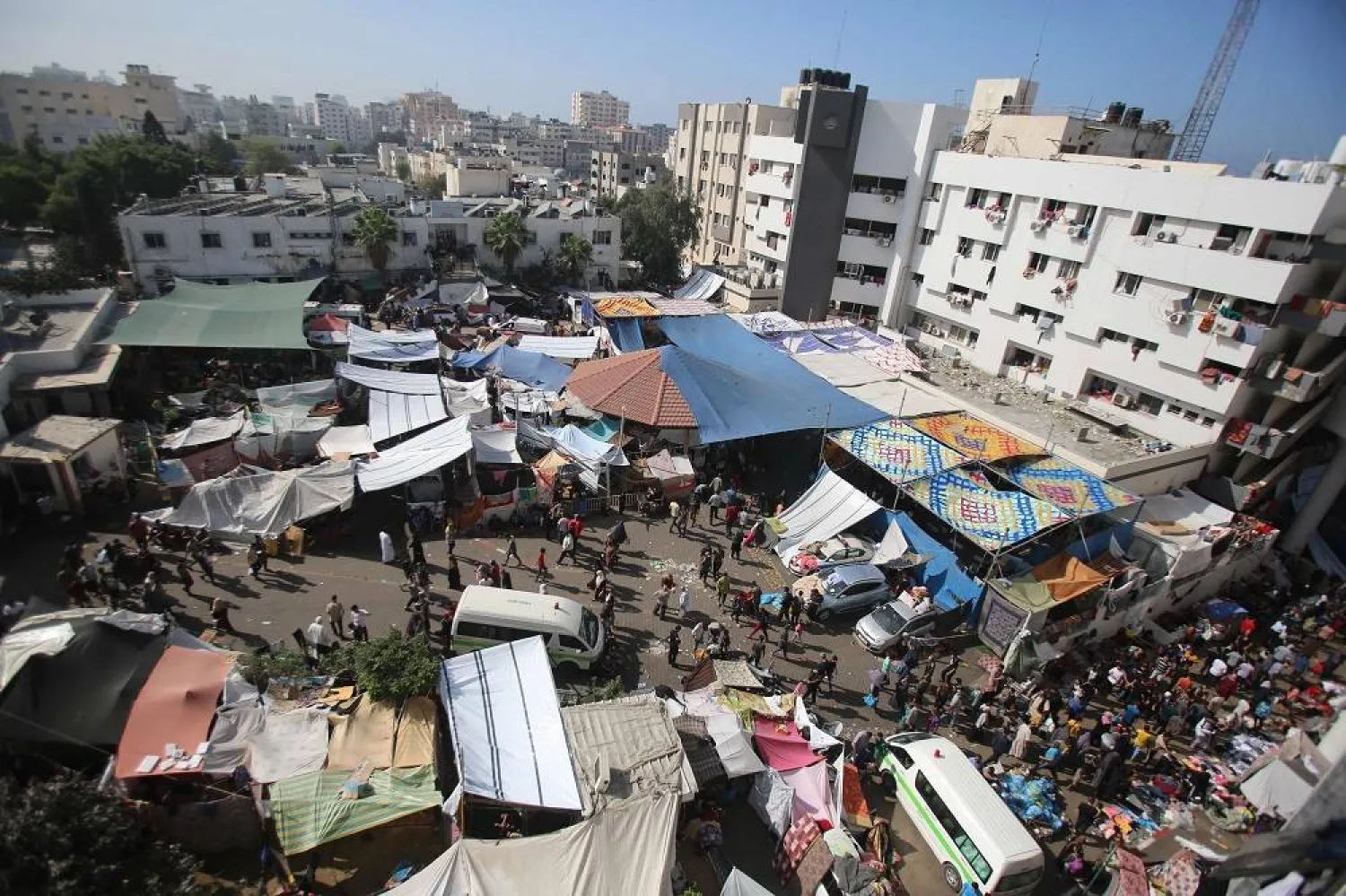

North Gaza Hospitals Not Functioning as Fighting Rages

An aerial view shows the compound of al-Shifa hospital in Gaza City on November 7, 2023, amid the ongoing battles between Israel and the Palestinian group Hamas. (AFP)
TT

North Gaza Hospitals Not Functioning as Fighting Rages

An aerial view shows the compound of al-Shifa hospital in Gaza City on November 7, 2023, amid the ongoing battles between Israel and the Palestinian group Hamas. (AFP)

The hospitals in northern Gaza were no longer functioning amid fuel shortages and intense combat, with the death toll inside the territory's largest facility rising, the Hamas-run health ministry said Monday.  

Israel argues its Hamas enemies built their military headquarters under the Al-Shifa hospital complex, while UN agencies and doctors in the facility warned a lack of generator fuel was claiming lives, including infants.  

Witnesses reported intense overnight air strikes, with tanks and armored vehicles just meters from the gate of the sprawling Al-Shifa compound at the heart of Gaza City, now an urban war zone.

The Hamas government's deputy health minister Youssef Abu Rish said the death toll inside Al-Shifa rose to 27 adult intensive care patients and seven babies since the weekend as the facility suffered fuel shortages.

Gaza has been reliant on generators for over a month after Israel cut off power supplies following the October 7 attack and the besieged territory's only power plant ran out of fuel.  

Abu Rish told AFP all hospitals were "out of service" in the territory's north, where black smoke rose from a bombed mosque and a rare person on the street carried a white flag.  

The World Health Organization in the Palestinian Territories said early Monday that at least 2,300 people -- patients, health workers and people fleeing fighting -- were inside the crippled Al-Shifa facility.

"There are dozens of dead and hundreds of wounded that no one can get to. Ambulances are at a standstill because they get shot at when they go out," hospital director Mohammad Abu Salmiya told AFP.  

The Israeli army pushed on with their campaign, determined to destroy the movement whose gunmen it says killed at least 1,200 people, mostly civilians, and took about 240 hostages in the country's worst ever attack.  

But Israel is facing intense international pressure to minimize civilian suffering amid its massive air and ground operations that Hamas authorities say have killed 11,180 people, including 4,609 children.  

Israel said 44 of its troops have been killed in the Gaza offensive.  

A lack of fuel was also hitting the UN agency for Palestinian refugees UNRWA, with the group's Gaza chief Thomas White saying operations "will grind to a halt in the next 48 hours as no fuel is allowed to enter" the territory.  

Fear of regional conflict  

The Israel Defense Forces on Monday reported more heavy fighting and again stressed its claim that Hamas was hiding in civilian infrastructure.

"IDF troops are continuing to conduct raids... targeting terrorist infrastructure located in central governmental institutions in the heart of the civilian population, including schools, universities, mosques and residences of terrorists," it said.  

In another operation, "IDF ground troops entered the residence of a senior Islamic Jihad terrorist and located a large number of weapons inside the kids' room of the residence".  

Teams of Israeli troops ran between jagged ruins in Gaza while air strikes shown on grainy military-released video shattered buildings.  

Palestinian Prime Minister Mohammad Shtayyeh on Monday urged the European Union and the United Nations to "parachute aid" into Gaza, especially the hard-hit northern areas.  

Israel's Prime Minister Benjamin Netanyahu has said Hamas must first release the hostages before any ceasefire would be considered, but he told US media on Sunday that "there could be" a deal in works.  

Israelis are stunned by the October 7 attack and worried for the fate of the captives, with families planning to deliver a letter at the UN headquarters in Jerusalem seeking action.  

The war in Gaza has also spurred concerns of a wider regional conflict.  

At least eight pro-Iran fighters were killed in US strikes on eastern Syria, a war monitor said, in response to attacks on American forces.  

It was the third time in less than three weeks that the US military has targeted locations in Syria, amid a spike in attacks on American forces in the Middle East linked to the Israel-Hamas war.  

International concern  

International attention has focused on the plight of Palestinians, and protests have been held worldwide in solidarity with the 2.4 million under bombardment and siege for more than five weeks.  

Among those fleeing northern Gaza on Sunday was Adel Shamallakh, who was pushing a stretcher with four young children, some crying and shooing flies from their faces.  

"The road is so bumpy, more than expected. Destruction is everywhere, even birds there have no more life."

About 980 trucks carrying humanitarian aid have been let into Gaza since October 21, according to the UN humanitarian agency.  

Fuel has been a key need, especially for hospital generators, but Israel has been concerned that any fuel deliveries could be diverted to Hamas militants.  

Palestinians in Gaza's south have been forced to adapt to the lack of basic resources, with many resorting to clay ovens to cook.  

"People are using now (traditional) ovens in order to cook, what else can they do?" said a woman, who asked not to be named, making clay ovens in southern Khan Yunis.  

Almost 1.6 million people -- about two-thirds of Gaza's population -- have been internally displaced since October 7, according to UNRWA.  

Israel's military said it would observe a "self-evacuation corridor" Monday, allowing people to move from Al-Shifa southward, but admitted the area was still the scene of "intense battles".  

The area of fighting "currently includes the area surrounding the Al-Shifa hospital but not the hospital itself", an IDF spokesperson told AFP.  

The Israeli army also said its ground soldiers had hand-delivered 300 liters (80 gallons) of fuel near the hospital "for urgent medical purposes".  

Al-Shifa director Abu Salmiya said he told Israeli authorities he needed at least 8,000 liters to run the main generators and "save hundreds of patients and wounded, but they refused".  

AFP was unable to independently verify his account or Israel's claim that Hamas forbade the hospital from taking the fuel.



Israel Says will Only Withdraw Troops from Lebanon after Hezbollah Disarmed

A man with a Hezbollah flag drives past a damaged building following a ceasefire between Israel and Hezbollah in the town of Nabatiyeh, southern Lebanon, Monday, June 22, 2026. (AP Photo/Mohammed Zaatari)
TT

Israel Says will Only Withdraw Troops from Lebanon after Hezbollah Disarmed

A man with a Hezbollah flag drives past a damaged building following a ceasefire between Israel and Hezbollah in the town of Nabatiyeh, southern Lebanon, Monday, June 22, 2026. (AP Photo/Mohammed Zaatari)

Israel said Thursday that it would only withdraw its forces from southern Lebanon after Hezbollah was disarmed, as the two countries engaged in US-mediated talks in Washington.

"We will not withdraw our forces from southern Lebanon as long as Hezbollah remains a threat, are not disarmed and are not demilitarised," David Mencer, a government spokesman, said in a briefing to journalists.

Under US pressure, Lebanese officials began direct talks in April with Israel in Washington. The latest three-day round of talks is due to wrap up on Thursday, Reuters reported.

Commenting on the negotiations, US Secretary of State Marco Rubio said the two neighbors were close to making a "commitment of intent".

Asked about the talks, Mencer said: "We are making extremely clear that our responsibility is to our northern citizens and to the whole of Israel, and we will not allow any terrorist force anywhere near our border -- which means that any redeployment of - Israeli - forces comes after, not before, but after the demilitarisation of southern Lebanon and the disarming of Hezbollah."

"We've already been in this situation in 2024," he added. "Hezbollah were supposed to be disarmed. They weren't."

Meanwhile, Senior Israeli and Lebanese officials denied on Thursday that there had been any Israeli withdrawal from occupied southern Lebanon, after a US official said Israel had pulled some troops back in a good faith gesture toward Lebanon's government.

A US State Department official said that "Israel has already taken a concrete step by pulling back from a part of its buffer zone". The so-called buffer zone is a vast area of southern Lebanon that Israeli forces are occupying north of the Israeli border.

The official described the move as "a significant demonstration of good faith toward Lebanon's legitimate government."

"The (Lebanese Armed Forces) should now move in and verifiably clear out terrorist weapons and infrastructure. This model will be repeated across South Lebanon, enabling the safe return of displaced families, reconstruction of the south, and the restoration of full Lebanese sovereignty," the official added.

A senior Israeli defense official denied there had been any kind of pullback or withdrawal by Israeli forces, and said Israel would not be withdrawing from its buffer zone.

Another Israeli military official told Reuters on Wednesday that the military had not received orders to hand over any position to the Lebanese army and that, for now, it would not permit the Lebanese army or civilians to cross into the buffer zone.

"We will not allow the Lebanese army to go south from the security line," the official said.


Lebanese State Media Says Three Killed in Israeli Strike on South

Residents arrive to inspect what is left of their homes and businesses, destroyed in Israeli military strikes, in the southern Lebanese village of Srifa on June 24, 2026. (Photo by FADEL itani / AFP) /
TT

Lebanese State Media Says Three Killed in Israeli Strike on South

Residents arrive to inspect what is left of their homes and businesses, destroyed in Israeli military strikes, in the southern Lebanese village of Srifa on June 24, 2026. (Photo by FADEL itani / AFP) /

An Israeli strike on a vehicle in southern Lebanon killed three people on Thursday, Lebanese state media reported, despite a lull in the fighting between Israel and Hezbollah.

Lebanon's state-run National News Agency said "three people were killed and one person was wounded when an enemy drone targeted a... vehicle on the road between Zawtar and Mayfadoun".

It is the third deadly incident since Tuesday, bringing the number of people killed in Israeli attacks this week to seven. The strike comes as Lebanese and Israeli officials meet in Washington for a fifth round of direct negotiations.


Palestinians Decry Israeli Push for Control over Ancient West Bank Sites

Pillars and archaeological remains in the ancient village of Sebastia, near Nablus in the Israeli-occupied West Bank, June 4, 2026. REUTERS/Ammar Awad
TT

Palestinians Decry Israeli Push for Control over Ancient West Bank Sites

Pillars and archaeological remains in the ancient village of Sebastia, near Nablus in the Israeli-occupied West Bank, June 4, 2026. REUTERS/Ammar Awad

An Israeli bill that would extend civil control over ancient sites in the West Bank has drawn criticism from Palestinians and Israeli rights groups who say it is tantamount to annexation of occupied land and would expand Jewish settlements.

The "Heritage Authority in Judea and Samaria" bill passed one of three votes by Israel's parliament in May, but it is unclear whether the final vote will be held before parliament disperses ahead of an election expected by October 27.

The bill would bring management of Roman, Byzantine and Crusader-era sites under Israeli Ministry of Heritage management and allow related "expropriation and purchase of real estate" in the West Bank, which Israel calls by its Hebrew biblical name, Reuters reported.

That in effect would strip away oversight of some ancient sites from the Western-backed Palestinian Authority, which under the 1990s Oslo peace accords has exercised limited self-rule in parts of ‌the West Bank, ‌territory Israel captured in a 1967 war.

The PA's tourism minister, Hani Al-Hayek, said "control over these ‌antiquities ⁠is intended to ⁠expand control and expand settlements in these areas, deep inside Palestinian territories."

Israel says the bill's purpose is to protect ancient sites.

VILLAGE NEAR ANCIENT SEBASTIA SITE FACES LAND CONFISCATION

Peace Now, an Israeli settlements watchdog, said the bill "constitutes an annexationist measure in every respect" and would lead to broad-scale confiscation of Palestinian land.

Using archaeology to expand settlements is not a new practice, but the scope of the Israeli government's measures has been unprecedented, Peace Now said.

One example is the Palestinian village of Sebastia in the northern West Bank where residents, many of whom trace their roots to the land back centuries, rely heavily on tourism to a nearby archaeological site.

The ancient site in ⁠Sebastia has ruins from the 9th-century B.C. Israelite kingdom as well as Roman, Byzantine, Crusader ‌and Ottoman remnants, archaeologists say. It is on a tentative list for inclusion as ‌a UNESCO World Heritage Site.

In late 2025, Israel announced a plan to seize about 1,800 dunams (445 acres) at the site, which it ‌said was meant to develop the area, affecting around 5,000 olive trees growing in the village groves, village officials said.

"They ‌are incorporating areas containing water resources, roads and antiquities, leaving us as residents without any resources. It is part of settlement expansion," said Sebastia Deputy Mayor Nizar Kayed.

Business had already been suffering since late 2023 with tourism dropping because of war in the region, said Nahed Sakha, whose Sebastia restaurant is on land slated for confiscation.

"It seems that the Israeli plan (is) to isolate the archaeological site from the people," Sakha said.

ISRAEL CITES ‌ANCIENT TIES TO THE LAND

Israeli parliament member Zvi Sukkot, who has been key in advancing the new bill, says extending Israeli control over the sites is meant to safeguard ⁠ancient remnants dating back to biblical ⁠times.

"There's nothing here that changes the legal status of Judea and Samaria," he told Reuters.

"There are many people who are bothered by our desire to prove the ties between the people of Israel and this land," he said. "All the stories of the Bible, all our history, the people (of Israel) were born in Judea and Samaria."

Sukkot is a member of the pro-settler Religious Zionism party. Like many in Prime Minister Benjamin Netanyahu's coalition, he opposes the creation of a Palestinian state and advocates annexation of the West Bank.

UN bodies and most countries view Israel's settlements as illegal under international law, violating the Fourth Geneva Convention provision barring the transfer of civilian population into occupied territory.

Israel rejects this view, saying the West Bank, which it captured in the 1967 war, is disputed territory. It cites security needs and biblical and historical ties to the land.

But the new bill has also caused concern among legal officials in Israel's defense establishment and Israeli scientists.

In an open letter to Netanyahu and Sukkot, the Israel Academy of Sciences and Humanities called for it to be scrapped.

"This will undoubtedly lead to an immediate deterioration in Israel's international relations in the field of archaeology, and it will also have an impact on other areas of science and research," the academy said.