South Korea and Members of the US-led UN Command Warn North Korea over Its Nuclear Threat

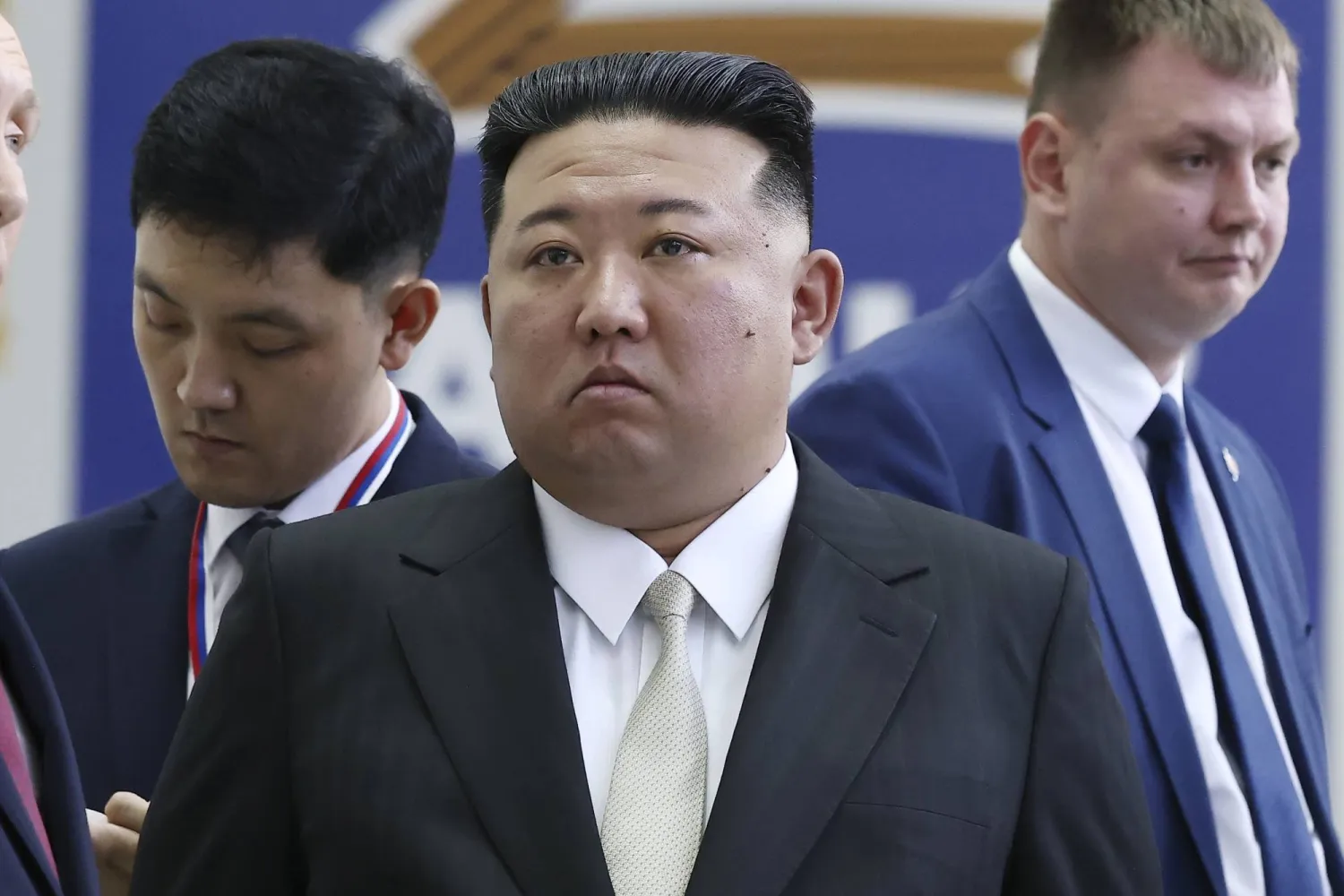
North Korea's leader Kim Jong Un, center, examines a rocket assembly hangar at the Vostochny Cosmodrome outside the city of Tsiolkovsky, in Russia's Far East, on Wednesday, Sept. 13, 2023. (Vladimir Smirnov, Sputnik, Kremlin Pool Photo via AP, File)
TT

South Korea and Members of the US-led UN Command Warn North Korea over Its Nuclear Threat

North Korea's leader Kim Jong Un, center, examines a rocket assembly hangar at the Vostochny Cosmodrome outside the city of Tsiolkovsky, in Russia's Far East, on Wednesday, Sept. 13, 2023. (Vladimir Smirnov, Sputnik, Kremlin Pool Photo via AP, File)

Senior defense officials from South Korea, the United States and other nations on Tuesday warned North Korea over its nuclear ambitions and threats, vowing an unspecified collective response to any war-like aggression by the North toward its rival.
Their joint statement came after a meeting in Seoul involving US Secretary of Defense Lloyd Austin, South Korean Defense Minister Shin Won-sik and officials from 16 other countries under the US-led United Nations Command, which provided combat or medical forces in support of the South during the 1950-53 Korean War.
The meeting came a day after Austin and Shin held annual defense talks where the allies updated a bilateral security agreement with the aim of more effectively countering North Korea’s evolving nuclear and missile threats, The Associated Press said.
In the joint statement, the defense ministers and other representatives of the UN Command’s member states strongly condemned North Korea’s “unlawful” nuclear and ballistic missile programs which violate multiple UN Security Council resolutions and called for Pyongyang to recommit to diplomacy aimed at defusing the nuclear standoff.
The UN Command’s member states also declared “they will be united upon any renewal of hostilities or armed attack on the Korean Peninsula challenging the principles of the United Nations and the security of (South Korea).”
Shin during a speech at the meeting said the North would face a “strong response from the international community centered on the UN Command” if it ever attempts to invade the South again. He also issued a veiled warning toward Pyongyang’s growing alignment with Russia and China, as North Korean leader Kim Jong Un tries to break out of diplomatic isolation and insert Pyongyang as part of a united front against Washington.
“If the countries that supported North Korea during the Korean War offer to do so again, they too will face the same punishment as North Korea,” Shin said.
The Korean War was triggered by a North Korean sneak attack on the South in June 1950. The North was backed by forces from the newly formed People’s Republic of China, which was aided by the then-Soviet Union's air force.
South Korea, the United States and troops from various countries under the direction of the United Nations fought to push back the invasion before the fighting was halted by an armistice in 1953, leaving the Korean Peninsula in a technical state of war. The UN Command has since remained in the South to enforce and maintain the armistice.
Before Tuesday’s meeting, North Korea’s Foreign Ministry condemned the event as reflecting a “dangerous scheme to ignite a new war of aggression.” The North’s state media also criticized the visits by Austin and US Secretary of State Antony Blinken, who traveled to Seoul last week, calling them “warmongers” bringing a “new war cloud” to Asia.
Animosity between the Koreas has spiked in recent months after Kim ramped up his weapons demonstrations, including events he described as simulated nuclear attacks on the South, and also authorized his military to launch pre-emptive nuclear strikes against enemies if it perceives Pyongyang’s top leadership as under threat.
South Korea has responded by expanding its combined military exercises with the United States as well as trilateral security cooperation with Japan. Seoul has also been seeking stronger public assurances from Washington that the United States would swiftly and decisively use its nukes to protect the South in the face of a North Korean nuclear attack.
During their annual Security Consultative Meeting on Monday, Austin and Shin signed a new version of their countries’ Tailored Deterrence Strategy agreement, which was revised for the first time in a decade to address the growing threat of the North’s military nuclear program.
Shin said the new document spells out that the United States would mobilize its full range of military capabilities, including nuclear ones, to defend the South in the event of a North Korean nuclear attack. He also said the document will provide a template for the allies to strategize how South Korea could assist US nuclear operations in such events with its conventional capabilities but didn’t elaborate further.
While Kim is also trying to strengthen relations with China, Russia has been his primary focus. A flurry of diplomacy between the countries, highlighted by a September summit between Kim and Russian President Vladimir Putin, has triggered concerns about an arms arrangement in which North Korea provides badly needed munitions to Russia to help it wage war on Ukraine in exchange for Russian technology transfers that would upgrade Kim’s military nuclear program.
A Russian delegation led by Alexander Kozlov, minister of natural resources, arrived at Pyongyang's airport Tuesday, in the latest sign of diplomatic activity. While The Associated Press photographed the arrival, the North’s state media did not immediately release details of the visit.
In written responses to questions from AP, South Korean President Yoon Suk Yeol said he will discuss the international response to the purported weapons deal between North Korea and Russia during the Asia-Pacific Economic Cooperation summit in San Francisco this week. He said such military cooperation between the countries not only poses a serious threat to the security of Asia and Europe but also undermines the rules-based international order.
Both Pyongyang and Moscow have denied US and South Korean claims that the North has been supplying munitions and military equipment to Russia.



Iran Nobel Winner Mohammadi ‘Between Life and Death’, Say Supporters

 Chirinne Ardakani, lawyer for Iran's imprisoned Nobel Peace Prize winner Narges Mohammadi, who was urgently transferred from prison to a hospital intensive care unit in Tehran, speaks during a news conference, while sitting next to Mona Armande of the Narges Mohammadi Association, in Paris, Tuesday, May 5, 2026. (AP)
Chirinne Ardakani, lawyer for Iran's imprisoned Nobel Peace Prize winner Narges Mohammadi, who was urgently transferred from prison to a hospital intensive care unit in Tehran, speaks during a news conference, while sitting next to Mona Armande of the Narges Mohammadi Association, in Paris, Tuesday, May 5, 2026. (AP)
TT

Iran Nobel Winner Mohammadi ‘Between Life and Death’, Say Supporters

 Chirinne Ardakani, lawyer for Iran's imprisoned Nobel Peace Prize winner Narges Mohammadi, who was urgently transferred from prison to a hospital intensive care unit in Tehran, speaks during a news conference, while sitting next to Mona Armande of the Narges Mohammadi Association, in Paris, Tuesday, May 5, 2026. (AP)
Chirinne Ardakani, lawyer for Iran's imprisoned Nobel Peace Prize winner Narges Mohammadi, who was urgently transferred from prison to a hospital intensive care unit in Tehran, speaks during a news conference, while sitting next to Mona Armande of the Narges Mohammadi Association, in Paris, Tuesday, May 5, 2026. (AP)

Jailed Iranian Nobel Peace Prize winner Narges Mohammadi is fighting for her life after being hospitalized under guard for the last five days with a heart condition, her supporters said on Tuesday.

"We are not just fighting for the freedom of Narges, we are fighting so that her heart continues to beat," said her Paris-based lawyer Chirinne Ardakani at a news conference of her supporters, adding that the 2023 laureate was now "between life and death".

Jonathan Dagher of Paris-based press freedom group Reporters Without Borders (RSF), which is also part of her support committee, said: "This is the first time we are saying that she is between life and death, that there is a risk of death."

"We must act before it is too late," he added.

Mohammadi, who has spent much of the past two decades in and out of prison for her activism, was arrested most recently in December after denouncing Iranian authorities at a funeral for a lawyer.

Already suffering from a heart condition, she had two suspected heart attacks on March 24 and May 1 in prison in Zanjan in northern Iran, according to her supporters.

After the most recent incident, she was rushed to hospital in Zanjan for treatment but remains under constant guard, Ardakani said.

Mohammadi is experiencing an "unprecedented degradation" of her health, said Ardakani.

"We have never been so afraid for Narges's life; she could leave us at any moment," she added.

Mohammadi has lost 20 kilograms (44 pounds) in prison, has difficulty speaking and is currently "unrecognizable" from her former state before her latest arrest.

Her supporters want Mohammadi to be transferred to Tehran for treatment by her personal medical team but there has been no sign of her being moved from Zanjan.

Mohammadi's twin teenage children and her husband live in Paris and Ardakani urged the French foreign ministry and President Emmanuel Macron to take a tougher line on her case.

"We are expecting the president of the republic (Macron) to take a strong position. I don't think this is something excessive," she said.


Macron Says US and EU Are Wasting Time on Tariff Threats as Trump Fumes Over Germany

France's President Emmanuel Macron is greeted by people in Gyumri on May 5, 2026. (AFP)
TT

Macron Says US and EU Are Wasting Time on Tariff Threats as Trump Fumes Over Germany

France's President Emmanuel Macron is greeted by people in Gyumri on May 5, 2026. (AFP)

Europe and the United States have more important things to do than waste time on tariff threats, French President Emmanuel Macron said Tuesday, after President Donald Trump announced higher duties on European vehicles.

Trump said on Friday that he would increase the tariffs charged on cars and trucks from the European Union this week to 25%, a move that could further harm the global economy as it reels from war in the Middle East.

“Especially in the geopolitical period we are experiencing, allies like the United States of America and the European Union have much better things to do than to stir up threats of destabilization,” Macron told reporters in Armenia.

“For our businesses, our households, our populations, we should rather send a message of stability and confidence,” Macron said. He added that he hoped “reason will prevail soon.”

EU and US trade officials were due to meet in Paris on Tuesday to discuss the issue.

Trump accused the EU of “not complying with our fully agreed to Trade Deal,” without elaborating.

The threat of tariffs comes as Trump fumes over remarks by German Chancellor Friedrich Merz, who said the US has been humiliated by Iran in talks to end the war. Germany is a major automobile manufacturer, and higher tariffs would damage its industry.

Trump has since threatened to pull thousands of US troops out of Germany.

Trump and European Commission President Ursula von der Leyen agreed to a trade deal in July 2025 that set a tariff ceiling of 15% on most goods, though the US Supreme Court this year ruled against the legal authority that Trump had used to charge that tax.

Asked at the EU-Armenia summit in Yerevan on Tuesday about the threat of another tariff hike, von der Leyen said: “A deal is a deal, and we have a deal. And the essence of this deal is prosperity, common rules and reliability.”

The commission, the EU’s executive branch, negotiates trade on behalf of the 27 member countries. Von der Leyen said that “we are prepared for every scenario” if things go wrong.

Macron insisted that agreements must be respected. “If they were challenged again, it would reopen everything,” he said, and warned that “the European Union has instruments that would then need to be activated.”


US Attempt to Open Strait of Hormuz Tests Fragile Iran War Ceasefire

In this picture obtained from Iran's ISNA news agency and taken on May 2, 2026, the Iran-flagged container vessel Hamouna is pictured while anchored as a small motorboat passes by, in the Strait of Hormuz off Bandar Abbas in southern Iran. (ISNA/AFP)
TT

US Attempt to Open Strait of Hormuz Tests Fragile Iran War Ceasefire

In this picture obtained from Iran's ISNA news agency and taken on May 2, 2026, the Iran-flagged container vessel Hamouna is pictured while anchored as a small motorboat passes by, in the Strait of Hormuz off Bandar Abbas in southern Iran. (ISNA/AFP)

The Iran war risked reigniting after the US tried to force open the Strait of Hormuz for commercial shipping, though a ceasefire seemed to be holding Tuesday even after the United Arab Emirates said Iran fired missiles and drones at it.

It is unclear what will follow after an American attempt to end Iran’s stranglehold on the strait by creating an “enhanced security area." A prominent Iranian official accused the US of undermining regional security with the effort and warned that Iran will respond.

The US military said two American-flagged merchant ships successfully transited the strait on Monday, and that it fired on Iranian forces, sinking six small boats that were targeting vessels. It remained to be seen if any more ships would cross on Tuesday.

Ship tracking data showed a Panamanian-flagged crude oil tanker heading toward the center of the strait Tuesday morning after leaving an anchorage in the Gulf, though it was unclear if it would try to pass through. The tanker had a stated destination of Singapore, according to the MarineTraffic ship tracking site.

Iran’s effective closure of the strait, through which about a fifth of the world’s trade in oil and natural gas typically passes, along with fertilizer and other petroleum-derived products, has sent fuel prices skyrocketing, rattled the global economy, and proved a major strategic advantage in negotiations to end the war. Breaking that chokehold would ease global economic concerns and deny Tehran a major source of leverage.

But such efforts also risk reigniting the full-scale fighting that erupted when the US and Israel first attacked Iran on Feb. 28, prompting it to close the strait.

Iran accuses US of ceasefire violation

Iran has said the new US effort is a violation of the fragile ceasefire that has held for more than three weeks.

In a post on X Tuesday, Iran’s powerful parliamentary speaker and chief negotiator, Mohammad Bagher Qalibaf, accused Washington of undermining shipping security in the Strait of Hormuz.

Qalibaf warned that a “new equation” in the strait is taking shape. He signaled that Tehran has yet to fully respond to the US attempt to reopen the waterway, saying: “We know full well that the continuation of the status quo is intolerable for America; while we have not even begun yet.”

Trump vows to reopen the strait

US President Donald Trump on Sunday warned that Iranian efforts to halt passage through the strait “will, unfortunately, have to be dealt with forcefully.” He said the US effort to reopen the strait, dubbed “Project Freedom,” was intended to aid stranded seafarers on hundreds of ships stuck in the Gulf since the war began.

The US-led Joint Maritime Information Center advised ships on Monday to cross the strait in Oman’s waters, saying it had set up an “enhanced security area.”

The UAE bore the brunt of Iran’s retaliation

The United Arab Emirates' Defense Ministry said its air defenses had engaged 15 missiles and four drones fired by Iran. Authorities in the eastern emirate of Fujairah said one drone sparked a fire at a key oil facility, wounding three Indian nationals.

Indian Prime Minister Narendra Modi on Tuesday condemned the attacks, saying the targeting of civilians and infrastructure was “unacceptable.”

In a statement on X, Modi said India stands in “firm solidarity” with the UAE and stressed the need for safe and uninterrupted shipping through the Strait of Hormuz, saying it “is vital for enduring regional peace, stability and global energy security.”

Tehran did not confirm or deny the attacks but early on Tuesday, Iran’s Foreign Minister Abbas Araghchi said on X that both the US and the UAE “should be wary of being dragged back into quagmire.”

Pakistan, which has been mediating between the US and Iran, and Saudi Arabia both condemned the strikes against the UAE.

Strait of Hormuz closure has far-reaching consequences

The disruption of the waterway has squeezed countries in Europe and Asia that depend on Gulf oil and gas, raising prices far beyond the region.

The US has meanwhile enforced a naval blockade on Iranian ports since April 13, telling at least 49 commercial ships to turn back, according to Central Command. It's also warned shipping companies they could face sanctions if they pay Iran for transit of the strait.

The blockade has deprived Tehran of oil revenue it needs to shore up its ailing economy. US officials have expressed hope the blockade will force Iran to make concessions in talks on its disputed nuclear program and other longstanding issues.

Negotiations make little progress

Iran’s latest proposal for ending the war calls for the US to lift sanctions, end the blockade, withdraw forces from the region, and cease all hostilities including Israel’s operations in Lebanon, according to the semiofficial Nour News and Tasnim agencies, which have close ties to Iran’s security apparatus.

Iranian officials said they were reviewing the US response. Tehran has claimed its proposal does not include its nuclear program and enriched uranium, long a driving force in tensions with the US and Israel.

Iran wants other issues resolved within 30 days and aims to end the war rather than extend the ceasefire. Trump expressed doubt over the weekend that the proposal would lead to a deal.