China Wants More Investment from French Firms, Xi Tells Macronhttps://english.aawsat.com/business/4679971-china-wants-more-investment-french-firms-xi-tells-macron
China Wants More Investment from French Firms, Xi Tells Macron
China's President Xi Jinping (L) arrives for the APEC Economic Leaders' Retreat, during the annual Asia-Pacific Economic Cooperation conference at the Moscone West Convention Center in San Francisco, California, USA, 17 November 2023. (EPA)
TT
TT
China Wants More Investment from French Firms, Xi Tells Macron
China's President Xi Jinping (L) arrives for the APEC Economic Leaders' Retreat, during the annual Asia-Pacific Economic Cooperation conference at the Moscone West Convention Center in San Francisco, California, USA, 17 November 2023. (EPA)
China wants more French companies to invest in the country and hopes France will provide a fair business environment for Chinese firms, President Xi Jinping said on Monday, while France also called for fair rules for foreign companies in China.
Xi made the comments in a phone call with French President Emmanuel Macron, Chinese state television reported, seeking to strengthen ties with its European trading partner after Macron visited China in April.
China faces an electric vehicle subsidy investigation by the European Union and a looming probe into its steelmakers. Meanwhile, several European countries have complained about China's opaque laws and rules regarding foreign companies in the country.
"China is willing to maintain high-level exchanges with the French side," Xi said, adding that he welcomed more French products entering the Chinese market.
Macron's office said the opening of the Chinese market should go hand-in-hand with fair competition rules for foreign companies.
Asked whether France had made progress to counter Chinese plans to force French cosmetics companies to share manufacturing secrets with Chinese parties, a French presidential adviser said it was a major issue that Macron had raised himself.
"It's an important point for us, considering what's at stake for French companies," the adviser said.
Macron's office also said China had joined a French initiative called "Buildings Breakthrough" that sets a zero carbon emissions goal for the building sector for 2030.
Xi also said China was willing to strengthen cooperation with France at the United Nations and other multilateral institutions. China took over the presidency of the UN Security Council (UNSC) this month.
The leader of the world's second-largest economy also called on France to play a constructive role in promoting the positive development of China-EU relations, as ties have been strained over issues ranging from the EU's push to reduce supply chain reliance on China to the war in Ukraine.
"China and the European Union should remain partners for mutually beneficial cooperation," Xi said in the call.
The two leaders also exchanged views on the conflict in Gaza, and agreed that it was imperative to avoid a further deterioration of the situation, in particular an even more serious humanitarian crisis, state television reported.
The French presidential adviser said China, as a member of the UN Security Council, should contribute more to UNRWA, the UN Palestinian refugee agency than the $1 million it currently gives every year.
"We encourage the Chinese authorities to do much more," the adviser said.
Chevron's Upstream Strength Lifts First-quarter Earnings Past Estimate
3D-printed oil pump jacks and the Chevron logo appear in this illustration taken March 2, 2026. REUTERS/Dado Ruvic/Illustration
Chevron exceeded Wall Street estimates for its first-quarter earnings on Friday, as elevated oil prices linked to the US-Israeli war on Iran helped boost results from its upstream business.
The company reported adjusted earnings of $1.41 per share, well above the consensus estimate of 95 cents, according to data compiled by LSEG. Despite the strong beat, overall profit marked its lowest level in five years, partly due to unfavorable timing effects tied to financial derivatives.
Chevron's upstream segment, its largest business unit, generated $3.9 billion in earnings, up 4% year-on-year as higher oil prices led to increased revenue.
"Despite heightened geopolitical volatility and related supply disruptions, Chevron delivered solid first-quarter performance, underscoring the resilience of our portfolio and the value of disciplined execution," CEO Mike Wirth said in a statement.
The conflict with Iran, which began on February 28, significantly disrupted global energy markets. Shipping through the Strait of Hormuz was nearly halted, tightening supply and pushing oil prices up as much as 50% during the reported quarter.
Net income for the January-March period totaled $2.2 billion, down from $3.5 billion a year earlier. However, Chevron's exposure to the Middle East turmoil remains limited, accounting for less than 5% of its total production.
DOWNSTREAM RESULTS IN THE RED
In contrast, downstream operations swung to a loss of $817 million, from a profit of $325 million last year. This decline was largely due to accounting mismatches from derivative-related timing effects, which are expected to start reversing in the next quarter.
Larger rival Exxon also disclosed a similar hit from timing effects.
Chevron anticipates that paper positions worth about $1 billion will close and result in profit in the second quarter, Chief Financial Officer Eimear Bonner said in an interview.
Excluding timing effects that are typical in a volatile environment, she said Chevron's underlying business was strong.
"We can see cash flow growing, we can see earnings growing, and all our plans are on track."
The company said it could see additional timing effects if oil prices continue to rise and further "unwinds" when prices fall.
LIMITED MIDDLE EAST EXPOSURE
Chevron has lower production exposure to the Middle East compared with its peers. Production in the US remained robust, exceeding 2 million barrels per day for the third consecutive quarter, the company said.
First-quarter volumes declined slightly to 3.86 million barrels of oil equivalent per day compared with the previous three months due to downtime at the Tengiz field in Kazakhstan after a fire.
Free cash flow also swung to a negative $1.5 billion due to lower operating cash flow. On an adjusted basis excluding impacts to working capital, the metric was still down from the year-ago quarter.
Bonner reaffirmed the company's target of achieving at least 10% annual growth in adjusted free cash flow through 2030. During the quarter, Chevron paid $3.5 billion in dividends and repurchased $2.5 billion worth of shares. The buyback figure was lower than the previous quarter, though Bonner said the company continues to target full-year buybacks between $10 billion and $20 billion.
Chevron's results were strong, though some investors may be disappointed by the lack of buyback increases, said Biraj Borkhataria, an analyst with RBC Capital Markets, in a research note. He added that stronger cash generation this year could help lift repurchases in the second quarter.
The company said that capital expenditure in the first three months of 2026 was higher than last year, partly due to investments tied to its Hess acquisition, although this was offset by reduced spending in the Permian Basin.
Chevron shares were up less than 1% in pre-market trading.
Gold Heads for Weekly Loss as High Oil Prices Feed inflation worrieshttps://english.aawsat.com/business/5268544-gold-heads-weekly-loss-high-oil-prices-feed-inflation-worries
Gold Heads for Weekly Loss as High Oil Prices Feed inflation worries
A jeweller holds gold bars in Cairo, Egypt, March 9, 2026. (Reuters)
Gold prices fell more than 1% on Friday and were headed for a weekly loss of a similar magnitude, as elevated oil prices continued to fan inflation concerns that would discourage central banks from cutting interest rates.
Spot gold was down 1.1% at $4,573.33 per ounce at 1149 GMT, and on track for a weekly loss of 2.8%. US gold futures for June delivery fell 1% to $4,585.20.
"Gold remains negatively correlated to oil in the short term, as it impacts interest rate expectations," said UBS analyst Giovanni Staunovo.
Iran said on Thursday it would respond with "long and painful strikes" on US positions if Washington renewed attacks, reiterating its claim to the Strait of Hormuz, Reuters reported.
Brent crude prices have touched double the levels seen at the start of the year, raising concerns about a global economic slowdown and higher inflation as fuel prices surge.
US inflation accelerated in March as the war raised gasoline prices, reinforcing expectations that the Federal Reserve could keep interest rates on hold well into next year.
The European Central Bank and the Bank of England left interest rates unchanged on Thursday, following similar decisions this week by the Fed and the Bank of Japan.
Gold, traditionally seen as a hedge against geopolitical uncertainty and inflation, can come under pressure in a high interest rate environment as it loses its appeal to yield-bearing assets like US Treasuries.
However, Staunovo said UBS retained a constructive outlook over the next six to 12 months.
"Uncertainty surrounding upcoming (US) midterm elections, expectations of a weaker US dollar over time, and declining real interest rates (as the Fed cuts) will likely support investment demand alongside continued central bank demand," he said.
He added that these factors could drive prices towards $5,900/oz by late 2026.
Spot silver prices fell 0.3% to $73.53 per ounce, platinum was down 0.5% at $1,975.65, and palladium lost 0.1% to $1,522.18.
Iran’s Monthslong Internet Shutdown Is Crushing Businesses in an Already Battered Economyhttps://english.aawsat.com/business/5268448-iran%E2%80%99s-monthslong-internet-shutdown-crushing-businesses-already-battered-economy
A man uses his smartphone while riding the subway in Tehran, Iran, Tuesday, Dec. 24, 2024. (AP)
TT
TT
Iran’s Monthslong Internet Shutdown Is Crushing Businesses in an Already Battered Economy
A man uses his smartphone while riding the subway in Tehran, Iran, Tuesday, Dec. 24, 2024. (AP)
At her studio in Iran's capital, Amen Khademi prepared a fashion shoot for a jacket she designed with Persian-inspired motifs. But even as she applied lipstick to the model, she was distracted, worrying if her business would survive after four months without its main link to customers — the internet.
Iran's 90 million people have been cut off from the internet for most of 2026, one of the world's longest and strictest national shutdowns. That is devastating an online economy that had long defied government restrictions and international sanctions. From fashion to fitness, to advertising and retailers, many have seen their incomes evaporate.
Khademi hasn't made a sale in months. “The internet outage in the past four months has completely destroyed not only my business, but many online businesses," she said.
Despite an uneasy truce with the US and Israel, Iran’s rulers have refused to reverse the shutdown they have depicted as a wartime necessity. But they are facing an outcry as it adds to mass job losses from strikes on key industries and an ongoing US blockade.
Before January, Iranians could access the internet, but authorities blocked a large amount of content. Now all access to the global web has been shut down. Some workarounds exist, but they have become enormously expensive, out of reach for most Iranians.
The internet cutoff costs the economy an estimated $30-40 million daily, with indirect losses likely twice that much, a member of Iran’s Chamber of Commerce, Afshin Kolahi, told a local newspaper. About 10 million people have jobs that depend on internet connectivity, according to the communications minister, Sattar Hashemi.
An unprecedented shutdown guts an online economy
Throughout years of economic turmoil in Iran brought on by sanctions and mismanagement, platforms like Instagram and WhatsApp helped small businesses to find customers, and people to earn extra income to afford skyrocketing prices for basic goods.
Iranian authorities first shut down the internet in January during mass anti-government protests. That cutoff was just starting to ease when the government imposed a complete internet blackout on Feb. 28 as the US and Israel launched the war.
Mahsa Alimardani, an expert on internet censorship, said Kashmir and Myanmar have had longer blocks affecting specific regions or platforms. Countries like China, with its “Great Firewall,” and North Korea, have always strictly limited access to the global internet.
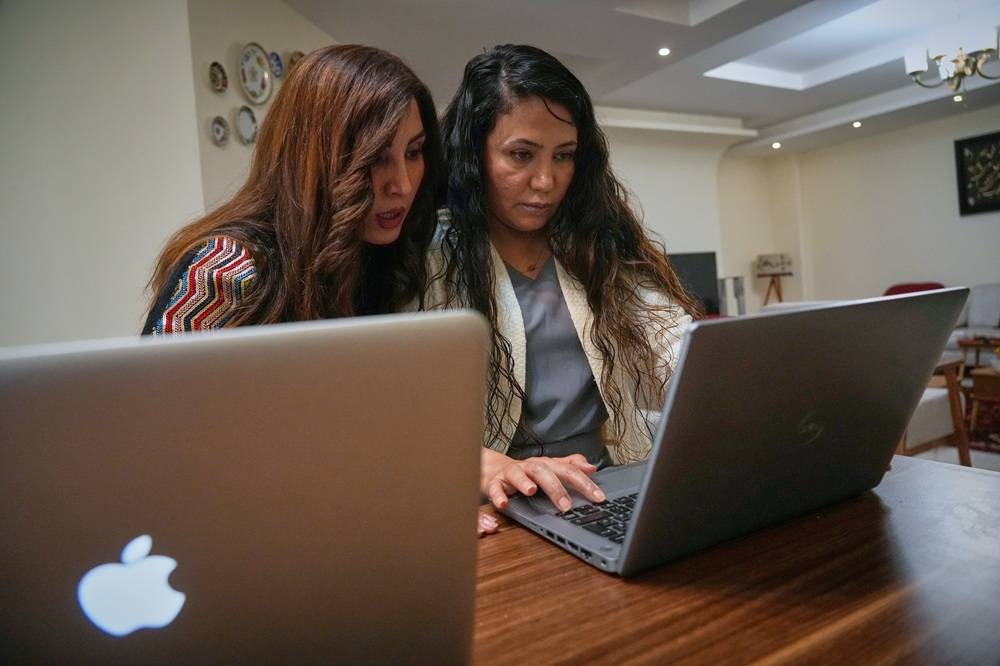
Fashion designer Amen Khademi works on her laptop with model Farnaz Ojaghloo, left, at her studio in Tehran, Iran, Thursday, April 23, 2026. (AP)
“What makes Iran’s shutdown unprecedented is the combination of scale and severity: an entire country of 90 million people with a developed digital economy deliberately reverted to a controlled national intranet,” said Alimardani, an associate director for technology threats and opportunities at the rights group Witness.
A flagship company of Iran’s digital economy, online retailer DigiKala, recently said it was laying off 200 people, about 3% of its workforce. The pain extends to “production, foreign trade and even traditional business,” Reza Olfatnasab, head of a national group representing digital businesses, said in comments published in Iranian media.
Khademi's shopfront is Instagram. But her studio’s page — with more than 30,000 followers — is now inactive. She was doing the photo shoot to save the pictures for later, hoping to find an alternative.
Her model, Farnaz Ojaghloo, is also a fitness coach. The shutdown has dried up both her modeling gigs and the online courses she ran for people inside Iran and abroad.
“Psychologically, it really hits hard,” Ojaghloo said. “All the plans you had for six months or a year ahead get pushed aside, and your only concern becomes surviving in the moment.”
The alternatives are ‘terrible’
For years, authorities in Iran have enforced filters and policed content on platforms like YouTube and Instagram. But before the war, Iranians could bypass restrictions with cheap virtual private networks, known as VPNs, and other easy workarounds.
Now, the shutdown has stoked high prices for black-market VPNs. Iranian state media routinely report arrests of people for using illegal VPNs or the American satellite system Starlink, which was banned last year.
Senior government officials are awarded “white” SIM cards granting them access to the global internet. Under pressure to alleviate the economic harm, the government is now allowing less-restricted internet access to a small number of professions, business and media.
An e-commerce trade group in Tehran condemned the tiered system in Iranian media on Wednesday, calling it “an abuse of an obvious need of every citizen.” It said the outage threatens “the destruction of the country’s infrastructure at the hands of our own decision-makers.”
The vast majority of people have no choice but Iran’s national net.
Two women use a smartphone in northern Tehran, Iran, Sept. 28, 2025. (AP)
A Tehran resident who works in advertising said sponsors have little interest in paying for content that can’t be posted on major platforms like Instagram, where he has tens of thousands of followers. He said his income is down to near zero since the war began.
A gamer in Isfahan — also with a large following on YouTube and Instagram — said Iran’s domestic net “is terrible” — slow, insecure and full of bugs. He too has lost almost all his income from sponsors and donations.
Iran has its own social media platforms modeled on services like WhatsApp and YouTube, but content is closely monitored and often censored.
“Nobody really wants to use these platforms, but there is no other option,” the gamer said. Both he and the advertising worker spoke on condition of anonymity out of security concerns.
A growing number of street vendors
The shutdown has piled new pressures on Iran’s once large and educated middle class, already struggling in the face of a prewar currency crash.
Economic decline in Iran has spurred waves of anti-government protests, most recently in December. Now, more Iranians are thinking of emigrating, a software developer said.
The developer — likewise speaking on condition of anonymity out of safety fears — said the internet shutdown has wiped out remote work. He lost his own job when his former company laid off almost all its employees in recent weeks, he said.
The consequences are visible in the rising numbers of street peddlers in Tehran. Reza Amiri, a 32-year-old former employee of an internet provider, now sells hats and umbrellas by a metro stop. He lost his job after the war started and has not received his last month’s salary, he said.
Monireh Pishgahi sells ornaments and accessories on the capital’s famed Vali Asr Street. She said her tailoring business used to supply three online shops. As business dried up, she shut down and laid off her five employees.
One downtown shopkeeper, Mohammad Rihai, said he had given up on trying to persuade street vendors to stop blocking the sidewalk outside his store. “After the war, you see them all along the sidewalk. I cannot fight them anymore.”
لم تشترك بعد
انشئ حساباً خاصاً بك لتحصل على أخبار مخصصة لك ولتتمتع بخاصية حفظ المقالات وتتلقى نشراتنا البريدية المتنوعة