


Israel Faces Mounting Outrage Over Gaza War 

Palestinian paramedics inspect damage in the patient rooms caused by the Israeli strikes on the maternity ward at Nasser Hospital in the town of Khan Younis, southern Gaza Strip, Sunday, Dec. 17, 2023. (AP)
TT

Israel Faces Mounting Outrage Over Gaza War 

Palestinian paramedics inspect damage in the patient rooms caused by the Israeli strikes on the maternity ward at Nasser Hospital in the town of Khan Younis, southern Gaza Strip, Sunday, Dec. 17, 2023. (AP)

Israel faced mounting international pressure Monday over the rising civilian death toll and destruction of hospitals in Gaza, as it pressed on with its war against Hamas militants in the besieged Palestinian territory.

The United Nations Security Council was set to vote Monday on a new resolution calling for an "urgent and sustainable cessation of hostilities" in Gaza.

The deadliest ever Gaza war began with unprecedented attacks by Hamas on October 7, when the group killed 1,139 people, mostly civilians, and abducted around 250, according to updated Israeli figures.

The health ministry in the Hamas-run territory says more than 18,800 people, mostly women and children, have been killed in Israel's campaign in Gaza. It said dozens were killed in Israeli strikes on Sunday.

Following months of fierce bombardment and fighting, most of Gaza's population has also been displaced and people are grappling with shortages of fuel, food, water and medicine.

Fewer than one-third of Gaza's hospitals are partly functioning, according to the UN, with the World Health Organization denouncing on Sunday the impact of Israeli operations on two hospitals in the north of the territory.

WHO chief Tedros Adhanom Ghebreyesus said the agency was "appalled by the effective destruction" of the Kamal Adwan hospital, where Israeli forces carried out a multi-day operation against Hamas.

Outside the hospital courtyard, which showed tank and bulldozer tracks, Abu Mohammed, who came to look for his son, stood crying.

"I don't know how I will find him," he said, pointing to the debris.

The Israeli army pulled out of the hospital on Sunday after an operation lasting several days, claiming it had been used as a command and control center by Hamas.

Israel said that before entering the hospital it had negotiated safe passage for the evacuation of most of the people inside.

The WHO also said Israeli bombing had reduced the emergency department at the Al-Shifa hospital to "a bloodbath".

The Hamas-run health ministry said an Israeli strike on Sunday hit Nasser Hospital in southern Gaza's main city of Khan Younis, killing one person and injuring seven others.

And the ministry said Israeli forces had stormed Al Awda hospital in northern Gaza on Sunday and detained medical staff following several days of siege and bombing.

Israeli Prime Minister Benjamin Netanyahu again vowed to "fight until the end" on Sunday, promising to achieve the aims of eliminating Hamas, freeing all hostages and ensuring that Gaza will never again become "a center for terrorism".

Near Gaza's northern border crossing at the Israeli city of Erez, the Israeli army said it had uncovered the biggest Hamas tunnel so far.

An AFP photographer reported that the tunnel was large enough for small vehicles to use.

Israel said the tunnel cost millions of dollars and took years to construct, featuring rails, electricity, drainage and a communications network.

The Israeli army said five soldiers were killed on Sunday, bringing the death toll to 126 in the Gaza Strip since ground operations began in late October.

Calls for truce

The Israeli government has come under growing pressure from the international community to pause the fighting and do more to protect civilians.

The United Nations estimates that 1.9 million Gazans -- around 80 percent -- have been displaced by the war.

"I would not be surprised if people start dying of hunger, or a combination of hunger, disease, weak immunity," said Philippe Lazzarini, head of the United Nations agency for Palestinian refugees.

Gazans have also faced repeated communications outages but on Sunday Gaza's main telecoms firm said mobile and internet service had been gradually restored.

French Foreign Minister Catherine Colonna was in Israel on Sunday, where she called for an "immediate and durable" truce.

France separately condemned an Israel bombardment that killed one of its foreign ministry officials in Gaza.

Qatar, which helped mediate a truce last month that saw 80 Israeli hostages exchanged for 240 jailed Palestinians, said there were "ongoing diplomatic efforts to renew the humanitarian pause".

But Hamas said on Telegram it was "against any negotiations for the exchange of prisoners until the aggression against our people ceases completely".

US Defense Secretary Lloyd Austin was in Kuwait on Monday as part of a regional trip that will include stops in Israel and Qatar, which brokered a previous ceasefire deal.

'Daily humiliation'

Israel is also facing calls from the families of hostages, to either slow, suspend or end the military campaign.

There are 129 hostages still in Gaza, Israel says, and relatives again rallied in Tel Aviv to call for a deal to bring them home after the army admitted to mistakenly killing three of the captives in Gaza.

One hostage already freed, German-Israeli Raz Ben-Ami, 57, spoke of the "daily humiliation, mental, physical", she endured, including having one meal a day and no access to proper toilets.

The conflict in Gaza has also seen violence spiral in the Israeli-occupied West Bank.

The Palestinian health ministry said Israeli forces killed five Palestinians on Sunday morning at a West Bank refugee camp.

Israel's army said air strikes had targeted militants who had endangered soldiers.

Health officials say more than 290 Palestinians have been killed by Israeli forces or settlers in the West Bank since the war erupted.

Syria strikes

Fears continued to grow that the conflict in Gaza could engulf the wider region.

Israel carried out air strikes near Damascus on Sunday, wounding two Syrian soldiers, the Syrian defense ministry said.

Israeli forces and Iran-backed Hezbollah militants are exchanging regular fire across Israel's northern border with Lebanon.

Yemen's Iran-backed Houthi militias, saying they want to pressure Israel, have launched attacks on passing vessels in the vital Red Sea shipping zone, forcing major companies to redirect vessels.

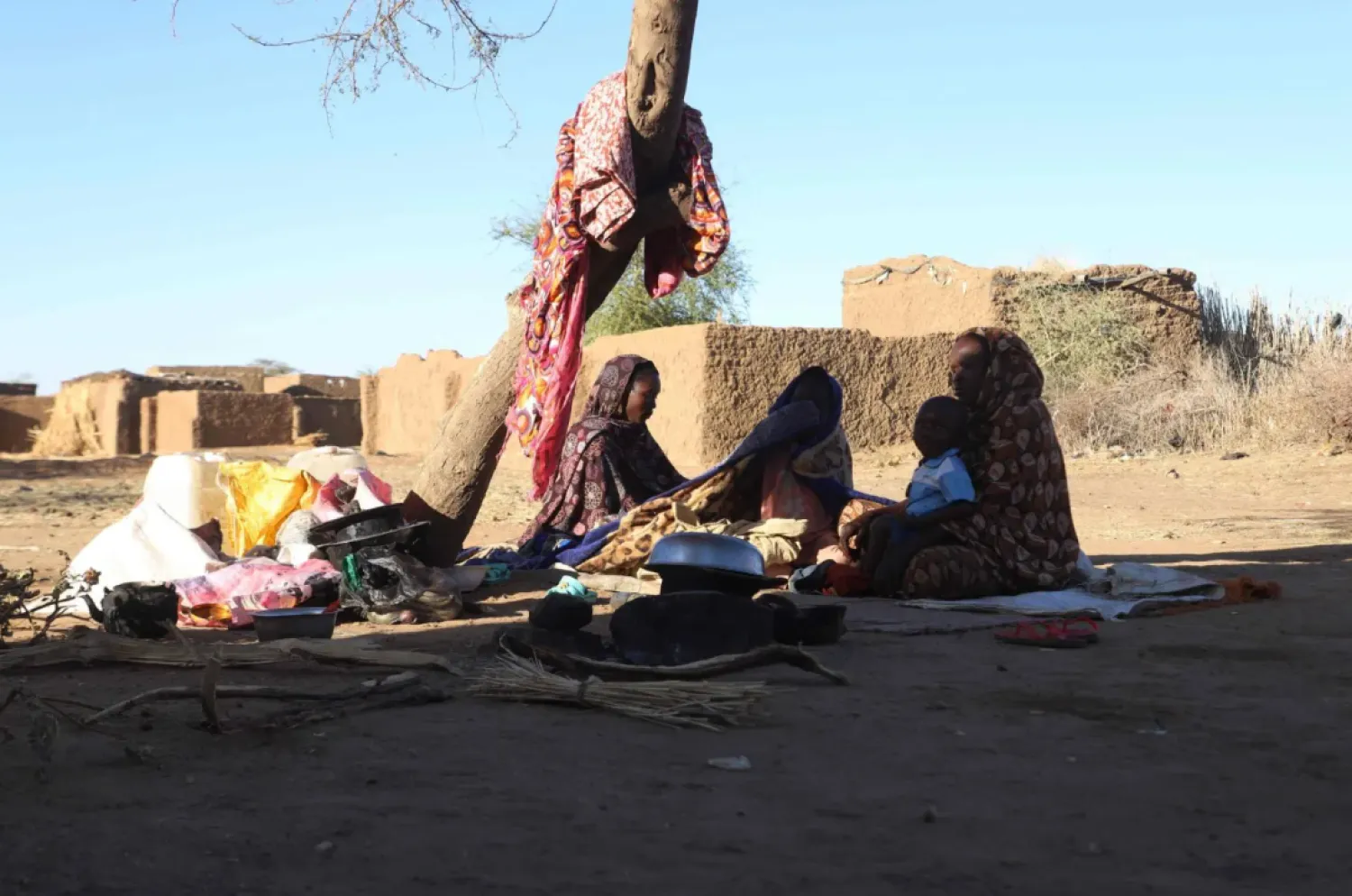


Arab League Condemns Attack on Aid Convoys in Sudan

A general view shows the opening session of the meeting of Arab foreign ministers at the Arab League Headquarters (Reuters)
TT

Arab League Condemns Attack on Aid Convoys in Sudan

A general view shows the opening session of the meeting of Arab foreign ministers at the Arab League Headquarters (Reuters)

Arab League Secretary-General Ahmed Aboul Gheit strongly condemned the attack by the Rapid Support Forces on humanitarian aid convoys and relief workers in North Kordofan State, Sudan.

In a statement reported by SPA, secretary-general's spokesperson Jamal Rushdi quoted Aboul Gheit as saying the attack constitutes a war crime under international humanitarian law, which prohibits the deliberate targeting of civilians and depriving them of their means of survival.

Aboul Gheit stressed the need to hold those responsible accountable, end impunity, and ensure the full protection of civilians, humanitarian workers, and relief facilities in Sudan.


Gaza's Rafah Crossing Reopens, Allowing Limited Travel as Palestinians Claim Delays, Mistreatment

Ayada Al-Sheikh is welcomed by his sister, Nisreen, upon his arrival in Khan Younis in the southern Gaza Strip after returning to Gaza following the long-awaited reopening of the Rafah border crossing, early Thursday, Feb. 5, 2026. (AP Photo/Abdel Kareem Hana)
TT

Gaza's Rafah Crossing Reopens, Allowing Limited Travel as Palestinians Claim Delays, Mistreatment

Ayada Al-Sheikh is welcomed by his sister, Nisreen, upon his arrival in Khan Younis in the southern Gaza Strip after returning to Gaza following the long-awaited reopening of the Rafah border crossing, early Thursday, Feb. 5, 2026. (AP Photo/Abdel Kareem Hana)

A limited number of Palestinians were able to travel between Gaza and Egypt on Sunday, after Gaza's Rafah crossing reopened after a two-day closure, Egyptian state media reported.

The vital border point opened last week for the first time since 2024, one of the main requirements for the US-backed ceasefire. The crossing was closed Friday and Saturday because of confusion about reopening operations.

Egypt's Al Qahera television station said that Palestinians began crossing in both directions around noon on Sunday. Israel didn't immediately confirm the information, according to The AP news.

Meanwhile, Israeli Prime Minister Benjamin Netanyahu is expected to travel to Washington this week, though the major subject of discussion will be Iran, his office said.

Over the first four days of the crossing's opening, just 36 Palestinians requiring medical care were allowed to leave for Egypt, plus 62 companions, according to UN data, after Israel retrieved the body of the last hostage held in Gaza and several American officials visited Israel to press for the opening.

Palestinian officials say nearly 20,000 people in Gaza are seeking to leave for medical care that isn't available in the territory. Those who have succeeded in crossing described delays and allegations of mistreatment by Israeli forces and other groups involved in the crossing, including an Israeli-backed Palestinian armed group, Abu Shabab.

A group of Palestinian patients and wounded gathered Sunday morning in the courtyard of a Red Crescent hospital in Gaza’s southern city of Khan Younis, before making their way to the Rafah crossing with Egypt for treatment abroad, family members told The Associated Press.

Amjad Abu Jedian, who was injured in the war, was scheduled to leave Gaza for medical treatment on the first day of the crossing’s reopening, but only five patients were allowed to travel that day, his mother, Raja Abu Jedian, said. Abu Jedian was shot by an Israeli sniper while he doing building work in the central Bureij refugee camp in July 2024, she said.

On Saturday, his family received a call from the World Health Organization notifying them that he is included in the group that will travel on Sunday, she said.

“We want them to take care of the patients (during their evacuation),” she said. “We want the Israeli military not to burden them.”

The Israeli defense branch that oversees the operation of the crossing didn't immediately confirm the opening.

Heading back to Gaza A group of Palestinians also arrived Sunday morning at the Egyptian side of the Rafah crossing to return to the Gaza Strip, Egypt’s state-run Al-Qahera News satellite television reported.

Palestinians who returned to Gaza in the first few days of the crossing's operation described hours of delays and invasive searches by Israeli authorities and Abu Shabab. A European Union mission and Palestinian officials run the border crossing, and Israel has its screening facility some distance away.

The crossing was reopened on Feb. 2 as part of a fragile ceasefire deal to halt the Israel-Hamas war.

The Rafah crossing, an essential lifeline for Palestinians in Gaza, was the only one in the Palestinian territory not controlled by Israel before the war. Israel seized the Palestinian side of Rafah in May 2024, though traffic through the crossing was heavily restricted even before that.

Restrictions negotiated by Israeli, Egyptian, Palestinian and international officials meant that only 50 people would be allowed to return to Gaza each day and 50 medical patients — along with two companions for each — would be allowed to leave, but far fewer people have so far crossed in both directions.

A senior Hamas official, Khaled Mashaal, said the militant group is open to discuss the future of its arms as part of a “balanced approach” that includes the reconstruction of Gaza and protecting the Palestinian enclave from Israel.

Mashaal said the group has offered multiple options, including a long-term truce, as part of its ongoing negotiations with Egyptian, Qatari and Turkish mediators.

Hamas plans to agree to a number of “guarantees,” including a 10-year period of disarmament and an international peacekeeping force on the borders, “to maintain peace and prevent any clashes,” between the militants and Israel, Mashaal said at a forum in Qatar’s capital, Doha.

Israel has repeatedly demanded a complete disarmament and destruction of Hamas and its infrastructure, both military and civil.

Mashaal accused Israel of financing and arming militias, like the Abu Shabab group which operates in Israeli military-controlled areas in Gaza, “to create chaos” in the enclave.

In the forum, Mashaal was asked about Hamas’ position from US President Donald Trump’s Board of Peace. He didn’t offer a specific answer, but said that the group won’t accept “foreign intervention” in Palestinian affairs.

“Gaza is for the people of Gaza. Palestinians are for the people of Palestine,” he said. “We will not accept foreign rule.”


Three Deadly Attacks on Health Centers in Sudan's South Kordofan in Past Week, Says WHO

Sudanese families prepare to ride on trucks while on their way to Egypt through the Qustul border, after the crisis in Sudan's capital Khartoum, in the Sudanese city of Wadi Halfa, Sudan May 1, 2023. (Reuters)
TT

Three Deadly Attacks on Health Centers in Sudan's South Kordofan in Past Week, Says WHO

Sudanese families prepare to ride on trucks while on their way to Egypt through the Qustul border, after the crisis in Sudan's capital Khartoum, in the Sudanese city of Wadi Halfa, Sudan May 1, 2023. (Reuters)

Sudan's South Kordofan region has seen attacks on three health facilities in the past week alone, leaving more than 30 dead, the World Health Organization said Sunday, AFP reported.

"Sudan's health system is under attack again," WHO chief Tedros Adhanom Ghebreyesus said on X, pointing out that, since February 3, "three health facilities were attacked in South Kordofan, in a region already suffering acute malnutrition".