


North Korea’s Kim Threatens ‘More Offensive Actions’ Against US After Watching Powerful Missile Test 

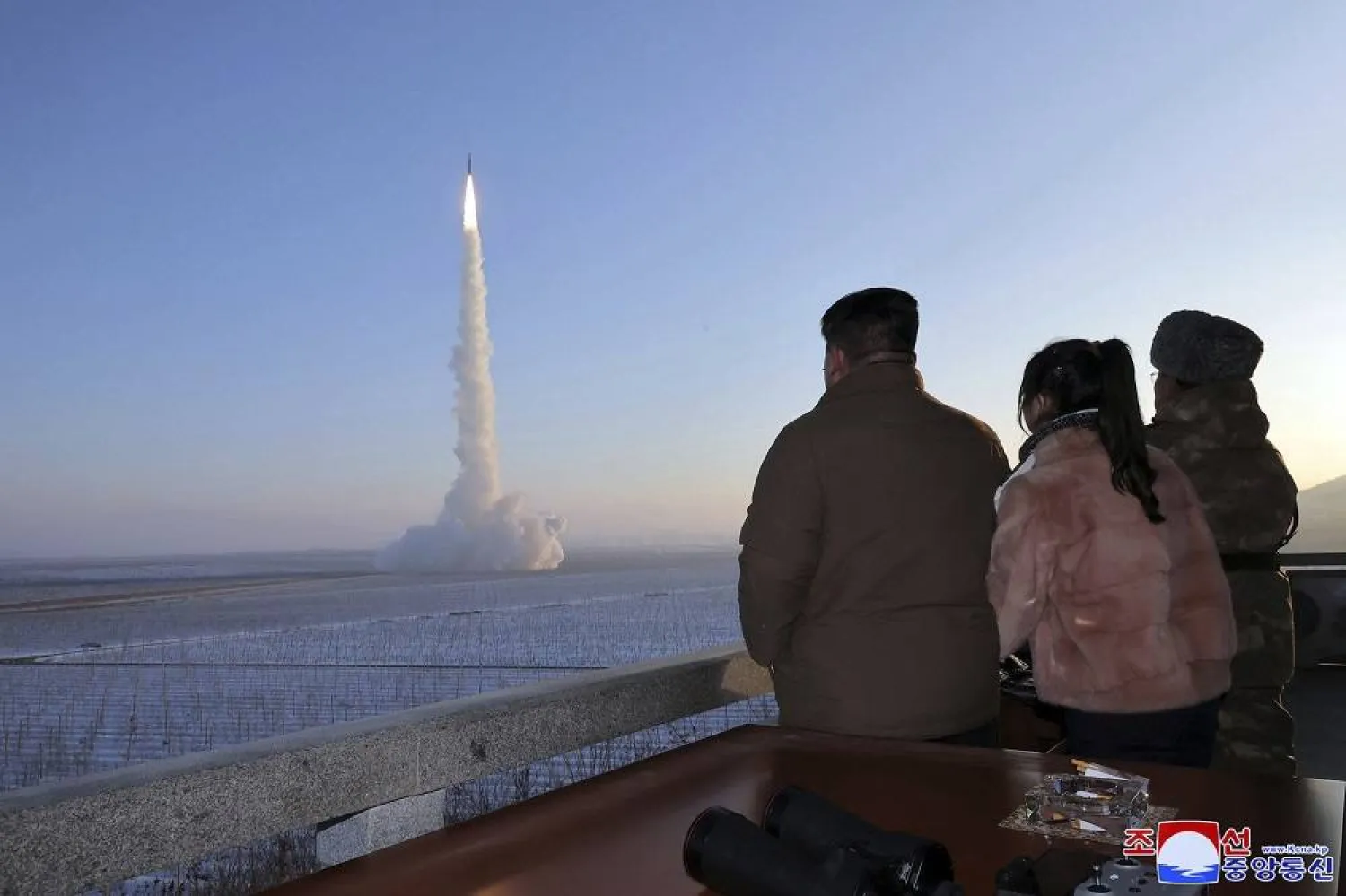
In this undated photo provided Monday, Dec. 18, 2023, by the North Korean government, North Korean leader Kim Jong Un, his daughter and an official watch what it says is an intercontinental ballistic missile launching from an undisclosed location in North Korea. (Korean Central News Agency/Korea News Service via AP)
TT

North Korea’s Kim Threatens ‘More Offensive Actions’ Against US After Watching Powerful Missile Test 

In this undated photo provided Monday, Dec. 18, 2023, by the North Korean government, North Korean leader Kim Jong Un, his daughter and an official watch what it says is an intercontinental ballistic missile launching from an undisclosed location in North Korea. (Korean Central News Agency/Korea News Service via AP)

North Korean leader Kim Jong Un threatened “more offensive actions” to repel what he called increasing United States-led military threats after he supervised the third test of his country’s most advanced missile designed to strike the mainland US, state media reported Tuesday.

Kim’s statement suggests he is confident in his growing missile arsenal and will likely continue weapons testing activities ahead of the 2024 US presidential election. But many observers say North Korea still needs to perform more significant tests to prove it has functioning missiles targeting the US mainland.

After watching Monday’s launch of the Hwasong-18 intercontinental ballistic missile, Kim said the test showed how North Korea could respond if the United States were to make “a wrong decision against it,” according to the official Korean Central News Agency.

Kim stressed the need to “never overlook all the reckless and irresponsible military threats of the enemies ... and to strongly counter them with more offensive actions,” KCNA said.

The Hwasong-18 ICBM is a developmental, solid-fueled ICBM that is considered North Korea’s most powerful weapon. Its built-in solid propellant makes launches harder for outsiders to detect than liquid-fueled missiles, which must be fueled before liftoffs. But many foreign experts say North Korea still has some other technological hurdles to master to acquire reliable nuclear-tipped ICBMs, such as one to protect warheads from the harsh conditions of atmospheric reentry.

KCNA said the Hwasong-18 missile — launched at a high angle to avoid neighboring countries — flew a distance of 1,002 kilometers (622 miles) for 73.5 minutes at a maximum altitude of 6,518 kilometers (4,050 miles) before landing in an area off the North’s east coast. It said Kim expressed “great satisfaction” with the launch, which verified again the reliability of “the most powerful strategic core striking means” of North Korea.

It was the North’s third test of the Hwasong-18 missile. Its two previous launches were in April and July.

“Based on their statement, this looks to have been an exercise in signaling and a developmental test in one,” said Ankit Panda, an expert with the Carnegie Endowment for International Peace. “There’s nothing new here technically as far as I can tell at this early stage, but they’re certainly growing increasingly confident in their new solid propellant ICBM.”

Leif-Eric Easley, a professor at Ewha University in Seoul, said the North’s latest ICBM test is another indicator of how far its missile engine technology has progressed, but added there are limits to what North Korea can learn from lofted trajectory firings.

“Demonstrating warhead targeting and reentry capabilities would involve provocative launches across greater distances,” Easley said. “So more significant tests of both technology and diplomacy are likely in the New Year.”

KCNA said that a recent US-South Korean meeting to discuss their nuclear deterrence plan openly revealed their intention to hold joint drills with a simulated nuclear attack on North Korea.

It referred to the second Nuclear Consultative Group meeting between senior US and South Korean officials Friday. During their meeting in Washington, the two countries agreed to update their nuclear deterrence and contingency strategies and incorporate nuclear operation scenarios in their combined military exercises in the summer, according to officials in Seoul.

South Korean President Yoon Suk Yeol said during a Cabinet Council meeting Tuesday that a “nuclear-based, powerful Korea-US alliance” would be formed soon.

The nuclear consultative body is responsible for sharing information on nuclear and strategic weapons operation plans and joint operations, though the US will retain operational control of its nuclear weapons. The group’s establishment was part of US efforts to ease South Korean worries about North Korean provocations while keeping Seoul from pursuing its own nuclear program.

Since 2022, North Korea has performed more than 100 ballistic missile tests in violation of the United Nations' bans in what outside experts call an effort to upgrade its nuclear arsenal and win greater US concessions. The North has still avoided fresh international sanctions as China and Russia blocked the US and others' efforts to toughen UN sanctions on the country.

The United States and South Korea have expanded their military training and increased the temporary deployments of powerful US military assets in South Korea.

On Tuesday, South Korea, the US and Japan began putting into operation the sharing of real-time missile warning data on North Korea and established details of their trilateral exercises in coming years, South Korea's Defense Ministry said in a statement. It added the three countries will beef up their three-way cooperation to cope with regional challenges and promote peace in the region.

North Korea has viewed growing US-South Korea-Japan partnerships as a security threat and sought to boost its own ties with China and Russia in response. North Korea recently faced outside suspicions that it receives sophisticated weapons technologies from Russia in return for supplying conventional arms to support Russia’s war in Ukraine.

“The allies’ justified actions of cooperation and information-sharing will remain the Kim regime’s primary reason to concentrate greater resources and energy into its weapons program,” said Soo Kim, an expert with Virginia-based consultancy LMI and a former CIA analyst.

“Kim (Jong Un) is clear-eyed in the regional split between the US-allied countries and the North Korea-Russia-China trilateral relationship,” she said. “So while Kim continues to raise issues with the US-Japan-Korea trilateral, he sees the utility in forming alliances and gravitates toward Beijing and Moscow to serve as a thorn in our side and to protect his own security and interests.”



Türkiye’s Erdogan Distances Govt from Main Opposition Crisis, Warns Against Unrest

30 October 2025, Türkiye, Ankara: Recep Tayyip Erdogan, President of Türkiye, speaks at the press conference with German Chancellor Friedrich Merz after talks at the presidential palace. (dpa)
TT

Türkiye’s Erdogan Distances Govt from Main Opposition Crisis, Warns Against Unrest

30 October 2025, Türkiye, Ankara: Recep Tayyip Erdogan, President of Türkiye, speaks at the press conference with German Chancellor Friedrich Merz after talks at the presidential palace. (dpa)

President Recep Tayyip Erdogan said on Monday that the government would not be drawn into disputes within Türkiye's main opposition CHP and would not allow unrest on the streets, in ‌his first ‌public comments ‌since ⁠a court ruling last ⁠month annulled the party's 2023 congress and removed its leadership.

The court ruling effectively reinstated former CHP ⁠chairman Kemal Kilicdaroglu, a divisive ‌figure ‌within the party who ‌lost a presidential election ‌to Erdogan in 2023.

Speaking after a cabinet meeting in Ankara, Erdogan said ‌the government had no part in a ⁠political ⁠and legal struggle that had "spilled from party congress halls into court corridors" and would not allow "the streets to be thrown into turmoil" or the public to be pitted against security forces.


Mandelson Documents Cast Light on Government Work, Appointment of US Ambassador

Former UK ambassador to the United States, Peter Mandelson, is pictured as he walks his dog near his residence in central London on April 20, 2026. (AFP)
TT

Mandelson Documents Cast Light on Government Work, Appointment of US Ambassador

Former UK ambassador to the United States, Peter Mandelson, is pictured as he walks his dog near his residence in central London on April 20, 2026. (AFP)

Britain's government released reams of documents on Monday relating to the appointment of Peter Mandelson as ambassador to the United States, offering a glimpse into the often acerbic world of Westminster and his messy clearance for the job.

The Mandelson saga, which forced the departure of Prime Minister Keir Starmer's closest aide, has become a focus for criticism of Britain's prime minister, who is fighting for his political survival against a probable leadership challenge.

In a 1,504-page document, the government released messages — ranging from vetting emails to personal WhatsApps — in a data dump it hopes will take some of the focus off Starmer and show that ‌Mandelson was ‌less than frank over his ties to the late convicted sex ‌offender ⁠Jeffrey Epstein.

MANDELSON: 'YOU WILL ⁠NEVER REGRET' THE APPOINTMENT

In one document, the government said it had written to Mandelson on March 31 to request any information held on his personal phone as part of an investigation into his appointment and work - something he had declined to hand over.

Private messages from Mandelson - who was twice sacked from cabinet under Labour's longest-serving prime minister, Tony Blair - show him regularly chatting to Labour insiders, pressing his case and sometimes exchanging criticisms of ⁠the government.

In a handwritten note to then-foreign minister David Lammy on ‌November 18, 2024, Mandelson writes: "I just wanted you ‌to know that if you were minded to appoint me (as ambassador), I would make sure you ‌never regret it."

He also said he went "tonto" over the government's failure to immediately approve ‌a personalized red ministerial box as a gift to US President Donald Trump, using a slang term for going crazy.

He also took a swipe at Starmer, telling senior minister Pat McFadden he believed "Keir is not leading from the front".

In the same exchange, McFadden told Mandelson the government was "asking ‌the wrong questions", saying that every meeting was about "who can we tax in order to pay benefits to others".

The government ⁠hopes the release ⁠of the documents and his messages will put an end to questions surrounding Starmer's judgment in appointing a man whose friendship with Epstein was known. But they are unlikely to silence calls for the prime minister to stand down after Labour lost in local elections last month.

Mandelson is under police investigation for allegedly leaking government documents to the late Epstein. He does not face allegations of sexual misconduct.

An initial tranche of documents was released in March, which showed Starmer was warned of the risks of the appointment, not just over Mandelson's ties to Epstein but also because of the Labour veteran's support for closer ties with China.

Starmer now faces a possible leadership challenge later this year, if his main rival, Greater Manchester mayor Andy Burnham, wins a seat in parliament in an election on June 18.


‘We Need to Act Now’: Race to Develop Ebola Vaccine Heats Up

Health workers receive boxes of tents at the Evangelical Medical Center, one of the facilities at the forefront of the response to the Ebola outbreak, as agencies intensify efforts to contain a new Ebola outbreak caused by the Bundibugyo virus strain, in Bunia, Ituri province, Democratic Republic of Congo, May 31, 2026. (Reuters)
TT

‘We Need to Act Now’: Race to Develop Ebola Vaccine Heats Up

Health workers receive boxes of tents at the Evangelical Medical Center, one of the facilities at the forefront of the response to the Ebola outbreak, as agencies intensify efforts to contain a new Ebola outbreak caused by the Bundibugyo virus strain, in Bunia, Ituri province, Democratic Republic of Congo, May 31, 2026. (Reuters)

Several non-profit organizations announced Monday they are ramping up efforts to rapidly develop a vaccine for the rare strain of Ebola driving a deadly outbreak in the Democratic Republic of Congo.

Nearly 250 people are suspected to have died and more than 1,100 infected with the strain in the DRC and neighboring Uganda, though the true spread of the virus is feared to be much wider.

While it marks the 17th Ebola outbreak in the DRC, it is just the third caused by the Bundibugyo strain, for which there are no approved vaccines or treatments.

The escalating nature of the outbreak has sparked a race to find a vaccine that can be quickly developed, manufactured then tested in humans during clinical trials in the affected region.

The World Health Organization said on Saturday that its experts had determined "the most promising candidate vaccine" was a single-dose shot using the rVSV platform.

The only licensed Ebola vaccine, which targets the more common Zaire strain, uses the same platform.

The non-profit International AIDS Vaccine Initiative (IAVI) announced Monday it had reached a deal with the University of Texas Medical Branch to develop the rVSV candidate.

The university's Thomas Geisbert led work on both the Bundibugyo candidate and the licensed Zaire jab.

Geisbert told AFP last month that 2013 research demonstrated his jab provided very strong protection against Bundibugyo in monkeys.

However the vaccine "just sat there" for more than a decade because of a lack of interest, in particular from pharmaceutical firms, the virologist added.

The WHO estimated it would take seven to nine months before the rVSV vaccine is ready to be tested in humans.

- 'Fast-track' -

Also on Monday, the Coalition for Epidemic Preparedness Innovations (CEPI) announced funding to "fast-track" development of three Bundibugyo vaccine candidates, including $3.2 million towards the rVSV jab.

WHO chief Tedros Adhanom Ghebreyesus, who visited the epicenter of the outbreak in the DRC on the weekend, said in a statement the funding was "an important step forward".

Another vaccine candidate receiving CEPI funding was developed on the University of Oxford's ChAdOx1 platform, which also underpinned AstraZeneca's Covid vaccine.

This viral vector jab -- which will be manufactured by the huge Serum Institute of India -- could become available for clinical trials within two to three months, the WHO said.

CEPI also said it had committed $50 million to a vaccine candidate being developed by US pharma giant Moderna which uses the mRNA technology pioneered in its Covid vaccine.

In a preprint paper published online last week, researchers at France's INSERM institute called for trials to see if the licensed Zaire vaccine could also help fight Bundibugyo.

- $50 million pledge -

Also on Monday, the Gavi vaccine alliance announced it would make up to $50 million available for Bundibugyo vaccine efforts.

"We need to act now to ensure that, once one or more vaccine candidates are ready, manufacturers are in a position to start producing doses at scale," Gavi CEO Sania Nishtar said in a statement.

IAVI president Mark Feinberg told a press conference on Monday that Gavi's new commitment could fund the production of roughly 500,000 doses.

It also provided a "signal to manufacturers they can make this investment and not carry excessive risk," he added.

Even once doses for a trial are ready, there will be challenges in deploying them in a vast, remote area of the DRC that is already suffering crises including hunger, malaria and conflict.

Gaining the trust of communities where vaccines will be trialed will be crucial, the WHO emphasized.

And once a trial is finally carried out, there is no guarantee it will demonstrate the vaccine works.

"We have reasons to believe that we can generate effective vaccines, but we don't want to downplay at all that we have to treat them as investigational products," CEPI CEO Richard Hatchett said last week.

There are also several efforts to quickly trial several Bundibugyo treatments, including antivirals called remdesivir and obeldesivir, and the monoclonal antibody MBP134.