


Iraq Elections: Halbousi Surprises Maliki in Baghdad, Coordination Framework Sweeps South

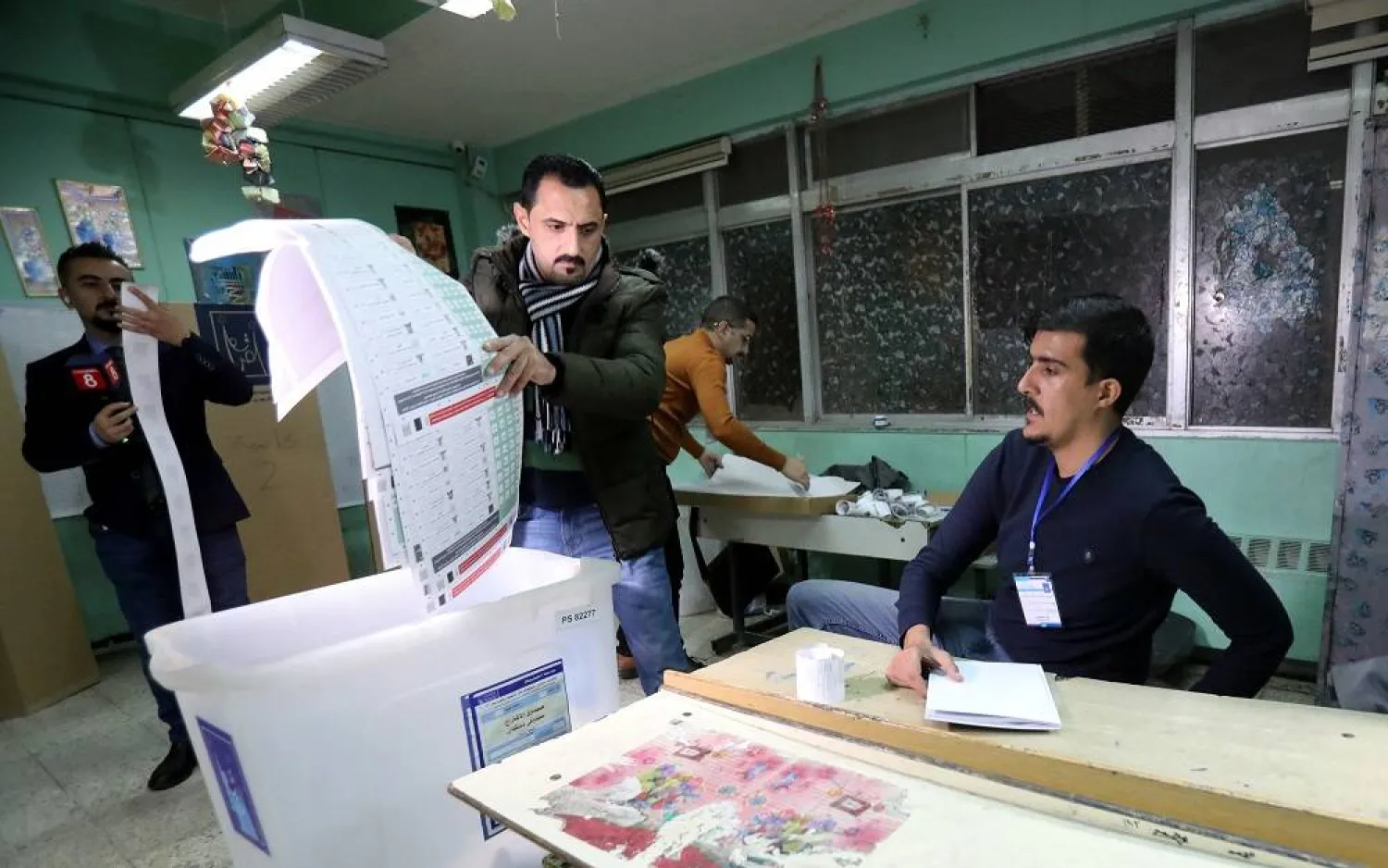
Election committee staff members count the votes at the end of the provincial election day at a polling station in Karada district, Baghdad, Iraq, 18 December 2023. (EPA)
TT

Iraq Elections: Halbousi Surprises Maliki in Baghdad, Coordination Framework Sweeps South

Election committee staff members count the votes at the end of the provincial election day at a polling station in Karada district, Baghdad, Iraq, 18 December 2023. (EPA)

Iraq announced on Tuesday the results of the provincial council elections after counting 90 percent of the ballots.

The Taqadum party of ousted parliament Speaker Mohammed al-Halbousi won the most votes in the capital Baghdad. The State of Law coalition of former Prime Minister Nouri al-Maliki came second.

Some 6 million Iraqis out of 23 million eligible voters took part in the elections.

Voter apathy has increased among a mostly young population that feels it has not seen the benefits of Iraq's massive oil wealth, much of which is misdirected or stolen in a country ranked among the world's most corrupt.

The provincial elections are seen as an indicator of the balance of power in a country where groups close to neighboring Iran have steadily gained influence, and come ahead of 2025 parliamentary polls.

The results from the Independent High Electoral Commission showed that Halbousi’s party won over 132,000 votes in Baghdad, while Maliki’s coalition won around 130,000.

Halbousi’s politically symbolic win may have surprised the Shiite pro-Iran Coordination Framework, which dominated the elections given a boycott by their rival, influential cleric Moqtada al-Sadr.

Halbousi also came first in the al-Anbar province, winning 154,000 votes, Diyala province with some 75,000 votes, Salaheddine with over 48,000 votes and Ninenveh with some 71,000 votes.

Elsewhere, lists backed by the Coordination Framework were leading in most provinces.

They include a list led by Hadi Al-Amiri's Badr Organization that began as a Shiite paramilitary group, and other Iran-backed factions; and a list including cleric Ammar al-Hakim and former prime minister Haidar al-Abadi.

The Coordination Framework swept strongholds of Sadr, as well as backers of the 2019 Tishreen anti-government protest movement, including Dhi Qar and Misan provinces.

A notable exception came in the southern oil-producing province of Basra, where the Tasmim party of popular governor Asaad al-Edani won with a landslide of more than 250,000 votes - more than all of the Coordination Framework-backed lists put together.

In the northern oil-rich city of Kirkuk, the Patriotic Union of Kurdistan, a Kurdish party allied with the Coordination Framework, took the most votes, followed by a Sunni Arab list and a Turkmen list.

In the northern province of Mosul, a Sunni Arab list supported by the former governor, Najim al-Jabouri, garnered the most votes, followed by the Kurdistan Democratic Party (KDP).

Voting took place on Monday in 15 of Iraq's 18 provinces to select 285 council members who appoint powerful provincial governors and oversee local administration.



Syria to Start Currency Swap on January 1st, Central Bank Governor Says

Syrian pounds are pictured inside an exchange currency shop in Azaz, Syria February 3, 2020. Picture taken February 3, 2020. REUTERS/Khalil Ashawi/File Photo
TT

Syria to Start Currency Swap on January 1st, Central Bank Governor Says

Syrian pounds are pictured inside an exchange currency shop in Azaz, Syria February 3, 2020. Picture taken February 3, 2020. REUTERS/Khalil Ashawi/File Photo

Syria will start swapping old banknotes for new ones under a ​plan to replace Assad-era notes starting from January 1, 2026, Central Bank Governor Abdelkader Husrieh said on Thursday.

Husrieh announced the introduction of the new Syrian currency, saying the decree "sets January ‌1, 2026, ‌as the start date ‌for ⁠the ​exchange ‌process". Sources familiar with the matter told Reuters in August that the country will issue new banknotes, removing two zeros from its currency in an attempt to restore ⁠public confidence in the severely devalued pound.

The ‌step is intended ‍to strengthen ‍the Syrian pound after its purchasing ‍power collapsed to record lows following a 14-year conflict that ended with President Bashar al-Assad's ouster in December.

Husrieh ​said the operation will take place through a smooth and orderly ⁠swap - a move bankers hope will ease fears that the new currency could fuel inflation and further erode the purchasing power of Syrians already reeling from high prices.

He added that a press conference will soon outline the exact regulations and mechanisms.


Türkiye Begins Black Box Analysis of Jet Crash That Killed Libyan Military Chief and 7 Others

Libyan national flags fly at half-mast in Tripoli on December 24, 2025, after the head of Libya's armed forces and his four aides died in a plane crash in Türkiye. (AFP)
TT

Türkiye Begins Black Box Analysis of Jet Crash That Killed Libyan Military Chief and 7 Others

Libyan national flags fly at half-mast in Tripoli on December 24, 2025, after the head of Libya's armed forces and his four aides died in a plane crash in Türkiye. (AFP)

The technical analysis of the recovered black boxes from a jet crash that killed eight people, including western Libya’s military chief, began as the investigation proceeded in cooperation with Libyan authorities, the Turkish Ministry of Defense said Thursday.

The private jet with Gen. Muhammad Ali Ahmad al-Haddad, four other military officials and three crew members crashed on Tuesday after taking off from Türkiye’s capital, Ankara, killing everyone on board. Libyan officials said the cause of the crash was a technical malfunction on the plane.

The high-level Libyan delegation was on its way back to Tripoli after holding defense talks in Ankara aimed at boosting military cooperation between the two countries.

The wreckage was scattered across an area covering 3 square kilometers (more than a square mile), complicating recovery efforts, according to the Turkish Interior Minister Ali Yerlikaya.

A 22-person delegation, including five family members, arrived from Libya early on Wednesday to assist in the investigation.


Lebanese President: We are Determined to Hold Parliamentary Elections on Time

President Joseph Aoun between Prime Minister Nawaf Salam and Speaker Nabih Berri (Lebanese Presidency file photo)
TT

Lebanese President: We are Determined to Hold Parliamentary Elections on Time

President Joseph Aoun between Prime Minister Nawaf Salam and Speaker Nabih Berri (Lebanese Presidency file photo)

Lebanese President Joseph Aoun reiterated on Thursday that the country’s parliamentary elections are a constitutional obligation that must be carried out on time.

Lebanon’s state-run National News Agency quoted Aoun as saying that he, alongside Prime Minister Nawaf Salam and Parliament Speaker Nabih Berri, is determined to hold the elections on schedule.

Aoun also emphasized that diplomatic efforts have continued unabated to keep the specter of war at bay, noting that "things are heading in a positive direction".

The agency also cited Berri reaffirming that the elections will take place as planned, with "no delays, no extensions".

The Lebanese parliamentary elections are scheduled for May next year.