


UN Approves Watered-Down Resolution on Aid to Gaza without Call for Suspension of Hostilities

Members of the United Nations Security Council from the United States and Russia raise their hand to vote to abstain in regards to the amendment proposed by United Arab Emirates during a Security Council vote on two resolutions regarding the Israel-Hamas conflict in New York, New York, USA, 22 December 2023. (EPA)
TT

UN Approves Watered-Down Resolution on Aid to Gaza without Call for Suspension of Hostilities

Members of the United Nations Security Council from the United States and Russia raise their hand to vote to abstain in regards to the amendment proposed by United Arab Emirates during a Security Council vote on two resolutions regarding the Israel-Hamas conflict in New York, New York, USA, 22 December 2023. (EPA)

The UN Security Council adopted a watered-down resolution Friday calling for immediate speeded-up aid deliveries to hungry and desperate civilians in Gaza – but without the original call for an “urgent suspension of hostilities” between Israel and Hamas.

The long-delayed vote in the 15-member council was 13-0 with the United States and Russia abstaining. The vote came immediately after the United States vetoed a Russian amendment that would have restored the call to immediately suspend hostilities. That vote was 10 countries in favor, the US against and four abstentions.

The final-vote US abstention avoided a second American veto of a Gaza resolution following Hamas’ surprise Oct. 7 attacks inside Israel. A relieved US Ambassador Linda Thomas-Greenfield told the council after the resolution’s adoption: “This was tough, but we got there.”

She said the vote bolsters efforts “to alleviate this humanitarian crisis to get lifesaving assistance into Gaza and to get hostages out of Gaza, to push for the protection of innocent civilians and humanitarian workers and to work towards a lasting peace.”

But Russia’s UN Ambassador Vassily Nebenzia called the resolution “entirely toothless” and accused the United States of “shameful, cynical and irresponsible conduct” and resorting to tactics “of gross pressure, blackmail and twisting arms” to avoid a US veto.

In proposing the amendment to restore call for suspending hostilities, the Russian said that adopting the revised resolution “would essentially be giving the Israeli armed forces complete freedom of movement for the clearing of the Gaza Strip.”

The final resolution, with some late changes Friday morning, culminated a week and a half of high-level diplomacy by the United States, the United Arab Emirates on behalf of Arab nations and others.

Between Tuesday and Thursday, US Secretary of State Antony Blinken spoke to the foreign ministers of Egypt and the United Arab Emirates three times each as well as to the foreign ministers of Saudi Arabia, Jordan, Britain, France and Germany.

The vote, initially scheduled for Monday, was delayed every day until Friday.

Rather than watered down, Thomas-Greenfield described the resolution as “strong” and said it “is fully supported by the Arab group that provides them what they feel is needed to get humanitarian assistance on the ground.”

But it was stripped of its key provision with teeth — the call for “the urgent suspension of hostilities to allow safe and unhindered humanitarian access, and for urgent steps towards a sustainable cessation of hostilities” which Russia sought to restore.

Instead, the resolution calls “for urgent steps to immediately allow safe, unhindered and expanded humanitarian access, and also for creating the conditions for a sustainable cessation of hostilities.” The steps are not defined, but diplomats said its adoption marks the council’s first reference to stopping fighting.

On a key sticking point concerning aid deliveries, the resolution eliminated a previous request for the UN “to exclusively monitor all humanitarian relief consignments to Gaza provided through land, sea and air routes” by outside parties to confirm their humanitarian nature.

It substituted a request to UN Secretary-General Antonio Guterres to expeditiously appoint “a senior humanitarian and reconstruction coordinator with responsibility for facilitating, coordinating, monitoring and verifying” whether relief deliveries to Gaza that are not from the parties to the conflict are humanitarian goods.

It asks the coordinator to expeditiously establish a “mechanism” to speed aid deliveries and demands that the parties to the conflict — Israel and Hamas — cooperate with the coordinator.

Guterres has said Gaza faces “a humanitarian catastrophe” and warned that a total collapse of the humanitarian support system would lead to “a complete breakdown of public order and increased pressure for mass displacement into Egypt.”

According to a report released Thursday by 23 UN and humanitarian agencies, Gaza’s entire 2.2 million population is in a food crisis or worse and 576,600 are at the “catastrophic” starvation level. With supplies to Gaza cut off except for a small trickle, the UN World Food Program has said 90% of the population is regularly going without food for a full day.

Nearly 20,000 Palestinians have been killed, according to the Gaza Health Ministry, since the war started. During the Oct. 7 attack, Hamas militants killed about 1,200 people in Israel and took about 240 hostages back to Gaza.

Hamas controls the Gaza Strip, and its Health Ministry does not differentiate between civilian and combatant deaths. Thousands more Palestinians lie buried under the rubble of Gaza, the UN estimates.

Security Council resolutions are legally binding, but in practice many parties choose to ignore the council’s requests for action. General Assembly resolutions are not legally binding, though they are a significant barometer of world opinion.


Israel Army Says Struck Hezbollah Members in Southern Lebanon

Smoke rises above Lebanon, following an Israeli strike, amid ongoing cross-border hostilities between Hezbollah and Israeli forces, as seen from Israel's border with Lebanon in northern Israel, May 5, 2024. REUTERS/Ayal Margolin /File Photo
TT

Israel Army Says Struck Hezbollah Members in Southern Lebanon

Smoke rises above Lebanon, following an Israeli strike, amid ongoing cross-border hostilities between Hezbollah and Israeli forces, as seen from Israel's border with Lebanon in northern Israel, May 5, 2024. REUTERS/Ayal Margolin /File Photo

The Israeli military said it targeted three members of the Iran-backed Hezbollah group in strikes on southern Lebanon on Sunday.

The Lebanese health ministry said on Sunday that two people had been killed in separate Israeli strikes in the south of the country, which came despite a ceasefire between Israel and Hezbollah.

"Since this morning (Sunday), the (military) has struck three Hezbollah terrorists in several areas in southern Lebanon," the Israeli military said in a statement, AFP reported.

"The terrorists took part in attempts to reestablish Hezbollah's terror infrastructure, and their activities constituted a violation of the understandings between Israel and Lebanon," it added, referring to the November 2024 ceasefire.

The agreement sought to end over a year of fighting between Israel and Hezbollah, which broke out at the start of the Gaza war in October 2023.

Israel has repeatedly bombed Lebanon despite the truce, usually saying it is targeting Hezbollah members and infrastructure to stop the group from rearming.

The Lebanese health ministry said earlier on Sunday that an "Israeli enemy strike" on a motorcycle in Yater, south Lebanon, killed one individual and wounded another.

It added later in another statement that a second person was killed in a separate strike on southern Lebanon targeting a car in Safad Al-Battikh.

On Saturday, the Israeli army said it had "temporarily" suspended a planned strike on a building in Yanuh, which it described as Hezbollah infrastructure.

The decision came after the Lebanese army "requested access again to the specified site... and to address the breach of the agreement", the Israeli military's Arabic-language spokesman Avichay Adraee said.

According to the ceasefire, Hezbollah was required to pull its forces north of the Litani River, some 30 kilometres from the border with Israel, and have its military infrastructure in the vacated area dismantled.

Under a government-approved plan, Lebanon's army is to conduct the dismantling south of the Litani by the end of the year, before tackling Hezbollah's weapons in the rest of the country.

In a televised speech on Saturday, Hezbollah chief Naim Qassem, who has repeatedly rejected attempts to disarm the group, said "disarmament will not achieve Israel's goal" of ending resistance, "even if the whole world unites against Lebanon".


Syrian Who Killed Americans was Part of Security Forces

Members of the Syrian security forces secure an area -REUTERS/Karam al-Masri
TT

Syrian Who Killed Americans was Part of Security Forces

Members of the Syrian security forces secure an area -REUTERS/Karam al-Masri

Syria's interior ministry said Sunday the gunman who killed three Americans in the central Palmyra region the previous day was a member of the security forces who was to have been fired for extremism.

Two US troops and a civilian interpreter died in what the Syrian government described as a "terrorist attack" on Saturday, while Washington said it had been carried out by an ISIS militant who was then killed.

The Syrian authorities "had decided to fire him" from the security forces before the attack for holding "extremist ideas" and had planned to do so on Sunday, interior ministry spokesman Noureddine al-Baba told state television.

A Syrian security official told AFP on Sunday that "11 members of the general security forces were arrested and brought in for questioning after the attack".

The official who spoke on condition of anonymity said the gunman had belonged to the security forces "for more than 10 months and was posted to several cities before being transferred to Palmyra".

Palmyra, home to UNESCO-listed ancient ruins, was controlled by ISIS at the height of its territorial expansion in Syria.

The incident is the first of its kind reported since the overthrow of longtime Syrian ruler Bashar al-Assad in December last year, and rekindled the country's ties with the United States.

US President Donald Trump vowed "very serious retaliation" following Saturday's attack.

A Syrian defense ministry official told AFP on condition of anonymity that prior to the attack, US forces had "arrived by land from the direction of the Al-Tanf military base" in southeastern Syria, near the border with Jordan.

"The joint Syrian-American delegation first toured the city of Palmyra, then proceeded to the T-4 airbase before returning to a base in Palmyra", the source added.

A Syrian military official who requested anonymity said on Saturday that the shots were fired "during a meeting between Syrian and American officers" at a Syrian base in Palmyra.

However, a Pentagon official speaking on condition of anonymity told AFP that the attack "took place in an area where the Syrian president does not have control."

- Warnings -

Pentagon spokesman Sean Parnell said the soldiers "were conducting a key leader engagement" in support of counter-terrorism operations when the attack occurred, while US envoy to Syria Tom Barrack said the ambush targeted "a joint US-Syrian government patrol".

Trump called the incident "an ISIS attack against the US, and Syria, in a very dangerous part of Syria, that is not fully controlled by them", using another term for the group.

He said the three other US troops injured in the incident were "doing well".

The official SANA news agency said the attack also wounded two members of the Syrian security forces.

Syrian Foreign Minister Asaad al-Shaibani said Damascus "strongly condemns the terrorist attack".

In an interview on state television on Saturday, Syrian Interior Ministry spokesman Anwar al-Baba said there had been "prior warnings from the internal security command to allied forces in the desert region".

"The international coalition forces did not take the Syrian warnings of a possible ISIS infiltration into consideration," he said.

ISIS seized swathes of Syrian and Iraqi territory in 2014 during Syria's civil war, before being territorially defeated in the country five years later.

Its fighters still maintain a presence, however, particularly in Syria's vast desert.

Last month, during Syrian President Ahmed al-Sharaa's historic visit to Washington, Damascus formally joined the US-led global coalition against ISIS.

US forces are deployed in Syria's Kurdish-controlled northeast as well as at Al-Tanf near the border with Jordan.


Hamas Says Weapons Are 'Legitimate Right'

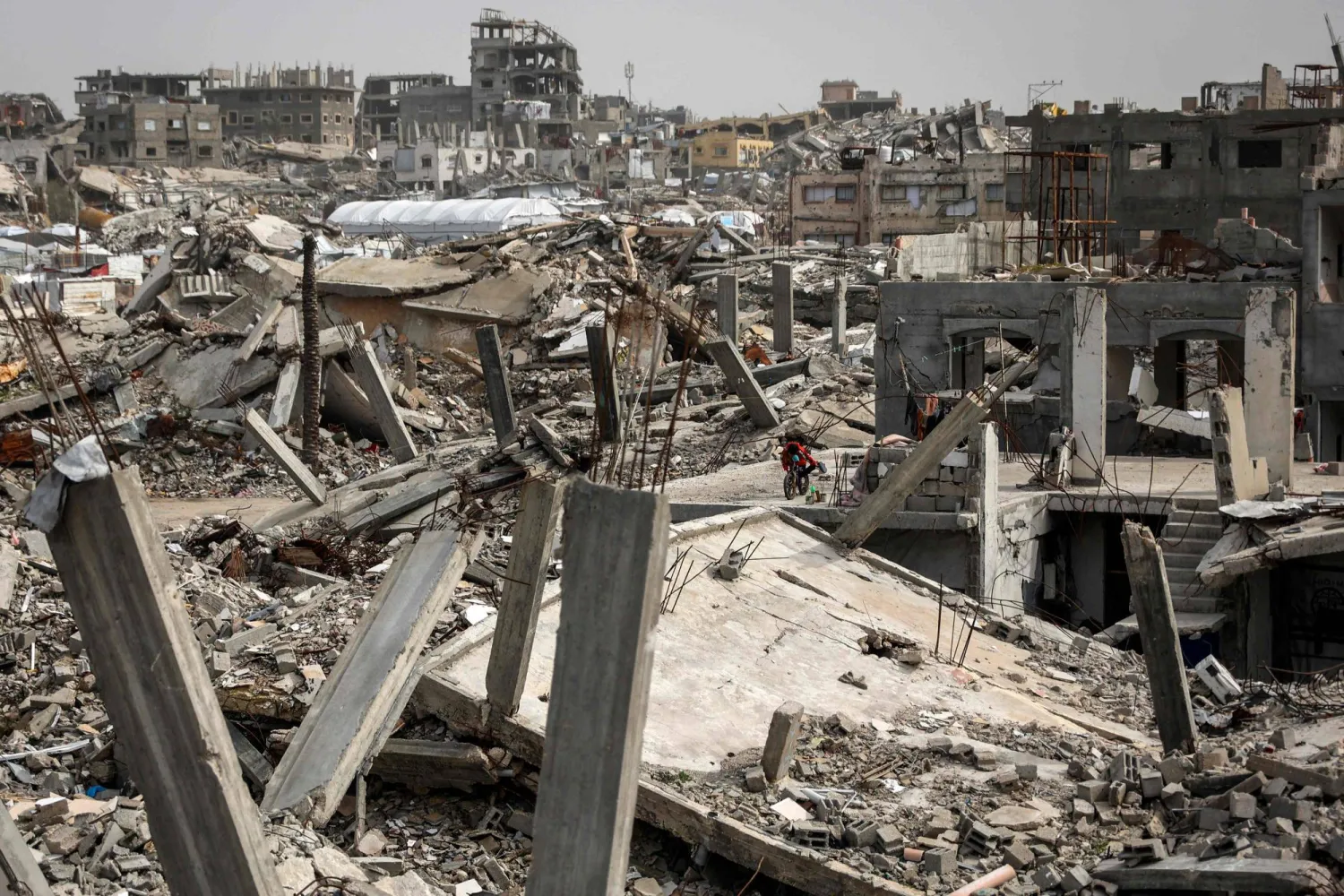
A Palestinian amputee walks in Yafa street among the destroyed Al Mahata mosque and destroyed buildings, in Al Tuffah neighborhood, east of Gaza City, 13 December 2025, near the yellow line amid a ceasefire between Israel and Hamas. EPA/MOHAMMED SABER
TT

Hamas Says Weapons Are 'Legitimate Right'

A Palestinian amputee walks in Yafa street among the destroyed Al Mahata mosque and destroyed buildings, in Al Tuffah neighborhood, east of Gaza City, 13 December 2025, near the yellow line amid a ceasefire between Israel and Hamas. EPA/MOHAMMED SABER

Hamas' Gaza chief Khalil al-Hayya said on Sunday that the group had a "legitimate right" to hold weapons and that any proposal for the next phases of the Gaza ceasefire must uphold that right.

"Resistance and its weapons are a legitimate right guaranteed by international law and are linked to the establishment of a Palestinian state," said al-Hayya in a televised address on the militant group's Al-Aqsa TV.

"We are open to studying any proposals that preserve this right while guaranteeing the establishment of a Palestinian state."

Al-Hayya also confirmed that the head of the group's weapons production was killed in an Israeli strike in the Gaza Strip the day before.

"The Palestinian people are currently going through difficult times and suffering greatly... with the martyrdom of more than 70,000 people, the latest of whom was the mujahid commander Raed Saad and his companions."

Israel announced on Saturday that it had killed Saad, describing him as "one of the architects" of the October 7, 2023 attack on Israel that sparked the war in Gaza.

It was the highest-profile assassination of a senior Hamas figure since the Gaza ceasefire deal came into effect in October this year.

The US-sponsored ceasefire remains fragile as Israel and Hamas accuse each other almost daily of violations.

The agreement is composed of three phases. In the first phase of the deal, Palestinian militants committed to releasing the remaining 48 living and dead captives held in the territory.

So far they have released all of the hostages except for one body.

Under the second phase Israeli troops would further withdraw from their positions in Gaza and be replaced by an international stabilization force, while Hamas would lay down its weapons.

Israel has repeatedly insisted Hamas "will be disarmed.”

The third phase includes the reconstruction of the vast areas of Gaza levelled by Israel's retaliatory military campaign.