


Israel Pounds Central Gaza, Dozens More Palestinians Killed

 Palestinians pray near the wrapped bodies of relatives killed in the Israeli bombardment of the Gaza Strip, outside a morgue in Khan Younis on Wednesday, Dec. 27, 2023. (AP)
Palestinians pray near the wrapped bodies of relatives killed in the Israeli bombardment of the Gaza Strip, outside a morgue in Khan Younis on Wednesday, Dec. 27, 2023. (AP)
TT

Israel Pounds Central Gaza, Dozens More Palestinians Killed

 Palestinians pray near the wrapped bodies of relatives killed in the Israeli bombardment of the Gaza Strip, outside a morgue in Khan Younis on Wednesday, Dec. 27, 2023. (AP)
Palestinians pray near the wrapped bodies of relatives killed in the Israeli bombardment of the Gaza Strip, outside a morgue in Khan Younis on Wednesday, Dec. 27, 2023. (AP)

Israeli forces pounded central Gaza by land, sea and air on Wednesday and Palestinian authorities reported dozens more deaths, including 20 in one attack.

Reflecting Israeli resolve to wipe out Hamas despite international calls for a ceasefire amid a humanitarian crisis, Israel's military chief Herzi Halevi said on Tuesday the war would last many months. There were "no short cuts in dismantling a terrorist organization," he said.

A Gaza health ministry statement said an Israeli air strike killed 20 Palestinians on Wednesday near the Al-Amal Hospital in Khan Younis, in the southern Gaza Strip. There was no immediate comment from the Israeli military.

A telecommunications outage in much of the enclave hindered efforts to reach Palestinian casualties overnight but was gradually coming back online at mid-morning.

In central Gaza's Al-Maghazi district, five Palestinians were killed in one air strike, medics said, while to the north in Gaza City health officials said the bodies of seven Palestinians killed overnight arrived at Al Shifa Hospital.

Residents also reported heavy fighting east and north of the Al-Bureij district and in the nearby village of Juhr Ad-Deek, where they said Israeli tanks are stationed.

Israel's military on Wednesday reported three more soldiers killed in action in Gaza, bringing total military losses in the enclave since ground operations began on Oct. 20 to 166.

The war erupted after Hamas killed 1,200 people and captured 240 hostages in a cross-border rampage on Oct. 7, the deadliest day in Israel's history. Prime Minister Benjamin Netanyahu has responded with an assault that has laid much of Hamas-ruled Gaza to waste.

The Gaza health ministry said Israeli forces had killed 195 Palestinians and wounded 325 in the past 24 hours, bringing the recorded toll to 21,110 killed and 55,243 wounded in Israeli attacks in the coastal Palestinian territory since Oct. 7.

Nearly all the enclave's 2.3 million people have been driven from their homes, many several times.

Meanwhile in Tel Aviv, a huge clock counted the time elapsed since Hamas took the hostages as families kept up their campaign for their loved ones to be freed.

Lebanon border

Israeli has intensified its raids this week, particularly in a central area just south of the waterway that bisects the narrow coastal strip. The Israeli army told civilians to leave the area, though many said there was nowhere left to go.

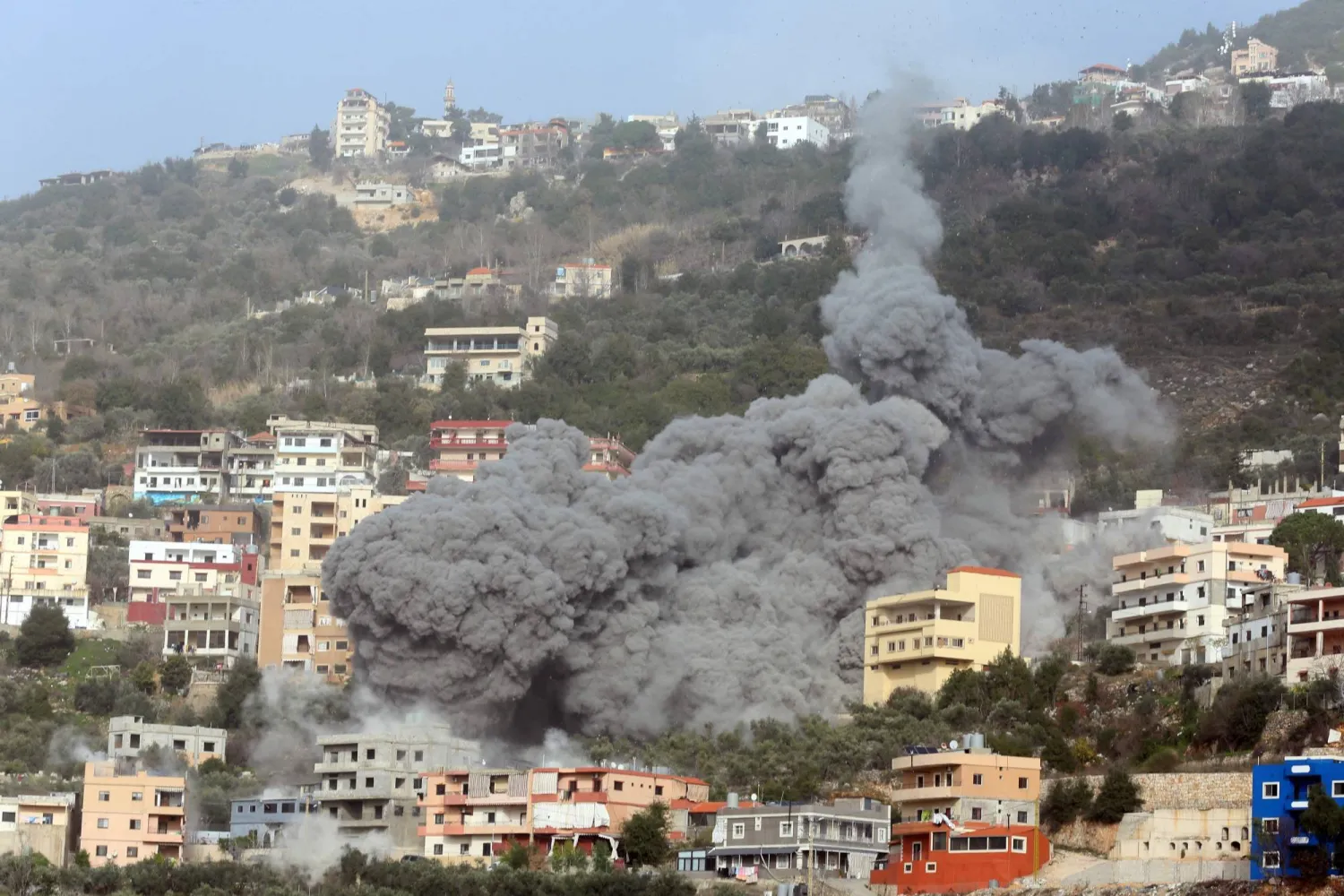
The Israeli military said on Wednesday its warplanes had also targeted Hezbollah military sites and other locations in Lebanon. Huge plumes of smoke were seen on the border.

Security sources said Hezbollah, an ally of Hamas, had fired the most rockets and weaponized drones against Israel on Wednesday that it has in a single day since the spate of daily clashes began.

Further highlighting the difficulties in treating the wounded in Gaza, the World Health Organization released footage, taken mostly on Monday and Tuesday at several hospitals, with WHO emergency medical team coordinator Sean Casey saying Gaza's health capacity was 20% of what it was 80 days ago.

"We're seeing almost only trauma cases come through the door and at a scale that's quite difficult to believe. It’s a bloodbath as we said before, it's carnage.”

Casey said nowhere in Gaza was safe.

The International Committee of the Red Cross said on Wednesday the Palestinian Red Crescent Society compound in Khan Younis was hit on Tuesday. It said on X the strike had caused damage and spread panic among those working there and displaced people sheltering in the facility.

Israel says it is doing what it can to protect civilians, and blames Hamas for putting them in harm's way by operating among them, which Hamas denies. Even Israel's closest ally the US has said it should do more to reduce civilian deaths from what President Joe Biden has called "indiscriminate bombing".

The Israeli military said it was continuing to strike militant targets in Gaza, at one point using its navy to hit suspects deemed to pose a threat to ground troops.

In the Shejaia district of Gaza City, an Israeli attack on militant fighters on foot caused secondary explosions, indicating the area was rigged with explosives to attack soldiers, a military statement said.

West Bank

In the Israeli-occupied West Bank, six youths were killed in an Israeli raid into the city of Tulkarm, the Palestinian health ministry said.

An Israeli military statement said Israeli forces on a counter-terrorism operation came under attack by militants who threw explosive devices at them. The attackers were struck by an Israeli air force aircraft, it said.

Residents said the youths were neither fighters nor militants.

"It was a sight I could not see, it was something you cannot look at," Saida Famawi, the mother of one of the youths, said.

In an interview with Egyptian TV, Palestinian Authority President Mahmoud Abbas said Israel intended to stay in Gaza after the war "but the whole world does not agree with it".

He said the US could "order" Israel to agree that Gaza become part of a future Palestinian state.


Gaza's Rafah Crossing Reopens, Allowing Limited Travel as Palestinians Claim Delays, Mistreatment

Ayada Al-Sheikh is welcomed by his sister, Nisreen, upon his arrival in Khan Younis in the southern Gaza Strip after returning to Gaza following the long-awaited reopening of the Rafah border crossing, early Thursday, Feb. 5, 2026. (AP Photo/Abdel Kareem Hana)
TT

Gaza's Rafah Crossing Reopens, Allowing Limited Travel as Palestinians Claim Delays, Mistreatment

Ayada Al-Sheikh is welcomed by his sister, Nisreen, upon his arrival in Khan Younis in the southern Gaza Strip after returning to Gaza following the long-awaited reopening of the Rafah border crossing, early Thursday, Feb. 5, 2026. (AP Photo/Abdel Kareem Hana)

A limited number of Palestinians were able to travel between Gaza and Egypt on Sunday, after Gaza's Rafah crossing reopened after a two-day closure, Egyptian state media reported.

The vital border point opened last week for the first time since 2024, one of the main requirements for the US-backed ceasefire. The crossing was closed Friday and Saturday because of confusion about reopening operations.

Egypt's Al Qahera television station said that Palestinians began crossing in both directions around noon on Sunday. Israel didn't immediately confirm the information, according to The AP news.

Meanwhile, Israeli Prime Minister Benjamin Netanyahu is expected to travel to Washington this week, though the major subject of discussion will be Iran, his office said.

Over the first four days of the crossing's opening, just 36 Palestinians requiring medical care were allowed to leave for Egypt, plus 62 companions, according to UN data, after Israel retrieved the body of the last hostage held in Gaza and several American officials visited Israel to press for the opening.

Palestinian officials say nearly 20,000 people in Gaza are seeking to leave for medical care that isn't available in the territory. Those who have succeeded in crossing described delays and allegations of mistreatment by Israeli forces and other groups involved in the crossing, including an Israeli-backed Palestinian armed group, Abu Shabab.

A group of Palestinian patients and wounded gathered Sunday morning in the courtyard of a Red Crescent hospital in Gaza’s southern city of Khan Younis, before making their way to the Rafah crossing with Egypt for treatment abroad, family members told The Associated Press.

Amjad Abu Jedian, who was injured in the war, was scheduled to leave Gaza for medical treatment on the first day of the crossing’s reopening, but only five patients were allowed to travel that day, his mother, Raja Abu Jedian, said. Abu Jedian was shot by an Israeli sniper while he doing building work in the central Bureij refugee camp in July 2024, she said.

On Saturday, his family received a call from the World Health Organization notifying them that he is included in the group that will travel on Sunday, she said.

“We want them to take care of the patients (during their evacuation),” she said. “We want the Israeli military not to burden them.”

The Israeli defense branch that oversees the operation of the crossing didn't immediately confirm the opening.

Heading back to Gaza A group of Palestinians also arrived Sunday morning at the Egyptian side of the Rafah crossing to return to the Gaza Strip, Egypt’s state-run Al-Qahera News satellite television reported.

Palestinians who returned to Gaza in the first few days of the crossing's operation described hours of delays and invasive searches by Israeli authorities and Abu Shabab. A European Union mission and Palestinian officials run the border crossing, and Israel has its screening facility some distance away.

The crossing was reopened on Feb. 2 as part of a fragile ceasefire deal to halt the Israel-Hamas war.

The Rafah crossing, an essential lifeline for Palestinians in Gaza, was the only one in the Palestinian territory not controlled by Israel before the war. Israel seized the Palestinian side of Rafah in May 2024, though traffic through the crossing was heavily restricted even before that.

Restrictions negotiated by Israeli, Egyptian, Palestinian and international officials meant that only 50 people would be allowed to return to Gaza each day and 50 medical patients — along with two companions for each — would be allowed to leave, but far fewer people have so far crossed in both directions.

A senior Hamas official, Khaled Mashaal, said the militant group is open to discuss the future of its arms as part of a “balanced approach” that includes the reconstruction of Gaza and protecting the Palestinian enclave from Israel.

Mashaal said the group has offered multiple options, including a long-term truce, as part of its ongoing negotiations with Egyptian, Qatari and Turkish mediators.

Hamas plans to agree to a number of “guarantees,” including a 10-year period of disarmament and an international peacekeeping force on the borders, “to maintain peace and prevent any clashes,” between the militants and Israel, Mashaal said at a forum in Qatar’s capital, Doha.

Israel has repeatedly demanded a complete disarmament and destruction of Hamas and its infrastructure, both military and civil.

Mashaal accused Israel of financing and arming militias, like the Abu Shabab group which operates in Israeli military-controlled areas in Gaza, “to create chaos” in the enclave.

In the forum, Mashaal was asked about Hamas’ position from US President Donald Trump’s Board of Peace. He didn’t offer a specific answer, but said that the group won’t accept “foreign intervention” in Palestinian affairs.

“Gaza is for the people of Gaza. Palestinians are for the people of Palestine,” he said. “We will not accept foreign rule.”


Three Deadly Attacks on Health Centers in Sudan's South Kordofan in Past Week, Says WHO

Sudanese families prepare to ride on trucks while on their way to Egypt through the Qustul border, after the crisis in Sudan's capital Khartoum, in the Sudanese city of Wadi Halfa, Sudan May 1, 2023. (Reuters)
TT

Three Deadly Attacks on Health Centers in Sudan's South Kordofan in Past Week, Says WHO

Sudanese families prepare to ride on trucks while on their way to Egypt through the Qustul border, after the crisis in Sudan's capital Khartoum, in the Sudanese city of Wadi Halfa, Sudan May 1, 2023. (Reuters)

Sudan's South Kordofan region has seen attacks on three health facilities in the past week alone, leaving more than 30 dead, the World Health Organization said Sunday, AFP reported.

"Sudan's health system is under attack again," WHO chief Tedros Adhanom Ghebreyesus said on X, pointing out that, since February 3, "three health facilities were attacked in South Kordofan, in a region already suffering acute malnutrition".


Killing of Seif al-Islam al-Gadhafi Raises Succession Questions in September Current

Seif al-Islam al-Gadhafi (file photo, Reuters)
TT

Killing of Seif al-Islam al-Gadhafi Raises Succession Questions in September Current

Seif al-Islam al-Gadhafi (file photo, Reuters)

Since the killing of Seif al-Islam al-Gadhafi, son of Libya’s late leader Moammar Gadhafi, in the western Libyan city of Zintan last Tuesday, urgent questions have surfaced over who might succeed him in leading the political current he represented.

The questions reflect Seif al-Islam’s symbolic status among supporters of the former regime, known as the September Current, a reference to backers of the September 1 Revolution led by Moammar Gadhafi in 1969.

Search for new leadership

Othman Barka, a leading figure in the National Current that backed Seif al-Islam al-Gadhafi, said supporters of the former regime had yet to agree on a new leader but retained the organizational and political capacity to overcome the current phase and later move toward an alternative leadership framework.

Barka told Asharq Al-Awsat that ties to Gadhafi and his sons had been both emotional and political, but said that what he described as national work would continue. He said organized efforts would be made to reach a new leadership after the repercussions of the killing were overcome.

It remains unclear how Ahmed Gaddaf al-Dam, the political official in the Libyan National Struggle Front and one of the most prominent figures of the former regime, views the future leadership of the September Current following Seif al-Islam’s killing.

Sources close to him told Asharq Al-Awsat it was too early to speak of a new leadership while mourning ceremonies continued in Bani Walid.

Gaddaf al-Dam limited his public response to reposting a statement by those describing themselves as supporters of the Jamahiriya system on his Facebook page. He stressed unity, saying the killing would not lead to the fragmentation of the current and that September supporters remained a single, solid bloc.

In Bani Walid in western Libya, where Seif al-Islam was buried on Friday, shock was evident in the tone of Libyan activist Hamid Gadhafi, a member of the late leader’s tribe. He told Asharq Al-Awsat that clarity over the future leadership would emerge after about 10 days.

Possible successors

Libyan social media pages circulated the names of potential successors, including Seif al-Islam’s sister, Aisha, and his brother, Saadi. Libyan political analyst Ibrahim Belqasem rejected that view, telling Asharq Al-Awsat that the only remaining driver for supporters of the former regime would be the emergence of an unexpected, nonpolitical figure, describing it as an attempt to rescue the current.

After the fall of Gadhafi’s rule in 2011, following 42 years in power since the 1969 revolution, his supporters reemerged under the banner of the September Current. They are popularly known as the Greens, a reference to the Green Book.

Fragmented components and the absence of unified leadership mark the September Current. Seif al-Islam was widely seen as a central symbol among supporters, as well as among political figures and groups calling for the reintegration of former regime supporters into political life and for the recognition of their rights.

Nasser Saeed, spokesman for the Libyan Popular National Movement, one of the political arms of former regime supporters, said he expected a national political leadership to take shape in the coming phase to continue what he described as national work until the country stabilizes. Libyans can determine their future.

He said the emergence of a new leader or symbol was a matter for a later stage, stressing that the project was ideological rather than tied to individuals.

Saeed told Asharq Al-Awsat that Seif al-Islam al-Gadhafi’s legacy lay in a unifying national project that rejected foreign intervention and sought to restore sovereignty and stability. He said Seif al-Islam had represented hope for overcoming the crisis and that his project extended the path of the September Revolution as a liberation choice that still retained supporters.

Structural challenges

Organizationally, the former regime cannot be confined to a single political framework. Its structures and leadership are diverse, including independent organizations and figures.

Among the most prominent are the Libyan Popular National Movement, founded in 2012, and the Popular Front for the Liberation of Libya, formed in 2016 by politicians and tribal leaders in support of Seif al-Islam al-Gadhafi.

Their representatives increased their presence after 2020, whether in the Geneva forum that led to the formation of the Government of National Unity or in UN-sponsored structured dialogue tracks, before suspending participation following Seif al-Islam’s killing.

Voices within the September Current believe the killing marked a decisive turning point that cast heavy shadows over the ability of former regime supporters to forge unified leadership, citing structural difficulties rooted in historical disagreements between what is known as the old guard and supporters of change led by Seif al-Islam.

Khaled al-Hijazi, a prominent political activist in the September Current, agreed with that assessment, saying Seif al-Islam’s symbolic role had helped balance internal disputes due to his reformist project before the February 17 uprising.

Al-Hijazi told Asharq Al-Awsat that the loss of that symbolism could revive old divisions and complicate efforts to recreate an inclusive leadership, amid internal and external factors that make unification highly complex in the foreseeable future.

Barka said differences were natural, stressing that the current was not a closed party and believed in democracy and pluralism. He said generational competition did not amount to conflict and noted there had been no violent clashes between supporters of different paths within the September Current.

He concluded by saying that the diversity of approaches served a single goal: the freedom and prosperity of Libyan citizens and the building of a sovereign state capable of overcoming the crisis that has persisted since 2011.