Harvest Lost as War Expands in Famine-threatened Sudan

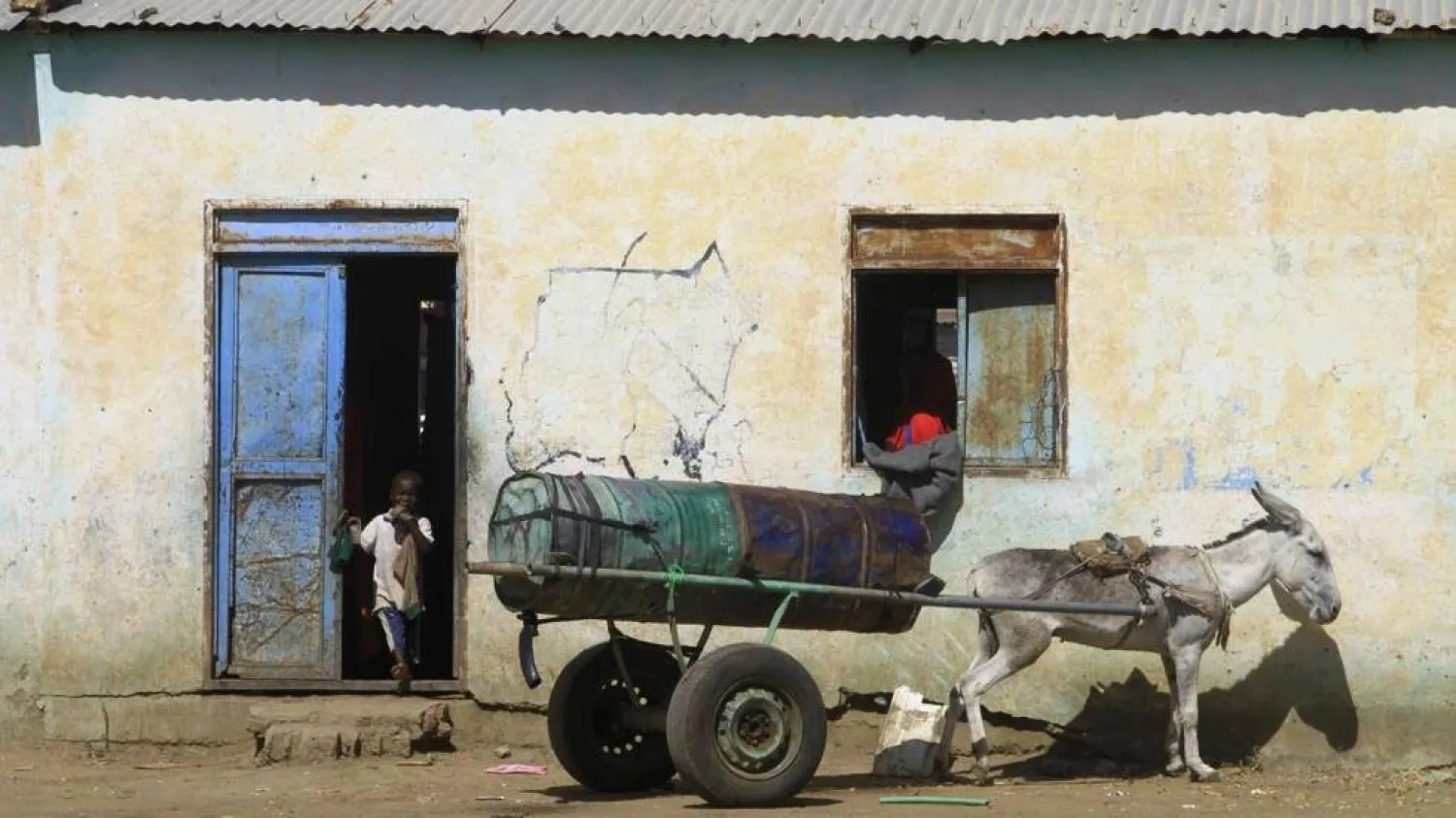
A child displaced from Al-Jazira state at the entrance of a temporary shelter in Gedaref in Sudan's east. AFP
TT

Harvest Lost as War Expands in Famine-threatened Sudan

A child displaced from Al-Jazira state at the entrance of a temporary shelter in Gedaref in Sudan's east. AFP

Since Sudan's war spread to Al-Jazira state south of Khartoum, farmers have watched their livelihoods wither away after fighting between paramilitary forces battling the army wreaked havoc on once-bountiful lands.
"For weeks I haven't been able to reach the wheat I planted in November," Ahmed al-Amin, 43, told AFP from his farm 20 kilometers (12 miles) north of state capital Wad Madani.
After war erupted in April last year between the regular army and the paramilitary Rapid Support Forces (RSF), Al-Jazira -- just south of Khartoum -- became a sanctuary for more than half a million people, according to the United Nations.
But the front line has been edging southwards for months, and in December the fragile peace in Al-Jazira was shattered.
The fight for Wad Madani began, and hundreds of thousands of people were forced to flee from the state.
When the army quickly retreated from the state capital, the RSF took over swathes of agricultural land, laying siege to entire villages and leaving farmers unable to tend to vital crops.
Amin says his crops need water and fertilizer that he and other farmers in the area can no longer provide.
His farm is part of the Gezira agricultural scheme, an important irrigation project that is a key source of food for the northeast African country.
Local officials had announced plans in October to plant 600,000 acres of wheat -- vital to fend off widespread hunger.
Most of its food is imported, and with a war-crippled economy and 5.8 million people displaced within the country, the specter of famine has stalked Sudan for months.
Widespread hunger
According to the UN's World Food Program (WFP), nearly 18 million people are currently facing acute hunger, with five million at "emergency levels of hunger".
Although a famine has not been officially declared, "there is no other way around what's about to happen in Sudan", according to Norwegian Refugee Council (NRC) country director William Carter.
On Saturday, US agency USAID's Famine Early Warning Systems Network said "fighting in central and eastern Sudan, which is the country's most important region for crop production, is a serious threat to national food availability".
The NRC's Carter is more direct.
"Unless peace magically descends on Sudan, there is going to be famine. At this point, it's not just air strikes and urban warfare killing people," he told AFP.
The fighting has killed more than 12,190 people, according to a conservative estimate from the Armed Conflict Location and Event Data Project.
There are no figures for indirect casualties, including those who have died due to the nationwide breakdown of essential services, infrastructure and hospitals -- 80 percent of which remain out of service.
All along the highway from Khartoum to Wad Madani, the RSF has set up checkpoints, seized land and besieged entire communities.
Kamel Saad, 55, saw this happen to his village, 50 kilometers (31 miles) north of Wad Madani.
He had just begun to collect his vegetable crop -- on which he had spent his life savings -- in a last-ditch effort to make it through this year's harvest season.
"My crop rotted because of the RSF deployment on the road," Saad told AFP. He now has nothing left to his name.
Rotting crops
Others were lucky enough to have gathered in their harvest before the tanks arrived. But now they have nowhere to take their produce.
At this time of year, markets across the state would usually be teeming with farmers and merchants moving their crops, feeding millions.
Now most of these markets are abandoned, looted or closed for fear of attack.
According to officials, local activists and farmers, the RSF fighters have left nearly nothing untouched in their wake.
In a statement, Gezira scheme head Omar Marzouk said "the project's cars and machinery have been looted and workers in every department are unable to reach their work".
Last month, the WFP said paramilitary fighters looted its warehouse in Al-Jazira, stealing "enough stocks to feed nearly 1.5 million severely food insecure people for one month".
By the end of December, "300 cars and farm vehicles" had been looted from the Junaid project on the east bank of the Nile, according to project head Mohamed Gad al-Rabb.
Fertilizer and pesticide warehouses stood empty, their contents looted, and water pumps came to a halt.
"Already we hadn't been paid our profits from the government for two years. Now the water pumps have stopped and our crops are at risk of rotting," farmer Khader Abbas told AFP.
Sudan was already suffering before the war, with triple-digit inflation and a third of the population needing humanitarian aid.
Now, as the fighting spreads southeast, local experts have warned that the damage to the country's agriculture sector could cripple its food security for years to come.



Rescue Teams Search for Survivors in Building Collapse that Killed at Least 2 in Northern Lebanon

A Lebanese flag is pictured, in the aftermath of a massive explosion, in Beirut's damaged port area, Lebanon August 17, 2020. REUTERS/Hannah McKay
TT

Rescue Teams Search for Survivors in Building Collapse that Killed at Least 2 in Northern Lebanon

A Lebanese flag is pictured, in the aftermath of a massive explosion, in Beirut's damaged port area, Lebanon August 17, 2020. REUTERS/Hannah McKay

At least two people were killed and four rescued from the rubble of a multistory apartment building that collapsed Sunday in the city of Tripoli in northern Lebanon, state media reported.

Rescue teams were continuing to dig through the rubble. It was not immediately clear how many people were in the building when it fell.

The bodies pulled out were of a child and a woman, the state-run National News Agency reported.

Dozens of people crowded around the site of the crater left by the collapsed building, with some shooting in the air.

The building was in the neighborhood of Bab Tabbaneh, one of the poorest areas in Lebanon’s second largest city, where residents have long complained of government neglect and shoddy infrastructure. Building collapses are not uncommon in Tripoli due to poor building standards, according to The AP news.

Lebanon’s Health Ministry announced that those injured in the collapse would receive treatment at the state’s expense.

The national syndicate for property owners in a statement called the collapse the result of “blatant negligence and shortcomings of the Lebanese state toward the safety of citizens and their housing security,” and said it is “not an isolated incident.”

The syndicate called for the government to launch a comprehensive national survey of buildings at risk of collapse.


Israel to Take More West Bank Powers and Relax Settler Land Buys

A view of Israeli settlement of Maale Adumim, in the West Bank, Sunday, June 18, 2023. (AP)
TT

Israel to Take More West Bank Powers and Relax Settler Land Buys

A view of Israeli settlement of Maale Adumim, in the West Bank, Sunday, June 18, 2023. (AP)

Israel's security cabinet approved a series of steps on Sunday that would make it easier for settlers in the occupied West Bank to buy land while granting Israeli authorities more enforcement powers over Palestinians, Israeli media reported.

The West Bank is among the territories that the Palestinians seek for a future independent state. Much of it is under Israeli military control, with limited Palestinian self-rule in some areas run by the Western-backed Palestinian Authority (PA).

Citing statements by Finance Minister Bezalel Smotrich and Defense Minister Israel Katz, Israeli news sites Ynet and Haaretz said the measures included scrapping decades-old regulations that prevent Jewish private citizens buying land in the West Bank, The AP news reported.

They were also reported to include allowing Israeli authorities to administer some religious sites, and expand supervision and enforcement in areas under PA administration in matters of environmental hazards, water offences and damage to archaeological sites.

Palestinian President Mahmoud Abbas said the new measures were dangerous, illegal and tantamount to de-facto annexation.

The Israeli ministers did not immediately respond to requests for comment.

The new measures come three days before Prime Minister Benjamin Netanyahu is scheduled to meet in Washington with US President Donald Trump.

Trump has ruled out Israeli annexation of the West Bank but his administration has not sought to curb Israel's accelerated settlement building, which the Palestinians say denies them a potential state by eating away at its territory.

Netanyahu, who is facing an election later this year, deems the establishment of any Palestinian state a security threat.

His ruling coalition includes many pro-settler members who want Israel to annex the West Bank, land captured in the 1967 Middle East war to which Israel cites biblical and historical ties.

The United Nations' highest court said in a non-binding advisory opinion in 2024 that Israel's occupation of Palestinian territories and settlements there is illegal and should be ended as soon as possible. Israel disputes this view.


Arab League Condemns Attack on Aid Convoys in Sudan

A general view shows the opening session of the meeting of Arab foreign ministers at the Arab League Headquarters (Reuters)
TT

Arab League Condemns Attack on Aid Convoys in Sudan

A general view shows the opening session of the meeting of Arab foreign ministers at the Arab League Headquarters (Reuters)

Arab League Secretary-General Ahmed Aboul Gheit strongly condemned the attack by the Rapid Support Forces on humanitarian aid convoys and relief workers in North Kordofan State, Sudan.

In a statement reported by SPA, secretary-general's spokesperson Jamal Rushdi quoted Aboul Gheit as saying the attack constitutes a war crime under international humanitarian law, which prohibits the deliberate targeting of civilians and depriving them of their means of survival.

Aboul Gheit stressed the need to hold those responsible accountable, end impunity, and ensure the full protection of civilians, humanitarian workers, and relief facilities in Sudan.