


Blinken Seeks Palestinian Governance Reform for Postwar Gaza as Deadly Israeli Strikes Continue

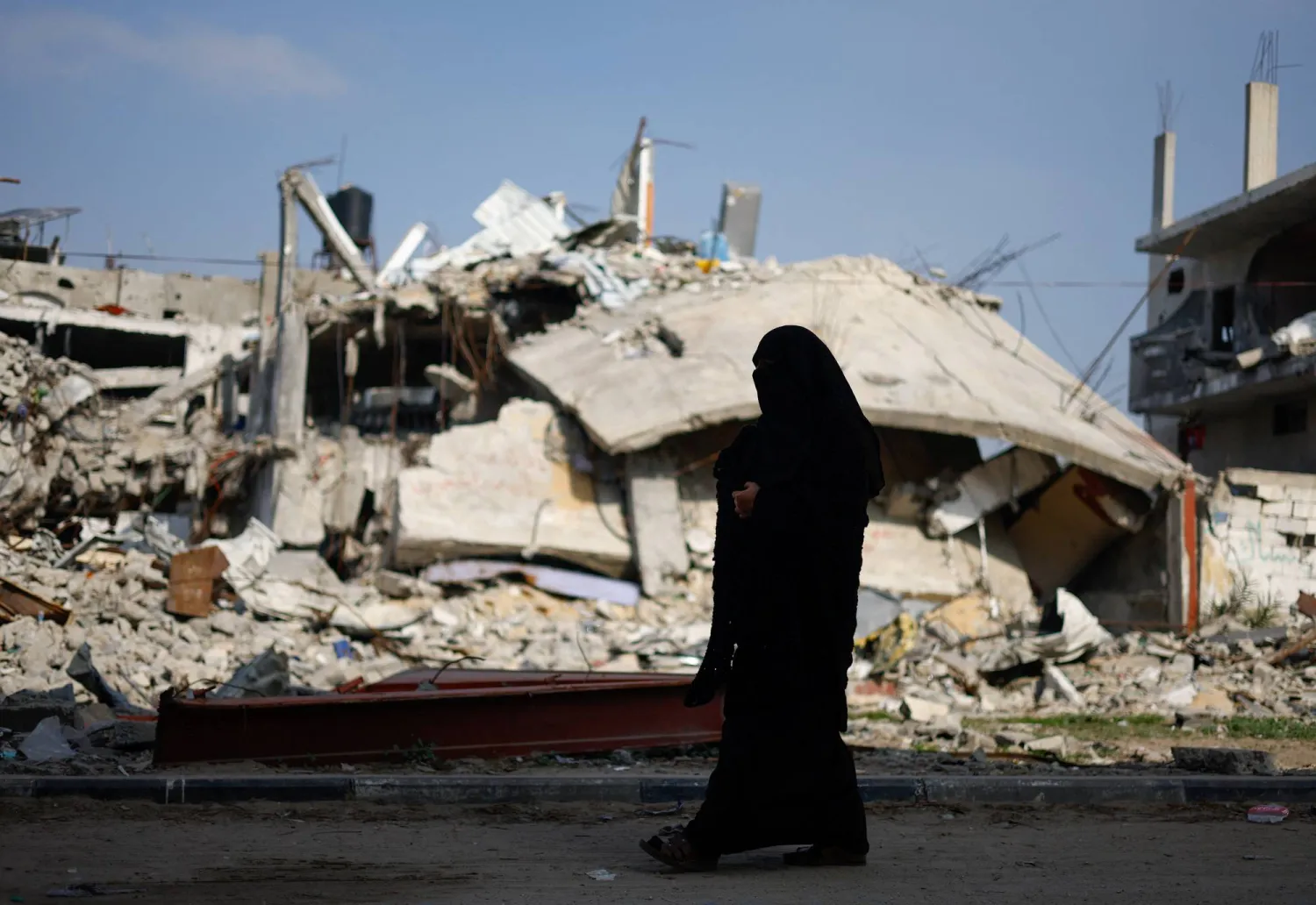
A Palestinian woman walks near the rubble of a house destroyed in an Israeli strike amid the ongoing conflict between Israel and the Palestinian group Hamas, in Rafah in the southern Gaza Strip, January 9, 2024. REUTERS/Mohammed Salem
TT

Blinken Seeks Palestinian Governance Reform for Postwar Gaza as Deadly Israeli Strikes Continue

A Palestinian woman walks near the rubble of a house destroyed in an Israeli strike amid the ongoing conflict between Israel and the Palestinian group Hamas, in Rafah in the southern Gaza Strip, January 9, 2024. REUTERS/Mohammed Salem

US Secretary of State Antony Blinken spoke Wednesday to Palestinian President Mahmoud Abbas about reforming his government as Blinken sought to rally the region behind postwar plans for Gaza that include concrete steps toward a Palestinian state.

The US is pushing for a reformed Palestinian Authority to govern Gaza once the war is over. Blinken says multiple countries in the region have agreed to help rebuild the territory and that wider Israeli-Arab normalization is still possible, but only if there is "a pathway to a Palestinian state."

In their meeting in the West Bank city of Ramallah, Blinken told Abbas that the US supports "tangible steps" toward a Palestinian state, according to State Department spokesman Matthew Miller. He said the two discussed administrative reform.

The vision outlined by Blinken faces serious obstacles. Israeli Prime Minister Benjamin Netanyahu's government has so far rejected Palestinian Authority control in Gaza and adamantly opposes the creation of a Palestinian state alongside Israel. The Western-backed Palestinian leadership, whose forces were driven from Gaza when Hamas took over in 2007, lacks legitimacy in the view of many Palestinians.

The war in Gaza is still raging with no end in sight, fueling a humanitarian catastrophe in the tiny coastal enclave. The fighting has also stoked escalating violence between Israel and Lebanon’s Hezbollah militants that has raised fears of a wider conflict.

BLINKEN PRESSURES BOTH SIDES ON WHIRLWIND TRIP On his fourth visit to the region since the war began three months ago, Blinken has met in recent days with the leaders of Saudi Arabia, Jordan, Qatar, the United Arab Emirates and Türkiye. He says they are open to contributing to postwar plans in return for progress on creating a Palestinian state.

Blinken said that in his talks with Abbas, they discussed reforming the Palestinian Authority so "it can effectively take responsibility for Gaza."

Abbas appeared ready to "engage in all of these efforts," he said at his next stop, Manama, the capital of the Gulf nation of Bahrain.

Abbas spokesman Nabil Abu Rudeineh said they heard "good statements" from the Americans. "But nothing has happened," he said. "The priority now is to stop the war on Gaza."

The 88-year-old Abbas has not stood for election since 2005 and lacks support among his own people.

The Palestinian Authority governs parts of the Israeli-occupied West Bank under interim peace deals reached in the 1990s and cooperates with Israel on security matters. But it has been powerless to prevent the expansion of Israeli settlements in occupied territory it wants for a future state, and there have been no serious or substantive peace talks since Netanyahu returned to office in 2009.

US President Joe Biden's administration has been unable to get Israel to make even relatively minor concessions to the Palestinians, like turning over all the tax revenue it collects on their behalf or allowing the reopening of a US Consulate to serve Palestinians in Israeli-annexed east Jerusalem.

After meeting with Netanyahu and other top Israeli officials Tuesday, Blinken delivered a stark message, saying Israel must stop undercutting the Palestinians’ ability to govern themselves with its expansion of settlements, home demolitions and evictions in the West Bank.

Later Wednesday, Abbas met with King Abdullah II of Jordan and Egyptian President Abdel Fattah al-Sisi in Jordan's Red Sea city of Aqaba. The three vowed to continue pressuring Israel to stop the offensive and working together toward a Palestinian state, according to a statement by the monarchy.

WAR RAGES ON WITH NO END IN SIGHT Israel has vowed to keep fighting until it crushes Hamas and returns scores of hostages held by the group after its Oct. 7 attack that triggered the war. Israeli officials say the campaign will continue through the rest of the year. Israel's own postwar plans call for open-ended military control over the territory, from which it withdrew soldiers and settlers in 2005.

Nearly 85% of Gaza’s population of 2.3 million have been driven from their homes by the fighting, and a quarter of its residents face starvation, with only a trickle of food, water, medicine and other supplies entering through an Israeli siege.

Blinken said more food, water, medicine and other aid needs to enter and be distributed effectively, and he called on Israel to "do everything it can to remove any obstacles."

The offensive has reduced much of northern Gaza, including Gaza City, to a moonscape, raising concerns over whether the hundreds of thousands of Palestinians who fled from those areas will ever be able to return. Far-right members of Netanyahu's government have called for them to be resettled elsewhere, which critics say would amount to ethnic cleansing.

Blinken said the US was opposed to any such scenario and that resettlement is not the policy of the Israeli government. He also said he had secured agreement on a UN inspection mechanism in northern Gaza to evaluate how and when people can return.

HEAVY FIGHTING IN CENTER AND SOUTH The military is now focusing major operations on the southern city of Khan Younis and built-up refugee camps in central Gaza that date back to the 1948 war surrounding Israel's creation. Hundreds of people have been killed in recent days in continuing strikes across the territory, including in areas of the far south where people have been told to seek refuge.

A heavy strike on Wednesday brought down a two-story building in the central town of Deir al-Balah, close to its main Al-Aqsa Martyrs Hospital, killing at least six people, according to hospital officials. Footage from the scene showed people running toward the collapsed building, then pulling concrete blocks off people buried in the rubble.

Late Tuesday, a strike in Gaza's southernmost city Rafah hit a house, killing at least 14 people and wounding at least 20 others, including women and children, health officials said. Associated Press reporters saw the dead and wounded being brought into nearby hospitals.

Since the war began, Israel’s offensive has killed more than 23,300 Palestinians and wounded more than 59,000, according to an update issued Wednesday by the Health Ministry in Hamas-run Gaza. About two-thirds of the dead are women and children, health officials say. The death toll does not distinguish between combatants and civilians.

In the Oct. 7 attack, in which Hamas overwhelmed Israel's defenses and stormed through several communities, Palestinian militants killed some 1,200 people, mainly civilians. They abducted around 250 others, nearly half of whom were released during a weeklong cease-fire in November.

The Israeli military says it tries to avoid harming civilians and blames the high toll on Hamas because the militants fight in densely populated areas. Israel says it has killed some 8,000 militants — without providing evidence — and that 186 of its own soldiers have been killed in the offensive.



Israeli Strikes Damage Hospital in Lebanon

File photo: Destroyed houses that were hit in an Israeli airstrike in Saksakiyeh village, south Lebanon, Friday, April 3, 2026. (AP Photo/Hussein Malla)
TT

Israeli Strikes Damage Hospital in Lebanon

File photo: Destroyed houses that were hit in an Israeli airstrike in Saksakiyeh village, south Lebanon, Friday, April 3, 2026. (AP Photo/Hussein Malla)

A hospital in the coastal Lebanese city of Tyre was damaged by Israeli airstrikes on nearby buildings that wounded 11 people, the health ministry said on Saturday.

The director of the Lebanese Italian Hospital told the state-run National News Agency (NNA) that it would "remain open to provide the necessary medical care" despite the damage.

Strikes destroyed two buildings nearby, an AFP correspondent saw, shattering windows and causing suspended ceilings to collapse in the hospital, the facility's management said.

A series of attacks hit the Tyre region on Saturday, including one on its port that struck a small boat and damaged others moored nearby, the AFP correspondent said.

Israel has been carrying out strikes across Lebanon and launched a ground invasion in the south after Hezbollah entered the war in the Middle East on the side of its backer Iran on March 2.

Tens of thousands of people have left Tyre, but around 20,000 remain, including 15,000 displaced from surrounding villages, despite Israeli evacuation warnings covering most of the city and a broad swathe of southern Lebanon.

The NNA also reported that Israeli forces abducted a man in Shebaa, near the Israeli border in the east, at around 3:00 am on Saturday.


Indonesia Slams 'Unacceptable' Peacekeeper Casualties in Lebanon

FILE PHOTO: UNIFIL vehicles drive on a main road in Qlayaa, amid escalating hostilities between Israel and Hezbollah, as the US-Israel conflict with Iran continues, in Qlayaa, southern Lebanon, March 27, 2026. REUTERS/Karamallah Daher/File Photo
TT

Indonesia Slams 'Unacceptable' Peacekeeper Casualties in Lebanon

FILE PHOTO: UNIFIL vehicles drive on a main road in Qlayaa, amid escalating hostilities between Israel and Hezbollah, as the US-Israel conflict with Iran continues, in Qlayaa, southern Lebanon, March 27, 2026. REUTERS/Karamallah Daher/File Photo

The Indonesian government on Saturday slammed as "unacceptable" an explosion that injured three of its peacekeepers in Lebanon within days of three other blue helmets from the Southeast Asian nation being killed.

The United Nations Interim Force in Lebanon (UNIFIL) said three peacekeepers were wounded in a blast that occurred inside a UN facility near Adaisseh on Friday afternoon, and rushed to hospital.

Two were seriously wounded.

The UN Information Center in Jakarta said the "origin of the explosion" was unknown but identified the injured soldiers as Indonesian.

"Repeated attacks or incidents of this kind are unacceptable," the Indonesian foreign ministry said in a statement.

"Regardless of their cause, these events underscore the urgent need to strengthen protection for UN peacekeeping forces amid an increasingly dangerous conflict situation."

The government urged the UN Security Council to investigate the events and "to immediately convene a meeting of troop-contributing countries to UNIFIL to conduct a review and take measures to enhance the protection of personnel serving with UNIFIL".

Friday's incident came just days after an Indonesian peacekeeper died when a projectile exploded on March 29 in southern Lebanon, where Israel and Hezbollah have been fighting since Lebanon was drawn into the Middle East war.

A UN security source told AFP on condition of anonymity Tuesday that fire from an Israeli tank was responsible for that attack.

A day later, two more Indonesian peacekeepers died after an explosion struck a UNIFIL logistics convoy, also in southern Lebanon.

The father of one of the two fallen soldiers, 33-year-old Zulmi Aditya Iskandar, said this week he was shocked that peacekeepers were losing their lives in the conflict.

"We were really sad and regretful, because this is a UN troop, a peacekeeping troop, not deployed for war," 60-year-old Iskandarudin told reporters at his house in West Java province.

The bodies of the three peacekeepers are scheduled to arrive in Jakarta on Saturday evening, according to the military.

The Indonesian National Armed Forces has said it will deploy more than 750 personnel to Lebanon next month as part of the scheduled UNIFIL peacekeeping troop rotation.


Strike Kills One Iraqi Fighter near Syria Border

Mourners attend the funeral of members of Iraq's Hashed al-Shaabi, who were killed in an airstrike in the town of al‑Qaim near the Syrian border, amid heightened regional tensions due to the US-Israel conflict with Iran, in Baghdad, Iraq, March 12, 2026. REUTERS/Stringer
TT

Strike Kills One Iraqi Fighter near Syria Border

Mourners attend the funeral of members of Iraq's Hashed al-Shaabi, who were killed in an airstrike in the town of al‑Qaim near the Syrian border, amid heightened regional tensions due to the US-Israel conflict with Iran, in Baghdad, Iraq, March 12, 2026. REUTERS/Stringer

An attack killed one fighter from the former paramilitary coalition Hashed al-Shaabi on Saturday, the alliance said, blaming the US and Israel.

Iraq has been dragged into the war between the United States, Israel and Iran, with strikes targeting both US interests and pro-Iran groups in the country, reported AFP.

"This treacherous attack resulted in the martyrdom of one PMF fighter and the wounding of four others, as well as a member of the ministry of defense," said a short statement from the group, which is also known as the Popular Mobilization Forces (PMF), adding it was a "Zionist-American attack".

The PMF is a coalition of armed groups -- formed in 2014 to fight extremists-- that is now part of Iraq's regular army, but also contains pro-Iran factions who have a reputation for acting independently.

PMF positions have been repeatedly targeted since the outbreak of war, with the group consistently blaming the attacks on the US and Israel.

According to the group's statement, the latest attack targeted a position in western Anbar province of the 45th Brigade, which belongs to the US-blacklisted, pro-Iran Kataeb Hezbollah group.

Kataeb Hezbollah is part of the umbrella movement known as the Islamic Resistance in Iraq, which has been claiming daily attacks since the start of the war on US interests in Iraq and the region.

The Pentagon has said helicopters have carried out strikes against pro-Iran armed groups in Iraq during the war.

Washington has strongly denied claims it has targeted Iraqi security forces.