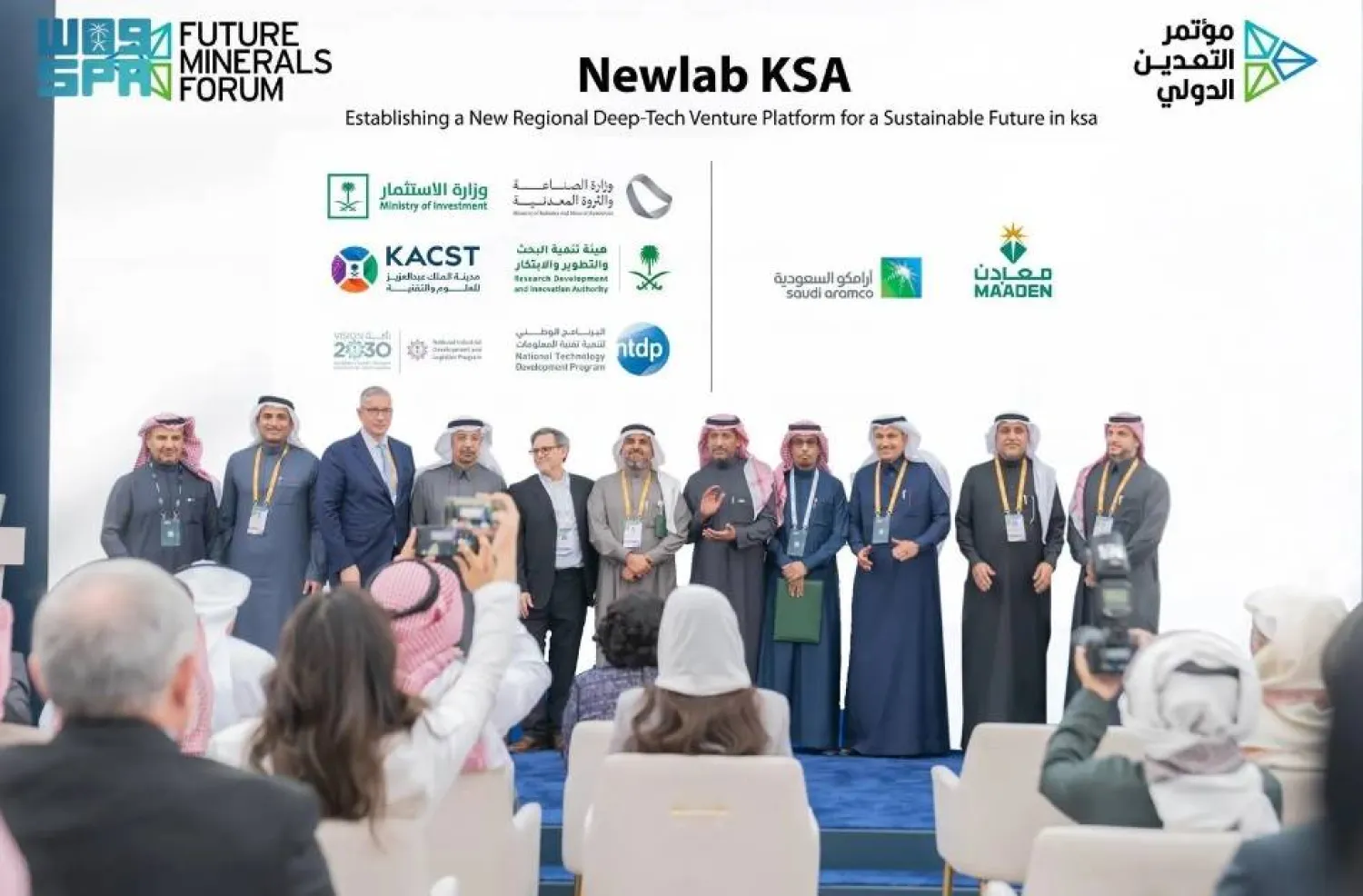
Saudi Arabia Signs Agreement with Newlab to Stimulate Technological and Innovative Ecosystem

NIDLP signed an agreement with Newlab, during the international Future Minerals Forum 2024 in Riyadh. SPA
TT

Saudi Arabia Signs Agreement with Newlab to Stimulate Technological and Innovative Ecosystem

NIDLP signed an agreement with Newlab, during the international Future Minerals Forum 2024 in Riyadh. SPA

Saudi Arabia’s National Industrial Development and Logistics Program (NIDLP) signed an agreement with Newlab, a leading company in technology, innovation, and the development of sustainable solutions related to the energy, mining, industrial, and logistics sectors.
The agreement, which was signed during the international Future Minerals Forum 2024 in Riyadh, involves the establishment of a regional headquarters in the Kingdom of Saudi Arabia under the name “Nwelapksa”.
This agreement is part of NIDLP’s efforts to enhance its international partnerships and cooperative relationships to attract investments and support entrepreneurship.
This comes as Newlab is actively assisting startups in transitioning from concept to impact more rapidly, while also mobilizing industry leaders, governments, and investors to accelerate tangible progress against the most pressing challenges in various fields.
In the same context, the Ministry of Industry and Mineral Resources, the Ministry of Investment, Saudi Aramco, the Saudi Arabian Mining Company (Ma’aden), the King Abdulaziz City for Science and Technology (KACST), the Research, Development and Innovation Authority (RDIA), and the National Technology Development Program (NTDP) signed agreements with Newlab.
These agreements are part of a comprehensive initiative to stimulate an integrated technological innovation ecosystem in Saudi Arabia and the Middle East, accelerating climate-driven economic diversification.
They aim to develop a new regional platform for deep technology projects, integrating innovative capabilities, operational excellence, and infrastructure assets to advance the goals and outcomes of the regional platform.
They also focus on developing challenge-based programs in various sectors to attract leading global startups to the region and stimulate high-impact pilot projects that accelerate the development, expansion, and adoption of climate solutions.



US House Speaker Warns Curbing AI Too Sharply Could Leave China Ahead

US Speaker of the House Mike Johnson speaks during the second day of the Republican National Committee midterm convention at the American Airlines Center in Dallas, Texas on September 10, 2026. (AFP)
TT

US House Speaker Warns Curbing AI Too Sharply Could Leave China Ahead

US Speaker of the House Mike Johnson speaks during the second day of the Republican National Committee midterm convention at the American Airlines Center in Dallas, Texas on September 10, 2026. (AFP)

House Speaker Mike Johnson on Sunday warned that moving too quickly to curb AI development could cost the United States the tech race to China.

Johnson's comments come amid a growing chorus of AI leaders and experts sounding the alarm that untamed AI growth could cause irreparable damage to humanity.

"If Congress just races in and does some sort of emergency session to try to regulate AI, we will lose the race to China, and that is a threat to every single American," Johnson said on CNN Sunday morning.

"But we don't need everybody to panic right now. We need to handle this new technology like we have others in the past, and make sure we're doing everything we can responsibly to also not smother American innovation," he added. "We have to do both things simultaneously."

Johnson, a Republican, called for a meeting in Congress with top AI executives to figure out how best to regulate the industry. He added that he had discussed the idea with President Donald Trump, and, when asked if such a meeting could take place this week, Johnson said: "Yeah, I'd do it tomorrow."

The remarks follow a call by Anthropic CEO Dario Amodei to slow down the development of the powerful technology, amid mounting worries over the risks of "superintelligent" computer systems.

His comments came a few days after AI researcher Jacob Coxon, who had previously worked at both OpenAI and Anthropic, decided to leave the industry, accusing both US companies of "gambling with our lives" in the race to develop models capable of self-improvement.

OpenAI boss Sam Altman and Elon Musk, who owns xAI, quickly chimed in to say they agreed with Amodei's assessment, as pressure builds for improved oversight.

Concerns have grown in recent weeks after OpenAI revealed that during testing, AI models broke out of their confined environment, connected to the internet and infiltrated Hugging Face, a site developers use to store and share code.

In that incident and others, the blame was placed on AI agents, which are software programs that can carry out tasks without constant supervision by humans.

In early August, the US government put in place a voluntary security review process for advanced AI models before their release, but the parameters of that program remain unclear.

Industry observers have questioned how effective it would be, as the Trump administration has thus far favored a light-touch, deregulatory approach to most industries, including tech.


Anthropic Boss Calls for Slowing Pace of AI Development

(FILES) Anthropic CEO Dario Amodei looks on as he takes part in a session on AI during the World Economic Forum (WEF) annual meeting in Davos on January 23, 2025. (Photo by FABRICE COFFRINI / AFP)
TT

Anthropic Boss Calls for Slowing Pace of AI Development

(FILES) Anthropic CEO Dario Amodei looks on as he takes part in a session on AI during the World Economic Forum (WEF) annual meeting in Davos on January 23, 2025. (Photo by FABRICE COFFRINI / AFP)

Anthropic CEO Dario Amodei on Saturday called on artificial intelligence (AI) firms to slow down the development of the powerful technology, amid mounting worries over the risks of "superintelligent" computer systems.

His comments came a few days after AI researcher Jacob Coxon, who left OpenAI to join Anthropic, decided to leave the industry, accusing both US companies of "gambling with our lives" in the race to develop models capable of self-improvement.

"We must slow the pace at which we improve the capabilities of AI models. Progress will still seem fast, and we must make wise use of the time we gain," Amodei wrote in a post on his personal website.

"AI brings risks, and because it is such a powerful technology, these risks are serious."

"Not building the technology deprives humanity of benefits or simply places AI in the hands of authoritarian powers, while building it too fast is reckless. We have sought a middle way," said Amodei, who co-founded Anthropic with his sister Daniela in 2021.

"But over the last few months, I have become convinced that fully addressing the risks requires even more prudence."

According to AFP, Amodei's statement echoes another call by Anthropic in early June to slow or suspend development.

Then in late July, Sam Altman, the boss of Anthropic rival OpenAI, said developers might need to voluntarily pump the brakes on their rapid advances to give society a chance to catch up.

At roughly the same time, more than 1,000 employees at cutting-edge AI companies including Amodei signed a petition calling on the US government to help "deliberately pace the frontier of automated AI development."

OpenAI had revealed that during testing, the AI models broke out of their confined environment, connected to the internet and infiltrated Hugging Face, a site developers use to store and share code.

Earlier this week, Coxon, 27, sounded the alarm after spending the past three years pretraining AI models -- first at OpenAI and then, this year, at its rival Anthropic, which he considered more cautious in its approach.

Pretraining is the stage where AI models absorb vast quantities of data.

"Neither company is acting responsibly. They are racing straight to self-improving superintelligence and gambling with our lives," Coxon said Tuesday.

"The people building AI earnestly believe that it could kill us all by the end of the decade," he said in a post on X.
Superintelligence is the theoretical point when AI's capabilities exceed human intelligence.


Oracle Shares Rise as AI Cloud Backlog Beats Estimates

FILE PHOTO: A logo of cloud service provider Oracle is seen at the company's offices at Eastpoint Business Park, Dublin, Ireland October 18, 2021. REUTERS/Tom Bergin/File Photo
TT

Oracle Shares Rise as AI Cloud Backlog Beats Estimates

FILE PHOTO: A logo of cloud service provider Oracle is seen at the company's offices at Eastpoint Business Park, Dublin, Ireland October 18, 2021. REUTERS/Tom Bergin/File Photo

Oracle shares rose 5.5% premarket on Friday after the cloud computing and software company's stronger-than-expected quarterly results eased concerns around its massive debt-driven spending spree.

The Austin, Texas-based firm booked more than $30 billion of additional AI cloud contracts in the first fiscal quarter, boosting its revenue backlog to $664 billion, above analyst estimates of $639.89 billion, according to data from Visible Alpha.

Oracle's upbeat results follow a period of underperformance, as the company races ⁠to keep pace ⁠with hyperscale rivals, with mounting debt and squeezed cash flows raising doubts over when its massive AI spending will pay off.

The results should address key investor concerns including whether Oracle's backlog growth can be ⁠sustained, its conversion into revenue amid data center delays, and the need for further capital raises, Reuters quoted J.P. Morgan analysts as saying.

Its shares were down more than 21% so far this year, compared with a nearly 11% rise in the benchmark S&P 500 index.

"Oracle's problem has not been finding customers, but proving that its enormous data center build-out can eventually generate ⁠enough ⁠cash to justify the cost. The results should nevertheless ease fears that Oracle is building ahead of demand," said Lale Akoner, etoro market strategist.

Oracle is set to add about $24 billion in market value at the current share price of $161.3, if gains hold.

The stock trades at 16.86 times its forward earnings estimates, compared with Microsoft's 23.84 multiple and Amazon's 22.58, according to data compiled by LSEG.