Japan PM Visits Quake-hit Region as Concerns Rise about Diseases

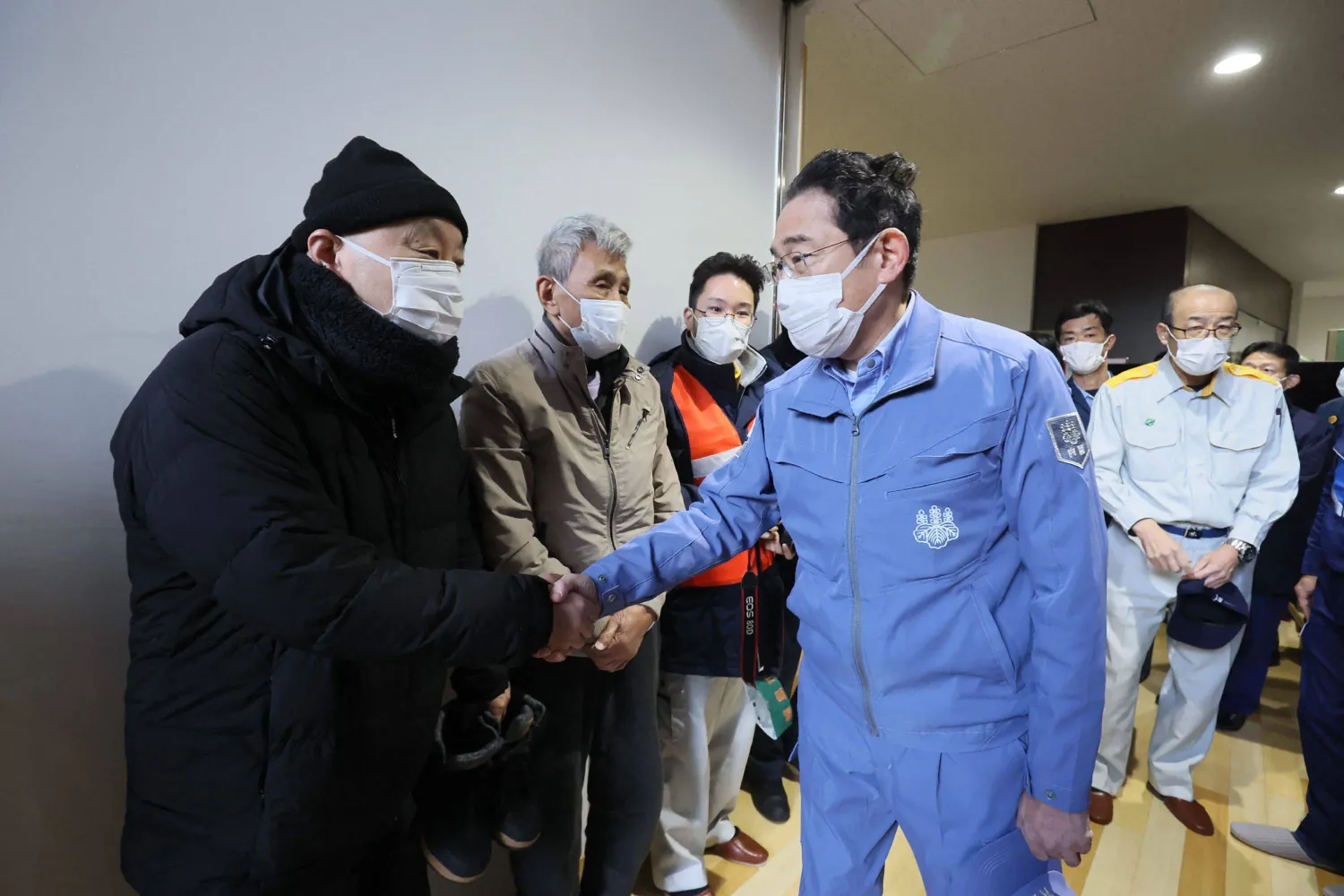
Japan's Prime Minister Fumio Kishida (R) speaks with evacuees in an evacuation center in Wajima city, of Ishikawa Prefecture on January 14, 2024, after a major 7.5 magnitude earthquake struck the Noto region in Ishikawa prefecture on New Year's Day. (Photo by JIJI PRESS / AFP)
TT

Japan PM Visits Quake-hit Region as Concerns Rise about Diseases

Japan's Prime Minister Fumio Kishida (R) speaks with evacuees in an evacuation center in Wajima city, of Ishikawa Prefecture on January 14, 2024, after a major 7.5 magnitude earthquake struck the Noto region in Ishikawa prefecture on New Year's Day. (Photo by JIJI PRESS / AFP)

Japan's Prime Minister Fumio Kishida visited Sunday the country's north-central region of Noto for the first time since the deadly Jan. 1 earthquakes to alleviate growing concern about slow relief work and the spread of diseases in evacuation centers.
The magnitude 7.6 earthquake left 220 dead and 26 others still missing while injuring hundreds. More than 20,000 people, many of whom had their homes damaged or destroyed, are taking refuge at about 400 school gymnasiums, community centers and other makeshift facilities, according to the Fire and Disaster Management Agency report.
Road damage has hampered rescue efforts, and though relief supplies have reached most regions affected by the quake, hundreds of people in isolated areas are getting little support. Additionally, in the hard-hit towns of Noto, Wajima and Suzu, elderly residents account for half their population, and many are facing growing risks of deteriorating health, officials and experts say.
Kishida, in his disaster-response uniform, visited a junior high school that has turned into an evacuation center in Wajima where officials showed him the evacuees' severe living conditions. They also spoke about the potential risk of spreading infectious diseases, such as influenza, COVID-19 and stomach flu due to the lack of running water.
The prime minister said he takes the evacuee's conditions seriously and promised support. “We will do everything we can so that you can have hope for the future," he said.
To prevent possible health problems and risk of death at evacuation centers, local and central government officials said they would provide the evacuees free accommodation at hotels and apartments — further away from their neighborhoods — until temporary housing was ready. But many of the locals have refused to move out, worried about their destroyed homes, belongings and communities.
Ishikawa Gov. Hiroshi Hase urged on Friday the residents to temporarily relocate to the recommended facilities to rest better and “protect your lives.”
Mototaka Inaba, a medical doctor who heads an international relief organization Peace Winds Japan, told an NHK talk show on Sunday that a secondary evacuation of elderly residents was critical from a medical perspective but should be done in a way that didn't isolate them.
According to The Associated Press, Chief Cabinet Secretary Yoshimasa Hayashi also stressed in a pre-recorded interview with NHK the importance of relocating the residents taking into consideration their sense of community, jobs and education.
Many have criticized Kishida's government over what they called a slow disaster response.
The cabinet has approved 4.7 billion yen (about $32 million) for relief efforts and is backing the call for a secondary evacuation, including to facilities in the capital region.



Russia: Man Suspected of Shooting Top General Detained in Dubai

An investigator works outside a residential building where the assassination attempt on Russian Lieutenant General Vladimir Alexeyev took place in Moscow, Russia February 6, 2026. REUTERS/Anastasia Barashkova
TT

Russia: Man Suspected of Shooting Top General Detained in Dubai

An investigator works outside a residential building where the assassination attempt on Russian Lieutenant General Vladimir Alexeyev took place in Moscow, Russia February 6, 2026. REUTERS/Anastasia Barashkova

Russia's Federal Security Service (FSB) said on Sunday that the man suspected of shooting top Russian military intelligence officer Vladimir Alexeyev in Moscow has been detained in Dubai and handed over to Russia.

Lieutenant General Vladimir Alexeyev, deputy head of the GRU, ⁠Russia's military intelligence arm, was shot several times in an apartment block in Moscow on Friday, investigators said. He underwent surgery after the shooting, Russian media ⁠said.

The FSB said a Russian citizen named Lyubomir Korba was detained in Dubai on suspicion of carrying out the shooting.

Russian Foreign Minister Sergei Lavrov accused Ukraine of being behind the assassination attempt, which he said was designed to sabotage peace talks. ⁠Ukraine said it had nothing to do with the shooting.

Alexeyev's boss, Admiral Igor Kostyukov, the head of the GRU, has been leading Russia's delegation in negotiations with Ukraine in Abu Dhabi on security-related aspects of a potential peace deal.


Factory Explosion Kills 8 in Northern China

Employees work on an electric vehicle (EV) production line at the Volkswagen Anhui factory in Hefei, Anhui province, China, February 4, 2026. REUTERS/Florence Lo
TT

Factory Explosion Kills 8 in Northern China

Employees work on an electric vehicle (EV) production line at the Volkswagen Anhui factory in Hefei, Anhui province, China, February 4, 2026. REUTERS/Florence Lo

An explosion at a biotech factory in northern China has killed eight people, Chinese state media reported Sunday, increasing the total number of fatalities by one.

State news agency Xinhua had previously reported that seven people died and one person was missing after the Saturday morning explosion at the Jiapeng biotech company in Shanxi province, citing local authorities.

Later, Xinhua said eight were dead, adding that the firm's legal representative had been taken into custody.

The company is located in Shanyin County, about 400 kilometers west of Beijing, AFP reported.

Xinhua said clean-up operations were ongoing, noting that reporters observed dark yellow smoke emanating from the site of the explosion.

Authorities have established a team to investigate the cause of the blast, the report added.

Industrial accidents are common in China due to lax safety standards.
In late January, an explosion at a steel factory in the neighboring province of Inner Mongolia left at least nine people dead.


Iran Warns Will Not Give Up Enrichment Despite US War Threat

Traffic moves through a street in Tehran on February 7, 2026. (Photo by ATTA KENARE / AFP)
TT

Iran Warns Will Not Give Up Enrichment Despite US War Threat

Traffic moves through a street in Tehran on February 7, 2026. (Photo by ATTA KENARE / AFP)

Iran will never surrender the right to enrich uranium, even if war "is imposed on us,” its foreign minister said Sunday, defying pressure from Washington.

"Iran has paid a very heavy price for its peaceful nuclear program and for uranium enrichment," Abbas Araghchi told a forum in Tehran.

"Why do we insist so much on enrichment and refuse to give it up even if a war is imposed on us? Because no one has the right to dictate our behavior," he said, two days after he met US envoy Steve Witkoff in Oman.

The foreign minister also declared that his country was not intimidated by the US naval deployment in the Gulf.

"Their military deployment in the region does not scare us," Araghchi said.