‘Freaky Tales,’ Kristen Stewart and Christopher Nolan Help Kick off Sundance Film Festival 

Kristen Stewart attends the 2024 Sundance Film Festival Opening Night Gala: Celebrating 40 Years at DeJoria Center on January 18, 2024 in Park City, Utah. (Getty Images/AFP)
TT

‘Freaky Tales,’ Kristen Stewart and Christopher Nolan Help Kick off Sundance Film Festival 

Kristen Stewart attends the 2024 Sundance Film Festival Opening Night Gala: Celebrating 40 Years at DeJoria Center on January 18, 2024 in Park City, Utah. (Getty Images/AFP)

Thousands of cinema lovers, Hollywood celebrities, industry executives and filmmakers from around the world have arrived in a very snowy Park City, Utah, for 10 days of movie watching.

The 40th edition of the Sundance Film Festival, the world’s premier showcase for independent film, kicked off Thursday with a starry gala honoring festival veterans such as Kristen Stewart and Christopher Nolan and numerous world premieres.

Nineteen films played on day one, including documentaries about Brian Eno, Lollapalooza and Frida Kahlo, Yance Ford’s inquiry into policing in America, "Power," as well as the mock government experiment "Girls State."

In fiction premieres, some lucky ticketholders were among the first to see Anna Boden and Ryan Fleck’s 80s-set "Freaky Tales" or "Thelma," featuring June Squibb as a Los Angeles grandmother who gets scammed and goes on a mission to get her money back with the late Richard Roundtree.

The festival has always been a major sales market for studios and distributors looking for films to fill their slates, including both theatrical and streaming releases. But in the aftermath of the dual Hollywood strikes, sales this year could be even more robust. The theatrical release calendar for the first half of the year was "decimated," producer Jason Blum noted at the opening day press conference. Around 80% of the 91 features playing do not yet have distributors.

"The one positive thing about the strike is that movies that might have struggled shouldn’t because there’s so many holes in the release schedule," Blum said. "I hope that a bunch of Sundance movies end up in theaters quickly."

Festival director Eugene Hernandez added that "these films are ready for their audience."

Blum, a Sundance board member, has had a longstanding relationship with the festival going back to the premiere of "Reality Bites" in 1992, which he said he almost missed because he was trapped "in a snowbank with Ethan Hawke."

Over the years, Blum has experienced both sides of the acquisition coin at Sundance, as the one buying films (including, he laughed, one of the least successful acquisitions ever, "Happy, Texas") and the one selling them (like Damien Chazelle's "Whiplash"). He also brought Jordan Peele's "Get Out" to the festival and said the response to that first screening "started the whole thing."

The main hub of activity remains in Park City, where many of the shops and restaurants on Main Street have been transformed into a hub of branded lounges from various sponsors and media partners. In addition to the venues playing movies around the clock, there are various talks and panels on everything from the legacy of Sundance to making your first feature. There will also be screenings in Salt Lake City, and, beginning on Jan. 25, online showings of select films for virtual festival passholders.

Slightly outside of town Thursday, some of the festival’s most well-heeled attendees gathered at the DeJoria Center in Kamas, Utah, for an opening night fundraising gala in which Nolan, Stewart, "Past Lives" director Celine Song and "The Eternal Memory" director Maite Alberdi received tribute awards.

Eisenberg gave the award to Stewart, who he has worked with on three films: "two gentle talkies and one aggressive shoot 'em up," he said.

"Kristen is one of these rare performers where she is so committed, so authentic, so feeling, that you almost want to make sure she’s okay at the end of the day," he said.

Stewart has been coming to Sundance for 20 years and this year has two films debuting: Rose Glass’s crime thriller "Love Lives Bleeding," which is heading to theaters in March, and "Love Me," with Steven Yeun, in which a buoy and a satellite fall in love.

"My whole life I have loved this festival," Stewart said. "I knew that in my bones this was just like a place full of ‘yes’ in a world full of ‘no.' I couldn’t even understand why, but I knew it."

Robert Downey Jr. also was on hand to toast his "Oppenheimer" director, who, he said, "is a bit blue because a terrible tragedy has befallen him and I don’t mean to bring this up and I know it’s very personal: He has become recognizable on the street."

Nolan won a screenwriting award for "Memento" after it screened at Sundance in 2001. Both that film and "Following," which played "up the hill" at Slamdance, were independently financed before he and his wife and producer Emma Thomas went on to have great successes with studio films.

But Nolan said he doesn’t think he has ever been an independent filmmaker, insofar as filmmaking is dependent on other people, from the crew to those who help get a movie out to the world.

"A lot of people know it came to Sundance, a lot of people know that it was a hit and enabled so much more that came after it for us," Nolan said.

But, he said, not a lot of people know that earlier, when the film was finished, all the independent distributors passed on buying it and the filmmakers found themselves in "terrible limbo" for a year not knowing whether it would ever be seen by an audience.

"It was an appalling position to be in, but so many people became so important in that moment," Nolan said. "These people who saw the film, believed in it and stood by it, those are the people you depend on as a filmmaker. You can't get anywhere without them."

The film festival runs through Jan. 28.


'Mad Dream': New Showcase for African Film Opens in London

Nigerian film director and media mogul Mo Abudu poses ahead of the opening the UK's first cinema dedicated exclusively to African and black films. Justin TALLIS / AFP
TT

'Mad Dream': New Showcase for African Film Opens in London

Nigerian film director and media mogul Mo Abudu poses ahead of the opening the UK's first cinema dedicated exclusively to African and black films. Justin TALLIS / AFP

Nigerian producer and media mogul Mo Abudu has realized a "mad dream" by opening a unique cultural center in London complete with a cinema dedicated to African film and black culture.

Close to the Houses of Parliament and its Big Ben clock, a massive concrete facade conceals the venue, which opens to the public this weekend - the first of its kind in Britain and Europe.

A small sign reads "EbonyLife Place London".

While the name may mean little to many passers-by, film lovers will recognize the reference to EbonyLife, a leading African production company and a major player in Nollywood, Nigeria's film industry.

Mosunmola "Mo" Abudu, 62, heads a media empire that stretches far beyond Nigeria's borders.

In 2025, Forbes ranked her among the world's 100 most influential women.

"It's time to tell our own stories," she told AFP. "I want to showcase the best of who we are, celebrate who we are. Let them see us at our very best."

Abudu, who was born in London, is pursuing that ambition in the British capital through the cultural center, which she describes as both "literally a blank canvas" and "a bit of a mad dream".

"We have to make the journey because the thing is that we have consumed so much of the world. How much of the world has consumed us?" she asked.

She recalled that growing up in England: "I could never go anywhere during my youth and watch a black movie."

So she decided to act.

"I'm not waiting anymore for anyone to take a six-hour trip from London to understand what it is to watch a Nigerian film or to see Nigerian fashion and so on and so forth. It's right here in London."

- 'Open to everyone' -

The two-storey venue includes a bar, a lounge called "Fehinti" -- a Yoruba word meaning to lean back and rest -- a restaurant and a boutique showcasing designers from Africa and its diaspora. Paintings by artists from across the continent line the walls.

Its centerpiece, however, is the new cinema, fitted with red seats, wood paneling and soft lighting. It has been named "Amani", meaning peace and harmony in Swahili.

The project, financed almost entirely by Abudu's media group, mirrors the upscale lifestyle complex she launched in Lagos in 2019.

Abudu, who is widely credited with helping usher in the era of Nollywood blockbusters, said African creatives should stop asking others to make room for them and instead "take responsibility for creating our own spaces".

Describing the center as a "safe space", she said it would be a place where "you can shop our fashion, you can view our art, you can listen to our music, and we can tell our stories".

Access will be through a membership scheme, details of which have yet to be announced. Such systems are common in Britain, particularly among cultural institutions.

There will be no ethnic or nationality restrictions. "Membership is open to everyone," she insisted.

The cinema's program is still being finalized. But here too, the objective is clear.

"We will have films from all parts of Africa. Everything should be on the table. We would show movies that celebrate black actors, black storytelling; that is why we are here," Abudu said.

Will audiences be able to see films by Senegalese director Ousmane Sembene or by Algerian filmmaker Mohammed Lakhdar-Hamina, the only African director ever to win the Cannes Palme d'Or? Her answer was an emphatic "yes".

The center will also showcase its own productions and films with black actors, including the next in the "Black Panther" series. Opening week will feature Nigerian filmmakers including Nwani Orire and Ifeyinwa Arinze.

And after London?

"I would love to do the same thing in Paris, perhaps through a partnership. I'm always open to collaborating with others," Abudu said.


Nicole Kidman, Zendaya and Hovering Cars See Paris Fashion Week Go Out on a High

Zendaya attends the Nicolas Ghesquiere's Spring/Summer 2027 collection show for fashion house Louis Vuitton during Paris Fashion Week in Paris, France, October 6, 2026. REUTERS/Sarah Meyssonnier
TT

Nicole Kidman, Zendaya and Hovering Cars See Paris Fashion Week Go Out on a High

Zendaya attends the Nicolas Ghesquiere's Spring/Summer 2027 collection show for fashion house Louis Vuitton during Paris Fashion Week in Paris, France, October 6, 2026. REUTERS/Sarah Meyssonnier

Coco Chanel designed her postwar suit so women could move. Seven decades later, designer Matthieu Blazy has made it stretch.

Suits in a new “smocked tweed” anchored Blazy’s spring-summer 2027 collection for Chanel, shown Monday night at the Grand Palais beneath a flock of illuminated birds as Nicole Kidman, Dua Lipa and Pedro Pascal watched from the front row.

The fabric gives like sportswear, but the idea is old. Chanel built its name by changing how women dressed, and a year after his debut as its designer, Blazy is applying that principle to the house’s own uniform.

Louis Vuitton closed Paris Fashion Week on Tuesday evening with Zendaya in the audience and car sculptures hovering above the runway at the Louvre Museum. It was the final major show of a spring runway season that began in New York last month.

Blazy came from Bottega Veneta to succeed the longtime right hand of Karl Lagerfeld, Virginie Viard, who took over after Lagerfeld's death in 2019. Viard’s tenure brought record sales. Blazy’s has brought back surprise.

He loosens the house’s symbols rather than replacing them. Tweed stretches. Jackets go on over bare skin. Quilted bags slouch. Longtime clients still recognize the codes; newer ones are invited to play with them.

This season, he staged Gabrielle “Coco” Chanel’s life as an escape: from the corsets and stiff tailoring of her Edwardian youth, through the men’s clothes she borrowed, to the easy suits of her postwar comeback.

“It’s about the women within a woman,” Blazy said.

Kidman, who attended with her daughter Faith Margaret, also supplied recorded readings from Virginia Woolf’s “Orlando.” Kidman won an Oscar for portraying Woolf in “The Hours.”

Kidman, Lipa, Pascal and Alexa Demie sang along to a-ha’s “Take On Me,” and the show ended with Britney Spears’ “Gimme More.”

On the Chanel runway Edwardian dress lingered in traces of boning, peplums and ruffled collars. Men’s formal wear was cut down into raw-edged vests and narrow skirt suits.

A pearl-stitched corset top worn with plain black trousers complicated the story of escape, making constraint part of the appeal.

The most beautiful pieces were dresses of layered, printed silk that tracked the sky from morning to nightfall, and 1930s-style sequined or beaded gowns that Chanel described as having the ease of a T-shirt.

Not everything landed. Pattern-on-pattern outfits and ballet tutus tipped into costume, and at 83 looks, the argument sometimes sprawled.

The birds made it more gracefully: swallows perched on buttons and jewelry, and a birdcage evening bag came with its birds already flown.

Model Dyanira Hurbuscher walked first and last, both times carrying the founder’s own 2.55 handbag from the house archives — freedom, with the past firmly in hand.

Vuitton lightens up Louis Vuitton offered a softer vision of the future — and another argument for giving the body room to move.

Nicolas Ghesquière, known for sculpted, futuristic silhouettes, loosened things up with gauzy shift dresses, cardigans, short jackets and soft tailoring. Delicate fabrics rippled as models walked, and slim trousers incorporated sheer mesh panels.

His taste for science fiction remained intact. An asphalt runway crossed the Louvre’s Cour Carrée beneath dozens of wedge-shaped concept cars raised on poles and decorated in the house’s Damier checkerboard pattern. Silver lamé gave some shift dresses a metallic flash.

Zendaya, a house ambassador, brought some informality to the front row, pairing jeans with the ruffled white lace jacket that she had worn to the Paris premiere of “The Odyssey.” Emma Stone, Saoirse Ronan, Blackpink’s Lisa, Sophie Turner and Catherine Deneuve also attended.

Paris loosens up Across Paris, designers made similar moves: mixing formal clothes with sportswear, bringing lingerie into public view and making elaborate decoration feel lighter.

Miu Miu worked the same seam from the opposite side, dressing sportswear up. Miuccia Prada paired pleated check skirts and blazers with running shorts and track tops. Shoelaces became belts, and guests watched from gym-style bleachers. Olivia Colman modeled a black leather skirt suit, joining Jamie Bell and Emma Corrin on the runway.

Sacai’s Chitose Abe, back on the women’s runway after a season away, set tough clothes in motion. Biker leathers broke into swinging fringe, silk tassels crowned military jackets, and prints of beads and rhinestones under sheer layers gave the look of embellishment without the weight. She finished by running to hug Pharrell Williams.

At Valentino, plain satin bustiers and knee-length skirts offered a more intimate kind of formality. Showing at the Sainte-Geneviève Library, Alessandro Michele compared unworn clothes with unread books in his notes: both “still speak to us of the lives we could have lived.” Alexander Skarsgård brought Icelandic sagas to donate.

Elie Saab took lingerie in a more nostalgic direction. Beaded slips and lace bralettes recalled the early 2000s, when Halle Berry won her Oscar in one of his gowns. Paris and Nicky Hilton sat in the front row.

Victoria Beckham’s pleated dresses hung from jewelry chains, taffeta raincoats looked weightless and wedge sandals had their heels hollowed out.

As with Blazy’s stretch tweed, the ambition was to make elaborate clothes feel easy to wear.


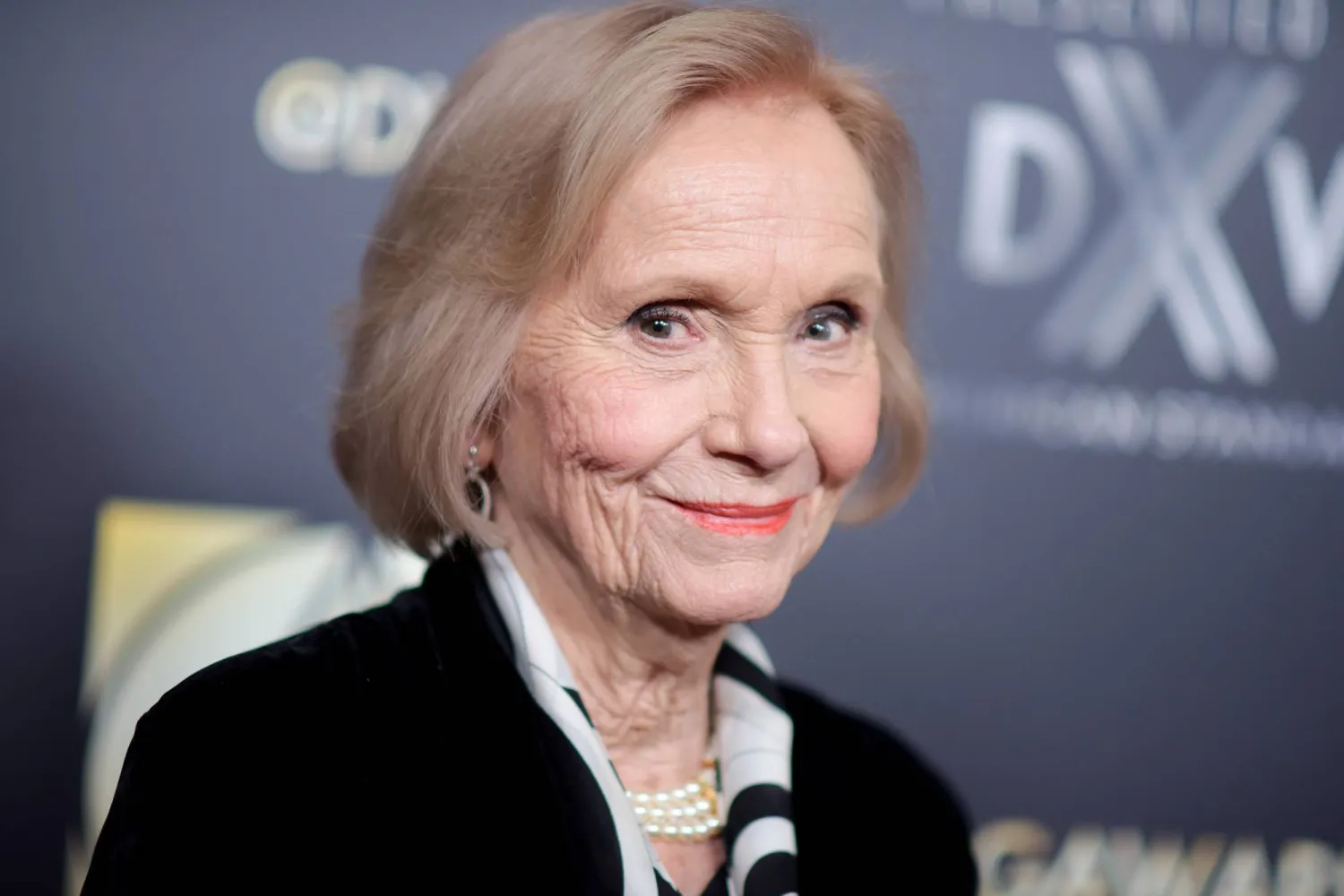
Eva Marie Saint, Oscar Winner of Hollywood Classics, Dies at 102

Actress Eva Marie Saint attends the 20th Annual Art Directors Guild Excellence In Production Design Awards held at the Beverly Hilton Hotel on Sunday, Jan. 31, 2016, in Beverly Hills, Calif. (AP)
TT

Eva Marie Saint, Oscar Winner of Hollywood Classics, Dies at 102

Actress Eva Marie Saint attends the 20th Annual Art Directors Guild Excellence In Production Design Awards held at the Beverly Hilton Hotel on Sunday, Jan. 31, 2016, in Beverly Hills, Calif. (AP)

Eva Marie Saint, the pale, willowy actor who won an Academy Award for her first movie, “On the Waterfront,” and starred opposite Cary Grant in the Alfred Hitchcock thriller “North by Northwest,” has died. She was 102. 

Saint, whose acting work lasted well into her 90s, died at her home in Los Angeles on Tuesday, confirmed family representative Jeff Sanderson. 

Saint had one of the most spectacular debuts in Hollywood history, as the love interest of Marlon Brando’s tormented Terry Malloy in “On the Waterfront,” and her first trip to the Academy Awards was memorable too. Pregnant with her first child, Saint accepted her Oscar from Frank Sinatra and smilingly murmured a unique winner's speech: “I think I may have the baby right here.” (Her son, Darrell, was born two days later.) 

The award for the 1954 classic made her an instant star, but she soon astonished Hollywood with a firm independence that would mark her career. She refused offers of studio contracts and declined chances to follow up on her great success, explaining that she was taking time off to become acquainted with her new son. (A daughter, Laurette, was born in 1958.) 

In her first decade in Hollywood, Saint appeared in a mere seven films. She declined such top-level productions as “The Man in the Gray Flannel Suit” with Gregory Peck, “Summer and Smoke” with Laurence Harvey and “The Rainmaker” with Burt Lancaster. She credited her husband, TV and stage director Jeffrey Hayden, with persuading her to star in Hitchcock’s “North by Northwest,” the classic 1959 thriller in which Saint plays a spy who seduces Grant, but ends up falling for him. 

“I vividly remember him saying, ‘Honey, I think you should find a quiet spot. I’ll take care of the children and I want you to really think about this and reread this script,’” she told Vanity Fair in 2014. “He was so right. And that’s what husbands are for.” 

Instead of being put off by her selectivity, studios continued offering her starring roles in such films as “Exodus” (with Newman), “Raintree County” (Elizabeth Taylor, Montgomery Clift) and “All Fall Down,” with Warren Beatty. 

She turned more to television in the 1970s and enjoyed renewed popularity in the 1980s as the mother of Cybill Shepherd in the hit sitcom “Moonlighting” and as Tom Hanks’ mother in the film comedy “Nothing in Common.”  

She won an Emmy for the 1990 miniseries “People Like Us,” and had roles in such 21st century movies as “Because of Winn-Dixie,” “Superman Returns” and “Winter’s Tale,” adapted from Mark Helprin's novel of the same name. In 2021, she played Marisa Tomei's aunt in the brief audio play “The Bus Ride,” part of “The Pack Podcast.” 

Saint was married to Hayden for 55 years, until his death in 2016. 

That was her real name  

When Saint emerged in the public consciousness, many believed her theatrical-sounding name must have been invented. She was born with it on July 4, 1924, in Newark, New Jersey. The family moved to Delmar, a small town near Albany, New York, where her father was a Goodrich Rubber Co. manager. Eva's goal was to become a third-grade teacher like her mother, but at Bowling Green State University in Ohio she tried out for a play and won the leading role. 

After graduation she lived with her parents in Flushing, Long Island, and began hunting for acting jobs in Manhattan. After a fruitless year, she landed a two-line role as a telephone operator on a radio drama and soon was working steadily on soap operas and nighttime dramas, appearing for two years as Claudia on “One Man's Family.” Network television was booming in the early 1950s, and her looks and dramatic sense made her a favorite with casting people and producers. 

A critical turn in Saint's career came when she auditioned before Elia Kazan and was accepted into the Actors Studio, which shaped a generation of method-actor stars. She credited acting coach Lee Strasberg with helping her overcome her shyness. 

“Lee Strasberg, when he got to know me a little bit, gave me a scene to do where I had to cry in front of my peers,” she told The Santa Barbara Independent in 2009. “I worried about it, I worked on it, I tried to use what I was learning at the studio. I finally did the scene, and I cried, and my peers were crying with me. It was just an incredible moment for me.” 

Saint was rejected for the single female role in the play “Mister Roberts,” but was hired to understudy the actor chosen, Jocelyn Brando, Marlon's sister. In six frustrating months Saint never got to substitute for Brando. She finally made it to Broadway in “A Trip to Bountiful,” which she had played on television. 

Kazan invited her to try out for the female lead in “On the Waterfront” by improvising a scene with Brando. She was told to try to stop a young man from entering her apartment. She told the Los Angeles Times in 2001: “All I know is that Marlon got in the door and turned on the music. We started dancing. He flicked my skirt. Kazan saw the sparks fly, and that's how I got the part.”