


UN Chief Warns That Israel’s Rejection of Two-State Solution Threatens Global Peace 

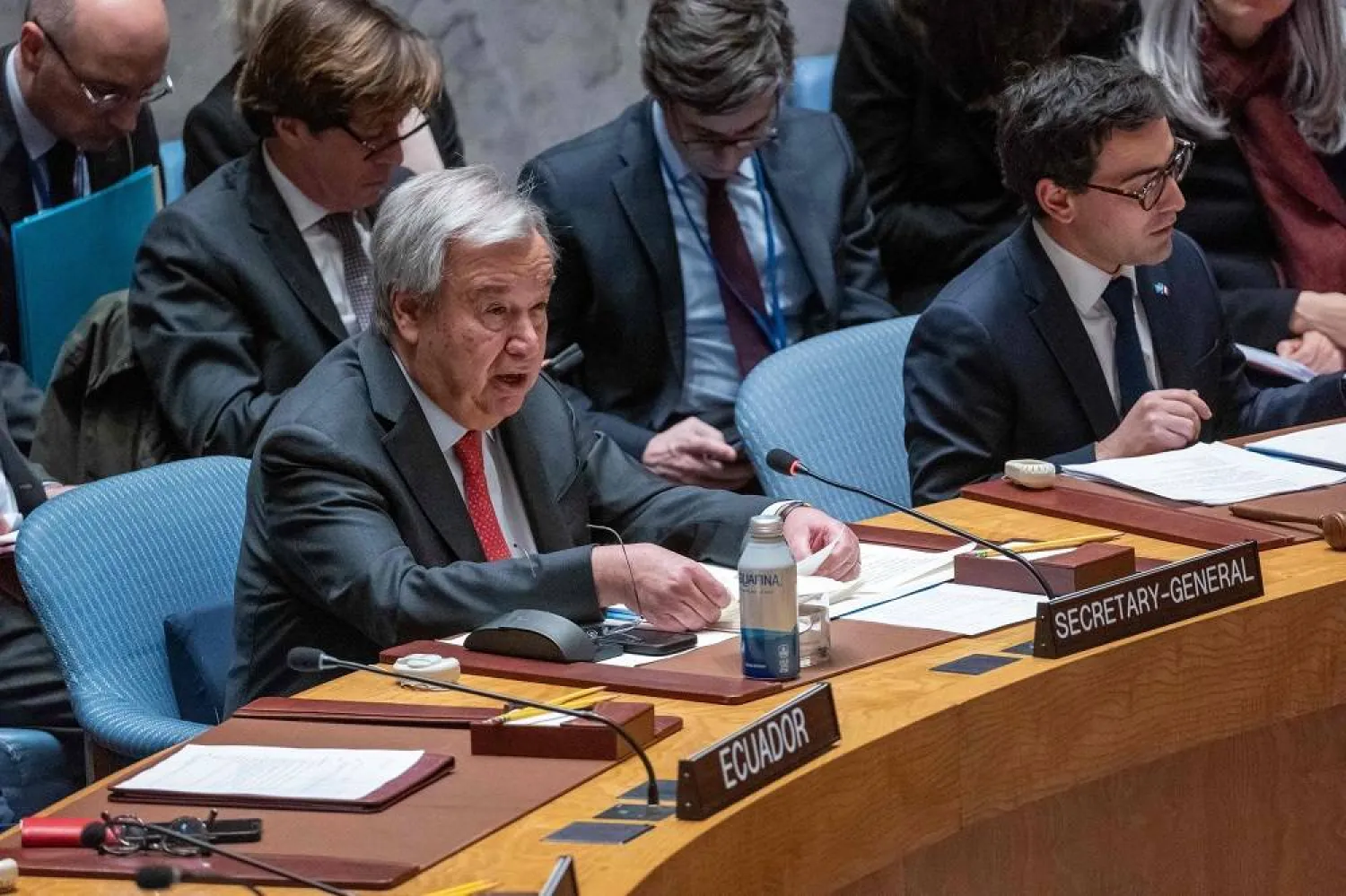
United Nations Secretary-General, Antonio Guterres speaks at a United Nations Security Council (UNSC) meeting on the Middle East, including the situation in Gaza and Israel on January 23, 2024 in New York City. (Getty Images via AFP)
TT

UN Chief Warns That Israel’s Rejection of Two-State Solution Threatens Global Peace 

United Nations Secretary-General, Antonio Guterres speaks at a United Nations Security Council (UNSC) meeting on the Middle East, including the situation in Gaza and Israel on January 23, 2024 in New York City. (Getty Images via AFP)

The United Nations chief warned Israel on Tuesday that Prime Minister Benjamin Netanyahu ’s rejection of a two-state solution will indefinitely prolong a conflict that is threatening global peace and emboldening extremists everywhere.

In his toughest language yet on the Israeli-Hamas war, Secretary-General Antonio Guterres told a ministerial meeting of the UN Security Council that “the right of the Palestinian people to build their own fully independent state must be recognized by all, and a refusal to accept the two-state solution by any party must be firmly rejected.”

The alternative of a one-state solution “with such a large number of Palestinians inside without any real sense of freedom, rights and dignity ... will be inconceivable,” he said.

Guterres also warned that the risks of regional escalation of the conflict “are now becoming a reality,” pointing to Lebanon, Yemen, Syria, Iraq and Pakistan. He urged all parties “to step back from the brink and to consider the horrendous costs” of a wider war.

Netanyahu’s rejection of a Palestinian state in any postwar scenario opened a wide rift with Israel’s closest ally, the United States, which says the war must lead to negotiations for a two-state solution where Israel and the Palestinians can live side-by-side in peace. That goal is supported by countries around the world, as ministers and ambassadors reiterated Tuesday.

Uzra Zeya, the State Department’s undersecretary for civilian security, democracy and human rights, told the council, “A key component of US diplomacy is to pursue a pathway both to a Palestinian state and normalization and integration between Israel and other regional states.”

“The goal is a future where Gaza is never again used as a platform for terror, and a future where Palestinians have a state of their own,” she said, reiterating the Biden administration’s call on Israel to do more to protect Palestinian civilians.

Russia’s Foreign Minister Sergei Lavrov countered that American diplomacy “oscillates between vetoing resolutions about the ceasefire and at the same time calling for a reduction in the intensity of hostilities in Gaza.”

“Without a doubt this serves as carte blanche for the ongoing collective punishment of Palestinians,” Lavrov told the council.

Secretary-General Guterres repeated his longstanding call for a humanitarian ceasefire — an appeal with overwhelming global support.

But Israel’s UN Ambassador Gilad Erdan again rejected a ceasefire, saying Hamas, which carried out a brutal attack on southern Israel on Oct. 7, is committed to attacking again and destroying Israel, and a halt to fighting will only allow the militants “to regroup and rearm.”

He urged the Security Council to “eliminate the root” of the conflict, which he said was Iran.

Erdan strongly criticized the presence of Iran’s foreign minister at the council meeting, saying the country provides weapons to Hamas, to Hezbollah fighters in Lebanon and Houthi militants in Yemen, “and soon these acts will be carried out under a nuclear umbrella” and “Iran’s terror will reach all of you.”

Iran has long denied seeking nuclear weapons and insists its nuclear program is entirely for peaceful purposes. But the UN nuclear watchdog has warned that Iran has enough enriched uranium for nuclear bombs if it chose to build them.

Iran’s Foreign Minister Hossein Amir-Abdollahian didn’t mention its nuclear program, but he warned Israel that it would not destroy Hamas, its stated goal.

“The killing of civilians in Gaza and the West Bank cannot continue on to the so-called total destruction of Hamas, because that time will never come,” he said. “Stopping the genocide in Gaza is the main key to security in the region.”

Riyad al-Maliki, the Palestinian foreign minister, said Israel is carrying out “the most savage bombing campaign” since World War II, which is leading to famine and the massive displacement of civilians. “This is an assault of atrocities,” which has destroyed countless innocent lives, he said.

The Health Ministry in Hamas-ruled Gaza says more than 25,000 Palestinians have been killed since the start of the war, which has caused widespread destruction, displaced an estimated 85% of Gaza’s 2.3 million people, and left one-quarter facing starvation.

Israel began its military campaign in response to the Oct. 7 attacks in which militants from the enclave killed around 1,200 people in Israel and took about 250 hostages.

Al-Maliki said Israel doesn’t see the Palestinians as a people and a “political reality to coexist with, but as a demographic threat to get rid of through death, displacement or subjugation.” He said those are the choices Israel has offered Palestinians, calling them tantamount to “genocide, ethnic cleansing or apartheid.”

Al-Maliki said there are only two future paths: One starts with Palestinian freedom and leads to Middle East peace and security, and the other denies freedom and “dooms our region to further bloodshed and endless conflict.”

France’s new foreign minister, Stéphane Séjourné, whose country holds the council presidency this month, presided at the meeting and warned that “a regional conflagration is real.”

He said the world should unite and deliver different messages to the warring parties.

Israel must be told that “there must be a Palestinian state” and that violence against Palestinians, including by West Bank settlers, must end, Séjourné said. And the Palestinians must be told that “there can be no ambiguity regarding Israel’s right to live in peace and security, and to exercise its right to self-defense against terrorism.”

But Türkiye's Foreign Minister Hakan Fidan said the argument that the war is about providing security for Israel “is far from being convincing.” He said supporters of this view never talk about the Palestinians’ right to security and self-defense.

Jordan’s Foreign Minister Ayman Safadi said the “ideology of hate embraced openly by Israeli ministers is normalizing the mass murder of Palestinians” and urged the council to stop it with a binding resolution.

Israel must be held accountable for war crimes and for blocking a Palestinian state, Safadi said. “The future of the region cannot be taken hostage to the political ambitions and the radical agendas of Israeli extremists, who described the Palestinians as human animals, unworthy of life, who enable settler terrorism against Palestinian people.”



Hezbollah Chief Accuses Lebanese Authorities of Working ‘in the Interest of What Israel Wants’

Hezbollah leader Naim Qassem
TT

Hezbollah Chief Accuses Lebanese Authorities of Working ‘in the Interest of What Israel Wants’

Hezbollah leader Naim Qassem

Hezbollah leader Naim Qassem on Sunday said moves to disarm the group in Lebanon are an "Israeli-American plan,” accusing Israel of failing to abide by a ceasefire agreement sealed last year.

Under heavy US pressure and fears of expanded Israeli strikes, the Lebanese military is expected to complete Hezbollah's disarmament south of the Litani River -- located about 30 kilometers from the border with Israel -- by the end of the year.

It will then tackle disarming the Iran-backed movement in the rest of the country.

"Disarmament is an Israeli-American plan," Qassem said.

"To demand exclusive arms control while Israel is committing aggression and America is imposing its will on Lebanon, stripping it of its power, means that you are not working in Lebanon's interest, but rather in the interest of what Israel wants."

Despite a November 2024 ceasefire that was supposed to end more than a year of hostilities between Israel and Hezbollah, Israel has kept up strikes on Lebanon and has maintained troops in five areas it deems strategic.

According to the agreement, Hezbollah was required to pull its forces north of the Litani River and have its military infrastructure in the vacated area dismantled.

Israel has questioned the Lebanese military's effectiveness and has accused Hezbollah of rearming, while the group itself has rejected calls to surrender its weapons.

"The deployment of the Lebanese army south of the Litani River was required only if Israel had adhered to its commitments... to halting the aggression, withdrawing, releasing prisoners, and having reconstruction commence," Qassem said in a televised address.

"With the Israeli enemy not implementing any of the steps of the agreement... Lebanon is no longer required to take any action on any level before the Israelis commit to what they are obligated to do."

Lebanese army chief Rodolphe Haykal told a military meeting on Tuesday "the army is in the process of finishing the first phase of its plan.”

He said the army is carefully planning "for the subsequent phases" of disarmament.


Israel Army Ends Crackdown on West Bank Town after Attack

Smoke rises following an explosion detonated by the Israeli army, which said it was destroying buildings used by Palestinian militants in the West Bank Jenin refugee camp, Sunday, February 2, 2025. © Majdi Mohammed, AP
TT

Israel Army Ends Crackdown on West Bank Town after Attack

Smoke rises following an explosion detonated by the Israeli army, which said it was destroying buildings used by Palestinian militants in the West Bank Jenin refugee camp, Sunday, February 2, 2025. © Majdi Mohammed, AP

The Israeli military said on Sunday it had ended its operation in a town in the occupied West Bank that it had sealed off after a Palestinian from the area killed two Israelis.

Around 50 residents of Qabatiya were briefly detained during the two-day operation, the official Palestinian news agency Wafa reported, quoting the town's mayor Ahmed Zakarneh.

The attacker's father and two brothers remained in custody, it added.

The military launched the operation on Friday, shortly after a 34-year-old Palestinian fatally stabbed an 18-year-old Israeli woman and ran over a man in his sixties with his vehicle.

When contacted by AFP on Sunday morning, the military confirmed the end of its operation in the area.

Defense Minister Israel Katz previously said the army had completely sealed off the town.

Wafa also reported that Israeli troops had withdrawn from Qabatiya, near the city of Jenin.

Zakarneh said the town had been in a state of "total paralysis" during the military activity.

Israeli army bulldozers tore up pavement on several streets and erected roadblocks to halt traffic, he said, adding that around 50 houses were searched.

Wafa reported that a school had been turned into a detention and interrogation center.

AFPTV footage filmed on Saturday showed Israeli soldiers carrying automatic rifles and patrolling the streets, where several armoured vehicles were deployed.

Shops were closed, though men and children were seen walking through the village.

On Sunday, the Israeli army said it had sealed off the assailant's home and was finalising "the procedures required for its demolition".

Israeli authorities argue that demolishing the homes of Palestinians who carry out attacks against Israelis has a deterrent effect.

Critics, however, condemn the practice as collective punishment that leaves families homeless.


Arab League Council Holds Extraordinary Session on Latest Developments in Somalia

A general view shows the opening session of the meeting of Arab foreign ministers at the Arab League Headquarters (Reuters)
TT

Arab League Council Holds Extraordinary Session on Latest Developments in Somalia

A general view shows the opening session of the meeting of Arab foreign ministers at the Arab League Headquarters (Reuters)

At the request of the Federal Republic of Somalia and with the support of Arab League member states, the Arab League Council on Sunday began its extraordinary session at the league’s General Secretariat, at the level of permanent representatives and under the chairmanship of the United Arab Emirates, to discuss developments regarding the Israeli occupation authorities’ declaration on mutual recognition with the Somaliland region.

The Kingdom’s delegation to the meeting was headed by its Permanent Representative to the Arab League Ambassador Abdulaziz bin Abdullah Al-Matar, SPA reported.

The meeting is discussing ways to strengthen the unified Arab position in addressing this step, to affirm full solidarity with Somalia, and to support its legitimate institutions in a manner that contributes to preserving security and stability in the region.

The meeting also aims to reaffirm the Arab League’s categorical rejection of any unilateral measures or decisions that could undermine Somalia’s sovereignty and territorial integrity, and to emphasize commitment to the principles of international law and the relevant resolutions of the Arab League and the African Union.