
How Does Dabaa Plant Bolster Egyptian-Russian Cooperation in Nuclear Energy?

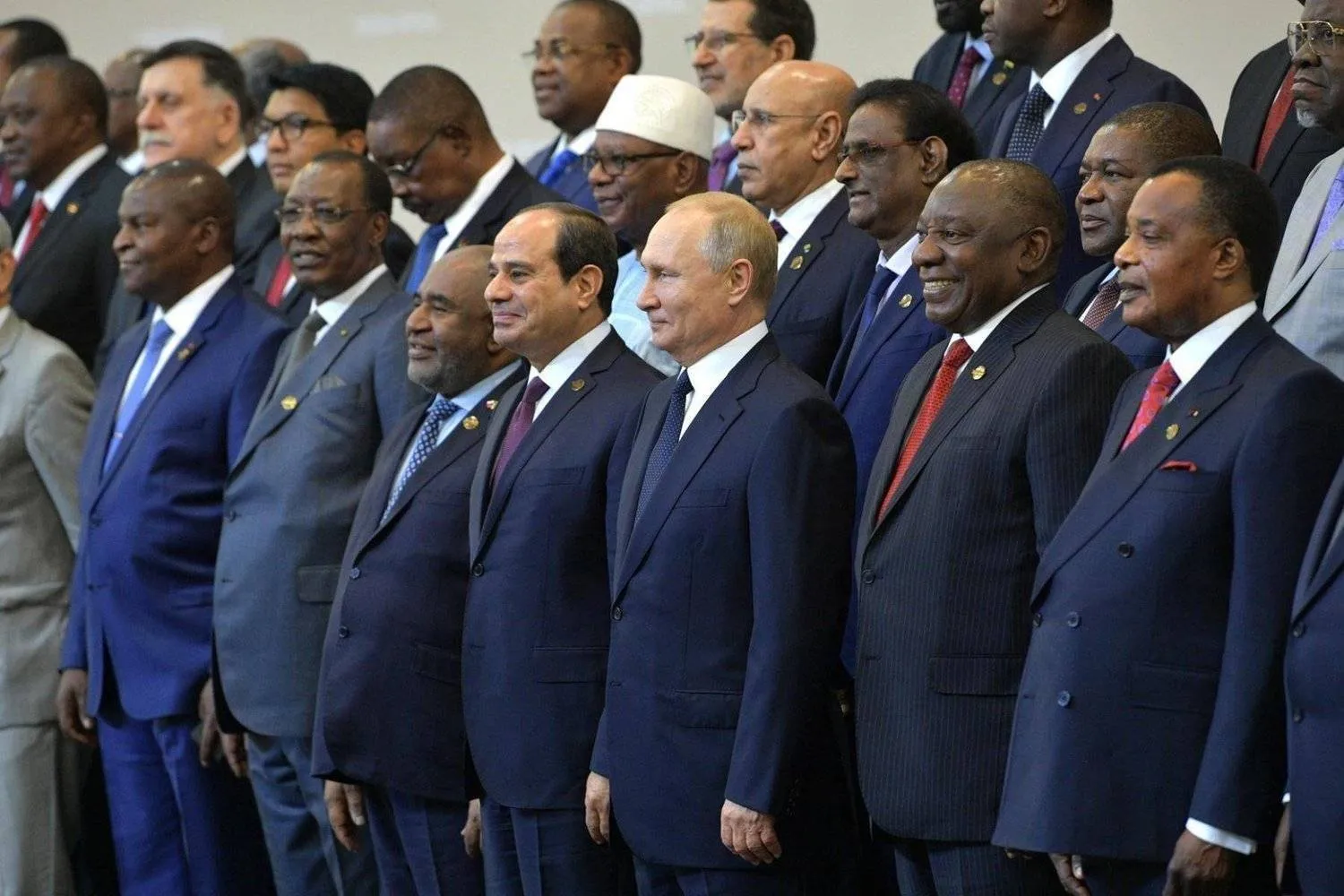
African leaders during the first summit in Sochi with Russian President Vladimir Putin last July (Russian Presidency)
TT

How Does Dabaa Plant Bolster Egyptian-Russian Cooperation in Nuclear Energy?

African leaders during the first summit in Sochi with Russian President Vladimir Putin last July (Russian Presidency)

Egyptian President Abdel Fattah al-Sisi and his Russian counterpart Vladimir Putin virtually laid the foundation of el-Dabaa, Egypt's first-ever nuclear power plant (NPP).
The Presidents witnessed the official ceremony for pouring the first concrete into the foundation of power unit 4 at the Nuclear Power Plant (NPP) developed by the Russian State Atomic Energy Corporation (Rosatom).
Experts said the new power plant will bolster cooperation between the two nations, describing it as the "partnership of the century."
At the inauguration ceremony, Sisi said Egypt is "writing a new bright chapter in history by fulfilling the long-held aspiration of all Egyptians of owning a peaceful nuclear plant."
The President said the "great event represents another chapter in the close cooperation between Egypt and Russia."
The Dabaa station is the first nuclear facility in Matrouh Governorate on the coast of the Mediterranean Sea, about 300 kilometers northwest of Cairo.
The Dabaa station will include four "Three +" generation reactors operating with pressurized water, with a total capacity of 4,800 megawatts, 1,200 megawatts each, with the first reactor scheduled to be launched in 2028.
The long-awaited NPP costs $28.75 billion, about 85% of which is financed by Russia and paid by Egypt over a 22-year loan with an annual 3% interest rate as per a bilateral agreement signed back in 2015.
Sisi said that the fourth unit allows Egypt to begin the next phase of building the nuclear reactor.
It "shall contribute to providing safe, cheap, and long-term energy supplies, reducing dependence on fossil fuels and avoiding fluctuations in their prices."
Sisi stressed that introducing nuclear power into the energy mix that Egypt relies on to produce electricity is crucial to meeting the growing demands for electrical energy to fulfill the needs of economic and social development plans.
It contributes to boosting reliance on new and renewable energy, which achieves environmental sustainability and addresses climate change.
Egypt suffers from a shortage of electrical energy, which prompted the Egyptian government to make decisions to reduce loads and cut off electricity in residential neighborhoods.
The President stated that the "great event" of pouring concrete for the fourth unit of the nuclear reactor "reflects the enormous efforts exerted by both sides towards implementing Egypt's national project, with the establishment of El-Dabaa Nuclear Power Plant."
The Egyptian President thanked his Russian counterpart and the project workers from both countries.
The process of pouring the concrete slab that will be used as the basis for the fourth unit of the nuclear power plant is the end of the preparation phase and a transition to begin the primary phase of the project.
Putin stressed that the Dabaa nuclear plant represents the culmination of cooperation between Cairo and Moscow and will contribute to developing the Egyptian economy and promoting modern industries.
He added that trade exchange with Egypt is witnessing significant development, and there is a partnership in many energy and agriculture projects, noting that the Dabaa nuclear station is the most important project between the two countries.

Egypt is Russia's strategic partner, said Putin and invited his Egyptian counterpart to attend the BRICS summit scheduled for next October, according to the Russian TASS news agency.
Recently, Rosatom announced it was opening a representative office in Egypt.
Director of Rosatom's country office in Egypt, Murad Aslanov, said at the time that the company launched a large-scale project initiative to unify the infrastructure of its projects abroad.

The Dabaa station is the company's most significant project in Africa. Located in the Matrouh Governorate, it is Egypt's first nuclear facility.


Israel Carries Out More Strikes in Lebanon amid Lack of Int’l Assurances on Wider Regional Escalation

People gather near a building damaged in an Israeli strike in the village of Bednayel in eastern Lebanon, 21 February 2026. EPA/WAEL HAMZEH
TT

Israel Carries Out More Strikes in Lebanon amid Lack of Int’l Assurances on Wider Regional Escalation

People gather near a building damaged in an Israeli strike in the village of Bednayel in eastern Lebanon, 21 February 2026. EPA/WAEL HAMZEH

Lebanese officials say the country has yet to obtain firm or decisive Western guarantees that it will be spared from a larger confrontation in the region as speculation grows over a potential US strike on Iran.

Chief concerns center on whether Hezbollah would be targeted as part of any large-scale strike, or whether the group might intervene militarily alongside Tehran.

Ministerial sources said Israeli airstrikes on Hamas in the Ain al-Hilweh Palestinian refugee camp in southern Lebanon, as well as overnight raids targeting Hezbollah in the eastern Bekaa Valley fall within the pattern of ongoing military operations Lebanon, particularly targeted assassinations against figures linked to both groups.

The sources told Asharq Al-Awsat Lebanon has not received explicit Western assurances that it would not be drawn into a wider confrontation if the conflict expands.

On Hezbollah’s position, the sources noted that the group has not offered a clear position on how it would respond to potential developments.

They pointed to behind-the-scenes efforts led primarily by Parliament Speaker Nabih Berri who believes “Hezbollah will not take any step if Iran is struck.”

Although Hezbollah has previously declared it “would stand idle” in case of escalation, the sources said the party has not announced any specific military plans.

Statements made by its officials have been vague, they added, citing remarks by head of Hezbollah’s parliamentary bloc Mohammad Raad, who stressed on Friday the party’s commitment to “the security and stability of the country and the continuation of normal life.”

In Lebanon’s official response, President Joseph Aoun strongly condemned the Israeli raids carried out overnight by land and sea, which targeted the Sidon area and towns in the Bekaa.

He described the continued attacks as “blatant aggression” aimed at sabotaging Lebanon’s diplomatic efforts with brotherly and friendly nations - foremost among them the United States - to consolidate stability and halt Israeli hostilities.

Aoun said the strikes were a renewed violation of Lebanon’s sovereignty and a clear breach of international obligations, particularly United Nations Security Council Resolution 1701, which calls for a cessation of hostilities and full implementation of its provisions.

The president renewed his appeal to countries supporting regional stability to assume their responsibilities by pressing for an immediate halt to the attacks and ensuring respect for international resolutions in a way that preserves Lebanon’s sovereignty, security, and territorial integrity, and prevents further escalation.


Syrian President Confident in Implementation of SDF Agreement

Syrian President Ahmed al-Sharaa shakes hands with Mazloum Abdi, commander of the Syrian Democratic Forces, in Damascus on March 10, 2025. (SANA)
TT

Syrian President Confident in Implementation of SDF Agreement

Syrian President Ahmed al-Sharaa shakes hands with Mazloum Abdi, commander of the Syrian Democratic Forces, in Damascus on March 10, 2025. (SANA)

Syrian President Ahmed al-Sharaa is confident in both the mechanism and the pace of implementation of the agreement with the Syrian Democratic Forces (SDF), sources in the capital told Asharq Al-Awsat on Saturday.

The sources, who met al-Sharaa days earlier, said the president believes he has “a thousand solutions to every problem” related to unifying Syria “as land and people,” despite what they described as attempts by a hardline faction within the SDF to derail the process.

The government appears determined to move forward. Damascus has begun implementing what it calls an “integration” of state institutions with the Kurdish-led group’s administrative and military structures.

Political writer Ibrahim al-Jabin said al-Sharaa is also closely managing developments in Hasakah province through understandings with the international coalition and the US military, which is vacating bases and transferring them to Syria’s Ministry of Defense.

Al-Jabin, who attended a recent meeting between the president and Arab writers participating in the Damascus International Book Fair, said al-Sharaa projected assurance about the agreement’s trajectory.

He pointed to a “hardline current” within the SDF seeking to push matters toward collapse, describing recent remarks by Ilham Ahmed as efforts to provoke Damascus while containing dissatisfaction among supporters of the Kurdistan Workers’ Party (PKK), who are critical of what they see as concessions by the SDF.

At the same time, al-Jabin said a strong current within the SDF is leaning toward pragmatism and compromise, shifting from a militia mindset to a governing role. He cited Decree No. 13, which grants Syrian Kurds long-demanded rights, including citizenship for those previously denied it and recognition of Kurdish-language instruction in areas with significant Kurdish populations. These measures, he added, are proceeding in parallel with US support for Damascus’ approach.

On Friday, Ilham Ahmed, co-chair of the Autonomous Administration’s Department of Foreign Relations, told the Kurdish channel Ronahi that many provisions of the Jan. 29 agreement had yet to be implemented, warning of “the risk of a new war in Syria.”

She accused the government of resisting meaningful Kurdish participation in state institutions and said hate speech from some sectors was obstructing progress.

Kurdish political researcher Mahdi Daoud described Ahmed’s remarks as “provocative,” arguing that the Democratic Union Party (PYD) benefits from heightened tensions and feels stronger in times of instability.

Daoud said it was too early to fully assess the integration mechanism, but noted that a plane landed at Qamishli airport on Saturday without incident, a sign of relative calm.

In a related development, Syria’s General Authority of Civil Aviation formally assumed control of Qamishli airport under the January 29 agreement.

Authorities also released 51 detainees from Alaya prison, still run by the SDF, in coordination with Hasakah Governor Noureddine Ahmad and local tribal leaders, alongside a presidential amnesty issued by al-Sharaa.


US Ambassador Causes Uproar by Claiming Israel has a Right to Much of the Middle East

US Ambassador to Israel Mike Huckabee is seen during an interview in Jerusalem, Wednesday, Aug. 20, 2025.(AP Photo/Ohad Zwigenberg, File)
TT

US Ambassador Causes Uproar by Claiming Israel has a Right to Much of the Middle East

US Ambassador to Israel Mike Huckabee is seen during an interview in Jerusalem, Wednesday, Aug. 20, 2025.(AP Photo/Ohad Zwigenberg, File)

Arab and Muslim nations on Saturday sharply condemned comments by the US ambassador to Israel, Mike Huckabee, who said Israel has a right to much of the Middle East.

Huckabee made the comments in an interview with conservative commentator Tucker Carlson that aired Friday. Carlson said that according to the Bible, the descendants of Abraham would receive land that today would include essentially the entire Middle East, and asked Huckabee if Israel had a right to that land, The AP news reported.

Huckabee responded: “It would be fine if they took it all." Huckabee added, however, that Israel was not looking to expand its territory and has a right to security in the land it legitimately holds.

His comments sparked immediate backlash from neighboring Egypt and Jordan, Saudi Arabia, Kuwait, Oman, the Organization of Islamic Cooperation and the League of Arab States.

Saudi Arabia's foreign ministry described Huckabee's comments as “extremist rhetoric” and “unacceptable,” and called for the State Department to clarify its position on them.

Egypt's foreign ministry called his comments a “blatant violation” of international law, adding that “Israel has no sovereignty over the occupied Palestinian territory or other Arab lands.”

“Statements of this nature — extremist and lacking any sound basis — serve only to inflame sentiments and stir religious and national emotions,” the League of Arab States said.

Since its establishment in 1948, Israel has not had fully recognized borders. Its frontiers with Arab neighbors have shifted as a result of wars, annexations, ceasefires and peace agreements.

During the six-day 1967 Mideast war, Israel captured the West Bank and east Jerusalem from Jordan, Gaza and the Sinai Peninsula from Egypt and the Golan Heights from Syria. Israel withdrew from the Sinai Peninsula as part of a peace deal with Egypt following the 1973 Mideast war. It also unilaterally withdrew from Gaza in 2005.

Israel has attempted to deepen control of the occupied West Bank in recent months. It has greatly expanded construction in Jewish settlements, legalized outposts and made significant bureaucratic changes to its policies in the territory. US President Donald Trump has said he will not allow Israel to annex the West Bank and has offered strong assurances that he’d block any move to do so.

Palestinians have for decades called for an independent state in the West Bank and Gaza with east Jerusalem its capital, a claim backed by much of the international community.

Huckabee, an evangelical Christian and strong supporter of Israel and the West Bank settlement movement, has long opposed the idea of a two-state solution for Israel and the Palestinian people. In an interview last year, he said he does not believe in referring to the Arab descendants of people who had lived in British-controlled Palestine as “Palestinians.”

In the latest interview, Carlson pressed Huckabee about his interpretation of Bible verses from the book of Genesis, where he said God promised Abraham and his descendants land from the Nile to the Euphrates.

“That would be the Levant, so that would be Israel, Jordan, Syria, Lebanon. It would also be big parts of Saudi Arabia and Iraq," Carlson said.

Huckabee replied: “Not sure we'd go that far. I mean, it would be a big piece of land."

Israel has encroached on more land since the start of its war with Hamas in Gaza, which was sparked by the Hamas-led attack on southern Israel on Oct. 7, 2023.

Under the current ceasefire, Israel withdrew its troops to a buffer zone but still controls more than half the territory. Israeli forces are supposed to withdraw further, though the ceasefire deal doesn’t give a timeline.

After Syrian President Bashar Assad was ousted at the end of 2024, Israel's military seized control of a demilitarized buffer zone in Syria created as part of a 1974 ceasefire between the countries. Israel said the move was temporary and meant to secure its border.

And Israel still occupies five hilltop posts on Lebanese territory following its brief war with Hezbollah in 2024.