UN: Global Trade is Being Disrupted by Red Sea Attacks, War in Ukraine and Low Water in Panama Canal

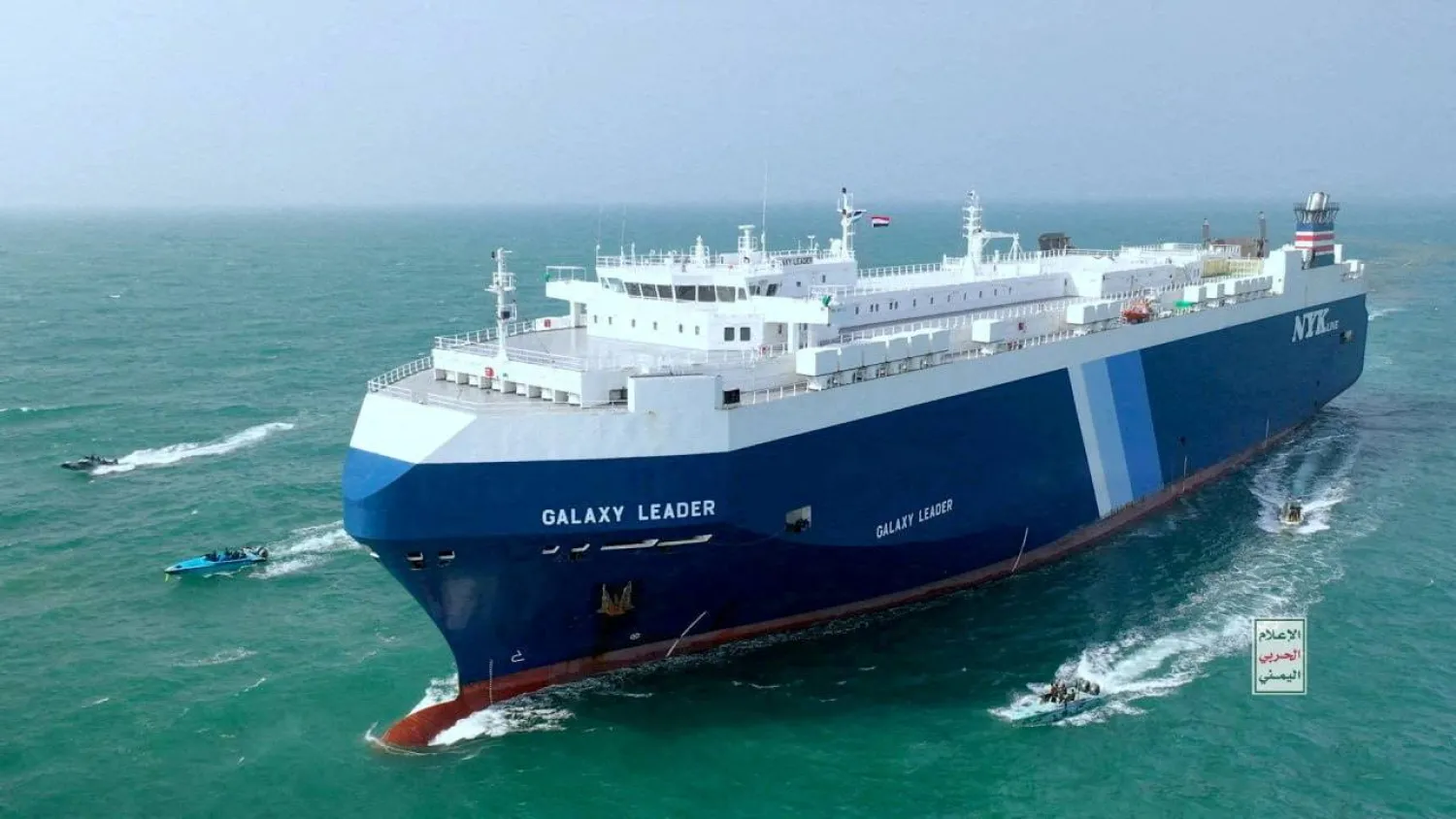
FILE PHOTO: The Galaxy Leader cargo ship is escorted by Houthi boats in the Red Sea in this photo released November 20, 2023. Houthi Military Media/Handout via REUTERS
TT

UN: Global Trade is Being Disrupted by Red Sea Attacks, War in Ukraine and Low Water in Panama Canal

FILE PHOTO: The Galaxy Leader cargo ship is escorted by Houthi boats in the Red Sea in this photo released November 20, 2023. Houthi Military Media/Handout via REUTERS

The UN trade body sounded an alarm Thursday that global trade is being disrupted by attacks in the Red Sea, the war in Ukraine, and low water levels in the Panama Canal.
Jan Hoffmann, a trade expert at the United Nations Conference on Trade and Development known as UNCTAD, warned that shipping costs have already surged and energy and food costs are being affected, raising inflation risks.
Since attacks by Yemen’s Houthi rebels on ships in the Red Sea began in November, he said, major players in the shipping industry have temporarily halted using Egypt’s Suez Canal, a critical waterway connecting the Mediterranean Sea to the Red Sea and a vital route for energy and cargo between Asia and Europe.
The Suez Canal handled 12% to 15% of global trade in 2023, but UNCTAD estimates that the trade volume going through the waterway dropped by 42% over the last two months, Hoffmann said.
Since November, the Iranian-backed Houthis have launched at least 34 attacks on shipping through the waterways leading to the Suez Canal. The Houthis support the Palestinians and have vowed to keep attacking until the Israel-Hamas war ends.
The United States and Britain have responded with strikes against Houthi targets, but the rebels have kept up their attacks.
Hoffmann, who heads the trade logistics branch at Geneva-based UNCTAD, told a video press conference with UN reporters that the Houthi attacks are taking place at a time when other major trade routes are under strain.
The nearly two-year war since Russia’s Feb. 24, 2022 invasion of Ukraine and other geopolitical tensions have reshaped oil and grain trade routes including through the Black Sea, he said.
Compounding difficulties for shipping companies, Hoffmann said, severe drought has dropped water levels in the Panama Canal to their lowest point in decades, severely reducing the number and size of vessels that can transit through it.
Total transits through the Panama Canal in December were 36% lower than a year ago, and 62% lower than two years ago, Hoffmann said.
Ships carry around 80% of the goods in world trade, and the percentage is even higher for developing countries, he said.
But the Red Sea crisis is causing significant disruptions in the shipment of grains and other key commodities from Europe, Russia and Ukraine, leading to increased costs for consumers and posing serious risks to global food security, Hoffmann said.
This is especially true in regions like East Africa, South Asia, Southeast Asia and East Asia, which heavily rely on wheat imports from Europe and the Black Sea area, he said.
Hoffmann said early data from 2024 show that over 300 container vessels, more than 20% of global container capacity, were diverting or planning alternatives to using the Suez Canal. Many are opting to go around the Cape of Good Hope in Africa, a longer and more costly trip.
Hoffmann said ships transporting liquified natural gas have stopped transiting the Suez Canal altogether because of fears of an attack.
As for costs, he said, average container shipping spot rates from Shanghai have gone up by 122% since early December, while rates from Shanghai to Europe went up by 256% and rates to the US west coast by 162%.
“Here you see the global impact of the crisis, as ships are seeking alternative routes, avoiding the Suez and the Panama Canal,” Hoffmann said.



Oil Falls as Trump Comments on Iran Talks Ease Supply Concerns

FILE PHOTO: A drone view shows the Portuguese flagged oil and chemical tanker ship CB Pacific docked at the Moran Shipping Agencies’ Citgo Petroleum Quincy/Braintree Terminal, March 18, 2026. REUTERS/Brian Snyder/File Photo
TT

Oil Falls as Trump Comments on Iran Talks Ease Supply Concerns

FILE PHOTO: A drone view shows the Portuguese flagged oil and chemical tanker ship CB Pacific docked at the Moran Shipping Agencies’ Citgo Petroleum Quincy/Braintree Terminal, March 18, 2026. REUTERS/Brian Snyder/File Photo

Oil prices fell on Friday as Middle East supply concerns eased after US President Donald Trump said the country would not attack Iran before US elections next month, amid productive talks to end their war that has disrupted global energy markets.

Brent crude futures dropped $1.68, or 1.61%, to $102.6 a barrel by 0819 GMT. US West Texas Intermediate (WTI) crude futures fell $1.31, or 1.43%, to $90.18, Reuters reported.

On a weekly basis, Brent prices are set to rise after settling 4% higher on Thursday, while WTI is set for a slight decline.

The US President’s pledge not to renew military attacks on Iran before the midterm elections along with China’s resumption of product exports were moving prices lower, PVM Oil Associates analyst Tamas Varga said.

Yet, the escalation of atrocities in ⁠the Arabian Gulf ⁠and around the Red Sea “has dashed hopes that swelling oil exports from the region will be sustainable and, as such, a protracted fall in oil prices in the foreseeable future seems implausible."

On Thursday, Trump said Washington was having "productive discussions" with Iran and said no attack was planned before the November 3 midterm congressional elections after media reports that he was considering an attack before then.

Iran's Tasnim news agency reported the same day ⁠that Foreign Minister Abbas Araqchi said Tehran is reviewing the US response to its proposal that would reopen the Strait of Hormuz within seven days.

"The prospect of easing tensions still needs to be reinforced by concrete progress in negotiations and improvements in shipping safety through the Strait of Hormuz," said XS.com analyst Linh Tran.

The US is still pressuring Iran economically to try to end the war, now in its eighth month, imposing sanctions on Thursday targeting individuals, networks and 17 vessels for transporting Iranian crude, oil products and petrochemicals.

Prices have been volatile this week as threats to shipping in the Gulf and the Strait of Hormuz, which carried shipments equal to about 20% of global ⁠oil and fuel ⁠before the war, have increased in October.

The Middle East war and the conflict between Russia and Ukraine have disrupted supplies of refined fuels such as gasoline, jet fuel and especially diesel fuel.

The oil market is also contending with Hurricane Isaias in the Gulf of Mexico. Because of the storm, producers there have shut in about 1.3 million barrels per day, or 62.9%, of current oil production as of Thursday, according to the US Marine Minerals Administration.

"This disruption provides additional support for oil prices, but the duration of its impact will depend on post-storm facility inspections and the pace of operational recovery," Tran said.


London Copper Rises on Supply Risks, China Buying

Stacks of copper cathodes sit inside Glencore's Canadian Copper Refinery in Montreal, Quebec, Canada on October 3, 2026. (Photo by ANDREJ IVANOV / AFP)
TT

London Copper Rises on Supply Risks, China Buying

Stacks of copper cathodes sit inside Glencore's Canadian Copper Refinery in Montreal, Quebec, Canada on October 3, 2026. (Photo by ANDREJ IVANOV / AFP)

London copper rose on Friday, recovering from the previous session's loss, as mine disruptions and buying in top consumer China supported prices.

Benchmark three-month copper on the London Metal Exchange was up 1.16% at $14,475 a metric ton by 0700 GMT, after dropping 1.15% in the previous session. It has climbed 1.52% so far this week, Reuters reported.

The most-traded copper contract on the Shanghai Futures Exchange fell 0.57% to 110,110 yuan a ‌ton, tracking overnight ‌losses in London.

"Copper is near record ‌levels, ⁠supported by supply-side issues," ⁠Daniel Hynes, senior commodity strategist at ANZ, said in a note.

The Yangshan copper premium <SMM-CUYP-CN> - a gauge of China's appetite for imported copper - ose to $125 a ton, its highest since November 2022, on Thursday, when China returned from a week-long holiday.

Copper in SHFE-monitored warehouses <CU-STX-SGH> increased by ⁠20,000 tons (51.6%) during the shortened week, but ‌stocks at 58,744 tons nonetheless ‌remain thin.

A workers' union at Antofagasta's Centinela copper mine in ‌Chile said their ongoing strike would begin to ‌weigh on outputin November. Antofagasta earlier downplayed the impact of the strike.

Disruptions at other mines added to already heightened supply risk, while stocks outside the US have fallen as copper has ‌been pulled into the country ahead of potential tariffs on refined copper imports.

The dollar ⁠index, ⁠which measures the greenback against a basket of other currencies, nudged lower. Oil prices also edged down on Friday.

Both had earlier in the week weighed on industrial metals.

A stronger dollar makes commodities more expensive for buyers using other currencies, while elevated energy prices threaten to stoke inflationary concerns and weigh on economic activity.

Among LME metals, aluminium gained 0.79%, zinc gained 1.25%, lead gained 0.7%, nickel gained 0.66% and tin gained 0.96%.

On the SHFE, aluminium lost 0.49%, zinc lost 1.12%, lead lost 1.45%, nickel lost 0.38% and tin dropped 4.23%.


China and EU Trade Envoys Seek Ways to Ease Tensions over Growing Imbalances

EU and Chinese flags are seen in this illustration taken, March 20, 2025. REUTERS/Dado Ruvic/Illustration
TT

China and EU Trade Envoys Seek Ways to Ease Tensions over Growing Imbalances

EU and Chinese flags are seen in this illustration taken, March 20, 2025. REUTERS/Dado Ruvic/Illustration

The top trade envoys for China and the European Union were wrapping up two days of talks Friday aimed at calming escalating tensions over growing imbalances between the two giant economies.

EU trade chief Maros Sefcovic traveled to Beijing saying it was crucial that the negotiations deliver “tangible outcomes” in rebalancing trade between China and the 27-nation bloc.

It was unclear, however, if the two sides would find the will to resolve key factors behind China’s growing trade surplus, which hit 360 billion euros ($410 billion) last year.

China is pushing for the EU to stop blocking its imports of advanced computer chipmaking machines, restrictions imposed on national security grounds at Washington's behest.

Sefcovic said the talks this week were the culmination of three months of intensive work. He had set an October deadline for meaningful results on trade rebalancing.

Earlier in the week, the Chinese Commerce Ministry issued a statement urging the EU to avoid protectionist measures, warning that such moves could backfire.

Trade tensions have grown in recent months, with both sides imposing or considering curbs on each other’s imports.

The EU has moved to limit imports of Chinese-made electric vehicles and EV batteries and enacted measures to protect the European steel industry. It also is limiting duty-free imports of e-commerce small parcels, essentially targeting Chinese fast fashion firms.

Last week, China launched an anti-dumping investigation into imports from the EU of p-nitrotoluene, a chemical compound used in dyes and pharmaceuticals.

Chinese officials and businesses have raised concerns over reports some EU members are pushing for new measures to protect local industries.

Worries over surging Chinese exports to Europe and other parts of the world in what some are calling a China shock 2.0 have deepened as the US, especially since President Donald Trump returned to the White House, has raised tariffs and enacted other measures to try to reduce its own huge trade deficit with Beijing.

Despite the backlash from some of its trading partners, China's global trade surplus hit $1.2 trillion in 2025 and is forecast to surpass $1 trillion again this year.

The EU's trade deficit with China widened to 103.34 billion euros (about $116 billion) in the April-July quarter, as imports rose to 153.63 billion euros ($172.3 billion) ,while European exports to China climbed to 50.3 billion euros ($56.4 billion), according to EU statistics.