


International Maritime Organization Deems Cape of Good Hope Navigation Route ‘Unsustainable’

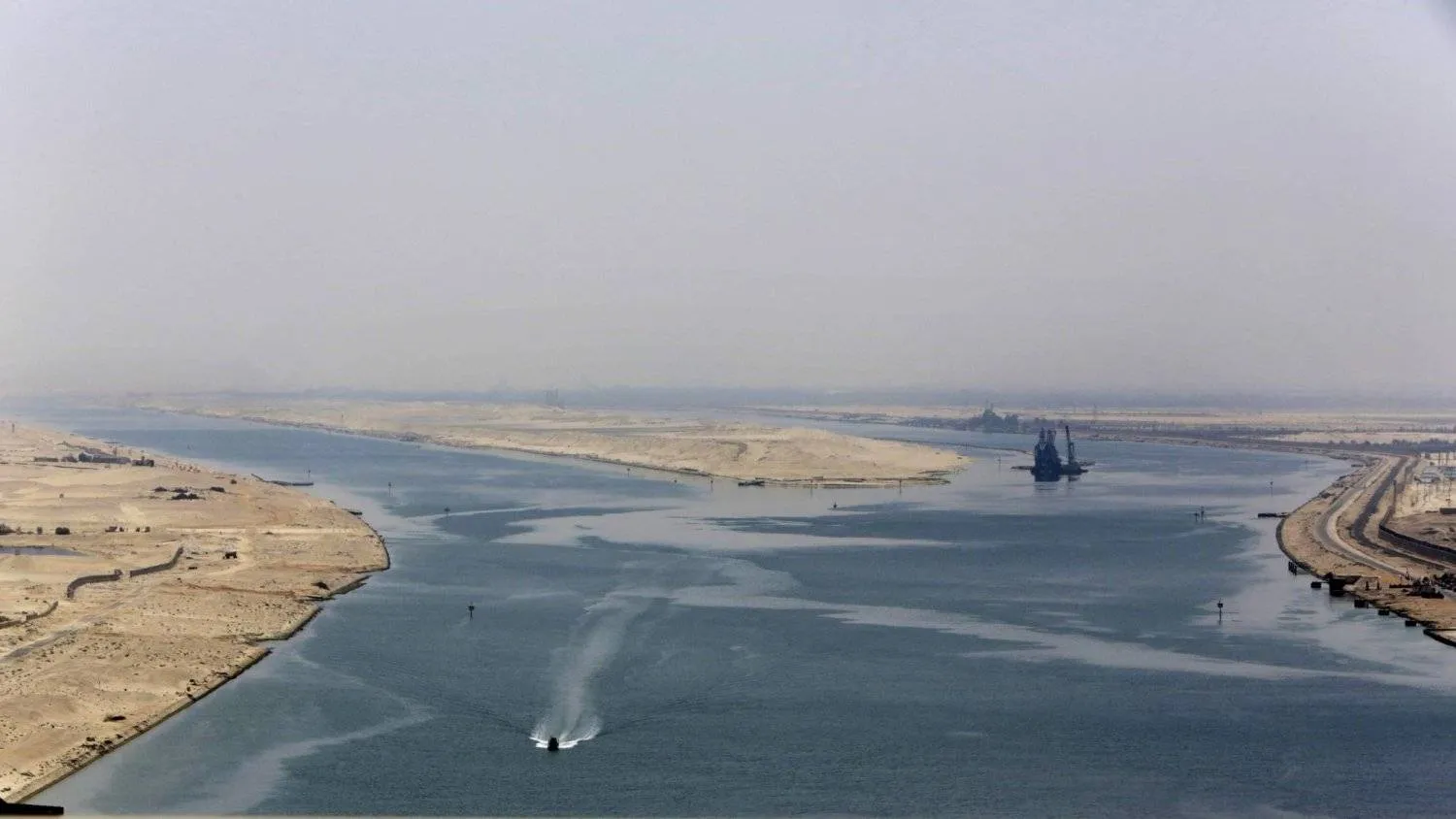
A naval forces boat secures one of the areas of the Suez Canal near the Egyptian city of Ismailia. (AP)
TT

International Maritime Organization Deems Cape of Good Hope Navigation Route ‘Unsustainable’

A naval forces boat secures one of the areas of the Suez Canal near the Egyptian city of Ismailia. (AP)

Secretary-General of the International Maritime Organization Arsenio Dominguez has stressed that the IMO supports freedom of navigation and calls for calm in the Red Sea region.

During his meeting with Chairman of the Suez Canal Authority (SCA) Admiral Ossama Rabie on Thursday, the IMO secretary-general explained that the current situation in the Red Sea region imposes many challenges on the global trade movement, the maritime transport market, the Suez Canal, and the ports in the region.

He affirmed that navigation in the canal is still open to everyone “especially in light of the logistical and security challenges faced by the vessels that go around the Cape of Good Hope,” noting that the “Cape route is deemed unsustainable for navigation traffic as it lacks essential services.”

For his part, Rabie stated that the Suez Canal achieves savings in time and distance compared to alternative routes, and this contributes to reducing fuel consumption by rates ranging from 10 to 90 percent, consequently reducing harmful carbon emissions.

He noted that the Suez Canal reduced carbon emissions by 55.4 million tons in 2023 by saving 16.9 million in fuel consumption.

The SCA Chairman also stressed that navigation in the canal is regular and “has not stopped for a single day” since the outbreak of the crisis, as part of the SCA’s continued efforts to support its clients to mitigate the impact of the current situation.

Additionally, Rabie reviewed the package of navigational and maritime services provided by SCA, which includes, in addition to pilotage services, Bunkering services, ship repair and maintenance services at SCA shipyards, marine ambulance services, marine salvage services, pollution control and other services that the Canal-transiting vessels may need in normal and emergency circumstances.

Yemen’s Houthi movement has been targeting Israel-linked vessels in the Bab Al-Mandab Strait in the Red Sea as an expression of solidarity with the Gaza Strip, which has been under an Israeli attack since October 7.

In response, the US and the UK have hit several Houthi sites to disrupt and degrade the capabilities that the Houthis use to threaten global trade.

Australian mining giant BHP said on Thursday that the Red Sea disruptions are forcing some of its freight service providers to take alternative routes, such as SA's Cape of Good Hope, while others still prefer the Red Sea with additional controls.

“The Red Sea is one of the key shipping routes in the world. However, the majority of BHP’s shipments do not go through this route,” and there have been no major business disruptions so far, the world’s largest listed miner said in a statement.

BHP Group is diverting almost all of its shipments from Asia to Europe away from the Red Sea, the Wall Street Journal reported on Thursday.

It generated $1.96 billion in revenue from Europe in 2023, about 3.6 percent of its total revenue of $53.82 billion.

The move follows reports from companies such as Kuwaiti oil majors BP and Shell that have paused transits through the Red Sea as strikes on commercial vessels by the Iran-aligned Houthis have stymied trade between Europe and Asia.

Some shipping companies have instructed vessels to reroute via a slower and more expensive Cape of Good Hope.

Kuwait Oil Tanker Company (KOTC) said on Thursday it is monitoring and assessing the situation in the Bab Al-Mandeb Strait and Red Sea.

It underlined in a press statement to KUNA that it is following globally applied precautionary measures for the protection and safety of its fleet.

It reiterated that it backs Kuwaiti oil shipments to global markets.

The Kuwaiti newspaper Al-Rai, citing informed sources, said the company has decided to temporarily suspend the passage of its tankers in the Red Sea due to the evolving events in the region.

The newspaper reported that the decision for the temporary suspension is subject to continuous periodic review until the region stabilizes, confirming "the Kuwait Petroleum Corporation's full commitment to implementing its contracts with various countries, using foreign tankers."

Qatar Energy announced on Wednesday that the attacks in the Red Sea “may affect” the scheduling of liquefied natural gas (LNG) shipments, in contrast to production, which it assured was “continuing without interruption.”

In a statement, the company said: “While the ongoing developments in the Red Sea area may impact the scheduling of some deliveries as they take alternative routes, LNG shipments from Qatar are being managed with our valued buyers.”



Trump's Greenland Threat Puts Europe Inc back in Tariff Crosshairs

A worker adjusts European Union and US flags at the EU Commission headquarters in Brussels, November 11, 2013.
TT

Trump's Greenland Threat Puts Europe Inc back in Tariff Crosshairs

A worker adjusts European Union and US flags at the EU Commission headquarters in Brussels, November 11, 2013.

Just as European companies were getting used to last year's hard-won US trade tariff deals, President Donald Trump has put them back in his ​crosshairs with an explosive threat to place levies on nations that oppose his planned takeover of Greenland.

Trump on Saturday said he would put rising tariffs from February 1 on goods imported from EU members Denmark, Sweden, France, Germany, the Netherlands and Finland, along with Britain and Norway, until the US is allowed to buy Greenland, a step major EU states decried as blackmail.

On Sunday, European Union ambassadors reached broad agreement to intensify efforts to dissuade Trump from imposing those tariffs, while also readying a package of retaliatory measures should the duties go ahead, EU diplomats said.

The shock move has rattled through industry and sent shockwaves through markets amid fears of a return to the volatility of last year's trade war, which was only eased with tariff deals reached in the middle of the year.

"This is a very serious situation, the scale of which is unknown," Gabriel Picard, ‌chairman of the French ‌wine and spirits export lobby FEVS, told Reuters.

He said the industry had already seen a ‌20% ⁠to ​25% hit ‌to US activity in the second half of last year from previous trade measures, and new tariffs would bring a "material" impact.

But he said what was happening went far beyond sectoral issues. "It is more a matter of political contacts and political intent that must be taken to the highest level in Europe, so that Europe, once again, is united, coordinated, and if possible speaks with one voice."

STAND-OFF COULD BRING BACK LAST YEAR'S TRADE WAR

In a post on Truth Social, Trump said additional 10% import tariffs would take effect next month on goods from the listed European nations — all already subject to tariffs imposed by the US president last year of between 10% and 15%.

The bloc - which had an estimated $1.5 trillion in goods and services trade with the US in 2024 - looks set ⁠to fight back. Europe has major carmakers in Germany, drugmakers in Denmark and Ireland, and consumer and luxury goods firms from Italy to France.

EU leaders are set to discuss options at an emergency ‌summit in Brussels on Thursday, including a 93 billion euro ($107.7 billion) package of tariffs on ‍US imports that could automatically kick in on February 6 after a ‍six-month pause.

The other is the so far never used "Anti-Coercion Instrument" (ACI), which could limit access to public tenders, investments or banking activity or restrict ‍trade in services, in which the US has a surplus with the bloc.

Analysts said the key question was how Europe responded - with a more "classic" trade war tit-for-tat tariff retaliation, or an even tougher approach.

"The most likely way forward is a return to the trade war that was put on hold in high-level US agreements with the UK and the EU in summer," said Carsten Nickel, deputy director of research at Teneo in London.

COMPANIES WILL LOOK TO TRADE WITH 'LESS PROBLEMATIC NATIONS'

German submarine maker ​TKMS CEO Oliver Burkhard said the Greenland threat was perhaps the jolt that Europe needed to toughen its approach and focus on developing its own joint programmes to be more independent from the US.

"It is probably necessary... to get ⁠a kick in the shin to realise that we may have to suit up differently in the future," he told Reuters.

Susannah Streeter, chief investment strategist at Wealth Club, said the new threat created "another layer" of complexity for firms grappling with an already "chaotic" US market. Firms had little capacity to soak up new tariffs, she added.

"A trade war only creates losers," said Christophe Aufrere, director general of French autos association the PFA.

An official at a French industry association that represents the country's largest firms added the Greenland issue was turning tariffs into a "tool for political pressure", and called for the region to reduce its dependency on the US market.

Neil Shearing, group chief economist at Capital Economics, pointed out that some EU countries - Spain, Italy and others - were not on the tariff list, which would likely see "re-routing" of trade within the EU free trade bloc to avoid the taxes.

Analysts added the new tariffs - if imposed - would likely hurt Trump. They would push up US prices and lead to front-loading of exports before the tariffs kicked in, while encouraging companies to seek new markets.

"For Europe, this is a bad geopolitical headache and a moderately significant economic problem. But it could also backfire for Trump," said Holger Schmieding, London-based chief economist at Berenberg.

"Logic ‌still points to an outcome that respects Greenland's right to self-determination, strengthens security in the Arctic for NATO as a whole, and largely avoids economic damage for Europe and the US."


IMF Upgrades Outlook for Surprisingly Resilient World Economy to 3.3% Growth this Year

FILE PHOTO: A view of the International Monetary Fund (IMF) logo at its headquarters in Washington, D.C., US, November 24, 2024. REUTERS/Benoit Tessier//File Photo/File Photo
TT

IMF Upgrades Outlook for Surprisingly Resilient World Economy to 3.3% Growth this Year

FILE PHOTO: A view of the International Monetary Fund (IMF) logo at its headquarters in Washington, D.C., US, November 24, 2024. REUTERS/Benoit Tessier//File Photo/File Photo

An unexpectedly sturdy world economy is likely to shrug off President Donald Trump's protectionist trade policies this year, thanks partly to a surge of investment in artificial intelligence in North America and Asia, the International Monetary Fund said in a report out Monday.

The 191-nation lending organization expects that global growth will come in at 3.3% this year, same as in 2025 but up from the 3.1% it had forecast for 2026 back in October, The Associated Press reported.

The world economy "continues to show notable resilience despite significant US-led trade disruptions and heightened uncertainty,'' IMF chief economist Pierre-Olivier Gourinchas and his colleague Tobias Adrian wrote in a blog post accompanying the latest update to the fund's World Economic Outlook.

The US economy, benefiting from the strongest pace of technology investment since 2001, is forecast to expand 2.4% this year, an upgrade on the fund's October forecast and on expected 2025 growth — both 2.1%.

China — the world's second-largest economy — is forecast to see 4.5% growth, an improvement on the 4.2% the IMF had predicted October, partly because a trade truce with the United States has reduced American tariffs on Chinese exports.

India, which has supplanted China as the world's fastest-growing major economy, is expected to see growth decelerate from 7.3% last year (when it was juiced by an unexpectedly strong second half) to a still-healthy 6.4% in 2026.


France Says Still Loyal to Syria Kurds, Hails Ceasefire

Syrian army personnel celebrate as government forces enter Raqqa city following the withdrawal of Syrian Democratic Forces, in Raqqa, Syria, January 18, 2026. REUTERS/Karam al-Masri
TT

France Says Still Loyal to Syria Kurds, Hails Ceasefire

Syrian army personnel celebrate as government forces enter Raqqa city following the withdrawal of Syrian Democratic Forces, in Raqqa, Syria, January 18, 2026. REUTERS/Karam al-Masri

France on Monday welcomed a ceasefire between the Syrian government and Kurdish-led forces and stressed it remained loyal to the latter who spearheaded the battle against the ISIS group.

"France is faithful to its allies," the foreign ministry said, urging all sides to respect the ceasefire deal, which will also see the Kurdish administration and forces integrate into the state after months of stalled negotiations.