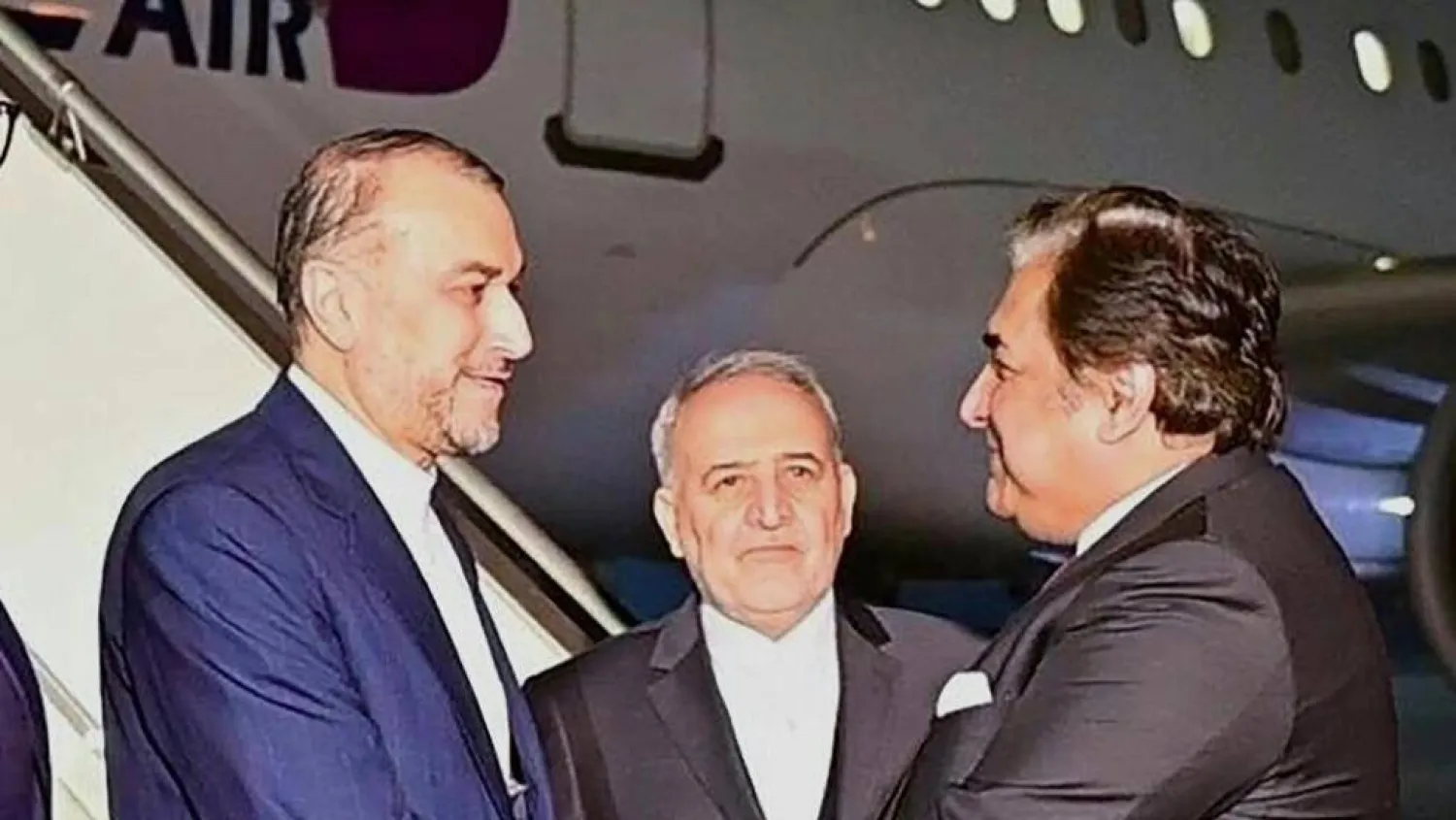
Pakistan and Iran Agree to Work Together to Improve Security after Tit-for-tat Airstrikes

Iranian Foreign Minister Hossein Amir-Abdollahian's (left) visit to Pakistan comes as the neighbors seek to de-escalate after cross-border strikes threatened relations. Handout / AFP
TT

Pakistan and Iran Agree to Work Together to Improve Security after Tit-for-tat Airstrikes

Iranian Foreign Minister Hossein Amir-Abdollahian's (left) visit to Pakistan comes as the neighbors seek to de-escalate after cross-border strikes threatened relations. Handout / AFP

Pakistan and Iran on Monday agreed to work together to improve security cooperation in the wake of deadly airstrikes by Tehran and Islamabad earlier this month that killed at least 11 people, marking a significant escalation in fraught relations between the neighbors.
The development came after the top Iranian diplomat, Hossein Amirabdollahian, held talks in Islamabad with his Pakistani counterpart, Jalil Abbas Jilani. The Iranian foreign minister also met with Pakistan’s caretaker Prime Minister Anwaarul-Haq-Kakar, the Associated Press said.
Iran-Pakistan ties were dramatically imperiled on Jan. 17, when Iran launched airstrikes in Pakistan’s restive southwestern Baluchistan province, targeting what Tehran said were hideouts of the anti-Iran militant group Jaish al-Adl, or the Army of Justice. Pakistan said two children were killed and three others were wounded.
Angered over the strikes, Pakistan recalled its ambassadors from Tehran and launched airstrikes against alleged militant hideouts inside Iran, in the Sistan and Baluchestan province, killing at least nine people. Islamabad said it was targeting Baluch militant groups with separatist goals.
At a joint news conference later Monday, Amirabdollahian and Jilani said they would work through existing channels in their leadership, diplomatic and military levels to cooperate with each other.
Jilani said the two countries were able to bring the “situation back to normal in the shortest possible time” after the airstrikes because both sides had agreed to resume dialogue to resolve all issues.
“Terrorism poses a common challenge to our countries," Jilani said and stressed that “respect for sovereignty and territorial integrity remains the immutable and foundational principle of this cooperation" between the neighbors.
He announced regular future meetings at top ministerial levels and also between liaison officers.
Iran and Pakistan "strongly respect sovereignty and territorial integrity of each other," Amirabdollahian. “We will tell all terrorists that we will not ... provide them with any opportunity to endanger our common security.”
Amirabdollahian said Pakistan and Iran will also set up free trade economic zones near the border regions to enhance their bilateral trade.
Iran and nuclear-armed Pakistan have long regarded each other with suspicion over militant attacks on their sides of the border. Experts say the tit-for-tat strikes this month were at least partially prompted by internal political pressures though they also raised the threat of violence spreading across the Middle East, already unsettled by Israel’s war with Hamas in Gaza.
During his visit, Amirabdollahian was also expecting to brief his hosts about an incident Saturday in which unknown gunmen shot and killed at least four Pakistani laborers and wounded three others in Iran’s Sistan and Baluchestan province. Pakistan has condemned the killings, describing the attack as “horrifying and despicable”.
Relatives of the slain Pakistanis rallied on Sunday, demanding that the bodies of their loved ones be brought home. Pakistan said arrangements were being made for that with Iran's help and that the three wounded workers were being treated at an Iranian hospital.



Top Trump Iran Negotiator Says Visits US Aircraft Carrier in Middle East

US Special Envoy Steve Witkoff delivers a press conference upon the signing of the declaration on deploying post-ceasefire force in Ukraine, during the so-called "Coalition of the Willing" summit, at the Elysee Palace in Paris, France, January 6, 2026. (Reuters)
TT

Top Trump Iran Negotiator Says Visits US Aircraft Carrier in Middle East

US Special Envoy Steve Witkoff delivers a press conference upon the signing of the declaration on deploying post-ceasefire force in Ukraine, during the so-called "Coalition of the Willing" summit, at the Elysee Palace in Paris, France, January 6, 2026. (Reuters)

US President Donald Trump's lead Iran negotiator Steve Witkoff on Saturday said he visited the USS Abraham Lincoln aircraft carrier currently in the Arabian Sea, with Washington and Tehran due to hold further talks soon.

"Today, Adm. Brad Cooper, Commander of US Naval Forces Central Command, Jared Kushner, and I met with the brave sailors and Marines aboard the USS Abraham Lincoln, her strike group, and Carrier Air Wing 9 who are keeping us safe and upholding President Trump's message of peace through strength," said Witkoff in a social media post.

Iranian Foreign Minister Abbas Araghchi said on Saturday he hoped talks with the United States would resume soon, while reiterating Tehran's red lines and warning against any American attack.


Israel’s Netanyahu Expected to Meet Trump in US on Wednesday and Discuss Iran

Israeli Prime Minister Benjamin Netanyahu delivers a speech during a special session to mark the 77th anniversary of the Knesset's establishment and the 60th anniversary of the dedication of the current building at the Knesset, the Israeli parliament, in Jerusalem, 02 February 2026. (EPA)
TT

Israel’s Netanyahu Expected to Meet Trump in US on Wednesday and Discuss Iran

Israeli Prime Minister Benjamin Netanyahu delivers a speech during a special session to mark the 77th anniversary of the Knesset's establishment and the 60th anniversary of the dedication of the current building at the Knesset, the Israeli parliament, in Jerusalem, 02 February 2026. (EPA)

Israeli Prime Minister Benjamin Netanyahu is expected to meet US President Donald Trump on Wednesday in Washington, where they will discuss negotiations with Iran, Netanyahu's office said on Saturday.

Iranian and US officials held indirect nuclear ‌talks in the ‌Omani capital ‌Muscat ⁠on Friday. ‌Both sides said more talks were expected to be held again soon.

A regional diplomat briefed by Tehran on the talks told Reuters Iran insisted ⁠on its "right to enrich uranium" ‌during the negotiations with ‍the US, ‍and that Tehran's missile capabilities ‍were not raised in the discussions.

Iranian officials have ruled out putting Iran's missiles - one of the largest such arsenals in the region - up ⁠for discussion, and have said Tehran wants recognition of its right to enrich uranium.

"The Prime Minister believes that any negotiations must include limiting ballistic missiles and halting support for the Iranian axis," Netanyahu's office said in a ‌statement.


Italy FM Rules Out Joining Trump’s ‘Board of Peace’

Italy's Minister for Foreign Affairs Antonio Tajani speaks to the press during the EPP Leaders’ meeting, in Zagreb, Croatia, 30 January 2026. (EPA)
TT

Italy FM Rules Out Joining Trump’s ‘Board of Peace’

Italy's Minister for Foreign Affairs Antonio Tajani speaks to the press during the EPP Leaders’ meeting, in Zagreb, Croatia, 30 January 2026. (EPA)

Italy will not take part in US President Donald Trump's "Board of Peace", Italian Foreign Minister Antonio Tajani said Saturday, citing "insurmountable" constitutional issues.

Trump launched his "Board of Peace" at the World Economic Forum in Davos in January and some 19 countries have signed its founding charter.

But Italy's constitution bars the country from joining an organization led by a single foreign leader.

Prime Minister Giorgia Meloni, a Trump ally, last month noted "constitutional problems" with joining, but suggested Trump could perhaps reopen the framework "to meet the needs not only of Italy, but also of other European countries".

Tajani appeared Saturday to rule that out.

"We cannot participate in the Board of Peace because there is a constitutional limit," he told the ANSA news agency.

"This is insurmountable from a legal standpoint," he said, the day after meeting US Secretary of State Marco Rubio and US Vice President JD Vance at the Olympics in Milan.

Although originally meant to oversee Gaza's rebuilding, the board's charter does not limit its role to the Palestinian territory and appears to want to rival the United Nations.