North Korea Says Leader Kim Supervised Tests of Cruise Missiles Designed to Be Fired from Submarines

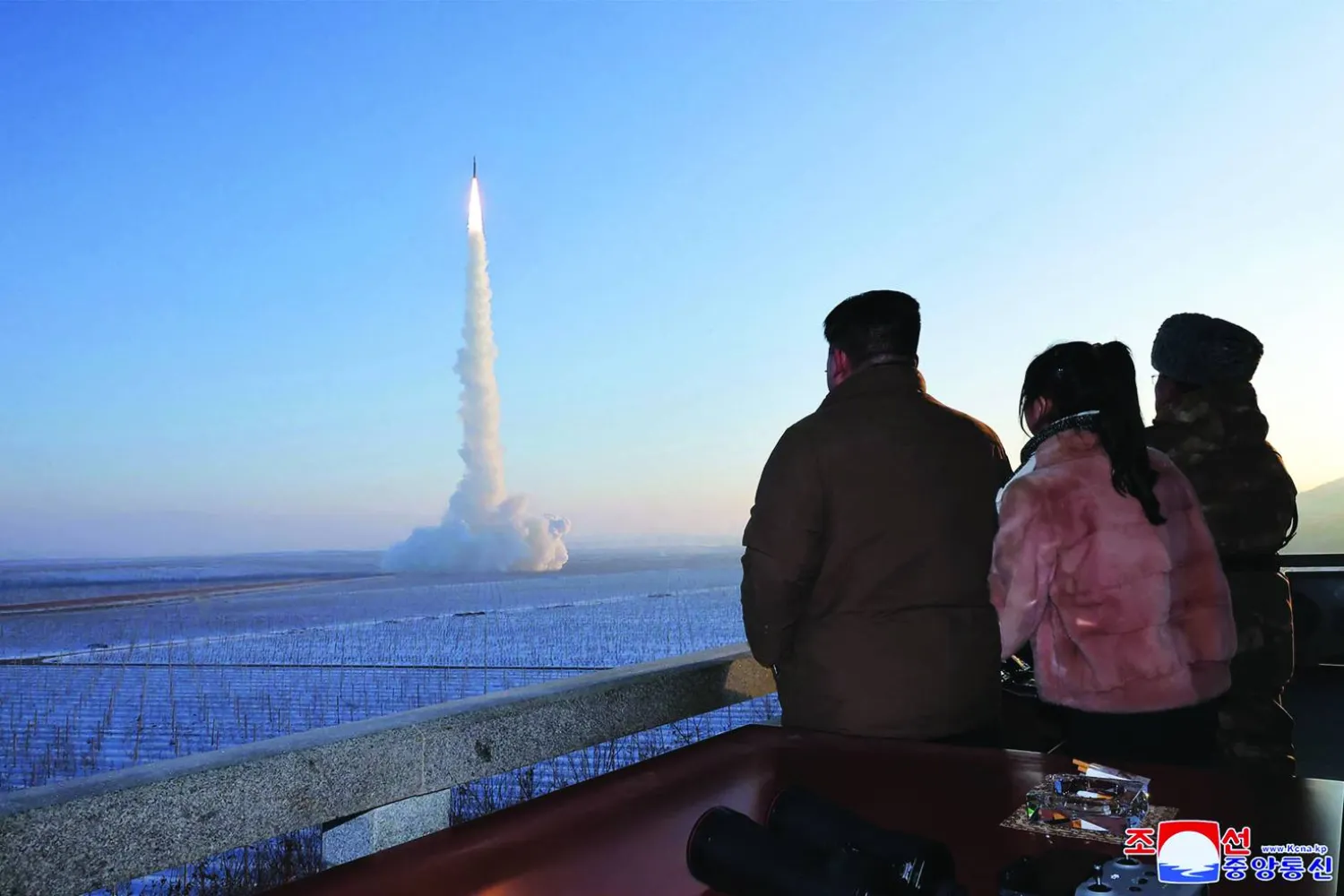
This undated picture released by North Korea's official Korean Central News Agency (KCNA) on December 19, 2023 shows North Korean leader Kim Jong Un (L) and his daughter watching the test launch of a Hwasongpho-18 intercontinental ballistic missile (ICBM) at an undisclosed location in North Korea. (Photo by KCNA VIA KNS / AFP)
TT

North Korea Says Leader Kim Supervised Tests of Cruise Missiles Designed to Be Fired from Submarines

This undated picture released by North Korea's official Korean Central News Agency (KCNA) on December 19, 2023 shows North Korean leader Kim Jong Un (L) and his daughter watching the test launch of a Hwasongpho-18 intercontinental ballistic missile (ICBM) at an undisclosed location in North Korea. (Photo by KCNA VIA KNS / AFP)

North Korean leader Kim Jong Un supervised test-firings of new cruise missiles designed to be launched from submarines and also reviewed efforts to build a nuclear-powered submarine while reiterating his goal of building a nuclear-armed navy to counter what he portrays as growing external threats, state media said Monday.
The report came a day after South Korea’s military said it detected North Korea firing multiple cruise missiles over waters near the eastern port of Sinpo, where the North has a major shipyard developing submarines. It was the latest in a streak of weapons demonstrations by North Korea amid increasing tensions with the United States, South Korea and Japan, The Associated Press said.
North Korea’s official newspaper Rodong Sinmun published photos of what appeared to be at least two missiles fired separately. Both created grayish-white clouds as they broke the water surface and soared into the air at an angle of around 45 degrees, which possibly suggests they were fired from torpedo launch tubes.
State media said the missiles were Pulhwasal-3-31, a new type of weapon first tested last week in land-based launches from North Korea's western coast.
The reports implied that two missiles were fired during the test. KCNA said the missiles flew more than two hours before accurately striking an island target, but it did not specify the vessel used for the launches. North Korea in past years has fired missiles both from developmental, missile-firing submarines and underwater test platforms built on barges.
Lee Sung Joon, spokesperson of South Korea’s Joint Chiefs of Staff, said the South Korean and US militaries were analyzing the launches, including the possibility that the North exaggerated the flight times.
In recent years, North Korea has tested a variety of missiles designed to be fired from submarines as it pursues the ability to conduct nuclear strikes from underwater. In theory, such capacity would bolster its deterrent by ensuring a survivable capability to retaliate after absorbing a nuclear attack on land.
Missile-firing submarines would also add a maritime threat to the North’s growing collection of solid-fuel weapons fired from land vehicles that are designed to overwhelm missile defenses of South Korea, Japan and the United States.
Still, it would take considerable time, resources and technological improvements for the heavily sanctioned nation to build a fleet of at least several submarines that could travel quietly and execute attacks reliably, analysts say.
The North’s official Korean Central News Agency said Kim expressed satisfaction after the missiles accurately hit their sea targets during Sunday’s test.
He then issued unspecified important tasks for “realizing the nuclear weaponization of the navy and expanding the sphere of operation,” which he described as crucial goals considering the “prevailing situation and future threats,” the report said. KCNA said Kim was also briefed on efforts to develop a nuclear-propelled submarine and other advanced naval vessels.
Kim issued similar comments about a nuclear-armed navy in September while attending the launching ceremony of what the North described as a new submarine capable of firing tactical nuclear weapons from underwater. He said then that the country was pursuing a nuclear-propelled submarine and that it plans to remodel existing submarines and surface vessels so they can handle nuclear weapons.
Nuclear-propelled submarines can quietly travel long distances and approach enemy shores to deliver strikes, which would bolster Kim's declared aim of building a nuclear arsenal that could viably threaten the US mainland. But experts say such vessels are likely unfeasible for the North without external assistance in the near-term.
North Korea has an estimated 70 to 90 diesel-powered submarines in one of the world’s largest submarine fleets. But they are mostly aging vessels capable of launching only torpedoes and mines.
South Korea’s military said the submarine unveiled by North Korea in September, the “Hero Kim Kun Ok,” didn't look ready for operational duty and suggested the North was exaggerating its capabilities.
The submarine appeared to have at least 10 launch tubes possibly designed for missiles. The South’s Joint Chiefs of Staff said that the North would have needed to increase the size of the bridge and other parts of the original vessel to accommodate missile launch systems, but that the appearance of the vessel suggested it could “not be operated normally.”
Tensions on the Korean Peninsula have increased in recent months as Kim accelerates his weapons development and issues provocative threats of nuclear conflict with the US and its Asian allies.
The US, South Korea and Japan in response have been expanding their combined military exercises, which Kim condemns as invasion rehearsals, and sharpening their deterrence strategies built around nuclear-capable US assets.
The recent cruise missile launches followed a Jan. 14 test firing of North Korea's first solid-fuel intermediate-range ballistic missile, which reflected Kim's efforts to expand his arsenal of weapons designed to overwhelm missile defenses in South Korea and Japan and remote US targets in the Pacific, including Guam.



Macron Says US and EU Are Wasting Time on Tariff Threats as Trump Fumes Over Germany

France's President Emmanuel Macron is greeted by people in Gyumri on May 5, 2026. (AFP)
TT

Macron Says US and EU Are Wasting Time on Tariff Threats as Trump Fumes Over Germany

France's President Emmanuel Macron is greeted by people in Gyumri on May 5, 2026. (AFP)

Europe and the United States have more important things to do than waste time on tariff threats, French President Emmanuel Macron said Tuesday, after President Donald Trump announced higher duties on European vehicles.

Trump said on Friday that he would increase the tariffs charged on cars and trucks from the European Union this week to 25%, a move that could further harm the global economy as it reels from war in the Middle East.

“Especially in the geopolitical period we are experiencing, allies like the United States of America and the European Union have much better things to do than to stir up threats of destabilization,” Macron told reporters in Armenia.

“For our businesses, our households, our populations, we should rather send a message of stability and confidence,” Macron said. He added that he hoped “reason will prevail soon.”

EU and US trade officials were due to meet in Paris on Tuesday to discuss the issue.

Trump accused the EU of “not complying with our fully agreed to Trade Deal,” without elaborating.

The threat of tariffs comes as Trump fumes over remarks by German Chancellor Friedrich Merz, who said the US has been humiliated by Iran in talks to end the war. Germany is a major automobile manufacturer, and higher tariffs would damage its industry.

Trump has since threatened to pull thousands of US troops out of Germany.

Trump and European Commission President Ursula von der Leyen agreed to a trade deal in July 2025 that set a tariff ceiling of 15% on most goods, though the US Supreme Court this year ruled against the legal authority that Trump had used to charge that tax.

Asked at the EU-Armenia summit in Yerevan on Tuesday about the threat of another tariff hike, von der Leyen said: “A deal is a deal, and we have a deal. And the essence of this deal is prosperity, common rules and reliability.”

The commission, the EU’s executive branch, negotiates trade on behalf of the 27 member countries. Von der Leyen said that “we are prepared for every scenario” if things go wrong.

Macron insisted that agreements must be respected. “If they were challenged again, it would reopen everything,” he said, and warned that “the European Union has instruments that would then need to be activated.”


US Attempt to Open Strait of Hormuz Tests Fragile Iran War Ceasefire

In this picture obtained from Iran's ISNA news agency and taken on May 2, 2026, the Iran-flagged container vessel Hamouna is pictured while anchored as a small motorboat passes by, in the Strait of Hormuz off Bandar Abbas in southern Iran. (ISNA/AFP)
TT

US Attempt to Open Strait of Hormuz Tests Fragile Iran War Ceasefire

In this picture obtained from Iran's ISNA news agency and taken on May 2, 2026, the Iran-flagged container vessel Hamouna is pictured while anchored as a small motorboat passes by, in the Strait of Hormuz off Bandar Abbas in southern Iran. (ISNA/AFP)

The Iran war risked reigniting after the US tried to force open the Strait of Hormuz for commercial shipping, though a ceasefire seemed to be holding Tuesday even after the United Arab Emirates said Iran fired missiles and drones at it.

It is unclear what will follow after an American attempt to end Iran’s stranglehold on the strait by creating an “enhanced security area." A prominent Iranian official accused the US of undermining regional security with the effort and warned that Iran will respond.

The US military said two American-flagged merchant ships successfully transited the strait on Monday, and that it fired on Iranian forces, sinking six small boats that were targeting vessels. It remained to be seen if any more ships would cross on Tuesday.

Ship tracking data showed a Panamanian-flagged crude oil tanker heading toward the center of the strait Tuesday morning after leaving an anchorage in the Gulf, though it was unclear if it would try to pass through. The tanker had a stated destination of Singapore, according to the MarineTraffic ship tracking site.

Iran’s effective closure of the strait, through which about a fifth of the world’s trade in oil and natural gas typically passes, along with fertilizer and other petroleum-derived products, has sent fuel prices skyrocketing, rattled the global economy, and proved a major strategic advantage in negotiations to end the war. Breaking that chokehold would ease global economic concerns and deny Tehran a major source of leverage.

But such efforts also risk reigniting the full-scale fighting that erupted when the US and Israel first attacked Iran on Feb. 28, prompting it to close the strait.

Iran accuses US of ceasefire violation

Iran has said the new US effort is a violation of the fragile ceasefire that has held for more than three weeks.

In a post on X Tuesday, Iran’s powerful parliamentary speaker and chief negotiator, Mohammad Bagher Qalibaf, accused Washington of undermining shipping security in the Strait of Hormuz.

Qalibaf warned that a “new equation” in the strait is taking shape. He signaled that Tehran has yet to fully respond to the US attempt to reopen the waterway, saying: “We know full well that the continuation of the status quo is intolerable for America; while we have not even begun yet.”

Trump vows to reopen the strait

US President Donald Trump on Sunday warned that Iranian efforts to halt passage through the strait “will, unfortunately, have to be dealt with forcefully.” He said the US effort to reopen the strait, dubbed “Project Freedom,” was intended to aid stranded seafarers on hundreds of ships stuck in the Gulf since the war began.

The US-led Joint Maritime Information Center advised ships on Monday to cross the strait in Oman’s waters, saying it had set up an “enhanced security area.”

The UAE bore the brunt of Iran’s retaliation

The United Arab Emirates' Defense Ministry said its air defenses had engaged 15 missiles and four drones fired by Iran. Authorities in the eastern emirate of Fujairah said one drone sparked a fire at a key oil facility, wounding three Indian nationals.

Indian Prime Minister Narendra Modi on Tuesday condemned the attacks, saying the targeting of civilians and infrastructure was “unacceptable.”

In a statement on X, Modi said India stands in “firm solidarity” with the UAE and stressed the need for safe and uninterrupted shipping through the Strait of Hormuz, saying it “is vital for enduring regional peace, stability and global energy security.”

Tehran did not confirm or deny the attacks but early on Tuesday, Iran’s Foreign Minister Abbas Araghchi said on X that both the US and the UAE “should be wary of being dragged back into quagmire.”

Pakistan, which has been mediating between the US and Iran, and Saudi Arabia both condemned the strikes against the UAE.

Strait of Hormuz closure has far-reaching consequences

The disruption of the waterway has squeezed countries in Europe and Asia that depend on Gulf oil and gas, raising prices far beyond the region.

The US has meanwhile enforced a naval blockade on Iranian ports since April 13, telling at least 49 commercial ships to turn back, according to Central Command. It's also warned shipping companies they could face sanctions if they pay Iran for transit of the strait.

The blockade has deprived Tehran of oil revenue it needs to shore up its ailing economy. US officials have expressed hope the blockade will force Iran to make concessions in talks on its disputed nuclear program and other longstanding issues.

Negotiations make little progress

Iran’s latest proposal for ending the war calls for the US to lift sanctions, end the blockade, withdraw forces from the region, and cease all hostilities including Israel’s operations in Lebanon, according to the semiofficial Nour News and Tasnim agencies, which have close ties to Iran’s security apparatus.

Iranian officials said they were reviewing the US response. Tehran has claimed its proposal does not include its nuclear program and enriched uranium, long a driving force in tensions with the US and Israel.

Iran wants other issues resolved within 30 days and aims to end the war rather than extend the ceasefire. Trump expressed doubt over the weekend that the proposal would lead to a deal.


IAEA Says Drone Damaged Equipment at Zaporizhzhia Nuclear Plant in Ukraine

The interior of the damaged flat in an apartment building hit by a Russian drone strike, amid Russia's attack on Ukraine, in Zaporizhzhia, Ukraine February 26, 2026. (Reuters)
TT

IAEA Says Drone Damaged Equipment at Zaporizhzhia Nuclear Plant in Ukraine

The interior of the damaged flat in an apartment building hit by a Russian drone strike, amid Russia's attack on Ukraine, in Zaporizhzhia, Ukraine February 26, 2026. (Reuters)

The International Atomic Energy Agency said on Monday meteorological monitoring equipment at the Russian-held Zaporizhzhia nuclear power plant in southeastern Ukraine had been damaged by a drone.

The Zaporizhzhia plant, Europe's largest with six reactors, was seized by Russian forces in the early weeks of Moscow's February 2022 invasion of Ukraine. Each side has since regularly accused the other of military action which could compromise safety at ‌the plant, ‌located near the war's front ‌line.

Posting ⁠on X, the ⁠IAEA said a team of its experts had visited the station's External Radiation Control Laboratory (ERCL), a day after the plant's Russian management said it had been hit by a drone.

"Team observed damage to some of the lab's meteorological monitoring equipment ⁠which is no longer operational," the ‌IAEA, the UN's nuclear ‌watchdog, said in its statement.

The statement said IAEA Director ‌General Rafael Grossi had issued a fresh appeal "for ‌maximum military restraint near all nuclear facilities to avoid safety risks".

The plant, which now produces no electricity, has been struck several times by drones since the ‌beginning of the conflict. The plant's management on Sunday said damage has been minor ⁠and that ⁠operations were otherwise unaffected.

One of the station's external power lines - required to keep nuclear fuel cool - has been down since late March and the IAEA said last week it was trying to arrange a local ceasefire to carry out repair work.

Grossi has paid several visits to the Zaporizhzhia plant since it came under Russian control and the IAEA has placed observers permanently at Zaporizhzhia and Ukraine's three other functioning nuclear stations.