


Israel Strikes Gaza, Regional Tensions High as Hamas Studies Ceasefire Proposal

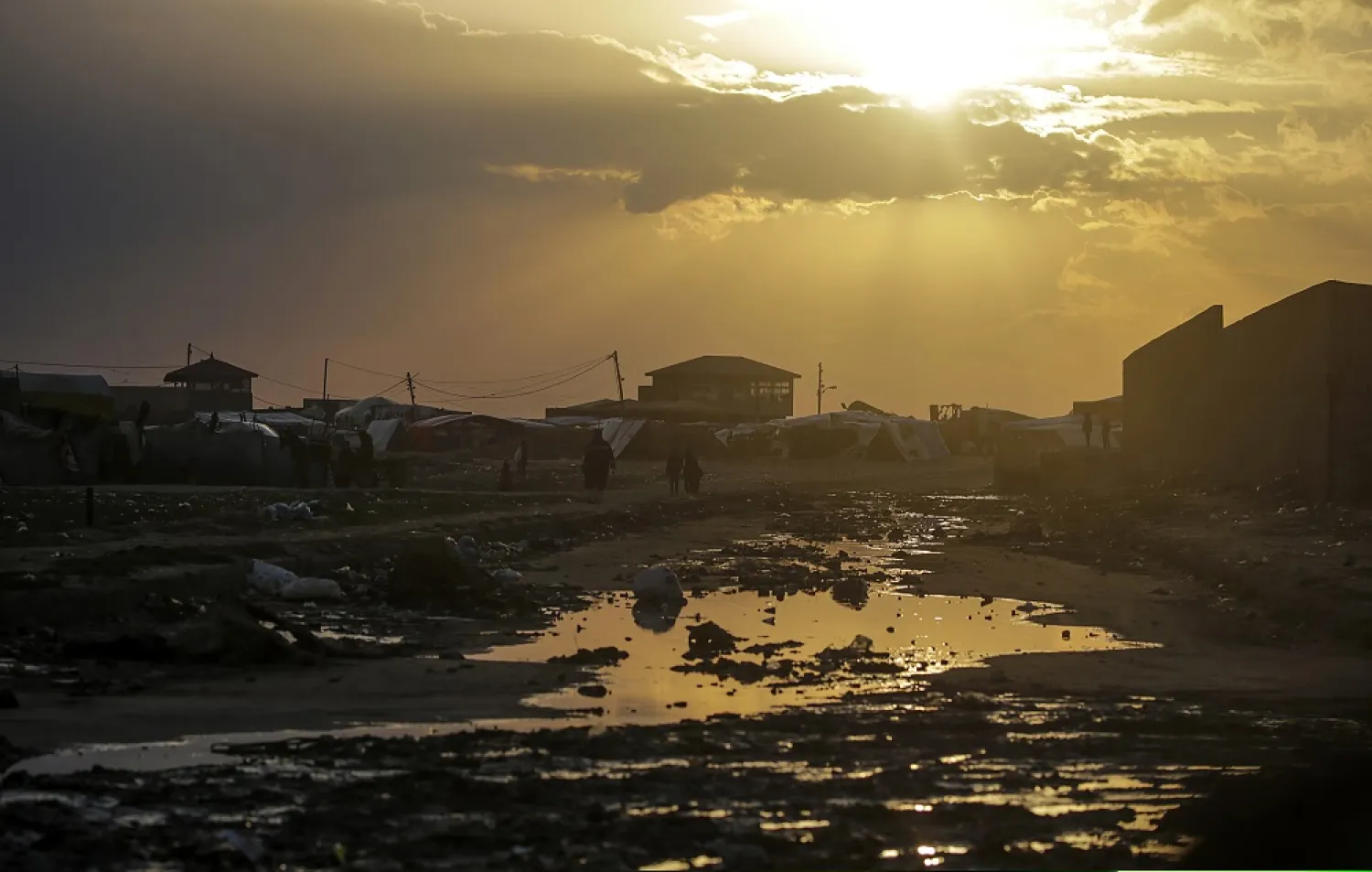
Displaced Palestinians who fled their houses from the northern Gaza Strip walk past a rain water puddle next to their shelters during a cold evening in Deir Al Balah town, southern Gaza Strip, 30 January 2024. (EPA)
TT

Israel Strikes Gaza, Regional Tensions High as Hamas Studies Ceasefire Proposal

Displaced Palestinians who fled their houses from the northern Gaza Strip walk past a rain water puddle next to their shelters during a cold evening in Deir Al Balah town, southern Gaza Strip, 30 January 2024. (EPA)

Israeli forces carried out air strikes in Gaza on Wednesday as the militant Palestinian group Hamas studied a new proposal for a ceasefire and the release of hostages held in the enclave.

Witnesses said Israel had stepped up air strikes on Gaza City, in the north, and bombarded parts of Khan Younis, in the south, despite what appeared to be the most serious peace initiative for months in the Israel-Hamas war.

World powers hope to prevent a wider conflict, but tensions in the Middle East remained high after Yemen's Iran-aligned Houthi militias said they would keep attacking US and British warships in the Red Sea in solidarity with Palestinians.

Relations between Tehran and Washington are also tense after the deaths of three US soldiers in a drone strike near the Syrian-Jordanian border that US officials blame on Iran-backed militants. Washington has not yet outlined its response, but Iran's Revolutionary Guards said on Wednesday they would respond to any US threat.

Israeli Prime Minister Benjamin Netanyahu, who has vowed to destroy Hamas and to achieve "total victory" in Gaza, said a "real effort" was being made to secure the hostages' release. Israel says some 136 hostages are still being held in Gaza.

"It's too early to say how it will take place, but efforts are being made in these days, in these moments, these very hours," he said on Wednesday at a meeting with families of the hostages, according to a statement released by his office.

Gaza health authorities said 26,900 Palestinians had been killed - including 150 over the past 24 hours - in the war that was triggered after Hamas fighters stormed from Gaza into Israeli towns on Oct. 7, killing 1,200 and taking 253 hostages.

Israel's military said its forces had killed at least 25 Palestinian militants in Gaza in the past 24 hours, and that three Israeli soldiers had been killed - taking to 224 the number of troops killed during Israel's ground offensive.

Smoke rose above Gaza City after the latest air strikes, some of which targeted the headquarters of the Hamas-run interior ministry, Hamas-run media and residents said.

The Al-Nuseirat refugee camp in central Gaza also came under fire and tanks pounded areas of Khan Younis around Nasser Hospital, the largest still functioning in the south, witnesses said.

Israel's military said soldiers from its intelligence gathering unit were operating on Wednesday "in the heart of Khan Younis". Since the start of the ground invasion, it added in a statement, the unit had located more than 100 tunnel shafts and destroyed some 200 pieces of "enemy infrastructure" in Gaza.

DETERIORATING HEALTH SYSTEM

As the health system deteriorates, Palestinian medics say they have formed field medical points to help reach front lines, as treating the wounded in Khan Younis has become increasingly difficult amid street battles and artillery strikes.

"There's a lot of injuries among the displaced who were in the industrial quarter and some schools," said Nassim Hassan, the head of the Emergency Unit at Nasser Hospital, adding that "many of the injured left loaded on carts, tuk-tuks, cars or even on foot."

Much of the densely populated Gaza Strip has been devastated by almost four months of Israeli bombardment, and most of its 2.3 million residents have been uprooted by fighting that international aid agencies say has caused a humanitarian crisis.

Health officials in Gaza say the situation has been complicated by Israeli allegations that some staff from the UN refugee agency for Palestinians (UNRWA) were involved in the Oct. 7 attack on Israel, prompting some countries, including the United States, to pause funding to the agency.

UN Secretary-General Antonio Guterres on Wednesday described UNRWA as "the backbone of all humanitarian response in Gaza" and appealed to all countries to "guarantee the continuity of UNRWA's life-saving work".

THREE-STAGE TRUCE

A senior Hamas official told Reuters the Gaza ceasefire proposal involved a three-stage truce, during which Hamas would release the remaining civilians among hostages captured on Oct. 7, then soldiers, and finally the bodies of dead hostages.

The proposal followed talks in Paris involving intelligence chiefs from Israel, the US and Egypt, with the prime minister of Qatar.

Palestinians welcomed the possibility of a ceasefire but said fighting must end permanently.

"Any ceasefire that doesn't end the war and return us to our homes in Gaza City and the north is not worth it," Ahmed, who fled his home in Gaza City for Rafah in the south, said by telephone. "We are exhausted."

The conflict has sparked concerns of regional escalation.

The US and Britain have carried out strikes on Houthi targets in Yemen over the group's attacks on Red Sea shipping, but the Houthis' military spokesperson said on Wednesday the group would continue what it called acts of self-defense.

US Secretary of State Antony Blinken will make his fifth visit to the region since Oct. 7 in the coming days, a US official said on Wednesday.




Al-Alimi Names New Yemeni Govt

Chairman of Yemen’s Presidential Leadership Council Dr. Rashad al-Alimi chairs a council meeting on Friday. (Saba)
TT

Al-Alimi Names New Yemeni Govt

Chairman of Yemen’s Presidential Leadership Council Dr. Rashad al-Alimi chairs a council meeting on Friday. (Saba)

Chairman of Yemen’s Presidential Leadership Council Dr. Rashad al-Alimi announced on Friday the formation of a new government.

The lineup was presented by Prime Minister Shaie Mohsen Al-Zindani and approved by al-Alimi.

Al-Zinadani retained his position of PM, as did Muammar Al-Iryani as Minister of Information.

The government is formed of Nayef Saleh Abdulqader Al-Bakri as Minister of Youth and Sports; Salem Abdullah Issa Al-Saqtari as Minister of Agriculture, Irrigation and Fisheries; Major General Ibrahim Ali Ahmed Haidan as Minister of Interior; Tawfiq Abdulwahid Ali Al-Sharjabi as Minister of Water and Environment; Mohammed Mohammed Hizam Al-Ashwal as Minister of Industry and Trade; and Dr. Qasim Mohammed Qasim Baheebah as Minister of Public Health and Population.

Judge Badr Abdo Ahmed Al-Aradha was named Minister of Justice; Major General (Staff) Taher Ali Aydha Al-Auqeeli as Minister of Defense; Engineer Badr Mohammed Mubarak Basalmah as Minister of Local Administration; Muti’a Ahmed Qasim Dammaj as Minister of Culture and Tourism; and Dr. Anwar Mohammed Ali Kalshat Al-Mahri as Minister of Technical Education and Vocational Training.

Engineer Adnan Mohammed Omar Al-Kaf was named Minister of Electricity and Energy; Marwan Faraj Saeed bin Ghanem as Minister of Finance; Dr. Afrah Abdulaziz Al-Zouba as Minister of Planning and International Cooperation; Salem Abu Bakr Mohammed Thabet Al-Awlaki as Minister of Civil Service and Insurance; Judge Ishraq Fadl Al-Maqtari as Minister of Legal Affairs; Dr. Adel Abdulmajid Alawi Al-Abbadi as Minister of Education; and Dr. Ameen Noman Mohammed Al-Qadsi as Minister of Higher Education and Scientific Research.

Dr. Shadi Saleh Basarah was appointed Minister of Communications and Information Technology; Dr. Mohammed Abdullah Ali Bamqa’a as Minister of Oil and Minerals; Mohsen Ali Haidarah Qasim Al-Omari as Minister of Transport; Engineer Hussein Awad Saeed Al-Aqrabi as Minister of Public Works and Roads; Mukhtar Omar Saleh Al-Yafei as Minister of Social Affairs and Labor; Mashdal Mohammed Omar Ahmed as Minister of Human Rights; Sheikh Turki Abdullah Ali Al-Wadei as Minister of Endowments and Guidance; Dr. Abdullah Ali Hussein Abu Hurriya as Minister of State for Parliamentary and Shura Council Affairs; Abdulghani Hefzullah Jameel as Minister of State and Secretary of the Capital Sanaa; Dr. Ahd Mohammed Salem Ja’sous as Minister of State for Women’s Affairs; and Abdulrahman Sheikh Al-Yafei as Minister of State and Governor of Aden Governorate.

Ahmed Saleh Ahmed Al-Awlaki, Judge Akram Naseeb Ahmed Al-Ameri, Walid Mohammed Mohammed Al-Qudaimi and Walid Ali Ismail Al-Abarah were named Ministers of State.


Yemen’s Presidential Leadership Council Praises Saudi Arabia’s Continued Support

Yemeni Presidential Leadership Council meeting in Riyadh (Asharq Al-Awsat)
TT

Yemen’s Presidential Leadership Council Praises Saudi Arabia’s Continued Support

Yemeni Presidential Leadership Council meeting in Riyadh (Asharq Al-Awsat)

Yemen’s Presidential Leadership Council renewed its appreciation to the Kingdom of Saudi Arabia for its continued support of the Yemeni people, the Saudi Press Agency said on Saturday.

The council praised the Kingdom’s leadership under Custodian of the Two Holy Mosques King Salman bin Abdulaziz Al Saud and Prince Mohammed bin Salman bin Abdulaziz Al Saud, Crown Prince and Prime Minister, for their sincere and steadfast positions in backing Yemen. It also commended Saudi Arabia’s dedicated efforts to enhance security and stability, strengthen state institutions, and provide generous humanitarian and development assistance.

The remarks were made during a meeting of the Presidential Leadership Council held on Friday in Riyadh.

The meeting reviewed local developments across various levels, including progress toward restoring recovery and normalizing conditions in the temporary capital, Aden, and in the liberated governorates.

Discussions also focused on the ongoing efforts of local authorities, as well as security and military agencies, to stabilize the situation and advance institutional performance.


Lebanese Army Chief Faces Labeling Dispute During Washington Visit

Lebanese Army Commander General Rodolphe Haykal during his visit to Washington (Lebanese Army Command)
TT

Lebanese Army Chief Faces Labeling Dispute During Washington Visit

Lebanese Army Commander General Rodolphe Haykal during his visit to Washington (Lebanese Army Command)

What was meant to be a routine visit by Lebanese Army Commander General Rodolphe Haykal to Washington to discuss military support and aid coordination turned into a political flashpoint, after a brief meeting with US Senator Lindsey Graham ignited a dispute over whether the army chief would describe Hezbollah as a “terrorist organization.”

The controversy was sparked by a brief meeting with hardline Republican Senator Lindsey Graham, who publicly said he cut the meeting short after Haykal declined to use the designation in what he called the “context of Lebanon.”

What happened in the Graham meeting

In a post on X, Graham said: “I just had a very brief meeting with the Lebanese Chief of Defense General Rodolphe Haykal. I asked him point blank if he believes Hezbollah is a terrorist organization. He said, “No, not in the context of Lebanon.” With that, I ended the meeting.”

“They are clearly a terrorist organization. Hezbollah has American blood on its hands. Just ask the US Marines,” he added.

“They have been designated as a foreign terrorist organization by both Republican and Democrat administrations since 1997 – for good reason.”

“As long as this attitude exists from the Lebanese Armed Forces, I don’t think we have a reliable partner in them.”

“I am tired of the double speak in the Middle East. Too much is at stake,” Graham concluded.

The reaction went beyond expressions of displeasure. Some US coverage suggested Graham effectively raised questions about the “usefulness” of continuing support for the Lebanese army if such a gap persists between the US position and Lebanon’s official language.

Haykal’s answer raises its cost in Washington

Inside Lebanon, the issue is not limited to the stance on Hezbollah. Still, it extends to the army’s role as a unifying institution in a country whose political balance rests on sectarian arrangements and deep sensitivities.

Adopting an external designation, even a US one, in official language by the head of the military could be interpreted domestically as a move that risks triggering political and sectarian division or drawing the army into confrontation with a component that has organized political and popular representation.

That explains why Lebanese voices, including some critics of Hezbollah, defended the logic that “the state does not adopt this classification.” Therefore, the army commander cannot formally do so.

In other words, Haykal sought to avoid two conflicting languages: Washington’s legal and political framing of Hezbollah, and the Lebanese state’s language, which walks a fine line between the demand for exclusive state control over arms and the avoidance of reproducing internal fractures.

US State Department position

Amid the controversy surrounding the Graham meeting, an official US position emerged on Tuesday through the US Embassy in Beirut, welcoming the visit and focusing on the core US message.

The statement said that “the Lebanese Armed Forces’ ongoing work to disarm non-state actors and reinforce national sovereignty as Lebanon’s security guarantor is more important than ever.”

The wording was notable because it separated two levels: continued US reliance on the army as a state institution, and, in practice, linking that reliance to the issue of disarming non-state actors.

The phrase avoids direct naming but, in the Lebanese context, is widely understood to refer primarily to Hezbollah.

The visit’s broader track

Despite the political awkwardness, Haykal’s visit was not reduced to a single meeting. He held senior-level military talks, including meetings with US Central Command chief Admiral Brad Cooper and Chairman of the Joint Chiefs of Staff General Dan Caine.

According to a statement from a Joint Chiefs spokesperson, the meeting “reaffirmed the importance of enduring US defense relationships in the Middle East.”

The visit coincided with broader discussions in Washington on support for the Lebanese army and plans to extend state authority, as international reports spoke of Lebanon entering new phases of a plan to dismantle illegal weapons structures in the south and north.

The army commander’s visit had initially been delayed for reasons that add another layer to understanding Washington’s sensitivity to the military’s language.

In November 2025, sources quoted the US State Department as saying Washington canceled scheduled meetings with the Lebanese army commander after objecting to an army statement on border tensions with Israel, prompting the visit to be postponed to avoid a pre-emptive political failure.