Blinken: Middle East Situation Most Dangerous ‘Since at Least 1973’

US Secretary of State Antony Blinken during his press conference with NATO Secretary-General Jens Stoltenberg in Washington. (AFP)
TT

Blinken: Middle East Situation Most Dangerous ‘Since at Least 1973’

US Secretary of State Antony Blinken during his press conference with NATO Secretary-General Jens Stoltenberg in Washington. (AFP)

US Secretary of State Antony Blinken is set to embark on his sixth visit to Israel next Saturday since the beginning of the Gaza war. The visit follows Blinken's recent cautionary statement, where he highlighted the "incredibly volatile time" in the Middle East, drawing historical parallels to 1973.

Meanwhile, the Biden administration is actively weighing responses to a recent attack by pro-Iran militias against American soldiers.

The Israeli newspaper Yedioth Ahronoth reported that Blinken's visit comes amid negotiations for a new deal aimed at securing the release of hostages held by Hamas and following agreements reached at the Paris meeting.

Notable participants at the Paris meeting included CIA chief William Burns, head of Israel's Mossad intelligence agency David Barnea, head of the Egyptian Intelligence Service Abbas Kamel, and Qatari Prime Minister and Minister of Foreign Affairs Mohammed bin Abdulrahman Al Thani.

Blinken's remarks on the recent attack on US military personnel were made during a joint press conference with NATO Secretary-General Jens Stoltenberg in Washington.

The attack, claimed by the Iraqi Kataib Hezbollah and executed with an Iranian-manufactured "Shahed" drone, targeted a dormitory in Tower 22, a military logistical base located in the far northeast of Jordan. The assault resulted in three soldiers losing their lives and 34 injuries.

“From the outset, we have been clear in warning that anyone looking to take advantage of conflict in the Middle East and try to expand it: Don’t do it,” said Blinken. “And the President has been crystal clear: We will respond decisively to any aggression.”

He added that the US is still working on “putting a durable end to the cycle of violence that we’ve seen in the region for generation after generation,” highlighting that the opportunity exists to achieve it: “an integrated Israel with relations with all of its neighbors, security commitments, assurances that it needs to make sure that it can move forward in peace and security; a Palestinian Authority that’s reformed, and a clear pathway to a Palestinian state.”

That vision and its realization can “isolate the small number of actors who don’t want to get there, who have a very different vision for what the future is – notably Iran.”

Stoltenberg accused Iran of destabilizing the region and backing the Houthis attacks on the vessels in the Red Sea.

Volatile time

“I think it’s very important to note that this is an incredibly volatile time in the Middle East,” Blinken said. “I would argue that we’ve not seen a situation as dangerous as the one we’re facing now across the region since at least 1973, and arguably even before that.”

“We’ve taken action, and significant action, to deter groups, to degrade their capabilities in Iraq, in Syria, in Yemen,” he continued.

Amid concerns the violence could spark a wider regional conflict, Blinken noted the Biden administration is looking to prevent “broader escalation.”

“We want to prevent this conflict from spreading. So, we are intent on doing both ... that is, standing up for our people when they’re attacked while at the same time working every single day to prevent the conflict from growing and spreading,” he added.

Blinken noted the US “will respond strongly” and that the “response could be multileveled, come in stages, and be sustained over time.”

UNRWA

Commenting on the recent crisis over the United Nations Relief and Works Agency (UNRWA) that provide aid to Palestinian refugees, Blinken said the accusations were “troubling,” calling on the agency to investigate and potentially hold people accountable if wrongdoing is found.

Many key donors, including the United States and Germany, suspended funding to UNRWA after an Israeli detailed allegations that 12 of its employees were involved in the Oct. 7 cross-border raid that triggered Israel’s war against Hamas.

Blinken noted: “The UNWRA has played and continues to play an absolutely indispensable role in trying to make sure that men, women, and children who so desperately need assistance in Gaza actually get it. And no one else can play the role that UNRWA's been playing. Certainly not in the -- in the near term.”

Hostages

Blinken met with Qatari Prime Minister and Minister of Foreign Affairs Mohammed bin Abdulrahman Al Thani in Washington.

The leaders discussed the importance of facilitating the immediate release of all hostages held by Hamas.

“Blinken additionally expressed gratitude for Qatar’s indispensable mediation efforts,” said State Department Spokesperson Matthew Miller. “They agreed to continue close coordination to provide increased humanitarian assistance to civilians in Gaza and to urge the protection of civilians consistent with humanitarian law.”

“Secretary Blinken underscored the US commitment to a more peaceful, integrated, and prosperous Middle East region with security for Israel and the establishment of an independent Palestinian state.”

Miller added that they also discussed “concerns with the Houthi threat to navigational rights and freedoms in the Red Sea.”

In the wake of the recent killing of American soldiers, Al Thani expressed his hope that the forthcoming response from Washington would not jeopardize the progress achieved in ongoing talks aimed at securing the release of hostages.

“I hope that nothing will hinder the efforts we are making or spoil the process,” he stated.


Iraq Parliament Fills Cabinet Posts, Naming a US-Sanctioned Deputy Prime Minister

 Iraqi Prime Minister Ali al-Zaidi attends a parliamentary session to approve the remaining members of his cabinet, in Baghdad, Iraq, October 15, 2026. (Iraqi Prime Minister's Media Office/Handout via Reuters)
Iraqi Prime Minister Ali al-Zaidi attends a parliamentary session to approve the remaining members of his cabinet, in Baghdad, Iraq, October 15, 2026. (Iraqi Prime Minister's Media Office/Handout via Reuters)
TT

Iraq Parliament Fills Cabinet Posts, Naming a US-Sanctioned Deputy Prime Minister

 Iraqi Prime Minister Ali al-Zaidi attends a parliamentary session to approve the remaining members of his cabinet, in Baghdad, Iraq, October 15, 2026. (Iraqi Prime Minister's Media Office/Handout via Reuters)
Iraqi Prime Minister Ali al-Zaidi attends a parliamentary session to approve the remaining members of his cabinet, in Baghdad, Iraq, October 15, 2026. (Iraqi Prime Minister's Media Office/Handout via Reuters)

Iraq's parliament voted Thursday to appoint ministers to previously vacant Cabinet posts and complete the country's government, including a deputy prime minister who is under US sanctions.

Laith al-Khazali, appointed to that post, is the brother of Qais al-Khazali, leader of the Iran-backed Asaib Ahl al-Haq armed faction. Laith al-Khazali was arrested by US forces in 2007 over allegations related to an attack targeting American forces in Karbala in January of that year, which resulted in the deaths of five US soldiers.

He was released from US custody in June 2009. In 2019, the US Treasury Department imposed sanctions on him, citing his leadership role in Asaib Ahl al-Haq and allegations involving human rights abuses as well as the 2007 attack.

His appointment to a senior government position raises questions about its potential implications for relations between Baghdad and Washington. Iraqi Prime Minister Ali al-Zaidi was backed by US President Donald Trump when he took the post and has strong relations with Washington, but he has also sought to maintain relations with Iran.

Past Iraqi governments have also sought to balance relations with Washington and Tehran, but the balancing act has become more difficult since the US and Iran went to war on Feb. 28.

There was no immediate official statement from the US on the appointment.

Republican US Rep. Joe Wilson wrote on X that al Khazali “is a designated terrorist and Iranian puppet whose militia AAH killed Americans and Iraqis.”

“He is no better than ISIS, maybe even worse,” Wilson said. "It is outrageous but sadly not shocking that he has been appointed deputy PM of Iraq.”

The parliament also appointed two other deputy prime ministers, as well as a new interior minister, defense minister, planning minister, minister of higher education and scientific research, and culture minister.

The other Cabinet posts had been appointed five months earlier.

Al-Zaidi said in a statement that with the vacant posts filled, “we are embarking on a phase of accelerated, diligent work” and pledged to "move forward in implementing our government’s priorities and program, and in fulfilling the aspirations of all Iraqis.”

He said the government had worked over the past several months amid complicated domestic and international circumstances, noting that the war in the region had imposed exceptional economic challenges on Iraq, in addition to security challenges.

Al-Zaidi has vowed to fight corruption and strengthen Iraq's sovereignty, both by completing the withdrawal of US forces from the country and by disarming non-state armed groups.

Some of the most powerful factions have said they have no intention of giving up their weapons, although Asaib Ahl al-Haq is one of a handful that have agreed to hand over their arms.


Houthis Launch Attack on Presidential Palace in Yemen’s Aden

A boat motors under Al-Maashiq Presidential Palace, at top, in Aden, Yemen, Aug. 20, 2024. (AP)
TT

Houthis Launch Attack on Presidential Palace in Yemen’s Aden

A boat motors under Al-Maashiq Presidential Palace, at top, in Aden, Yemen, Aug. 20, 2024. (AP)

At least six explosions struck Thursday near the palace used by Yemen's legitimate government in the port city of Aden, witnesses said. An official said at least two people were killed, and Iran-backed Houthi militants based in northern Yemen quickly claimed responsibility.

It was a rare attack on the palace area, as fighting has escalated between the militia and a Saudi-led coalition in the latest front in the Iran war. The explosions caused panic among residents, who fled the area.

Yemen's Ministry of Information confirmed the safety of Prime Minister Shaya Al-Zindani and ministers, saying they no longer hold permanent meetings inside the palace in anticipation of such attacks.

At least two people were killed and six wounded, said the official, who spoke on condition of anonymity because he was not authorized to speak to the press. The government said the Houthis attacked with missiles and drones, the Aden-based SABA news agency reported.

A security official said at least two explosions were on top of the hill near the Al-Maashiq Presidential Palace, and two others were near the security gate.

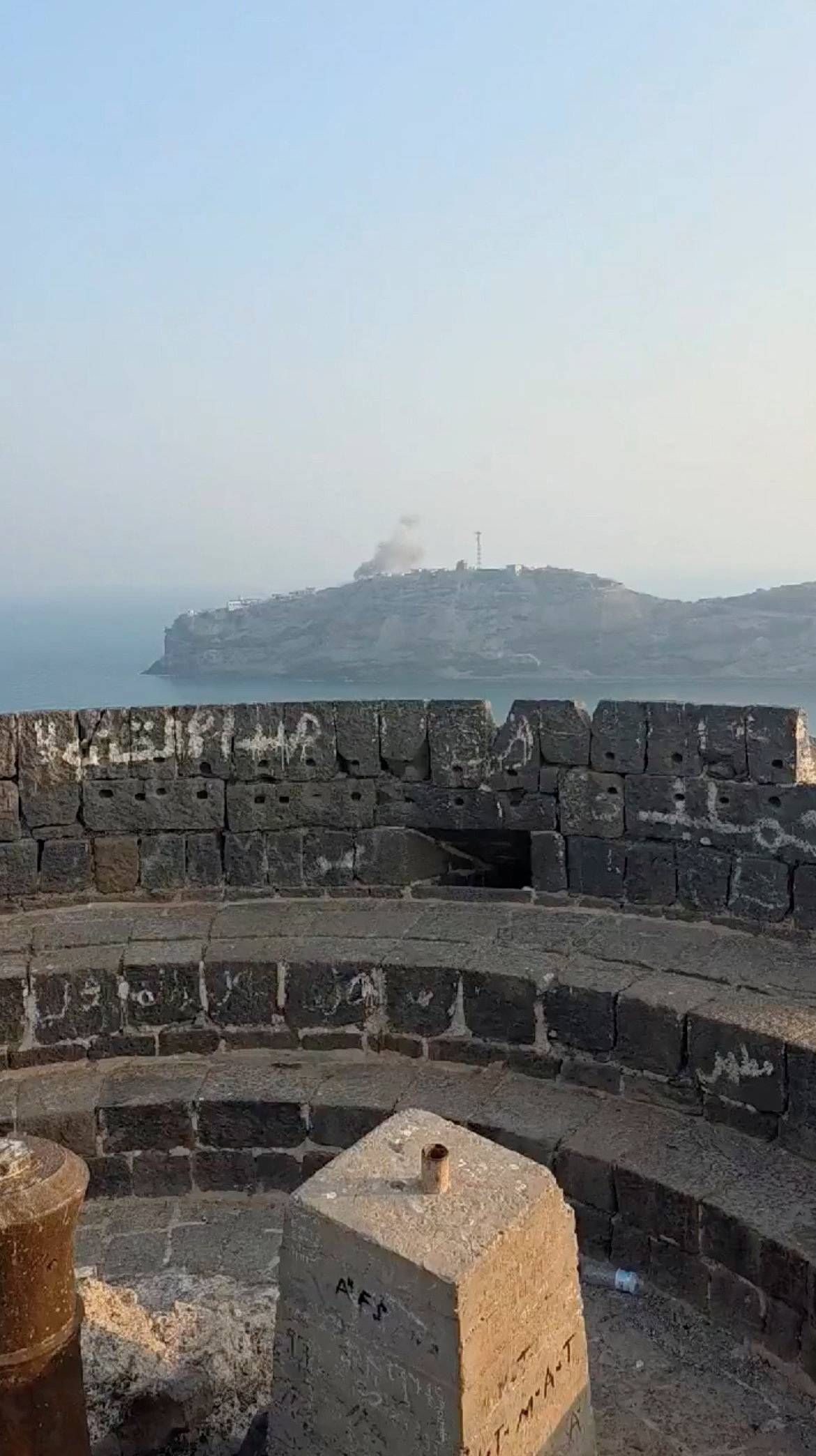
Many of Yemen's government leaders are living in exile, and those in Aden were safe, a government official said. Both officials spoke on condition of anonymity because they were not authorized to speak to the media. A video circulating on social media and analyzed by The Associated Press shows smoke rising from the area where the palace is located.

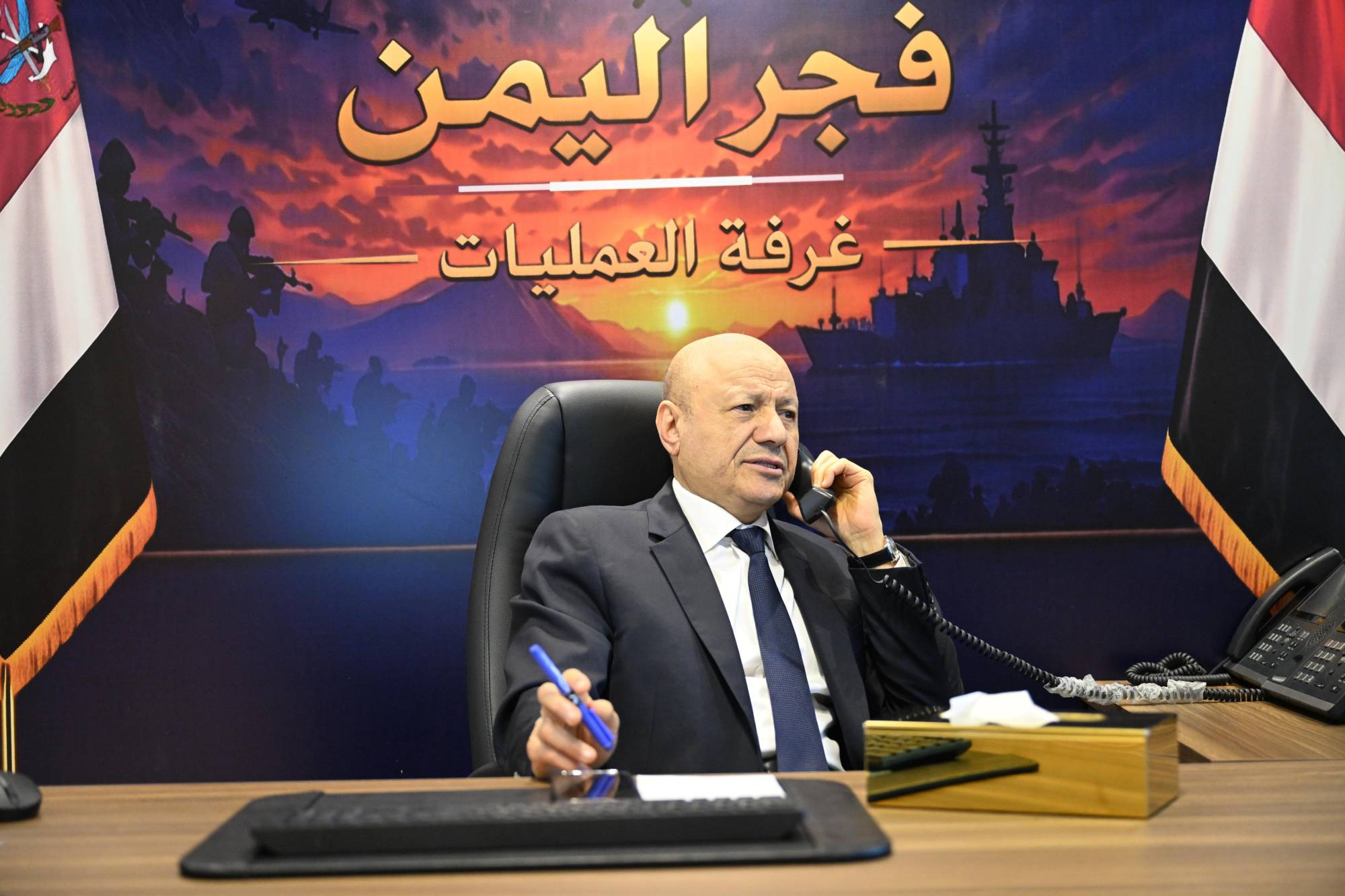
Chairman of the Presidential Leadership Council Dr. Rashad al-Alimi contacted ministers in wake of the attack.

Chairman of the Presidential Leadership Council Dr. Rashad al-Alimi contacted ministers in wake of the attack. (SABA)

He asserted that the Houthi attack on the palace is an extension of the militias' approach of targeting airports, oil facilities, and civilian objects in Yemen and Saudi Arabia, threatening regional security and waterways.

He stressed that the state will continue to carry out its constitutional responsibilities with utmost firmness, and that protecting its sovereign facilities and citizens is a non-negotiable responsibility.

He ordered the relevant military and security authorities to take the necessary measures to protect state institutions, counter terrorist threats, and respond appropriately to sources of threat in a manner that ensures the protection of civilians and civilian objects.

In turn, the cabinet affirmed that the attack on the Al-Maashiq Palace reveals the terrorist approach of the Houthis and their persistence in targeting civilians.

It stressed that it will not deter the government from performing its responsibilities and duties toward citizens, and continuing the battle to restore the state and its institutions and end the coup being pursued by the Dawn of Yemen Operation.

The attack on the palace is part of an escalating pattern of Houthi terrorism that has not been limited to targeting state institutions, but has extended to attacks on civilian objects and vital facilities in Saudi Arabia, and the shelling of residential neighborhoods in the governorates of Taiz and Lahj.

"The future of Yemen will not be held hostage by a militia that bears arms against its people, targets the security of its neighbors, and relies on violence to compensate for the Yemeni rejection of its coup project,” it added.

The cabinet called on the international community and the United Nations to take a clear and firm stance regarding these attacks, to stop treating them as isolated incidents separate from their context, to exert the necessary pressure to halt the targeting of civilians and civilian facilities, and to hold those responsible for the violations accountable.

Smoke billows from the presidential palace complex following an attack by Yemen's Houthis, according to government officials, in Aden, Yemen, October 15, 2026, in this screen grab obtained from a social media video. (Social media/via Reuters)

Elsewhere in Yemen, the fighting has revived a devastating civil war after four years of relative calm. One focus of alarm is the Houthi-besieged city of Taiz.

Residents of Yemen’s third-largest city are running short of basic necessities. Where goods can be found, prices have soared. Gas stations sit empty or out of service. The World Food Program said it can no longer reach more than 600,000 people in Taiz who depend on aid.

At a news conference late Thursday in Taiz, the Health Ministry said 120 people were killed and 307 wounded in the fighting through Oct. 5, with most of the deaths reported in Taiz, Saada and Jawf areas.

Fathiyya Mohamed al-Mugahed said she had gone looking for flour, cooking gas and fuel but found none.

“The Houthis have surrounded us from all sides,” she said. “Projectiles are all we have received from them.”

The International Committee of the Red Cross said Taiz has seen some of the “highest casualty burdens” in the country.


Netanyahu Rival Vows to End Hamas Rule within 18 Months if Elected

People walk past a banner featuring Israel's Prime Minister Benjamin Netanyahu (R) of the Likud party and country's former chief of the general staff and leader of the Yashar centrist political party Gadi Eisenkot in Ramat Gan on October 15, 2026. (AFP)
TT

Netanyahu Rival Vows to End Hamas Rule within 18 Months if Elected

People walk past a banner featuring Israel's Prime Minister Benjamin Netanyahu (R) of the Likud party and country's former chief of the general staff and leader of the Yashar centrist political party Gadi Eisenkot in Ramat Gan on October 15, 2026. (AFP)

Israeli opposition politician Gadi Eisenkot, Prime Minister Benjamin Netanyahu's main rival in upcoming elections, vowed Thursday to end Hamas rule in Gaza if he wins office following the October 27 vote.

"Today I give a public commitment: from the moment I enter the Prime Minister's Office, within 18 months Hamas will no longer rule the Gaza Strip," the leader of the center-right Yashar party said at a press conference near the war-ravaged Palestinian territory.

He said he would achieve this either by implementing US President Donald Trump's ceasefire plan, which provides for the gradual disarmament of Hamas and a transfer of power, or through "creative operations" by Israel's military aimed at destroying the Palestinian movement's military wing.

Hamas announced in July that it was disbanding its governing body to facilitate the transfer of Gaza's administration to a nascent technocratic Palestinian committee called the National Committee for the Administration of Gaza (NCAG).

The NCAG, currently based in Cairo, was created following the declaration of a ceasefire last October and is overseen by Trump's Board of Peace.

Later in July, Hamas announced it had agreed to a deal involving the handing over of its weapons to the NCAG.

But Israel has been skeptical, with Netanyahu demanding verifiable decommissioning of all weapons before any withdrawal of the military takes place.

Hamas has not gone ahead with disarmament, Israel has refused to reciprocate by starting to withdraw forces, and the NCAG is not operating inside the territory.

Israeli forces were allowed to stay in 53 percent of Gaza under the terms of the ceasefire, but a year later they control about 70 percent, according to official accounts.

- 'Strategic failure' -

Eisenkot's campaign pledge on Thursday is one of the strongest yet from the 66-year-old former military chief.

The close-fought election will be the first since Hamas's October 7, 2023, attack on Israel, which resulted in the deaths of more than 1,200 people.

In response to the attack, Israel launched a massive offensive in Gaza that has killed more than 74,300 people, according to the territory's health ministry, which operates under Hamas and whose figures are generally considered reliable by the United Nations.

Eisenkot on Thursday accused Netanyahu of a "strategic failure" in Gaza, where he said "Hamas is still the sovereign... armed, arming itself, and militarily active" after three years of war.

He also reiterated a pledge to establish a state commission of inquiry to identify those responsible for any security lapses leading up to October 7, a push the government has so far resisted.

"There is a way to prevent the next disaster," he said.

Eisenkot, like other opposition politicians, regularly accuses Netanyahu of bearing personal responsibility for the October 7 attack, notably by ignoring warnings from his security services, according to media reports.

Netanyahu has categorically rejected the accusations and maintains that security officials did not wake him on the morning of the attack.

Current polls show that neither Netanyahu's bloc nor that led by Eisenkot is in a position to win the 61 seats needed to control the 120-seat parliament and form a governing coalition.