Iran's Guards Reportedly Pull Officers from Syria after Israeli Strikes

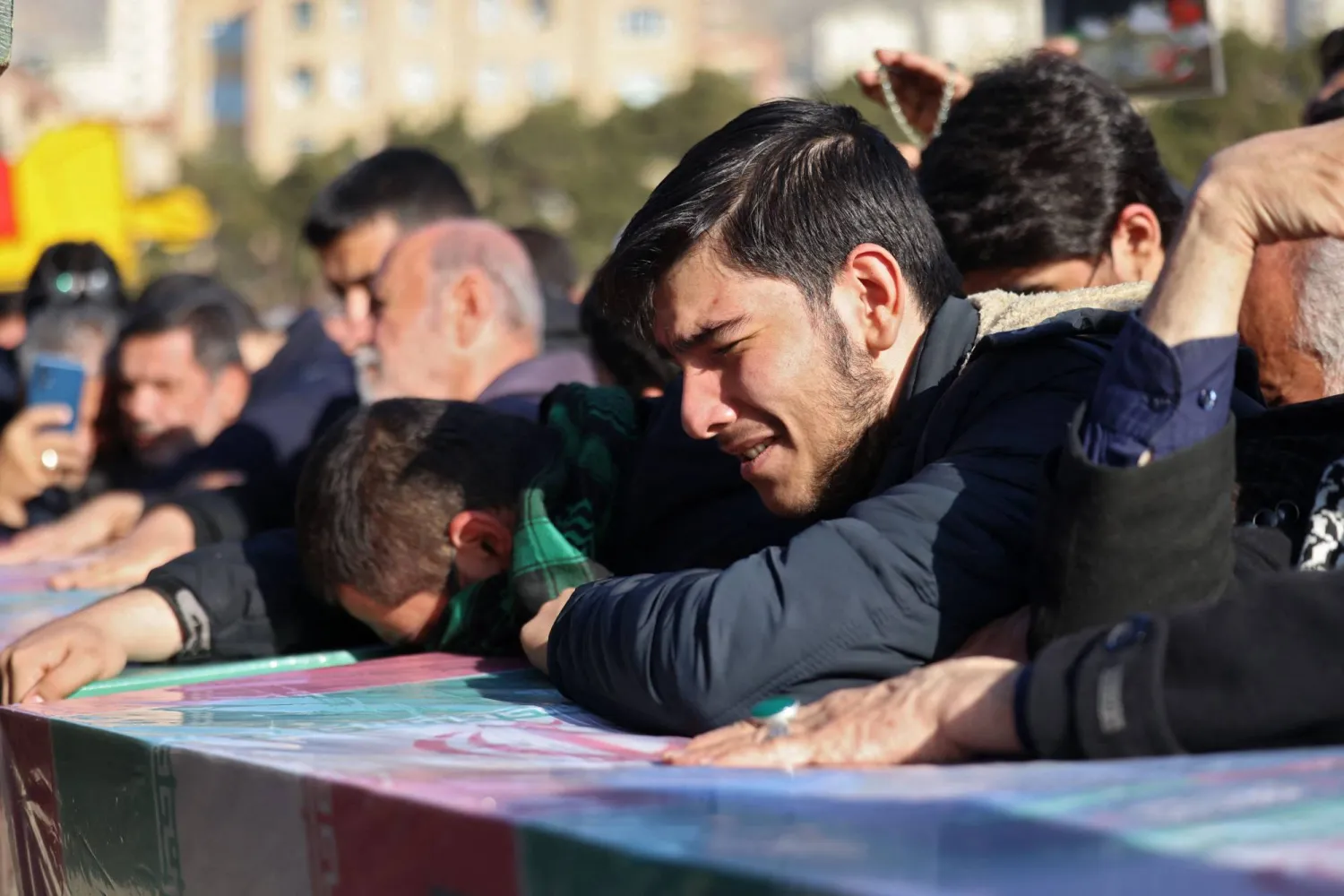
People mourn over the coffins of Iranian Revolutionary Guard Corps (IRGC) members killed in Damascus in a strike blamed on Israel on January 20, during their funeral in the Iranian capital Tehran on January 22, 2023. (Photo by ATTA KENARE / AFP)
TT

Iran's Guards Reportedly Pull Officers from Syria after Israeli Strikes

People mourn over the coffins of Iranian Revolutionary Guard Corps (IRGC) members killed in Damascus in a strike blamed on Israel on January 20, during their funeral in the Iranian capital Tehran on January 22, 2023. (Photo by ATTA KENARE / AFP)

Iran's Revolutionary Guards have scaled back deployment of their senior officers in Syria due to a spate of deadly Israeli strikes and will rely more on allied Shiite militia to preserve their sway there, five sources familiar with the matter said.
The Guards have suffered one of their most bruising spells in Syria since arriving a decade ago to aid President Bashar al-Assad in the Syrian war. Since December, Israeli strikes have killed more than half a dozen of their members, among them one of the Guards' top intelligence generals.
As hardliners in Tehran demand retaliation, Iran's decision to pull out senior officers is driven partly by its aversion to being sucked directly into a conflict bubbling across the Middle East, three of the sources told Reuters.
While the sources said Iran has no intention of quitting Syria - a key part of Tehran's sphere of influence - the rethink underscores how the consequences of the war ignited by Palestinian militant group Hamas' Oct. 7 attack on Israel are unfolding in the region.
Iran, a backer of Hamas, has sought to stay out of the conflict itself even as it supports groups that have entered the fray from Lebanon, Yemen, Iraq and Syria - the so-called "Axis of Resistance" that is hostile to Israeli and US interests.
One of the sources - a senior regional security official briefed by Tehran - said senior Iranian commanders had left Syria along with dozens of mid-ranking officers, describing it as a downsizing of the presence.
The source did not say how many Iranians had left and Reuters was unable independently to determine that.
The news agency could not reach the Guards for comment and the Syrian information ministry did not respond to emailed questions for this story.
Three of the sources said the Guards would manage Syrian operations remotely, with help from ally Hezbollah. The Lebanese group did not immediately respond to a request for comment.
Another source, a regional official close to Iran, said those still in Syria had left their offices and were staying out of sight. "The Iranians won't abandon Syria but they reduced their presence and movements to the greatest extent."
The sources said the changes so far had not had an impact on operations. The downsizing would "help Tehran to avoid being pulled into the Israel-Gaza war," one of the sources, an Iranian, said.
Since the Gaza war erupted, Israel has stepped up a years-long campaign of air strikes aimed at rolling back Iran's presence in Syria, attacking both the Guards and Hezbollah - which in turn has been exchanging fire with Israel across the Lebanese-Israeli border since Oct. 8.
Israel rarely comments on its attacks in Syria and has not declared responsibility for the recent strikes there. In response to Reuters' questions, the Israeli military said it did not comment on foreign media reports.
'INTELLIGENCE BREACH'
In one of the attacks, on Jan. 20, five members of the Guards were killed, Iranian state media reported, including a general who ran intelligence for the Quds Force, which is responsible for the Guards' overseas operations. The strike flattened a Damascus building.
Another, on Dec. 25 outside Damascus, killed a senior Guards adviser responsible for coordinating between Syria and Iran. Iran's Supreme Leader Ali Khamenei led prayers at his funeral.
Reuters spoke to six sources familiar with Iranian deployments in Syria for this story. They declined to be identified due to the sensitivity of the subject.
Three of the sources said the Guards had raised concerns with Syrian authorities that information leaks from within the Syrian security forces played a part in the recent lethal strikes.
Another source familiar with Iranian operations in Syria said the precise Israeli strikes had prompted the Guards to relocate operational sites and officers' residences, amidst concerns of an "intelligence breach".
The regional official close to Iran said the Guards were drawing more on Syrian Shiite militias.
Gregory Brew, an analyst with Eurasia group, a political risk consultancy, said the failure to protect Iranian commanders had "clearly undermined Iran's position" but Tehran was unlikely to end its commitment to Syria to preserving its role in Syria.
Russia has also supported Assad, deploying its air force to Syria in 2015, and any weakening of Iran's role there could play to its advantage. "Moscow and Tehran are working more closely together but their relationship may be strained if they compete openly in Syria," Brew said.
Russia said this month it expected President Vladimir Putin and his Iranian counterpart Ebrahim Raisi to sign a new treaty soon, amid strengthening political, trade and military ties between the two nations.



Israel Demolishes Home of Palestinian Accused of Attack

A picture taken on September 30, 2025 shows the demolished house of Yahya Abu Ghaliyeh, a Palestinian from a Bedouin village near the town of Al-Eizariya, also known as Bethany, east of Jerusalem. (AFP)
TT

Israel Demolishes Home of Palestinian Accused of Attack

A picture taken on September 30, 2025 shows the demolished house of Yahya Abu Ghaliyeh, a Palestinian from a Bedouin village near the town of Al-Eizariya, also known as Bethany, east of Jerusalem. (AFP)

The Israeli army demolished on Wednesday the home of a Palestinian accused of carrying out a stabbing and shooting attack that killed an Israeli earlier this year, the military said, AFP reported.

On July 10, two attackers killed 22-year-old Shalev Zvuluny in a shopping area near Jerusalem, before the Israeli army shot them dead.

On Wednesday, Israeli army bulldozers entered the village of Bazzaryah in the occupied West Bank, destroying the family home of one of the attackers after it had been evacuated.

Israeli forces "demolished the home of the terrorist who carried out the shooting and stabbing attack at the Gush junction, during which Shalev Zvuluny... was murdered", the army said in a statement.

Hazem Yassine, head of the Bazzaryah municipal council, denounced what he called a "heinous crime".

He told AFP that Israeli forces had sealed off the village's entrances since dawn in preparation for the demolition.

"Schools were closed as a precaution," he said, adding that the assailant's family had moved out around a month ago after being notified of the decision to demolish the house.

An AFP photographer saw children climbing on piles of rubble after the demolition, waving the Palestinian flag.

Israel, whose army has occupied the West Bank since 1967, regularly demolishes the homes of Palestinians accused of carrying out deadly attacks against Israelis.

The government defends the deterrent effect of these demolitions, but critics denounce the practice as a form of collective punishment that leaves families homeless.

Violence in the West Bank surged during the war in Gaza, which erupted on October 7, 2023 with Hamas's attack on Israel.

Since then, Israeli soldiers or settlers have killed more than a thousand Palestinians in the West Bank, many of them militants but also including civilians, according to an AFP tally based on Palestinian Authority data.

At the same time, according to official Israeli figures, at least 44 Israelis, including civilians and soldiers, have been killed in Palestinian attacks or during Israeli military raids in the area.


A Blast in Gaza Wounds Soldier and Israel Accuses Hamas of Ceasefire Violation

A woman sits next to her tent on an alley of a makeshift tent camp for displaced Palestinians in Deir al-Balah, central Gaza Strip, Tuesday, Dec. 23, 2025. (AP Photo/Abdel Kareem Hana)
TT

A Blast in Gaza Wounds Soldier and Israel Accuses Hamas of Ceasefire Violation

A woman sits next to her tent on an alley of a makeshift tent camp for displaced Palestinians in Deir al-Balah, central Gaza Strip, Tuesday, Dec. 23, 2025. (AP Photo/Abdel Kareem Hana)

An explosive device detonated in Gaza on Wednesday, injuring one Israeli soldier and prompting Israel to accuse Hamas of violating the US-backed ceasefire. It was the latest incident to threaten the tenuous truce that has held since Oct. 10 as each side accuses the other of violations.

The blast came as Hamas met with Turkish officials in Ankara to discuss the second stage of the ceasefire. Though the agreement has mostly held, its progress has slowed, The AP news reported.

All but one of the 251 hostages taken in the Hamas-led attack on Oct. 7, 2023, that sparked the war have been released, alive or dead, in exchange for Palestinian prisoners and detainees. The ceasefire's second phase has even bigger challenges: the deployment of an international stabilization force, a technocratic governing body for Gaza, the disarmament of Hamas and further Israeli troop withdrawals from the territory.

Israel vows to ‘respond accordingly’ Israel's military said the explosive detonated beneath a military vehicle as soldiers were “dismantling” militant infrastructure in the southern city of Rafah. The lightly injured soldier was taken to a hospital, the military said.

Prime Minister Benjamin Netanyahu in a statement called the incident a violation of the ceasefire and said Israel would "respond accordingly.”

Israel previously launched strikes in Gaza in response to alleged ceasefire violations. On Oct. 19, Israel said two soldiers were killed by Hamas fire and it responded with a series of strikes that killed over 40 Palestinians, according to local health officials.

Hamas accuses Israel of violating the ceasefire by not allowing enough aid into the territory and continuing to strike civilians. Palestinian health officials say over 370 Palestinians have been killed by Israeli fire since the truce.

On Friday, Israeli troops fired over the ceasefire line in northern Gaza, killing at least five Palestinians, including a baby, according to a local hospital that received the casualties.

Turkish Foreign Minister Hakan Fidan met with a Hamas delegation led by Khalil al-Haya to discuss the ceasefire's second phase, according to ministry officials.

Fidan reaffirmed Türkiye's efforts to defend the rights of Palestinians and outlined ongoing efforts to address shelter and other humanitarian needs in Gaza, the officials said.

The Hamas delegation said they had fulfilled the ceasefire’s conditions but that Israel’s continued attacks were blocking progress toward the next stage. They also asserted that 60% of the trucks allowed into Gaza were carrying commercial goods rather than aid.

According to the officials, the meeting also discussed reconciliation efforts between the Palestinian factions and the situation in the Israeli-occupied West Bank, stressing that Israel’s actions there were “unacceptable.”


Algeria Passes Law Declaring French Colonisation a Crime

Members of the committee drafting the law criminalizing colonialism (File Photo/ Algerian Parliament)
TT

Algeria Passes Law Declaring French Colonisation a Crime

Members of the committee drafting the law criminalizing colonialism (File Photo/ Algerian Parliament)

Algeria's parliament unanimously approved on Wednesday a law declaring France's colonisation of the country a crime, and demanding an apology and reparations.

Standing in the chamber, lawmakers wearing scarves in the colors of the national flag chanted "long live Algeria" as they applauded the passage of the bill, which states that France holds "legal responsibility for its colonial past in Algeria and the tragedies it caused".

The vote comes as the two countries are embroiled in a major diplomatic crisis, and analysts say that while Algeria's move is largely symbolic, it is still politically significant, AFP reported.

Parliament speaker Brahim Boughali told the APS state news agency before the vote that it would send "a clear message, both internally and externally, that Algeria's national memory is neither erasable nor negotiable".

The legislation lists the "crimes of French colonisation", including nuclear tests, extrajudicial killings, "physical and psychological torture", and the "systematic plundering of resources".

It states that "full and fair compensation for all material and moral damages caused by French colonisation is an inalienable right of the Algerian state and people".

France's rule over Algeria from 1830 until 1962 remains a sore spot in relations between the two countries.

The period was marked by mass killings and large-scale deportations, all the way up to the bloody war of independence from 1954-1962.

Algeria says the war killed 1.5 million people, while French historians put the death toll lower at 500,000 in total, 400,000 of them Algerian.

French President Emmanuel Macron has previously acknowledged the colonisation of Algeria as a "crime against humanity", but has stopped short of offering an apology.

Asked last week about the vote, French foreign ministry spokesman Pascal Confavreux said he would not comment on "political debates taking place in foreign countries".

Hosni Kitouni, a researcher in colonial history at the University of Exeter in the UK, said that "legally, this law has no international scope and therefore is not binding for France".

But "its political and symbolic significance is important: it marks a rupture in the relationship with France in terms of memory," he said.