

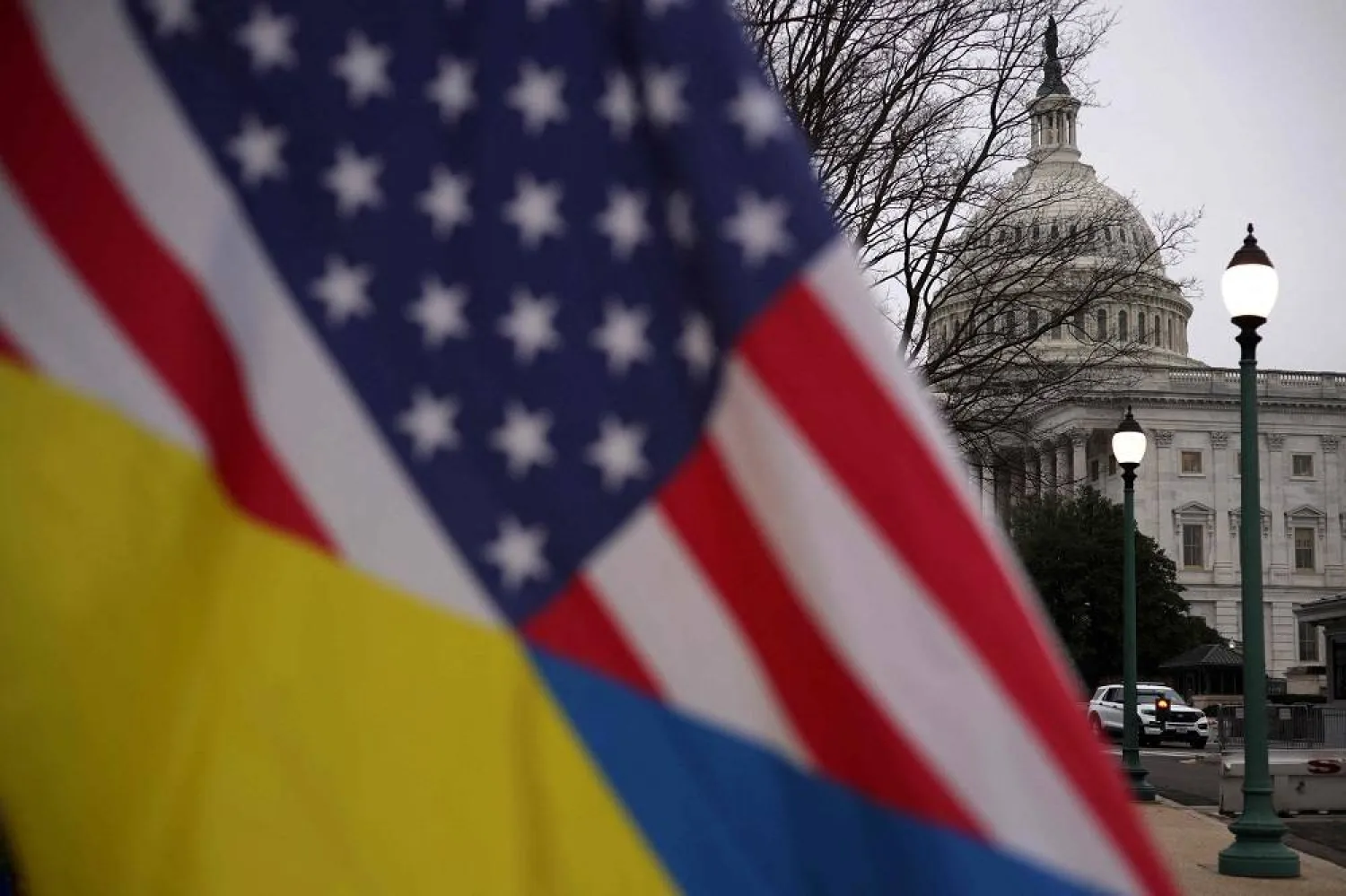

US Senate Passes $95.3 Billion Aid Package for Ukraine, Israel and Taiwan After Rare All-Night Session 

A man holds a mixed flag of Ukraine and America outside the US Capitol on February 12, 2024 in Washington, DC. (AFP/Getty Images)
TT

US Senate Passes $95.3 Billion Aid Package for Ukraine, Israel and Taiwan After Rare All-Night Session 

A man holds a mixed flag of Ukraine and America outside the US Capitol on February 12, 2024 in Washington, DC. (AFP/Getty Images)

The Senate early Tuesday passed a $95.3 billion aid package for Ukraine, Israel and Taiwan, pushing ahead after months of difficult negotiations and amid growing political divisions in the Republican Party over the role of the United States abroad.

The vote came after a small group of Republicans opposed to the $60 billion for Ukraine held the Senate floor through the night, using the final hours of debate to argue that the US should focus on its own problems before sending more money overseas. But 22 Republicans voted with nearly all Democrats to pass the package 70-29, with supporters arguing that abandoning Ukraine could embolden Russian President Vladimir Putin and threaten national security across the globe.

“With this bill, the Senate declares that American leadership will not waiver, will not falter, will not fail,” said Senate Majority Leader Chuck Schumer, who worked closely with Republican Leader Mitch McConnell on the legislation.

The bill’s passage through the Senate was a welcome sign for Ukraine amid critical shortages on the battlefield.

Yet the package faces a deeply uncertain future in the House, where hardline Republicans aligned with former President Donald Trump — the front-runner for the GOP presidential nomination, and a critic of support for Ukraine — oppose the legislation.

Speaker Mike Johnson cast new doubt on the package in a statement Monday evening, making clear that it could be weeks or months before Congress sends the legislation to President Joe Biden's desk — if at all.

Still, the vote was a win for both Senate leaders. Schumer noted the strong bipartisan support and projected that if the House speaker brings it forward it would have the same strong support in that chamber. McConnell has made Ukraine his top priority in recent months, and was resolute in the face of considerable pushback from his own GOP conference.

Speaking directly to his detractors in a floor speech on Sunday, McConnell said that “the eyes of the world” were on the US Senate.

“Will we give those who wish us harm more reason to question our resolve, or will we recommit to exercising American strength?” McConnell asked.

Dollars provided by the legislation would purchase US-made defense equipment, including munitions and air defense systems that authorities say are desperately needed as Russia batters the country. It also includes $8 billion for the government in Kyiv and other assistance.

“For us in Ukraine, continued US assistance helps to save human lives from Russian terror,” Ukrainian President Volodymyr Zelenskyy posted on social media. “It means that life will continue in our cities and will triumph over war.”

In addition, the legislation would provide $14 billion for Israel’s war with Hamas, $8 billion for Taiwan and partners in the Indo-Pacific to counter China, and $9.2 billion in humanitarian assistance for Gaza.

Two Democrats, Sens. Jeff Merkley of Oregon and Peter Welch of Vermont, as well as Sen. Bernie Sanders, an independent, voted against it. The progressive lawmakers have objected to sending offensive weaponry to Israel.

“I cannot in good conscience support sending billions of additional taxpayer dollars for Prime Minister Netanyahu's military campaign in Gaza,” Welch said. “It’s a campaign that has killed and wounded a shocking number of civilians. It’s created a massive humanitarian crisis.”

The bill’s passage followed almost five months of torturous negotiations over an expansive bill that would have paired the foreign aid with an overhaul of border and asylum policies. Republicans demanded the trade-off, saying the surge of migration into the United States had to be addressed alongside the security of allies.

But a bipartisan deal on border security fell apart just days after its unveiling, a head-spinning development that left negotiators deeply frustrated. Republicans declared the bill insufficient and blocked it on the Senate floor.

After the border bill collapsed, the two leaders abandoned the border provisions and pushed forward with passing the foreign aid package alone — as Democrats had originally intended.

While the slimmed-down foreign aid bill eventually won enough Republican support to pass, several GOP senators who had previously expressed support for Ukraine voted against it. The episode further exposed divisions in the party, made more public as Trump dug in and a handful of lawmakers openly called for McConnell to step down.

Sen. J.D. Vance, an Ohio Republican, argued that the US should step back from the conflict and help broker an end to it with Russia's Putin. He questioned the wisdom of continuing to fuel Ukraine’s defense when Putin appears committed to fighting for years.

“I think it deals with the reality that we’re living in, which is they’re a more powerful country, and it’s their region of the world,” he said.

Vance, along with Kentucky Sen. Rand Paul and other opponents, spent several hours on the floor railing against the aid and complaining about Senate process. They dug in their heels to delay a final vote, speaking on the floor until daybreak.

Supporters of the aid pushed back, warning that bowing to Russia would be a historic mistake with devastating consequences. In an unusually raw back-and-forth, GOP senators who support the aid challenged some of the opponents directly on the floor.

North Carolina Sen. Thom Tillis angrily rebutted some of their arguments, noting that the money would only help Ukraine for less than a year and that much of it would go to replenishing US military stocks.

“Why am I so focused on this vote?” Tillis said. “Because I don’t want to be on the pages of history that we will regret if we walk away. You will see the alliance that is supporting Ukraine crumble. You will ultimately see China become emboldened. And I am not going to be on that page of history.”

Sen. Jerry Moran, R-Kan., became emotional as he talked about the drudgery of the Senate and spending time away from his family to get little done. “But every so often there are issues that come before us that seem to be the ones that explain why we are here,” he said, his voice cracking.

Moran conceded that the cost of the package was heavy for him, but pointed out that if Putin were to attack a NATO member in Europe, the US would be bound by treaty to become directly involved in the conflict — a commitment that Trump has called into question as he seeks another term in the White House.

At a rally Saturday, Trump said that he had once told a NATO ally he would encourage Russia “to do whatever the hell they want” to members that are “delinquent” in their financial and military commitments to the alliance. The former president has led his party away from the foreign policy doctrines of aggressive American involvement overseas and toward an “America First” isolationism.

Evoking the slogan, Moran said, “I believe in America first, but unfortunately America first means we have to engage in the world.”

While the vast majority of House Republicans have opposed the aid and are unlikely to cross Trump, a handful of GOP lawmakers have signaled they will push to get it passed.

House Intelligence Committee Chairman Mike Turner, R-Ohio, traveled to Ukraine last week with a bipartisan delegation and met with Zelenskyy. Turner posted on X, formerly Twitter, after the trip that “I reiterated America’s commitment to support Ukraine in its fight against Russia.”

But Speaker Johnson is in a tough position. A majority of his conference opposes the aid, and he is trying to lead the narrowest of majorities and avoid the fate of his predecessor, former Speaker Kevin McCarthy, who was ousted in October.

Johnson, R-La., said in a statement Monday that because the foreign aid package lacks border security provisions, it is “silent on the most pressing issue facing our country.” It was the latest — and potentially most consequential — sign of opposition to the Ukraine aid from House GOP leadership, who had rejected the bipartisan border plan as a “non-starter,” contributing to its rapid demise.

“Now, in the absence of having received any single border policy change from the Senate, the House will have to continue to work its own will on these important matters,” Johnson said. “America deserves better than the Senate’s status quo.”

Rep. Abigail Spanberger, a Virginia Democrat, traveled to Kyiv last week with Turner and other House members. She said the trip underscored to her how Ukraine is still in a fight for its very existence.

As the group traveled through Kyiv in armored vehicles, she said, they witnessed signs of an active war, from sandbagged shelters to burned-out cars and memorials to those killed. During the meeting with Zelenskyy, she said the US lawmakers tried to offer assurances that the American people still stand with his country.

“He was clear that our continued support is critical to their ability to win the war,” Spanberger said. “It’s critical to their own freedom. And importantly, it’s critical to US national security interests.”



Man Charged with Threatening to Kill US Vice President

US Vice President JD Vance and US second lady Usha Vance watch the opening ceremony of the Milano Cortina 2026 Winter Olympic Games at the San Siro stadium in Milan, northern Italy, on February 6, 2026. (AFP)
TT

Man Charged with Threatening to Kill US Vice President

US Vice President JD Vance and US second lady Usha Vance watch the opening ceremony of the Milano Cortina 2026 Winter Olympic Games at the San Siro stadium in Milan, northern Italy, on February 6, 2026. (AFP)

A federal grand jury charged a 33-year-old man with threatening to kill US Vice President JD Vance during his visit to Ohio in January, the Justice Department said on Friday.

Shannon Mathre, a resident of Toledo, Ohio, is accused of "making a threat to take the life of, and to inflict bodily harm upon" the vice president, the department said in a statement.

Mathre reportedly said he was "going to find out where he (the vice president) is going to be and use my M14 automatic gun and kill him," according to the statement. It did not say where he made the comment.

US Secret Service agents arrested Mathre on Friday.

The threat is the latest reported incident involving Vance.

Vance said in early January "a crazy person" had tried to break into his Ohio home by hammering on the windows. The vice president and his family were not home at the time, and a 26-year-old man was taken into custody, according to US media reports.

The Justice Department said on Friday it found "multiple digital files of child sexual abuse materials" in Mathre's possession while investigating the alleged threat against Vance.

Mathre made his initial court appearance before a US Magistrate Judge for the Northern District of Ohio on Friday.

He is in custody pending a detention hearing on February 11, the Justice Department said.


Iran’s FM Criticizes Israel After Nuclear Talks with US

Iran's Foreign Minister Abbas Araghchi looks on as he speaks during the 17th edition of the Al Jazeera Forum in Doha on February 7, 2026. (AFP)
TT

Iran’s FM Criticizes Israel After Nuclear Talks with US

Iran's Foreign Minister Abbas Araghchi looks on as he speaks during the 17th edition of the Al Jazeera Forum in Doha on February 7, 2026. (AFP)

Iran's Foreign Minister Abbas Araghchi on Saturday criticized what he said was a "doctrine of domination" that allows Israel to expand its military arsenal while pressuring other countries in the region to disarm.

His remarks came a day after renewed nuclear talks with Washington, with previous talks collapsing when Israel launched an unprecedented bombing campaign against Iran last June that triggered a 12-day war.

Araghchi was speaking at the Al Jazeera Forum conference in Qatar but made no reference to Friday's talks with the United States.

"Israel's expansionist project requires that neighboring countries be weakened: militarily, technologically, economically and socially," Araghchi said.

"Under this project Israel is free to expand its military arsenal without limits ... Yet other countries are demanded to disarm. Others are pressured to reduce defensive capacity. Others are punished for scientific progress," he added.

"This is a doctrine of domination."

During the 12-day war Israel targeted senior Iranian military officials, nuclear scientists and sites as well as residential areas, with the US later launching its own attacks on key nuclear facilities.

Iran responded at the time with drone and missile attacks on Israel, as well as by targeting the largest US military base in the Middle East, located in Qatar.

On Friday, Araghchi led the Iranian delegation in indirect nuclear talks with US Middle East envoy Steve Witkoff in Muscat.

The top Iranian diplomat later described the atmosphere as having been "very positive", while US President Donald Trump said the talks were "very good," with both sides agreeing to proceed with further negotiations.

The talks followed threats from Washington and its recent deployment of an aircraft carrier group to the region following Iran's deadly crackdown on anti-government protests last month.

The United States has sought to address Iran's ballistic missile program and its support for militant groups in the region -- issues which Israel has pushed to include in the talks, according to media reports.

Tehran has repeatedly rejected expanding the scope of negotiations beyond the nuclear issue.


Trump Refuses to Apologize for Video Depicting Obama and Wife as Apes

FILE PHOTO: US President Donald Trump and first lady Melania Trump see off former US President Barack Obama and his wife Michelle Obama as they depart following Trump's inauguration at the Capitol in Washington, US January 20, 2017. REUTERS/Jonathan Ernst/File Photo
TT

Trump Refuses to Apologize for Video Depicting Obama and Wife as Apes

FILE PHOTO: US President Donald Trump and first lady Melania Trump see off former US President Barack Obama and his wife Michelle Obama as they depart following Trump's inauguration at the Capitol in Washington, US January 20, 2017. REUTERS/Jonathan Ernst/File Photo

President Donald Trump’s racist social media post featuring former President Barack Obama and his wife, Michelle Obama, as primates in a jungle was deleted Friday after a backlash from both Republicans and Democrats who criticized the video as offensive.

Trump said later Friday that he won't apologize for the post: “I didn't make a mistake,” he said.

The Republican president’s Thursday night post was blamed on a staffer after widespread backlash, from civil rights leaders to veteran Republican senators, for its treatment of the nation’s first Black president and first lady. A rare admission of a misstep by the White House, the deletion came hours after press secretary Karoline Leavitt dismissed “fake outrage” over the post. After calls for its removal — including by Republicans — the White House said a staffer had posted the video erroneously.

The post was part of a flurry of overnight activity on Trump's Truth Social account that amplified his false claims that the 2020 election was stolen from him, despite courts around the country and Trump's first-term attorney general finding no evidence of systemic fraud.

Trump has a record of intensely personal criticism of the Obamas and of using incendiary, sometimes racist, rhetoric — from feeding the lie that Obama was not a native-born US citizen to crude generalizations about majority-Black countries.

The post came in the first week of Black History Month and days after a Trump proclamation cited “the contributions of black Americans to our national greatness” and “the American principles of liberty, justice, and equality.”

An Obama spokeswoman said the former president, a Democrat, had no response.

‘An internet meme’

Nearly all of the 62-second clip appears to be from a conservative video alleging deliberate tampering with voting machines in battleground states as 2020 votes were tallied. At the 60-second mark is a quick scene of two jungle primates, with the Obamas’ smiling faces imposed on them.

Those frames originated from a separate video, previously circulated by an influential conservative meme maker. It shows Trump as “King of the Jungle” and depicts Democratic leaders as animals, including Joe Biden, who is white, as a jungle primate eating a banana.

“This is from an internet meme video depicting President Trump as the King of the Jungle and Democrats as characters from the Lion King,” Leavitt said by text.

Disney's 1994 feature film that Leavitt referenced is set on the savannah, not in the jungle, and it does not include great apes.

“Please stop the fake outrage and report on something today that actually matters to the American public,” Leavitt added.

By noon, the post had been taken down, with responsibility placed on a Trump subordinate.

Trump, answering questions from reporters accompanying him Friday night aboard Air Force One, said the video was about fraudulent elections and that he liked what he saw.

“I liked the beginning. I saw it and just passed it on, and I guess probably nobody reviewed the end of it,” he said.

Asked if he condemned the video's racism, Trump said, “Of course I do.”

The White House explanation raises questions about control of Trump’s social media account, which he's used to levy import taxes, threaten military action, make other announcements and intimidate political rivals. The president often signs his name or initials after policy posts.

The White House did not immediately respond to an inquiry about how posts are vetted and when the public can know when Trump himself is posting.

Mark Burns, a pastor and a prominent Trump supporter who is Black, said Friday on X that he'd spoken “directly” with Trump and that he recommended to the president that he fire the staffer who posted the video and publicly condemn what happened.

“He knows this is wrong, offensive, and unacceptable,” Burns posted.

Congressional Black Caucus Chairwoman Yvette Clarke, D-N.Y., told The Associated Press she does “not buy the White House's commentary.”

Condemnation across the political spectrum Trump and White House social media accounts frequently repost memes and artificial intelligence-generated videos. As Leavitt did Friday, Trump allies typically cast them as humorous.

This time, condemnations flowed from across the spectrum — along with demands for an apology that doesn't appear to be coming.