World Court Holds Hearings on Israel’s Occupation of Palestinian Territories

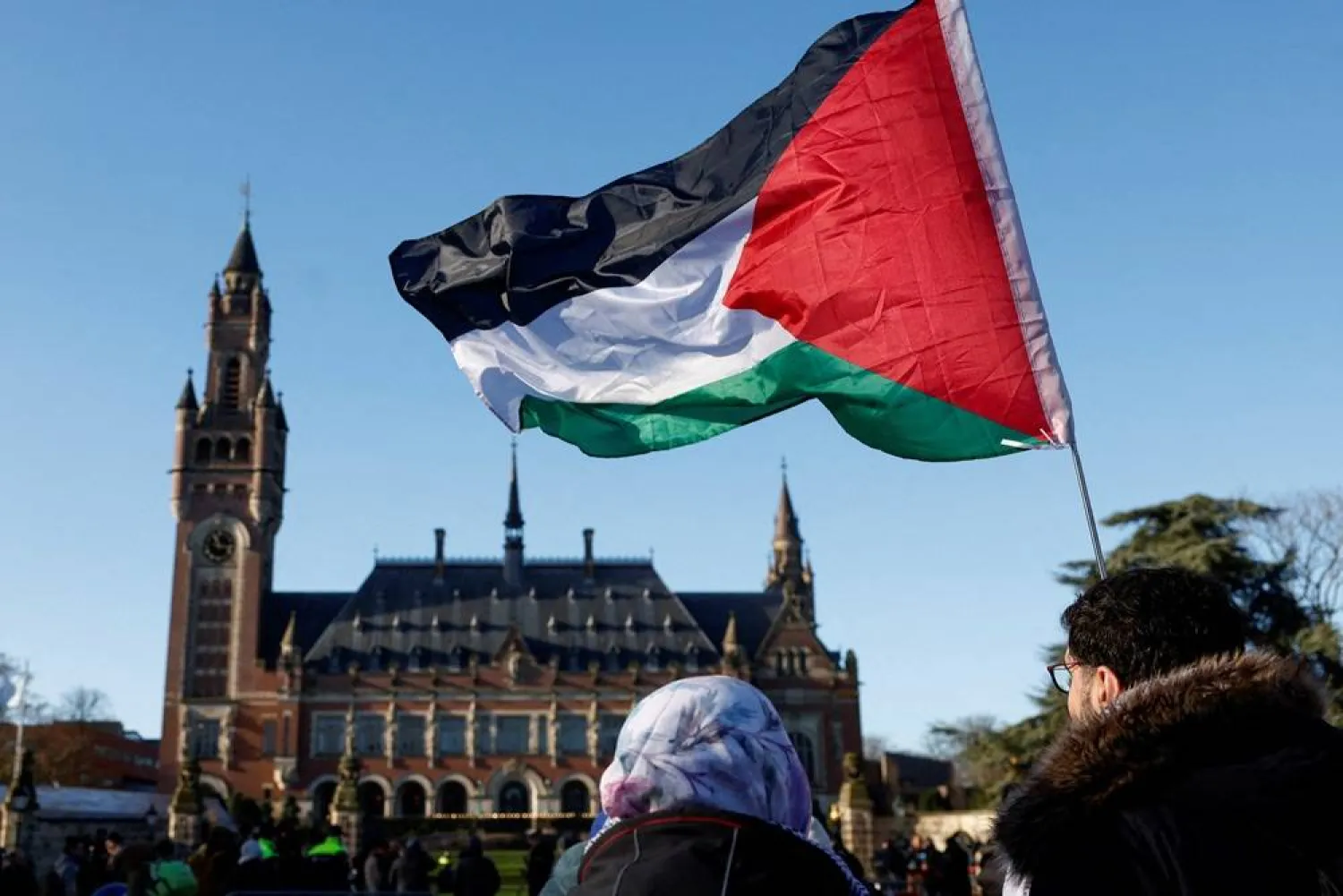
Protesters hold a Palestinian flag as they gather outside the International Court of Justice (ICJ) as judges rule on emergency measures against Israel following accusations by South Africa that the Israeli military operation in Gaza is a state-led genocide, in The Hague, Netherlands, January 26, 2024. (Reuters)
TT

World Court Holds Hearings on Israel’s Occupation of Palestinian Territories

Protesters hold a Palestinian flag as they gather outside the International Court of Justice (ICJ) as judges rule on emergency measures against Israel following accusations by South Africa that the Israeli military operation in Gaza is a state-led genocide, in The Hague, Netherlands, January 26, 2024. (Reuters)

A record 52 states will present arguments about the legal consequences of Israel's occupation of the Palestinian territories at the International Court of Justice (ICJ), the UN's highest legal body.

The ICJ's six days of hearings starting on Monday come after the UN General Assembly asked the court in 2022 for an advisory, or non-binding, opinion on the occupation.

While Israel has ignored such opinions in the past, it could add political pressure over its ongoing operation in Gaza, which has killed 28,775 people, mostly civilians. It is part of a Palestinian push to get international law institutions such as the ICJ to examine Israel's conduct which has become more urgent since the Oct. 7 attacks by Hamas in Israel and Israel's military response in the Gaza Strip.

"Politically, this will help in achieving a two-state solution. We are using the platform of the largest judicial body to advance our cause," Omar Awadallah, a senior official in the Palestinian Foreign Ministry, told journalists at a briefing before the hearings.

Israel captured the West Bank, Gaza and East Jerusalem - areas of historic Palestine which the Palestinians want for a state - in a 1967 war. It withdrew from Gaza in 2005, but, along with neighboring Egypt, still controls its borders.

It is the second time the UN General Assembly has asked the ICJ, also known as the World Court, for an advisory opinion related to the occupied Palestinian territory. In July 2004, the court found that Israel's separation wall in the West Bank violated international law and should be dismantled, though it still stands to this day.

"The International Court of Justice is set for the first time to broadly consider the legal consequences of Israel’s nearly six-decades-long occupation and mistreatment of the Palestinian people," said Clive Baldwin, senior legal adviser at Human Rights Watch.

"Governments that are presenting their arguments to the court should seize these landmark hearings to highlight the grave abuses Israeli authorities are committing against Palestinians, including the crimes against humanity of apartheid and persecution."

The advisory opinion proceedings are separate from the genocide case that South Africa filed at the World Court against Israel for its alleged violations in Gaza of the 1948 Genocide Convention. In late January the ICJ in that case ordered Israel to do everything in its power to prevent acts of genocide in Gaza.

The outcome of the advisory opinion would not be legally binding but would carry "great legal weight and moral authority," according to the ICJ.

The precise question put to the court is to give an opinion on the legal consequences of Israel's "occupation, settlement and annexation ... including measures aimed at altering the demographic composition, character and status of the Holy City of Jerusalem, and from its adoption of related discriminatory legislation and measures."

The general assembly also asked the 15-judge panel of the ICJ to advise on how those policies and practices "affect the legal status of the occupation" and what legal consequences arise for all countries and the United Nations from this status.

The court will hear over 50 states and three international organizations over six days of hearings including the United States, Russia, China and South Africa. While Israel has filed a written statement with the court, it has not asked to participate in the hearings. On Monday proceedings will start with submissions from the Palestinian authorities.


Russian FM to Visit Iran as Moscow Looks to Mediate in War

 Russia's Foreign Minister Sergei Lavrov speaks during a joint press conference with Bahrain's foreign minister and the Gulf Cooperation Council (GCC) secretary-general after the 9th Joint Ministerial Meeting of the Strategic Dialogue between GCC and the Russian Federation in Manama on October 18, 2026. (AFP)
Russia's Foreign Minister Sergei Lavrov speaks during a joint press conference with Bahrain's foreign minister and the Gulf Cooperation Council (GCC) secretary-general after the 9th Joint Ministerial Meeting of the Strategic Dialogue between GCC and the Russian Federation in Manama on October 18, 2026. (AFP)
TT

Russian FM to Visit Iran as Moscow Looks to Mediate in War

 Russia's Foreign Minister Sergei Lavrov speaks during a joint press conference with Bahrain's foreign minister and the Gulf Cooperation Council (GCC) secretary-general after the 9th Joint Ministerial Meeting of the Strategic Dialogue between GCC and the Russian Federation in Manama on October 18, 2026. (AFP)
Russia's Foreign Minister Sergei Lavrov speaks during a joint press conference with Bahrain's foreign minister and the Gulf Cooperation Council (GCC) secretary-general after the 9th Joint Ministerial Meeting of the Strategic Dialogue between GCC and the Russian Federation in Manama on October 18, 2026. (AFP)

Russian Foreign Minister Sergei Lavrov was due to arrive in Iran on Monday in his first visit since the outbreak of the Middle East war, as Russia seeks to play a mediating role.

Iranian foreign ministry spokesman Esmaeil Baqaei confirmed the trip on Sunday, saying in a statement that the two sides will discuss "regional and international developments".

Lavrov, who is scheduled to meet with Iranian Foreign Minister Abbas Araghchi, said Moscow's efforts are "aimed at preventing the return of a large-scale war", with talks stalled between Tehran and Washington.

The visit comes after Russian President Vladimir Putin told his Iranian counterpart Masoud Pezeshkian in early October that Moscow was prepared to contribute to mediation efforts.

Russia and Iran, two of the most heavily sanctioned nations in the world, maintain close ties. Their military and economic cooperation has only increased since the Russian invasion of Ukraine in 2022.

The Middle East war began in February with US-Israeli strikes on Iran.

Despite a ceasefire in April, followed by a US-Iran memorandum of understanding in June, hostilities in and around the Strait of Hormuz have not stopped.

Iran claims control over the strategic waterway -- through which one-fifth of the world's hydrocarbons pass in normal times -- and regularly targets vessels that cross without its authorization.

In response, Washington has been maintaining a naval counter-blockade on Iranian ports.

Russia's foreign ministry said discussions during Lavrov's visit were expected to focus on "ways to resolve the acute international crisis triggered by the unlawful aggression of the US and Israel against Iran".

The ministry said the war had been a blow to stability and security "not only in the near and Middle East, but also on a global scale".


Philippines Summons China’s Envoy Over Remarks Conveying ‘Threat’

This handout photo taken on October 19, 2026 and released by the Department of Foreign Affairs (DFA) shows Philippine Secretary of the Department of Foreign Affairs Maria Theresa Lazaro (L) and China's Ambassador to the Philippines Jing Quan posing for a photo during their meeting at the foreign ministry office in Manila. (Handout / Philippine Department of Foreign Affairs / AFP)
TT

Philippines Summons China’s Envoy Over Remarks Conveying ‘Threat’

This handout photo taken on October 19, 2026 and released by the Department of Foreign Affairs (DFA) shows Philippine Secretary of the Department of Foreign Affairs Maria Theresa Lazaro (L) and China's Ambassador to the Philippines Jing Quan posing for a photo during their meeting at the foreign ministry office in Manila. (Handout / Philippine Department of Foreign Affairs / AFP)

The Philippine foreign ministry on Monday summoned China's ambassador to express its "serious concern and strong objection" about remarks by the envoy that it said conveyed a threat of the use of force.

Philippine Foreign Secretary Ma. Theresa Lazaro summoned Ambassador Jing Quan and told him comments he made to media last week were "provocative and unacceptable", the Department of Foreign Affairs ‌said in ‌a statement.

Jing had told reporters ‌that ⁠China "may easily win" ⁠in a confrontation with the Philippines, but Beijing would not use force because "we love peace".

He was responding to a question about the Philippine defense secretary describing China as a regional troublemaker.

Diplomatic squabbles between China and US ally the ⁠Philippines have become more frequent ‌in recent years, typically ‌over standoffs and altercations between rival vessels in the ‌South China Sea, much of which ‌Beijing claims sovereignty over.

Manila has accused China's coast guard of aggressive conduct in the Philippines' exclusive economic zone, while Beijing insists it is enforcing the law ‌against vessels that are encroaching on its territory.

China's embassy in Manila did ⁠not ⁠immediately respond to a request for comment on the ambassador being summoned. It last week said Jing had been selectively quoted and his remarks over-interpreted.

Lazaro told Jing the comments aggravated an already sensitive atmosphere between the two countries and undermined mutual efforts to build understanding and cooperation, the foreign ministry said.

Sensitive issues should be addressed through established diplomatic channels and bilateral mechanisms that reserve space for dialogue and engagement, she said.


Austrian Airlines Flight from Tel Aviv Diverts to Sofia After ‘Threat’

An Austrian Airlines Boeing 777-200ER lands at Los Angeles International Airport (LAX), in Los Angeles, California, on June 14, 2026. (AFP via Getty Images)
TT

Austrian Airlines Flight from Tel Aviv Diverts to Sofia After ‘Threat’

An Austrian Airlines Boeing 777-200ER lands at Los Angeles International Airport (LAX), in Los Angeles, California, on June 14, 2026. (AFP via Getty Images)

An Austrian Airlines flight from Tel Aviv carrying 57 people was diverted to the Bulgarian capital Sofia late on Sunday after a threat was made against the aircraft, an airline spokesperson told Reuters.

Austrian Airlines said the threat was made against flight OS82 from Tel ‌Aviv to ‌Vienna, which required a ‌stopover ⁠in Sofia. The flight ⁠landed safely at 2042 CEST (1842 GMT), it said.

The Airbus A320 is being searched, and passengers will be rebooked onto an alternative flight once that is complete, the airline said. There were 51 ⁠passengers and six crew members aboard.

Data ‌from air tracker ‌Flightradar24 showed that the aircraft, registered OE-LZE, was ‌set to leave Tel Aviv ‌for Vienna but was diverted to Sofia.

Sky News earlier reported, citing Bulgaria’s transport ministry, that the plane landed after a “bomb threat signal.”

“During ‌the flight, on the border with Romania, the crew reported a ⁠bomb ⁠threat signal and decided to land in Sofia extraordinarily,” the ministry said, according to the report.

An Air Force fighter accompanied the plane until it landed in Sofia, with the passengers subsequently taken off the aircraft, the report added.

The ministry did not immediately respond to a Reuters request for comment.