


Israel Bombards Gaza, with Biggest Functioning Hospital Under Siege

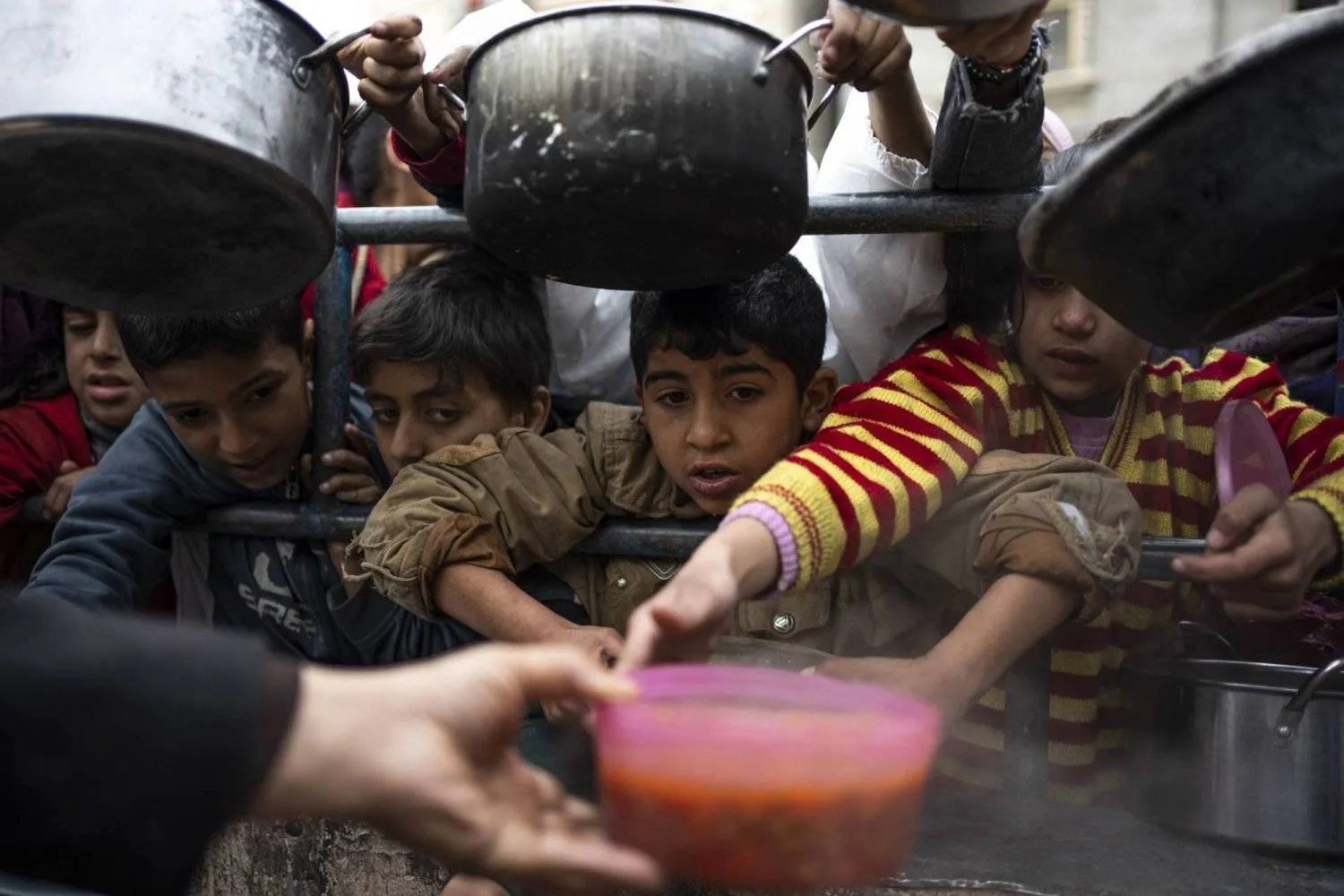
Palestinian children crowd to get food aid in Rafah, south of the Gaza Strip (The AP)
TT

Israel Bombards Gaza, with Biggest Functioning Hospital Under Siege

Palestinian children crowd to get food aid in Rafah, south of the Gaza Strip (The AP)

Gaza's largest functioning hospital was under siege on Friday in Israel's war with Hamas, leaving patients and doctors helpless in the chaos as warplanes struck Rafah, the last refuge for Palestinians in the enclave, officials said.

Israeli forces remained in Nasser Hospital in the town of Khan Younis after raiding it early Thursday. The Gaza Health Ministry said five intensive care patients died on Friday due to power outages and lack of oxygen supply caused by the attack.

Israel said it moved into the hospital because Hamas militants were hiding there. The Israeli military said on Friday its troops detained more than 20 militants in the hospital who participated in the Oct. 7 attacks on Israel and dozens of others for questioning. Hamas denies there were militants in the hospital, describing the claim as "lies aimed to cover up for destroying hospitals."

The Gaza Health Ministry said the hospital lost power and remained without electricity on Friday, jeopardizing patient care. But the Israeli military said it repaired one generator and provided another, ensuring "all vital systems continued to operate."

Two pregnant women gave birth on Friday “under tough conditions -- no water, no food and no way of warming them up” in cold weather, said ministry spokesman Ashraf Al-Qidra.

The ministry said Israeli forces inside Nasser Hospital forced women and children into the maternity department, which it turned into a military area. Women were not allowed to take any of their belongings.

According to the ministry, Israeli soldiers stopped an aid convoy outside the hospital, which was unable to deliver supplies. The military said it provided aid including baby food and water.

The incursion at the hospital raised alarm about patients, medical workers and displaced Palestinians sheltering there.

"There are still critically injured and sick patients that are inside the hospital," said Tarik Jasarevic, spokesperson for the World Health Organization, which said its staff was trying to reach the hospital after the Israeli raid.

"There is an urgent need to deliver fuel to ensure the continuation of the provision of life-saving services."

About 10,000 people were seeking shelter at the hospital earlier this week, but many left either in anticipation of the Israeli raid or because of Israeli orders to evacuate, the Gaza Health Ministry said.

Israel said its soldiers found ammunition and weapons in the hospital, as well as medication bearing names of some hostages.

At least two released Israeli hostages have said they were held in Nasser, which Hamas has denied.

The war began when Iran-backed Hamas sent fighters into Israel on Oct. 7, killing 1,200 people, mostly civilians, and seizing 253 hostages, according to Israeli tallies.

Israel's air and ground offensive has since devastated much of Gaza, killing 28,775 people, also mostly civilians according to Palestinian health authorities, and forcing nearly all of its more than 2 million inhabitants from their homes.

There is mounting international concern the humanitarian crisis in Gaza could worsen sharply if the Israeli military decides to storm the southern border city of Rafah, where more than half of the densely populated enclave's people are taking shelter in anticipation of a major attack.

An Israeli air strike hit two houses in Rafah in the southern Gaza Strip on Friday, killing 10 people and wounding several others, health officials said.

Rida Sobh, mourning the death of her sister in one of the Rafah strikes, said the house had been totally destroyed in the midnight attack, which also killed all her sister's children, her aunt, husband and cousin.

"Rafah is not safe. Everywhere in the Gaza Strip is a target. Don't say that Rafah is safe. From Beit Hanoun to Rafah, it is all dangerous."



EU Condemns Israel's West Bank Control Measures

The Israeli settlement of Har Homa, seen from the West Bank city of Bethlehem, Tuesday, Dec. 17, 2024. (AP)
TT

EU Condemns Israel's West Bank Control Measures

The Israeli settlement of Har Homa, seen from the West Bank city of Bethlehem, Tuesday, Dec. 17, 2024. (AP)

The European Union on Monday condemned new Israeli measures to tighten control of the West Bank and pave the way for more settlements in the occupied Palestinian territory, AFP reported.

"The European Union condemns recent decisions by Israel's security cabinet to expand Israeli control in the West Bank. This move is another step in the wrong direction," EU spokesman Anouar El Anouni told journalists.


Atrocities in Sudan's El-Fasher Were 'Preventable Human Rights Catastrophe'

Sudanese displaced people who left El Fasher after its fall, sit in the shade in Tawila at the Rwanda camp reception point on December 17, 2025. (Photo by AFP)
TT

Atrocities in Sudan's El-Fasher Were 'Preventable Human Rights Catastrophe'

Sudanese displaced people who left El Fasher after its fall, sit in the shade in Tawila at the Rwanda camp reception point on December 17, 2025. (Photo by AFP)

The atrocities unleashed on El-Fasher in Sudan's Darfur region last October were a "preventable human rights catastrophe", the United Nations said Monday, warning they now risked being repeated in the neighbouring Kordofan region.


"My office sounded the alarm about the risk of mass atrocities in the besieged city of El-Fasher for more than a year ... but our warnings were ignored," UN rights chief Volker Turk told the Human Rights Council in Geneva.


He added that he was now "extremely concerned that these violations and abuses may be repeated in the Kordofan region".


Arab League Condemns Israel's Decisions to Alter Legal, Administrative Status of West Bank

A general view shows the opening session of the meeting of Arab foreign ministers at the Arab League Headquarters (Reuters)
TT

Arab League Condemns Israel's Decisions to Alter Legal, Administrative Status of West Bank

A general view shows the opening session of the meeting of Arab foreign ministers at the Arab League Headquarters (Reuters)

The General Secretariat of the Arab League strongly condemned decisions by Israeli occupation authorities to impose fundamental changes on the legal and administrative status of the occupied Palestinian territories, particularly in the West Bank, describing them as a dangerous escalation and a flagrant violation of international law, international legitimacy resolutions, and signed agreements, SPA reported.

In a statement, the Arab League said the measures include facilitating the confiscation of private Palestinian property and transferring planning and licensing authorities in the city of Hebron and the area surrounding the Ibrahimi Mosque to occupation authorities.

It warned of the serious repercussions of these actions on the rights of the Palestinian people and on Islamic and Christian holy sites.

The statement reaffirmed the Arab League’s firm support for the legitimate rights of the Palestinian people, foremost among them the establishment of their independent state on the June 4, 1967 borders, with East Jerusalem as its capital.