



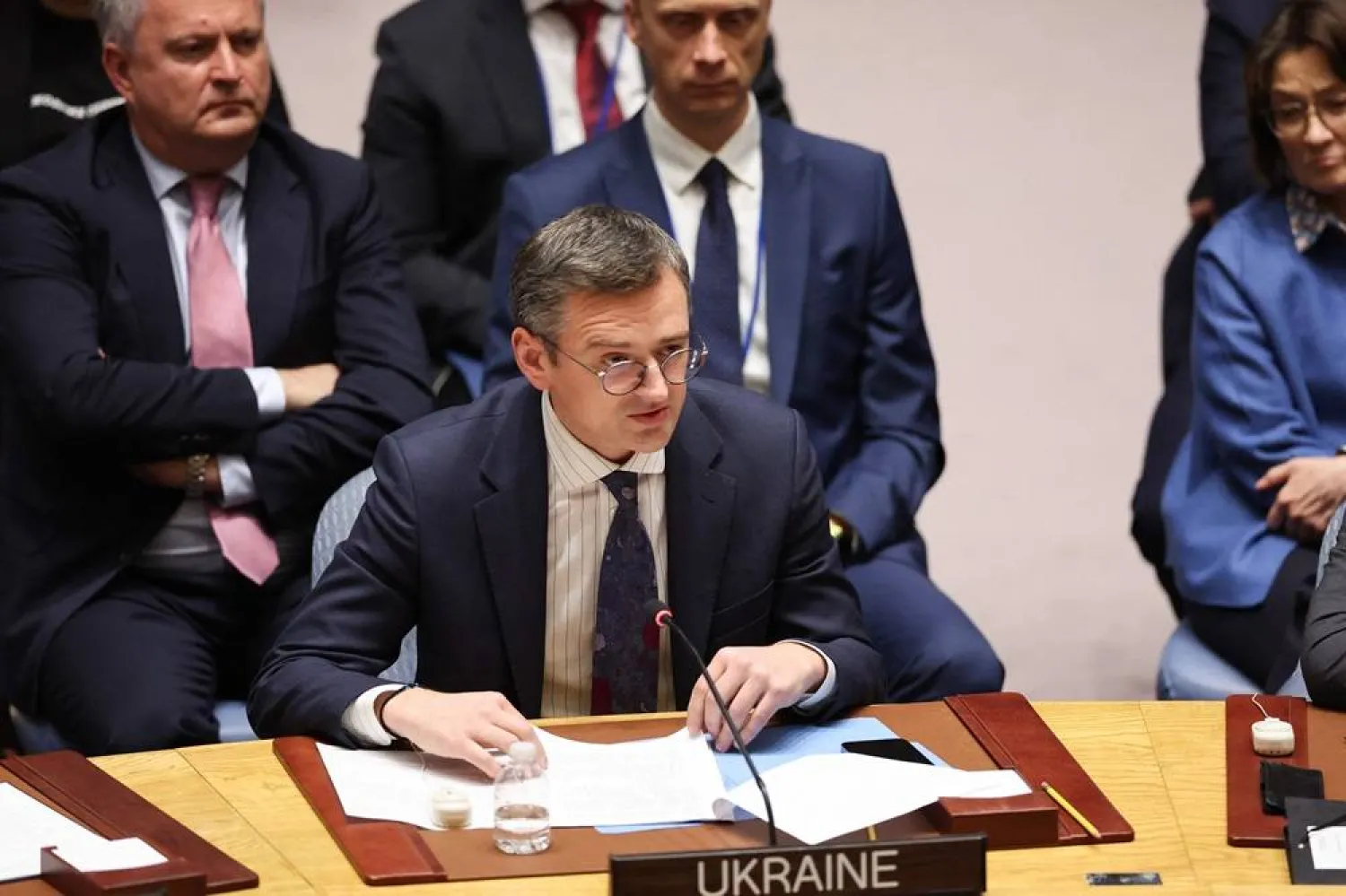

Ukraine’s foreign minister on Friday told skeptics who believe Ukraine can’t win the war with Russia that they will be proven wrong: “Ukraine will win the war.”
Dmytro Kuleba, speaking at the United Nations on the eve of the second anniversary of Russia's invasion, urged the world's nations to stand behind Ukraine. If they do, he said, victory will come “sooner rather than later.”
Russia’s UN Ambassador, Vassily Nebenzia, countered by repeating Moscow's claim that it didn't start the conflict. He blamed the West for fomenting it, accused Ukraine of being a tool of Western geopolitical ambitions, and vowed that Russia's “special military operation” won’t end until its goals are achieved.
Those goals — stated on Feb. 24, 2022, the day Russian troops crossed the border — include the de-militarization of Ukraine and ensuring its “neutral status.”
The UN General Assembly and the Security Council are marking the anniversary with ministerial meetings as President Volodymyr Zelenskyy pleads for more US military aid and Russian forces make new gains in eastern Ukraine.
The General Assembly has become the most important UN body dealing with Ukraine because the Security Council, which is charged with maintaining international peace and security, is paralyzed by Russia’s veto power. Assembly resolutions are not legally binding, unlike Security Council resolutions, but they serve as a barometer of world opinion.
Addressing the 193-member assembly, Kuleba recalled that over 140 nations supported resolutions backing Ukraine and calling for Russian forces to withdraw. But, he said, “Moscow’s aim is to destroy Ukraine and they’re quite outspoken about it.”
He said countries now saying Ukraine should negotiate with Russia and end the war are either “ill-informed” or didn't follow events after 2014, when Russia seized Crimea and backed an armed rebellion in eastern Ukraine. The two countries, he said, held approximately 200 rounds of negotiations and made 20 cease-fire agreements.
“All of these peace efforts ended two years ago, when Russia tore apart the Minsk process and launched its full-scale invasion,” Kuleba said. “Why would anyone suggest today that following the same logic will bring us to a different result?”
Zelenskyy’s 10-point peace plan is “the only serious peace proposal on the table,” Kuleba said, calling on other countries to add their diplomatic weight to it. The plan calls for expelling Russian forces, establishing a special tribunal to prosecute alleged Russian war crimes and building a European-Atlantic security architecture with guarantees for Ukraine.
When Russia invaded, diplomats and experts didn’t believe Ukraine would survive. Speaking to reporters, Kuleba said he wanted to make one point clear.
“Today, the same people do not believe that Ukraine can win this war,” he said. “They turned wrong once, and they will turn wrong again. Ukraine survived the invasion. Ukraine will win the war. And if we act collectively and jointly this will happen ... sooner rather than later.”
Nebenzia slammed Zelenskyy's plan.
“It is nothing other than an ultimatum to Russia and an attempt to lure as many countries as possible into endless meetings on this utopian project at any price possible,” he said.
At the General Assembly, where representatives of 64 countries are scheduled to speak, there was strong support for Ukraine.
Britain’s Foreign Secretary David Cameron said he recognized that there is a sense of fatigue with the war and a compromise might seem attractive, but he said Russian President Vladimir Putin isn't seeking compromise.
“Rather, this is a neo-imperialist bully who believes might is right,” he said. “If Putin were to eke out some kind of win, the rest of the world would suffer, too. What starts in Ukraine would not end there.”
Poland’s Foreign Minister Radoslaw Sikorski told the assembly: “Only our resolve can deter the neo-imperial delusions that may arise in any part of the world.”
“We need to stay the course until Mr. Putin understands that the days of European imperialism are gone for good,” he said.
Swiss Foreign Minister Ignazio Cassis said at Ukraine’s request his government will organize a high-level peace conference by the summer. He invited all nations to attend and work “to find common ground for peace” based on the UN Charter, and the sovereignty and territorial integrity of Ukraine.
Neither the assembly nor the council took any action to mark the anniversary. But before the council meeting, Kuleba read a statement from more than 50 countries, while surrounded by their ministers and ambassadors, condemning Russia’s aggression, its “flagrant violation of international law,” and its attacks on civilians and the infrastructure they need to survive, “which may constitute war crimes.”
UN Secretary-General Antonio Guterres briefed the council, saying Russia's full-scale invasion of Ukraine violated the UN Charter and international law and, two years later, “the war in Ukraine remains an open wound at the heart of Europe.”
He called the invasion “a dangerous precedent,” stressing that newly independent countries in Africa didn't change borders established by colonial powers “with the stroke of a pen” because they knew it would open “a Pandora's box.”
The UN chief said the path to peace is respect for the UN Charter's underlying principles of sovereignty and territorial integrity, warning that the war is deepening geopolitical divides.
“The danger of the conflict escalating and expanding is very real,” he said.
China’s UN Ambassador Zhang Jun, whose country is a Russian ally, said Beijing respects the sovereignty and territorial integrity of Ukraine and all other countries, and urged stepped-up peace efforts. He also stressed that “the legitimate security concerns of all countries” must be respected, and criticized NATO’s eastward expansion — which Moscow has strongly opposed.
Germany's Foreign Minister Annalena Baerbock told the Security Council: “Putin is making clear every day, every hour ... that he does not want to negotiate peace. He wants to complete his conquest.”
And US Ambassador Linda Thomas-Greenfield said that through all of Russia's “lies, Putin has tried to rewrite history, to justify the unjustifiable, to break the will of the Ukrainian people, and to break the will of the international community.”
“We cannot let that happen,” she said.


