


US Warns Iran from Stonewalling IAEA

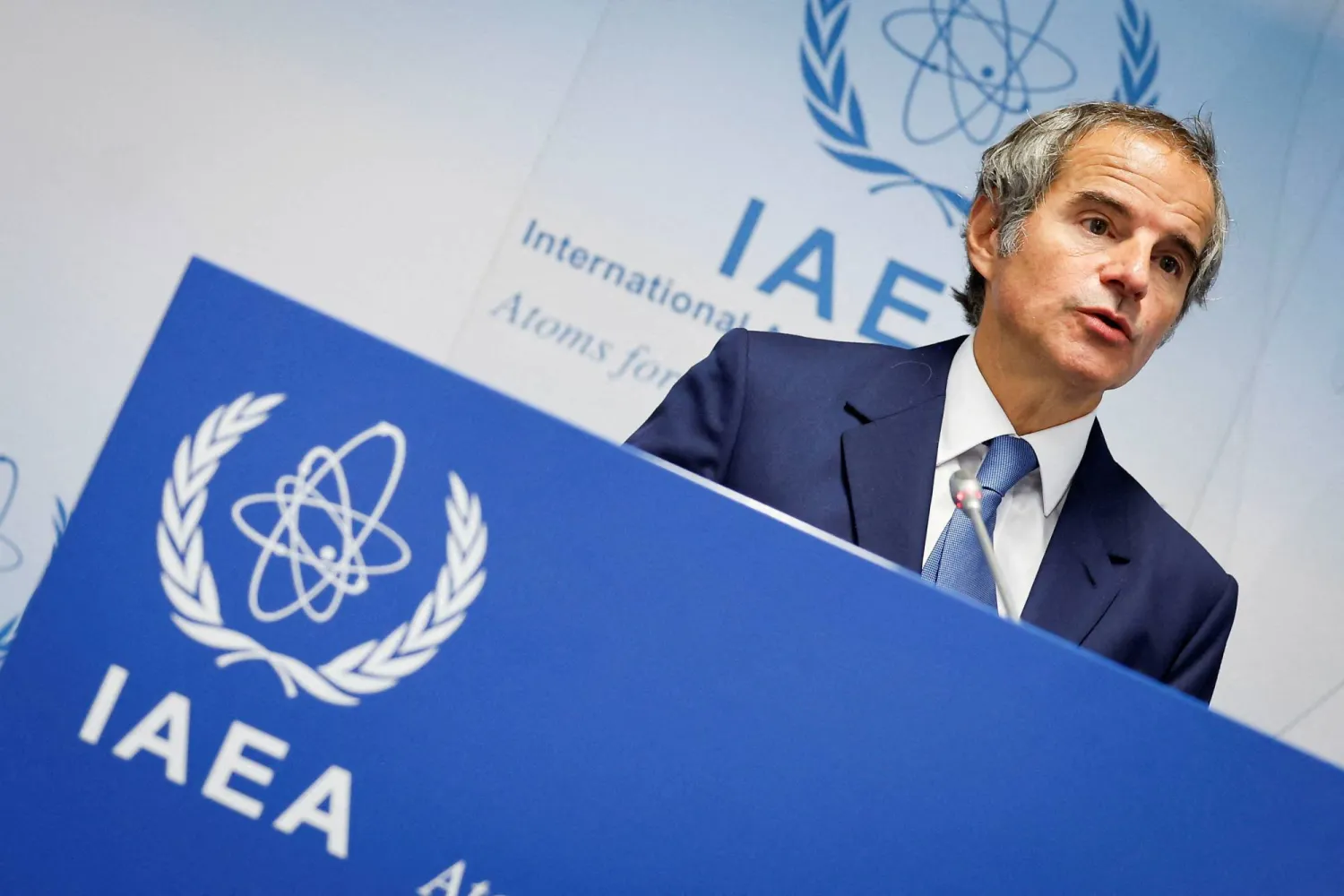
FILE PHOTO: Director General of the International Atomic Energy Agency (IAEA) Rafael Grossi holds a press conference on the opening day of a quarterly meeting of the IAEA Board of Governors in Vienna, Austria, March 4, 2024. REUTERS/Lisa Leutner/File Photo
TT

US Warns Iran from Stonewalling IAEA

FILE PHOTO: Director General of the International Atomic Energy Agency (IAEA) Rafael Grossi holds a press conference on the opening day of a quarterly meeting of the IAEA Board of Governors in Vienna, Austria, March 4, 2024. REUTERS/Lisa Leutner/File Photo

The United States on Thursday threatened future action against Iran at the UN nuclear watchdog if Tehran keeps “stonewalling” the watchdog by denying it the cooperation and answers it seeks on issues including long-unexplained uranium traces.

At a quarterly meeting of the International Atomic Energy Agency's 35-nation Board of Governors, Washington again told Iran to cooperate with IAEA inspectors who for years have been seeking explanations from Tehran on the origin of uranium particles at undeclared sites.

The United States has stopped short, for now, of seeking a resolution against Iran, however.

Diplomats have cited the US presidential election in November as a reason Washington has been reluctant to do that. Tehran bristles at such resolutions and often responds by stepping up its activities.

“We believe we have come to the point that we and the broader international community must consider anew how to respond to Iran's continued stonewalling," the United States said in a statement to the Board meeting. “We cannot allow Iran's current pattern of behavior to continue.”

It is now more than a year since the last Board resolution against Iran, which ordered it to cooperate urgently with the investigation into the particles. Tehran dismissed the resolution as “political” and “anti-Iranian” even though only China and Russia opposed it.

The United States and its three top European allies - Britain, France and Germany - again opted against seeking a resolution against Iran at this week's meeting but the United States said that if Iran did not provide the necessary cooperation soon, it would act.

“It is our strongly held view that Iran's continuing lack of credible cooperation provides grounds for pursuing further Board of Governors action, including the possibility of additional resolutions and consideration of whether Iran is once again in noncompliance with its safeguards obligations,” it said.

In 2018 then-President Donald Trump pulled the United States out of a 2015 deal under which major powers lifted sanctions against Iran in exchange for restrictions on its nuclear activities. After sanctions were re-imposed, Tehran expanded those activities far beyond the deal's limits.

Since April 2021, Iran has enriched uranium to up to 60% purity, close to the roughly 90% of weapons grade and far above the deal's cap of 3.67%.

While Iran says its aims are entirely peaceful and it has the right to enrich to high levels for civil purposes, Western powers say there is no credible civil explanation for enriching to that level and the IAEA says no country has done so without producing a nuclear bomb.

The United States said Iran should provide the IAEA with cooperation including access “for the purposes of collecting environmental samples ... and it must begin to do so now.”

If it did not, it would ask IAEA chief Rafael Grossi to provide a "comprehensive report" on Iran's nuclear activities more wide-ranging than his regular quarterly ones, it said.

“Then, based on the content of that report, we will take appropriate action in support of the IAEA and the global nuclear nonproliferation regime,” it added.

European Doubts

Meanwhile, France, Germany and the UK (E3) gave a joint statement to the IAEA Board of Governors on Iran’s implementation of its nuclear commitments under the JCPoA. They asked the Director General to keep the Board of Governors informed on the status of Iran’s nuclear program well ahead of the next meeting in June 2024.

“Regrettably, the IAEA’s report again confirms that Iran continues on its escalatory path, in increasing violation of its JCPoA commitments,” the E3 said.

The three countries affirmed that Iran continues to refuse to reverse the de-designation of Agency inspectors and is failing to implement the Joint Statement of 4 March 2023.

“These actions cast reasonable doubt on Iran’s willingness to fully live up to its obligation and commitment to cooperate with the IAEA,” the E3 statement noted.

The latest report issued by Grossi said Iran’s total stock of nuclear material stands at 27 times the limit agreed in the 2015 JCPOA nuclear deal.

Also, the UN's nuclear watchdog said in a confidential report to member states last week that Iran's stock of uranium enriched to up to 60% had fallen slightly in the past quarter as it had diluted, or “downblended,” more of its most highly enriched material than it had produced.

On Wednesday, the US called on Iran to dilute all of the uranium it has enriched to up to 60% purity, close to the weapons-grade level of roughly 90%.

As for the E3 countries, they said the recent slight reduction of the stockpile of uranium enriched up to 60 % should not lead to false hope and wrong conclusions.

“We note that Iran has taken no substantial action in response to the DG’s request to re-designate experienced Agency inspectors,” they said, reiterating their call on Iran to halt its nuclear escalation.



Top Trump Iran Negotiator Says Visits US Aircraft Carrier in Middle East

US Special Envoy Steve Witkoff delivers a press conference upon the signing of the declaration on deploying post-ceasefire force in Ukraine, during the so-called "Coalition of the Willing" summit, at the Elysee Palace in Paris, France, January 6, 2026. (Reuters)
TT

Top Trump Iran Negotiator Says Visits US Aircraft Carrier in Middle East

US Special Envoy Steve Witkoff delivers a press conference upon the signing of the declaration on deploying post-ceasefire force in Ukraine, during the so-called "Coalition of the Willing" summit, at the Elysee Palace in Paris, France, January 6, 2026. (Reuters)

US President Donald Trump's lead Iran negotiator Steve Witkoff on Saturday said he visited the USS Abraham Lincoln aircraft carrier currently in the Arabian Sea, with Washington and Tehran due to hold further talks soon.

"Today, Adm. Brad Cooper, Commander of US Naval Forces Central Command, Jared Kushner, and I met with the brave sailors and Marines aboard the USS Abraham Lincoln, her strike group, and Carrier Air Wing 9 who are keeping us safe and upholding President Trump's message of peace through strength," said Witkoff in a social media post.

Iranian Foreign Minister Abbas Araghchi said on Saturday he hoped talks with the United States would resume soon, while reiterating Tehran's red lines and warning against any American attack.


Israel’s Netanyahu Expected to Meet Trump in US on Wednesday and Discuss Iran

Israeli Prime Minister Benjamin Netanyahu delivers a speech during a special session to mark the 77th anniversary of the Knesset's establishment and the 60th anniversary of the dedication of the current building at the Knesset, the Israeli parliament, in Jerusalem, 02 February 2026. (EPA)
TT

Israel’s Netanyahu Expected to Meet Trump in US on Wednesday and Discuss Iran

Israeli Prime Minister Benjamin Netanyahu delivers a speech during a special session to mark the 77th anniversary of the Knesset's establishment and the 60th anniversary of the dedication of the current building at the Knesset, the Israeli parliament, in Jerusalem, 02 February 2026. (EPA)

Israeli Prime Minister Benjamin Netanyahu is expected to meet US President Donald Trump on Wednesday in Washington, where they will discuss negotiations with Iran, Netanyahu's office said on Saturday.

Iranian and US officials held indirect nuclear ‌talks in the ‌Omani capital ‌Muscat ⁠on Friday. ‌Both sides said more talks were expected to be held again soon.

A regional diplomat briefed by Tehran on the talks told Reuters Iran insisted ⁠on its "right to enrich uranium" ‌during the negotiations with ‍the US, ‍and that Tehran's missile capabilities ‍were not raised in the discussions.

Iranian officials have ruled out putting Iran's missiles - one of the largest such arsenals in the region - up ⁠for discussion, and have said Tehran wants recognition of its right to enrich uranium.

"The Prime Minister believes that any negotiations must include limiting ballistic missiles and halting support for the Iranian axis," Netanyahu's office said in a ‌statement.


Italy FM Rules Out Joining Trump’s ‘Board of Peace’

Italy's Minister for Foreign Affairs Antonio Tajani speaks to the press during the EPP Leaders’ meeting, in Zagreb, Croatia, 30 January 2026. (EPA)
TT

Italy FM Rules Out Joining Trump’s ‘Board of Peace’

Italy's Minister for Foreign Affairs Antonio Tajani speaks to the press during the EPP Leaders’ meeting, in Zagreb, Croatia, 30 January 2026. (EPA)

Italy will not take part in US President Donald Trump's "Board of Peace", Italian Foreign Minister Antonio Tajani said Saturday, citing "insurmountable" constitutional issues.

Trump launched his "Board of Peace" at the World Economic Forum in Davos in January and some 19 countries have signed its founding charter.

But Italy's constitution bars the country from joining an organization led by a single foreign leader.

Prime Minister Giorgia Meloni, a Trump ally, last month noted "constitutional problems" with joining, but suggested Trump could perhaps reopen the framework "to meet the needs not only of Italy, but also of other European countries".

Tajani appeared Saturday to rule that out.

"We cannot participate in the Board of Peace because there is a constitutional limit," he told the ANSA news agency.

"This is insurmountable from a legal standpoint," he said, the day after meeting US Secretary of State Marco Rubio and US Vice President JD Vance at the Olympics in Milan.

Although originally meant to oversee Gaza's rebuilding, the board's charter does not limit its role to the Palestinian territory and appears to want to rival the United Nations.