Biden Visiting Battleground States and Expanding Staff as His Campaign Tries to Seize the Offensive

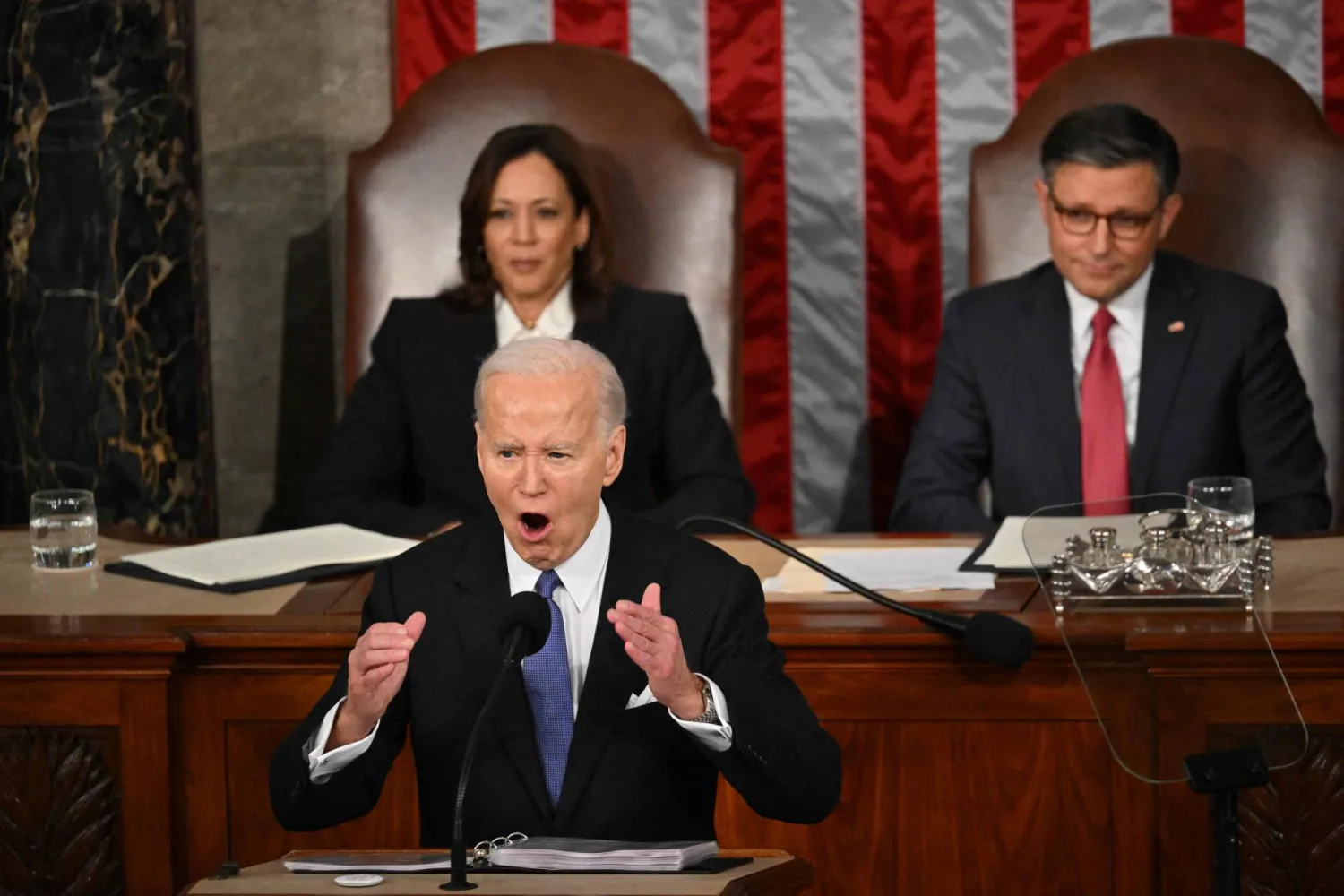
US President Joe Biden delivers the State of the Union address in the House Chamber of the US Capitol in Washington, DC, on March 7, 2024. (Photo by Mandel NGAN / AFP)
TT

Biden Visiting Battleground States and Expanding Staff as His Campaign Tries to Seize the Offensive

US President Joe Biden delivers the State of the Union address in the House Chamber of the US Capitol in Washington, DC, on March 7, 2024. (Photo by Mandel NGAN / AFP)

Fresh off his defiant State of the Union address, President Joe Biden on Friday laced into former President Donald Trump — by name this time — as he and his senior aides began barnstorming the country to aggressively sell his vision for a second term to voters.
The president is trying to ride the post-speech momentum to Pennsylvania and Georgia for campaign events in two critical battleground states that he flipped in 2020 and is hoping to keeping in his column this November. He arrived at a private home in the pivotal Philadelphia suburbs along with his wife, Jill Biden, to hold what his campaign billed as a “kitchen table” conversation with brothers Jack and David Cunicelli, the owners of 320 Market Cafe, and their families ahead of remarks to supporters at the local middle school. He'll move on to New Hampshire, Wisconsin and Michigan next week, The Associated Press said.
Biden's reelection campaign was almost giddy after the speech, vowing to stay on the offensive against Trump. Introducing her husband at Strath Haven Middle School, Jill Biden said, “Last night, Joe showed the world what I see every day.”
While Biden had referred only to his “predecessor” during Thursday's speech before Congress, on Friday it was a different story on the campaign trail, as Biden and his wife laid into Trump for raising the deficit, rolling back abortion access and fomenting the Jan. 6, 2021, insurrection at the Capitol.
He also blamed Trump for the coarsening of the country's political discourse.
“When you ride down the street and there’s a Trump banner with an F-U on it and a little 6-year-old kid putting up his middle finger," Biden said. “Did you ever think you’d hear people talk the way they do? It demeans who we are. That’s not America.”
Biden highlighted threats to in vitro fertilization in Alabama after a recent state Supreme Court ruling. “You know why it happened? I’ll tell you why. One reason: Donald Trump," Biden said.
And Biden criticized Trump for sowing doubts about America's commitments to its NATO allies and for hosting Hungary's Victor Orban at his Florida estate on Friday. “You know who he’s meeting with today down in Mar-a-Lago? Orban of Hungary, who’s stated flatly that he doesn’t thinks democracy works, he’s looking for dictatorship. Only member of NATO. That’s who he’s meeting with,” Biden said.
"I see a future where we defend democracy, not diminish it.”
Jill Biden called Trump “dangerous,” said “he mocks women’s bodies and devalues our existence" and added, “And we can’t let him win.”
Biden joked that he got his “usual warm reception” from Rep. Marjorie Taylor Greene, the Republican from Georgia, who heckled Biden to address the death of Laken Riley, a nursing student from Georgia. An immigrant from Venezuela who entered the US illegally has been arrested and charged with Riley's murder.
The president's campaign announced Friday that he and Vice President Kamala Harris will visit every major swing state in coming days, while launching a $30 million, six-week advertising campaign on TV and digital platforms designed to highlight key themes from the State of the Union to Black, Asian and Hispanic communities.
Harris is making her own trips, first to Arizona to continue her nationwide tour to promote reproductive rights and then to Nevada for her own campaign stop.
That push will include buys during the NCAA basketball tournament, as Biden's camp attempts to leverage high ratings, like it says it did when airing an ad promising to defend abortion rights during the recent Grammy Awards.
By the end of this month, the campaign expects to expand from 100 staff members in seven battleground states to more than 350, while also opening more than 100 field offices. Trump's campaign is targeting essentially the same areas, looking to flip Michigan, Wisconsin, Pennsylvania, Georgia and Arizona after 2020 defeats there, while fending off Biden's efforts to make inroads in North Carolina and Florida.
Biden’s campaign is seeking to hit Trump hard at a critical moment, when the former president is working to consolidate his party after the primary — and as more potentially persuadable voters begin coming to terms with the fact that November really will be a 2020 rematch.
“We know that he lost in 2020 and so, in order to win, he’s got to expand his base of voters to find new people to be with him and that is not something that he’s shown that he’s really focused on,” Biden campaign chair Jen O’Malley Dillon said on a conference call with reporters Friday.
She also noted that, after former UN ambassador Nikki Haley left the Republican presidential primary race, “instead of wrapping his arms around them — like we certainly have — Trump has really mocked her supporters.”
Biden’s reelection campaign said the first hour of the State of the Union prompted its best fundraising hour since it launched in 2023, and the next two hours each set new records. It did not say how much money it actually collected.
Speaking to reporters before taking off for Philadelphia on Friday, Biden did not commit to debating Trump, the likely Republican nominee, during the general election.
“It depends on his behavior,” Biden said.
Earlier this week, Trump challenged Biden to debates “anytime, anywhere, anyplace.” But he skipped all opportunities to spar with his Republican primary opponents, and he’s criticized the nonpartisan commission that organizes presidential debates. Televised debates have been a feature of every White House campaign since 1976.
The Trump campaign has also used his romp through the Republican primary to try to seize momentum of its own heading into November. A super PAC backing the former president has released an ad highlighting Biden’s age, 81, and declaring, “If Biden wins, can he even survive till 2029?”
Biden’s campaign said Thursday night’s speech showed that, rather than a contrast of age with the 77-year-old Trump, Biden is offering a stark policy choice with his predecessor.
“While he’s four years younger his ideas are old as hell,” Biden campaign spokesman Michael Tyler said of Trump. ”He’s talking about fundamentally taking us backward as a country.”
Presidents traditionally take their State of the Union message on the road, but Biden’s sales pitch this year is more critical than ever as he tries to sell not only his policy achievements to a skeptical electorate but show that he is up to the task of the presidency.
Cabinet secretaries and senior White House officials are embarking on their own post-State of the Union travel blitz to amplify Biden’s message starting Friday and continuing throughout the coming weeks, hitting not only swing states but rural territory such as Missouri, Kentucky and Tennessee.
In his address at the Capitol, Biden took on an unusually fiery tone, contrasting his vision to that of “my predecessor” — Trump — more than a dozen times not just on policies such as health care and taxes but for his views on freedom and democracy, both in the US and abroad.
As he gave live commentary on his social media site, Trump mocked Biden’s delivery — saying, “THIS IS LIKE A SHOUTING MATCH” — and defending his policies from Biden’s repeated jabs.
The Biden administration is parceling out chunks of Biden’s agenda for different Cabinet officials to promote in the coming weeks. Much of that will focus on how Biden’s policies have spurred key investments in communities nationwide, with Transportation Secretary Pete Buttigieg traveling to Philadelphia and Rhode Island in the coming weeks to promote bridge repairs and other infrastructure improvements.
The Cabinet travels include a heavy dose of climate policy, with Energy Secretary Jennifer Granholm and Interior Secretary Deb Haaland planning to boost Biden’s climate policies at a conference in Florida on Monday. Michael Regan, the administrator of the Environmental Protection Agency, is crisscrossing the country — stopping in Florida, California and Oregon — to promote electrified school buses and other efforts to transition to a clean energy economy.
Treasury Secretary Janet Yellen is headed to Kentucky next week to tout Biden’s efforts to bolster the economy in disadvantaged communities, while Education Secretary Miguel Cardona is hitting up Massachusetts and Pennsylvania to discuss education opportunities through Biden’s agenda.


Iranian Lawmaker: A Nuclear Bomb is a ‘Public Demand’

Satellite imagery from Jun 9th, 2025 via Airbus/Bulletin, shows a truck at Iran’s Isfahan underground complex carrying 18 sealed containers (AP)
TT

Iranian Lawmaker: A Nuclear Bomb is a ‘Public Demand’

Satellite imagery from Jun 9th, 2025 via Airbus/Bulletin, shows a truck at Iran’s Isfahan underground complex carrying 18 sealed containers (AP)

Iranian lawmaker Hosseinali Haji Deligani said on Saturday that building a nuclear bomb has become a public demand, just days before a meeting of the International Atomic Energy Agency’s Board of Governors to discuss Iran.

“Today, one of the people's demands is that Iran, in addition to its faith and missiles, must build and possess a nuclear bomb,” said Haji Deligani, the deputy head of the Article 90 Commission in the Iranian Parliament, according to Fars news agency.

He argued that Tehran should possess nuclear weapons regardless of whether it intends to use them.

“We must have this capability. Whether it is used or not is a separate matter,” the lawmaker noted.

He said, “based on current assessments, the enemy would not launch a nuclear attack on Iran because of the country’s vast size and the significant repercussions of such an attack.”

The Article 90 Commission of Iran's parliament is mandated to receive, investigate, and respond to written complaints regarding the performance of the legislative, executive, and judicial branches.

Iran has made no official decision to change its nuclear doctrine despite growing calls from lawmakers and members of the public to reconsider its position if war resumes.

Iranian Foreign Ministry spokesperson Esmaeil Baghaei said on Monday that Tehran had not suspended its obligations under its safeguards agreement with the International Atomic Energy Agency (IAEA).

Speaking to reporters, Baghaei said Iran remained a party to the Treaty on the Non-Proliferation of Nuclear Weapons (NPT) and continued to uphold both the treaty and its safeguards agreement. He said the country had demonstrated its adherence to those commitments.

Grossi’s Report

Haji Deligani’s statements came one day after the UN’s nuclear watchdog said it cannot confirm that Tehran hasn’t diverted nuclear material away from peaceful purposes.

In a confidential report on Iran seen by media outlets on Friday, the UN’s nuclear watchdog said because of a lack of cooperation from Iran, it “is not able to conclude that there has been no diversion of declared nuclear material from peaceful nuclear activities in Iran.”

IAEA said it is “increasingly concerned” about a uranium-enrichment plant at Isfahan that Iran declared to it last year but has still not let the watchdog inspect.”

“It is more than a year since the Agency lost continuity of knowledge in relation to the previously declared inventories of LEU (low-enriched uranium) and HEU (highly enriched ⁠uranium) enriched up to 60% U-235 at the declared nuclear facilities affected by the attacks of June 2025,” IAEA Director General Rafael Grossi wrote in his last report on Iran.

He added that Iran needs to allow inspectors back in “with the utmost urgency.”

Inspectors have yet to return to nuclear sites the United States and Israel bombed in June 2025.

Until those attacks, the IAEA estimates Iran had 440.9 kg of uranium enriched to up to 60% purity, a short step from the roughly 90% of weapons-grade uranium. That is enough material, if enriched further, for 10 nuclear weapons, according to an IAEA yardstick, and Iran also had material enriched to lower levels.

“The director general encourages Iran to consider technical and gradual measures by which conditions are achieved that allow for the return of agency inspectors to Iran,” the report said.

But Iran told the IAEA that discussions on restarting inspections in the country cannot resume amid “a series of persistent, explicit, and public threats by the President of the United States of America.”

Criticizing legal and technical basis of IAEA’s reports, Iran Mission to UN Office in Vienna said normal execution of safeguards cannot resume under the abnormal condition created by attacks on Iran’s safeguarded nuclear sites.

In a message posted on its X account on Saturday, the Iranian mission also criticized Grossi’s reporting, arguing that the Board’s decisions have been adopted through an abuse of process and that the US-Israeli attacks on Iran have disrupted inspections and forced the withdrawal of the IAEA’s inspectors.

“The United States removed aggression from bias resolutions, but its consequences cannot be erased from reality,” the statement added.

An Unavoidable Necessity

Last Thursday, Iran’s Assembly of Experts called for considering the country’s withdrawal from the Nuclear Non-Proliferation Treaty (NPT), alongside a review of Iran’s defense doctrine and the establishment of what it described as necessary deterrence.

In a statement carried by Iranian media, the Assembly said that reviewing withdrawal from the NPT, revising the country’s defense doctrine and establishing the necessary deterrence had become an “unavoidable necessity” and a “public and national demand.”

Two weeks ago, Mohsen Araki, a member of the Assembly of Experts and the Expediency Discernment Council, said Iran should reconsider its membership in the Nuclear Non-Proliferation Treaty. He also noted that the country had suffered setbacks without gaining comparable benefits.

“The Islamic Republic has suffered considerable harm and setbacks over the years because of its membership in and continued adherence to this treaty, while gaining no commensurate benefit from that membership,” said Araki.


IRGC Media: Technical Modifications to Allow Iran Develop Missiles that Reach US

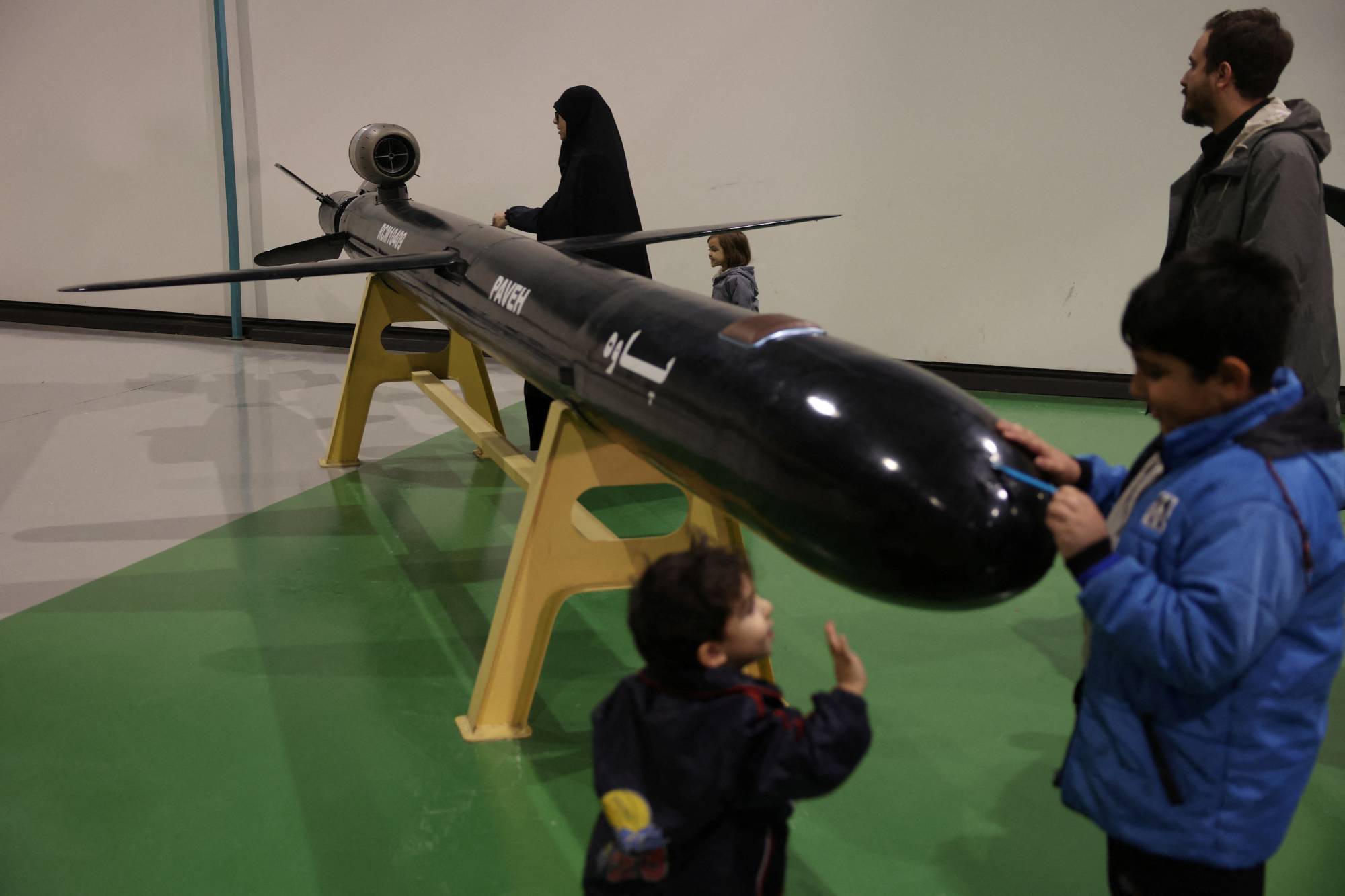
People visit the Revolutionary Guard Corps (IRGC) Aerospace Force Museum in Tehran, Iran, November 4, 2026. Majid Asgaripour/WANA (West Asia News Agency) via REUTERS
TT

IRGC Media: Technical Modifications to Allow Iran Develop Missiles that Reach US

People visit the Revolutionary Guard Corps (IRGC) Aerospace Force Museum in Tehran, Iran, November 4, 2026. Majid Asgaripour/WANA (West Asia News Agency) via REUTERS

Iran on Saturday said it could introduce technical modifications to its long-range missiles, enabling them to reach US territory.

Tasnim News agency, the Revolutionary Guard Corps (IRGC) affiliated media outlet, said modifications to the Khorramshahr-4’s warhead could increase its range to 3,000 or 4,000 kilometers by reducing the weight of its warhead to 1,500-kilogram instead of 2,000.

It said a modified version of the missile would reach US bases and those of its allies in eastern and southeastern Europe, as well as central Europe.

Also, the news agency said Iran would develop an intercontinental ballistic missile with a range of approximately 10,000 kilometers to reach the US East Coast, including areas near Washington and New York, and more than 13,000 kilometers to cover the entire US territory.

Tasnim noted that such modification “is possible at present” using the IRGC’s satellite launch vehicles, including the Qased, Zuljanah and Qaem systems, constructing underground “missile cities,” and developing a warhead capable of withstanding re-entry into the Earth's orbit.

Opened Lock

Last week, Supreme Leader Mojtaba Khamenei issued an order to respond to threats of any scale or type with an “immediate and effective response without geographical restrictions.”

Khamenei issued the directives during his first publicly announced meeting with senior military commanders since taking office.

Tasnim on Saturday admitted that former Leader Ali Khamenei had restricted the range of ballistic missiles manufactured in the country to 2,000 kilometers.

It said by “abusing our patience,” Iran’s “enemies unlocked a key aspect of its offensive capabilities.”

Last week, Iran’s Revolutionary Guard Corps spokesman General Hossein Mohebbi confirmed the removal of the 2,000-kilometer range restriction.

“That restriction has been lifted for us,” he declared, without specifying a new range or whether Iran possessed missiles exceeding the previous limit. He promised to demonstrate those capabilities “in practice.”

In August 2025, Iranian lawmaker Amir Hayat-Moqaddam told local media that Tehran has been developing long-range strike capabilities for two decades. He warned that “perhaps our next missile will hit Washington directly. We can target America from the sea.”

Also, Iranian lawmaker Kamran Ghazanfari claimed in early November that Iran developed intercontinental ballistic missiles capable of hitting Europe and the United States.

People visit the Revolutionary Guard Corps (IRGC) Aerospace Force Museum in Tehran, Iran, November 4, 2026. Majid Asgaripour/WANA (West Asia News Agency) via REUTERS

Stealth Cruise Missile

Meanwhile, Iranian state television displayed an inspection of a strategic missile facility belonging to the IRGC.

It aired footage on Tuesday describing the underground complex as a new “missile city.”

A military analyst said on his page that the Guards’ missile unit had “quietly” unveiled two new missiles, but that “their unveiling is significant” to those who “monitor and analyze.”

He described the first one as Iran’s “first stealth cruise missile,” noting that its jet engine—which had been mounted externally on previous cruise missiles, making them easier to detect—is now housed inside the body.

The second, he said, is a ballistic missile that combines the warhead of the “Fattah” hypersonic missile with the “Khyber Shikan 2” missile, explaining that the range of the “Fattah” has increased from about 1,400 kilometers to nearly 2,000 kilometers.

Iranian state television aired footage on Tuesday of Armed Forces Chief of Staff Maj. Gen. Ali Abdollahi during his inspection of a strategic missile facility belonging to the IRGC.

It reported the unveiling of new weapons, including a “surprise” missile, without disclosing its name, range or specifications. Iranian media revealed neither the facility’s location nor the date of the visit.

Treats Expand to Europe

Meanwhile, Iran’s hardline newspaper Kayhan said on Wednesday that Tehran would expand threats against US bases beyond the region, including facilities in Europe and neighboring countries if a new war resumes.

“By removing the geographical limits on threats, the enemy should hear the roar of new missiles at US bases thousands of kilometers away in Germany, Britain, Albania, Greece, Cyprus and some neighboring countries,” said the newspaper, which is published under the supervision of the supreme leader’s representative.

Despite claiming it restricts its missile range, Iran in March reportedly tried and failed to hit the joint US-UK base at Diego Garcia, in the Indian Ocean, some 4,000 kilometers away from Iran.

No War No Peace State

US President Donald Trump has told senior advisers in recent days that he may hold off on attacking Iran if the US faces no new provocations, according to three people familiar with the matter.

Trump has alternated between threats of escalating the war with new strikes and winding down hostilities, and current and former officials say he does not appear to have made up his mind about how to resolve the unpopular conflict, which he launched in February with Israel.

But in meetings with his national security advisers and after a series of intelligence briefings, Trump said he was considering holding off on strikes, said the people, who, like others interviewed for this story, spoke on condition of anonymity.

He has also indicated sympathy for allies in the region who have asked him not to return to a full-fledged war.

At the same time, the US military is ready to escalate if needed, three more people ⁠familiar with US planning said.

A third aircraft carrier is moving into the Middle East in the coming days to replace one of the two currently operating in the region, but all three carriers could stay if needed, the people said.

Trump could opt to bomb Iran's underground nuclear facilities, one of the people familiar with Trump's calls with several leaders said. But the US has already struck those facilities, and it is unclear whether further strikes would be successful.
US intelligence agencies have ⁠assessed that renewed strikes would not significantly shift Iran’s demands in negotiations, two US officials said.


Netanyahu Vows to Eliminate Iran Threat ‘Once and for All’

10 November 2026, Israel, Jerusalem: Caretaker Israeli Prime Minister Benjamin Netanyahu delivers a speech on the sidelines of the opening session of the new Knesset. (dpa)
TT

Netanyahu Vows to Eliminate Iran Threat ‘Once and for All’

10 November 2026, Israel, Jerusalem: Caretaker Israeli Prime Minister Benjamin Netanyahu delivers a speech on the sidelines of the opening session of the new Knesset. (dpa)

Israel's caretaker prime minister Benjamin Netanyahu on Saturday reiterated his calls for a national unity government with his opponent Gadi Eisenkot, as well as his vow to eliminate the threat from Iran.

A meeting with Eisenkot on Thursday "only strengthened the conviction that it is essential to form a national unity government" to guarantee Israel's security, Netanyahu said in a video statement, adding that such a government could "eliminate the Iranian threat once and for all".