Israeli Parliament Approves Amended 2024 Budget to Fund Gaza Warhttps://english.aawsat.com/world/4909806-israeli-parliament-approves-amended-2024-budget-fund-gaza-war
Israeli Parliament Approves Amended 2024 Budget to Fund Gaza War
Family members of Israeli hostages held by Hamas in Gaza, carry pictures of their loved ones during a protest march marking 150 days of their captivity, calling for their immediate release, at the Knesset, the Israeli Parliament in Jerusalem, 04 March 2024. (EPA)
TT
TT
Israeli Parliament Approves Amended 2024 Budget to Fund Gaza War
Family members of Israeli hostages held by Hamas in Gaza, carry pictures of their loved ones during a protest march marking 150 days of their captivity, calling for their immediate release, at the Knesset, the Israeli Parliament in Jerusalem, 04 March 2024. (EPA)
Israeli lawmakers gave their final approval on Wednesday to an amended 2024 state budget that adds tens of billions of shekels to fund Israel's war against the Palestinian group Hamas in Gaza, as the conflict runs into its sixth month.
The amended budget adds more spending on defense and compensation to households and businesses hurt by the war, which was sparked by Hamas' shock attack on Israel on Oct. 7.
Members of the Knesset, or parliament, voted 63-55 in favor of the spending package of 584 billion shekels ($160 billion), or 724 billion including debt repayment. The plan also includes higher allocations for health, education, police and welfare.
"The amended war budget... has clear goals - to win the war, support the reservists, strengthen the home front and continue to grow the Israeli economy," Finance Minister Bezalel Smotrich said after the vote.
The budget sets a deficit of 6.6% of gross domestic product (GDP) in 2024, revised from a pre-war level of 2.25%. But in February, the deficit rose to 5.6% over the previous 12 months from 4.8% in January.
Israel last year approved a two-year budget for 2023 and 2024, but the Gaza war has shaken up government finances, requiring budget changes and additional spending.
Spending was boosted by 70 billion shekels from the original budget - with 55 billion shekels going to the military and 15 billion to finance civilian needs.
The budget has become politically charged, in particular over funds to religious institutions that Prime Minister Benjamin Netanyahu's Likud party agreed to under a 2022 coalition accord with religious parties.
Despite calls by the central bank and opposition lawmakers to cut spending not related to the war, most of the so-called coalition funds will still be allocated, though there will be some tax hikes on cigarettes, tobacco products and bank profits.
Moody's last month downgraded Israel's credit rating to A2, citing material political and fiscal risks for the country stemming from the war. It was the first time that Israel's rating has ever been cut.
"Israel's most sectarian, disconnected (from reality) and irresponsible budget ever has been approved with cowards' votes," said opposition leader Yair Lapid.
Speaking in the Knesset, Lapid accused Netanyahu's coalition of abandoning ordinary Israelis and said the public would be paying for the failures of his government.
Iranian Lawmaker: A Nuclear Bomb is a ‘Public Demand’https://english.aawsat.com/world/5341357-iranian-lawmaker-nuclear-bomb-%E2%80%98public-demand%E2%80%99
Iranian Lawmaker: A Nuclear Bomb is a ‘Public Demand’
Satellite imagery from Jun 9th, 2025 via Airbus/Bulletin, shows a truck at Iran’s Isfahan underground complex carrying 18 sealed containers (AP)
Iranian lawmaker Hosseinali Haji Deligani said on Saturday that building a nuclear bomb has become a public demand, just days before a meeting of the International Atomic Energy Agency’s Board of Governors to discuss Iran.
“Today, one of the people's demands is that Iran, in addition to its faith and missiles, must build and possess a nuclear bomb,” said Haji Deligani, the deputy head of the Article 90 Commission in the Iranian Parliament, according to Fars news agency.
He argued that Tehran should possess nuclear weapons regardless of whether it intends to use them.
“We must have this capability. Whether it is used or not is a separate matter,” the lawmaker noted.
He said, “based on current assessments, the enemy would not launch a nuclear attack on Iran because of the country’s vast size and the significant repercussions of such an attack.”
The Article 90 Commission of Iran's parliament is mandated to receive, investigate, and respond to written complaints regarding the performance of the legislative, executive, and judicial branches.
Iran has made no official decision to change its nuclear doctrine despite growing calls from lawmakers and members of the public to reconsider its position if war resumes.
Iranian Foreign Ministry spokesperson Esmaeil Baghaei said on Monday that Tehran had not suspended its obligations under its safeguards agreement with the International Atomic Energy Agency (IAEA).
Speaking to reporters, Baghaei said Iran remained a party to the Treaty on the Non-Proliferation of Nuclear Weapons (NPT) and continued to uphold both the treaty and its safeguards agreement. He said the country had demonstrated its adherence to those commitments.
Grossi’s Report
Haji Deligani’s statements came one day after the UN’s nuclear watchdog said it cannot confirm that Tehran hasn’t diverted nuclear material away from peaceful purposes.
In a confidential report on Iran seen by media outlets on Friday, the UN’s nuclear watchdog said because of a lack of cooperation from Iran, it “is not able to conclude that there has been no diversion of declared nuclear material from peaceful nuclear activities in Iran.”
IAEA said it is “increasingly concerned” about a uranium-enrichment plant at Isfahan that Iran declared to it last year but has still not let the watchdog inspect.”
“It is more than a year since the Agency lost continuity of knowledge in relation to the previously declared inventories of LEU (low-enriched uranium) and HEU (highly enriched uranium) enriched up to 60% U-235 at the declared nuclear facilities affected by the attacks of June 2025,” IAEA Director General Rafael Grossi wrote in his last report on Iran.
He added that Iran needs to allow inspectors back in “with the utmost urgency.”
Inspectors have yet to return to nuclear sites the United States and Israel bombed in June 2025.
Until those attacks, the IAEA estimates Iran had 440.9 kg of uranium enriched to up to 60% purity, a short step from the roughly 90% of weapons-grade uranium. That is enough material, if enriched further, for 10 nuclear weapons, according to an IAEA yardstick, and Iran also had material enriched to lower levels.
“The director general encourages Iran to consider technical and gradual measures by which conditions are achieved that allow for the return of agency inspectors to Iran,” the report said.
But Iran told the IAEA that discussions on restarting inspections in the country cannot resume amid “a series of persistent, explicit, and public threats by the President of the United States of America.”
Criticizing legal and technical basis of IAEA’s reports, Iran Mission to UN Office in Vienna said normal execution of safeguards cannot resume under the abnormal condition created by attacks on Iran’s safeguarded nuclear sites.
In a message posted on its X account on Saturday, the Iranian mission also criticized Grossi’s reporting, arguing that the Board’s decisions have been adopted through an abuse of process and that the US-Israeli attacks on Iran have disrupted inspections and forced the withdrawal of the IAEA’s inspectors.
“The United States removed aggression from bias resolutions, but its consequences cannot be erased from reality,” the statement added.
An Unavoidable Necessity
Last Thursday, Iran’s Assembly of Experts called for considering the country’s withdrawal from the Nuclear Non-Proliferation Treaty (NPT), alongside a review of Iran’s defense doctrine and the establishment of what it described as necessary deterrence.
In a statement carried by Iranian media, the Assembly said that reviewing withdrawal from the NPT, revising the country’s defense doctrine and establishing the necessary deterrence had become an “unavoidable necessity” and a “public and national demand.”
Two weeks ago, Mohsen Araki, a member of the Assembly of Experts and the Expediency Discernment Council, said Iran should reconsider its membership in the Nuclear Non-Proliferation Treaty. He also noted that the country had suffered setbacks without gaining comparable benefits.
“The Islamic Republic has suffered considerable harm and setbacks over the years because of its membership in and continued adherence to this treaty, while gaining no commensurate benefit from that membership,” said Araki.
IRGC Media: Technical Modifications to Allow Iran Develop Missiles that Reach UShttps://english.aawsat.com/world/5341338-irgc-media-technical-modifications-allow-iran-develop-missiles-reach-us
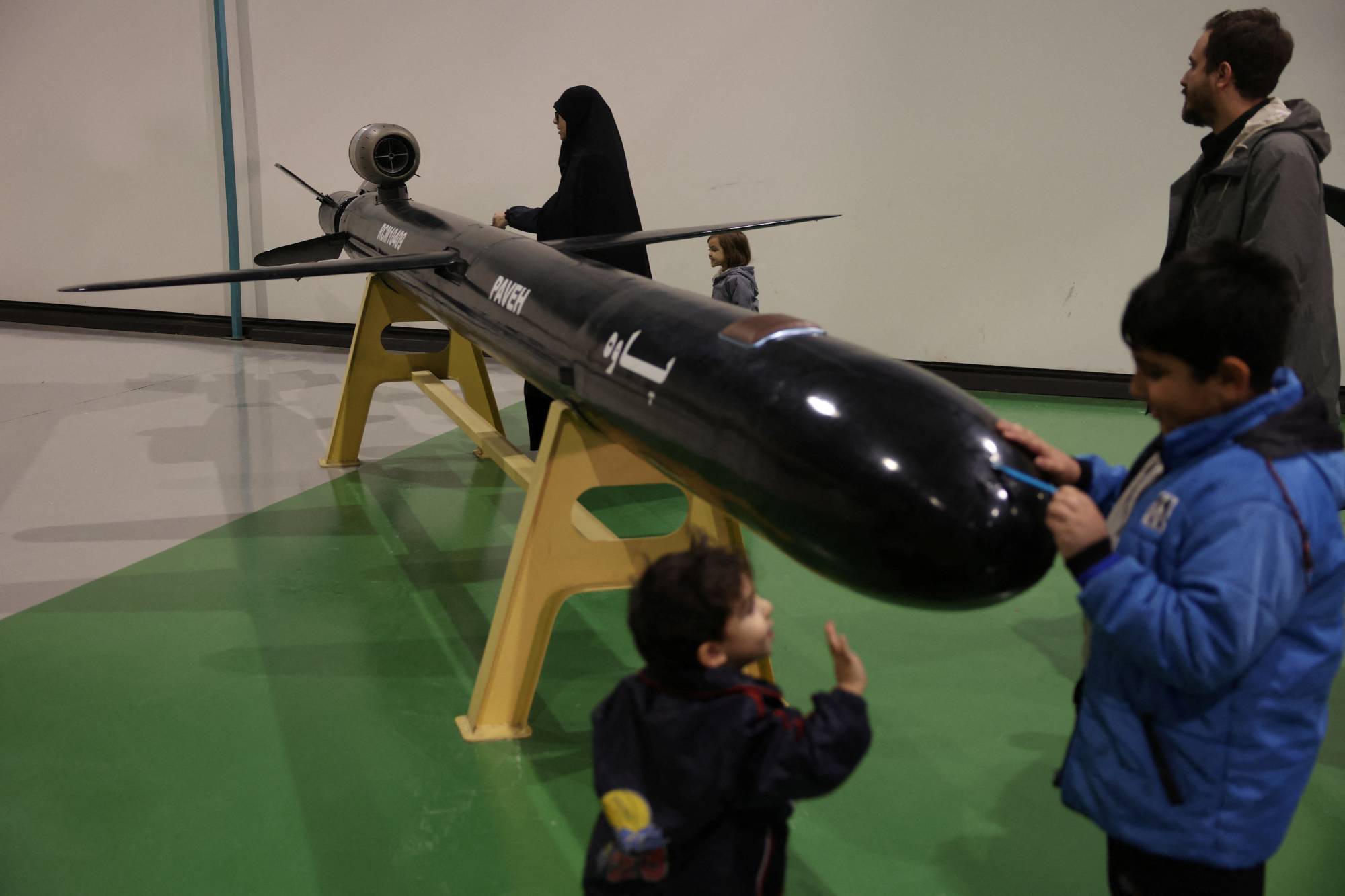
People visit the Revolutionary Guard Corps (IRGC) Aerospace Force Museum in Tehran, Iran, November 4, 2026. Majid Asgaripour/WANA (West Asia News Agency) via REUTERS
IRGC Media: Technical Modifications to Allow Iran Develop Missiles that Reach US
People visit the Revolutionary Guard Corps (IRGC) Aerospace Force Museum in Tehran, Iran, November 4, 2026. Majid Asgaripour/WANA (West Asia News Agency) via REUTERS
Iran on Saturday said it could introduce technical modifications to its long-range missiles, enabling them to reach US territory.
Tasnim News agency, the Revolutionary Guard Corps (IRGC) affiliated media outlet, said modifications to the Khorramshahr-4’s warhead could increase its range to 3,000 or 4,000 kilometers by reducing the weight of its warhead to 1,500-kilogram instead of 2,000.
It said a modified version of the missile would reach US bases and those of its allies in eastern and southeastern Europe, as well as central Europe.
Also, the news agency said Iran would develop an intercontinental ballistic missile with a range of approximately 10,000 kilometers to reach the US East Coast, including areas near Washington and New York, and more than 13,000 kilometers to cover the entire US territory.
Tasnim noted that such modification “is possible at present” using the IRGC’s satellite launch vehicles, including the Qased, Zuljanah and Qaem systems, constructing underground “missile cities,” and developing a warhead capable of withstanding re-entry into the Earth's orbit.
Opened Lock
Last week, Supreme Leader Mojtaba Khamenei issued an order to respond to threats of any scale or type with an “immediate and effective response without geographical restrictions.”
Khamenei issued the directives during his first publicly announced meeting with senior military commanders since taking office.
Tasnim on Saturday admitted that former Leader Ali Khamenei had restricted the range of ballistic missiles manufactured in the country to 2,000 kilometers.
It said by “abusing our patience,” Iran’s “enemies unlocked a key aspect of its offensive capabilities.”
Last week, Iran’s Revolutionary Guard Corps spokesman General Hossein Mohebbi confirmed the removal of the 2,000-kilometer range restriction.
“That restriction has been lifted for us,” he declared, without specifying a new range or whether Iran possessed missiles exceeding the previous limit. He promised to demonstrate those capabilities “in practice.”
In August 2025, Iranian lawmaker Amir Hayat-Moqaddam told local media that Tehran has been developing long-range strike capabilities for two decades. He warned that “perhaps our next missile will hit Washington directly. We can target America from the sea.”
Also, Iranian lawmaker Kamran Ghazanfari claimed in early November that Iran developed intercontinental ballistic missiles capable of hitting Europe and the United States.
People visit the Revolutionary Guard Corps (IRGC) Aerospace Force Museum in Tehran, Iran, November 4, 2026. Majid Asgaripour/WANA (West Asia News Agency) via REUTERS
Stealth Cruise Missile
Meanwhile, Iranian state television displayed an inspection of a strategic missile facility belonging to the IRGC.
It aired footage on Tuesday describing the underground complex as a new “missile city.”
A military analyst said on his page that the Guards’ missile unit had “quietly” unveiled two new missiles, but that “their unveiling is significant” to those who “monitor and analyze.”
He described the first one as Iran’s “first stealth cruise missile,” noting that its jet engine—which had been mounted externally on previous cruise missiles, making them easier to detect—is now housed inside the body.
The second, he said, is a ballistic missile that combines the warhead of the “Fattah” hypersonic missile with the “Khyber Shikan 2” missile, explaining that the range of the “Fattah” has increased from about 1,400 kilometers to nearly 2,000 kilometers.
Iranian state television aired footage on Tuesday of Armed Forces Chief of Staff Maj. Gen. Ali Abdollahi during his inspection of a strategic missile facility belonging to the IRGC.
It reported the unveiling of new weapons, including a “surprise” missile, without disclosing its name, range or specifications. Iranian media revealed neither the facility’s location nor the date of the visit.
Treats Expand to Europe
Meanwhile, Iran’s hardline newspaper Kayhan said on Wednesday that Tehran would expand threats against US bases beyond the region, including facilities in Europe and neighboring countries if a new war resumes.
“By removing the geographical limits on threats, the enemy should hear the roar of new missiles at US bases thousands of kilometers away in Germany, Britain, Albania, Greece, Cyprus and some neighboring countries,” said the newspaper, which is published under the supervision of the supreme leader’s representative.
Despite claiming it restricts its missile range, Iran in March reportedly tried and failed to hit the joint US-UK base at Diego Garcia, in the Indian Ocean, some 4,000 kilometers away from Iran.
No War No Peace State
US President Donald Trump has told senior advisers in recent days that he may hold off on attacking Iran if the US faces no new provocations, according to three people familiar with the matter.
Trump has alternated between threats of escalating the war with new strikes and winding down hostilities, and current and former officials say he does not appear to have made up his mind about how to resolve the unpopular conflict, which he launched in February with Israel.
But in meetings with his national security advisers and after a series of intelligence briefings, Trump said he was considering holding off on strikes, said the people, who, like others interviewed for this story, spoke on condition of anonymity.
He has also indicated sympathy for allies in the region who have asked him not to return to a full-fledged war.
At the same time, the US military is ready to escalate if needed, three more people familiar with US planning said.
A third aircraft carrier is moving into the Middle East in the coming days to replace one of the two currently operating in the region, but all three carriers could stay if needed, the people said.
Trump could opt to bomb Iran's underground nuclear facilities, one of the people familiar with Trump's calls with several leaders said. But the US has already struck those facilities, and it is unclear whether further strikes would be successful.
US intelligence agencies have assessed that renewed strikes would not significantly shift Iran’s demands in negotiations, two US officials said.
Netanyahu Vows to Eliminate Iran Threat ‘Once and for All’https://english.aawsat.com/world/5341241-netanyahu-vows-eliminate-iran-threat-%E2%80%98once-and-all%E2%80%99
10 November 2026, Israel, Jerusalem: Caretaker Israeli Prime Minister Benjamin Netanyahu delivers a speech on the sidelines of the opening session of the new Knesset. (dpa)
TT
TT
Netanyahu Vows to Eliminate Iran Threat ‘Once and for All’
10 November 2026, Israel, Jerusalem: Caretaker Israeli Prime Minister Benjamin Netanyahu delivers a speech on the sidelines of the opening session of the new Knesset. (dpa)
Israel's caretaker prime minister Benjamin Netanyahu on Saturday reiterated his calls for a national unity government with his opponent Gadi Eisenkot, as well as his vow to eliminate the threat from Iran.
A meeting with Eisenkot on Thursday "only strengthened the conviction that it is essential to form a national unity government" to guarantee Israel's security, Netanyahu said in a video statement, adding that such a government could "eliminate the Iranian threat once and for all".
لم تشترك بعد
انشئ حساباً خاصاً بك لتحصل على أخبار مخصصة لك ولتتمتع بخاصية حفظ المقالات وتتلقى نشراتنا البريدية المتنوعة