


Astrolabe: A Powerful Record of Scientific Exchange Between Muslims, Jews and Christians

Astrolabes are believed to have been around at the time of Apollonius of Perga. The New York Times
TT

Astrolabe: A Powerful Record of Scientific Exchange Between Muslims, Jews and Christians

Astrolabes are believed to have been around at the time of Apollonius of Perga. The New York Times

By Franz Lidz and Clara Vannucci


For 2,000 years, celestial observers mapped the heavens with astonishingly precise instruments called astrolabes.

Resembling large, old-fashioned vest pocket watches, astrolabes allowed users to determine time, distances, heights, latitudes and even (with a horoscope) the future.

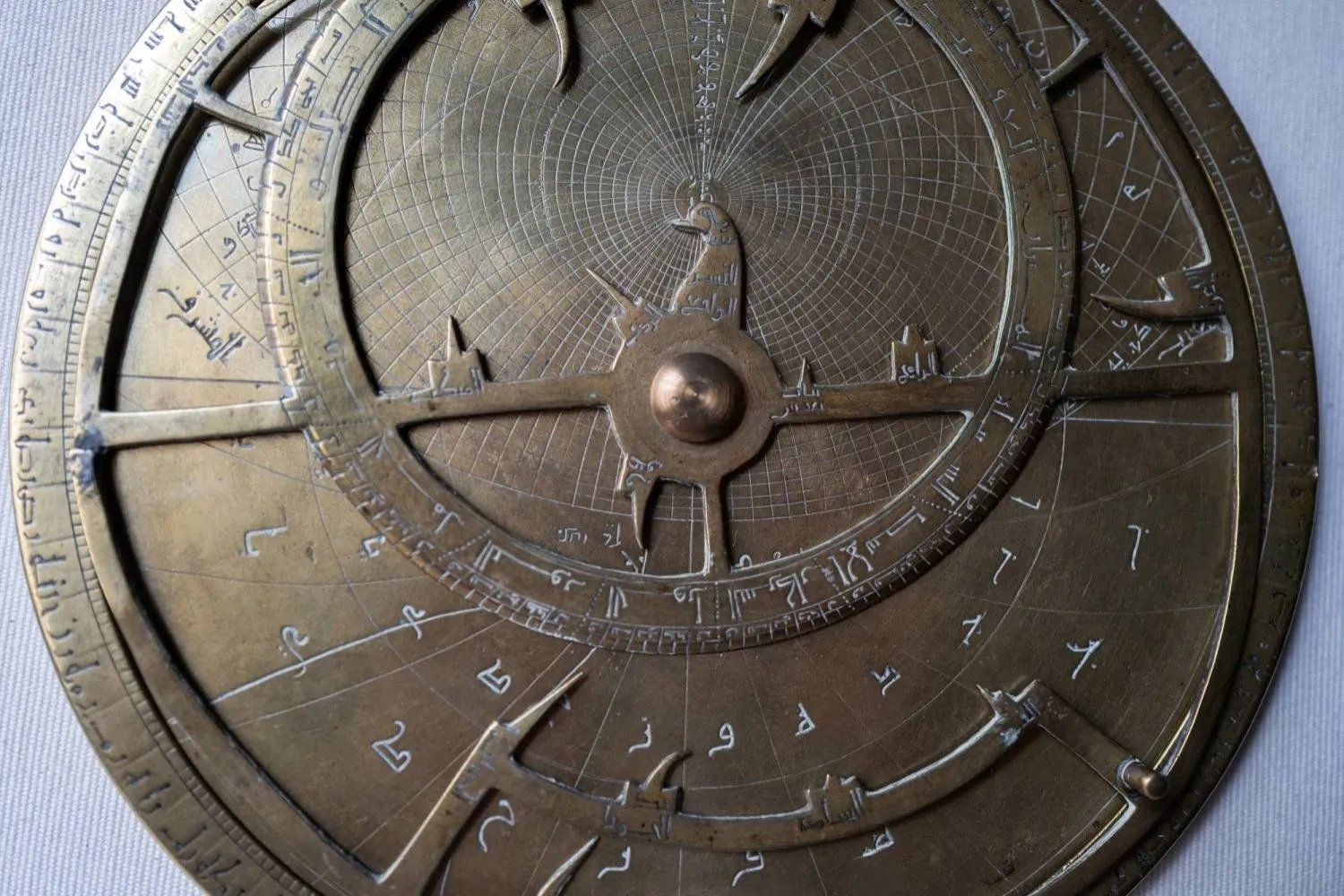
Recently, an astrolabe dating to the 11th century turned up at the Fondazione Museo Miniscalchi-Erizzo in Verona, Italy.

A historian first noticed it in a corner of a photograph while searching online for an image of a 17th-century collector whose miscellany was housed in the museum.

The historian, Federica Gigante of the University of Cambridge, learned that the museum staff had very little information about the piece. So she went to Verona for a closer look.

At the museum, a curator brought her to a side room, where she stood by a window and watched the sunlight illuminate the relic’s brass features.

She made out Arabic inscriptions and, seemingly everywhere, faint Hebrew markings, Western numerals and scratches that looked like they had been keyed.

“In the raking light, I realized that this wasn’t just an incredibly rare, ancient object but a powerful record of scientific exchange between Muslims, Jews and Christians over nearly a millennium,” Dr. Gigante said.

Astrolabes are believed to have been around at the time of Apollonius of Perga, a Greek mathematician from the third-century B.C. known as the Great Geometer.

Islamic scholars improved the gadgets, and by the ninth century A.D. the Persians were using astrolabes to locate Makkah and ascertain the five periods of prayer required each day, as stated in the Quran.

The tool reached Europe through the Moorish conquest of much of Spain.

By analyzing the Verona astrolabe’s design, construction and calligraphy, Dr. Gigante narrowed its provenance to 11th century Andalusia, where Muslims, Jews and Christians had worked alongside one another, particularly in the pursuit of science.

“As the astrolabe changed hands, it underwent numerous modifications, additions and adaptations,” Dr. Gigante said.

The original Arabic names of the signs of the zodiac were translated into Hebrew, a detail that suggested that the relic had at one point circulated within a Sephardi Jewish community.

One side of a plate was engraved in Arabic with the phrase “for the latitude of Cordoba, 38° 30’”; on the other side “for the latitude of Toledo, 40°.”

A handful of latitude values were corrected, some multiple times. Another plate was etched with North African latitudes which indicated that, during the instrument’s travels, it might have been used in Morocco or Egypt.

A series of Hebrew additions led Dr. Gigante to conclude that the astrolabe had eventually reached the Jewish diaspora in Italy, where Hebrew, rather than Arabic, was used.

“Basically, carving in the revisions was like adding apps to your smartphone,” Dr. Gigante said.


The New York Times


Saudi Heritage Commission Wins 2025 New York Product Design Award

Saudi Heritage Commission Wins 2025 New York Product Design Award
TT

Saudi Heritage Commission Wins 2025 New York Product Design Award

Saudi Heritage Commission Wins 2025 New York Product Design Award

Saudi Arabia's Heritage Commission achieved a new international milestone after winning the Silver Category at the 2025 New York Product Design Awards for its creative work, Al-Qaayed Craft Mural, one of the most prominent products of the Artisans House in Jazan Region.

This recognition coincides with the Year of Handicrafts 2025, launched by the Kingdom to strengthen the presence of traditional crafts and highlight their cultural and economic value. The award reflects the commission’s ability to present Saudi handicrafts in contemporary forms that keep pace with innovation while showcasing the richness of national identity, SPA reported.

With this achievement, the Heritage Commission has raised its total award count this year to six, including five international honors and one regional distinction, bringing its overall accolades since establishment to 13 across the fields of heritage, handicrafts, and design.

The commission emphasized that this international recognition embodies its ongoing commitment to preserving and developing handicrafts within the framework of the Year of Handicrafts 2025.

It also highlights the integration of efforts by its specialized teams and its effective local and international partnerships to support male and female artisans and enable their products to reach global creative platforms, in line with the objectives of Saudi Vision 2030.


Saudi National Museum Celebrates World Arabic Language Day with Focus on Heritage, Crafts

The Saudi National Museum is organizing a cultural program to celebrate World Arabic Language Day 2025, which is observed annually on December 18
TT

Saudi National Museum Celebrates World Arabic Language Day with Focus on Heritage, Crafts

The Saudi National Museum is organizing a cultural program to celebrate World Arabic Language Day 2025, which is observed annually on December 18

Saudi Arabia’s National Museum is organizing a cultural program to celebrate World Arabic Language Day 2025, which is observed annually on December 18.

The program will run over three days, offering visitors a unique experience that combines heritage, arts, and the Arabic language.

The celebration will feature a series of cultural and intellectual dialogues exploring the human and cultural dimensions of the Arabic language.

A key highlight is a session titled "the aesthetics of language in Saudi folk songs," which will examine the relationship between traditional folk songs and highlight the role of language in preserving cultural heritage, connecting tools and crafts to the living heritage of Saudi societies.

The program also offers visitors a unique opportunity to explore literary and cultural works through a book signing session with a conversational style, allowing direct interaction with authors and the exploration of the aesthetics of Arabic in their texts.

The program will conclude its activities with a series of workshops, interactive activities, and artistic performances that reflect the richness and diversity of traditional crafts and arts, providing visitors with an exceptional cultural experience that blends discovery, knowledge, and celebration of living heritage.


Saudi Culture Ministry Signs Partnership with ESSEC Business School for Riyadh University of Arts

The signing ceremony was held at Fenaa Alawwal, a leading cultural hub in Riyadh’s Diplomatic Quarter. SPA
TT

Saudi Culture Ministry Signs Partnership with ESSEC Business School for Riyadh University of Arts

The signing ceremony was held at Fenaa Alawwal, a leading cultural hub in Riyadh’s Diplomatic Quarter. SPA

The Saudi Ministry of Culture signed on Sunday a partnership with ESSEC Business School, for Riyadh University of Arts (RUA)’s College of Cultural Management, to nurture creative talent and foster cross-cultural exchange, according to a statement issued by the ministry

The signing ceremony was held at Fenaa Alawwal, a leading cultural hub in Riyadh’s Diplomatic Quarter. Deputy Minister for National Partnerships and Talent Development at the Culture Ministry Noha Kattan signed for Riyadh University of Arts, while Dean and President of the ESSEC Business School Vincenzo Vinzi signed on behalf of ESSEC Business School.

Under this partnership, ESSEC will collaborate with RUA to co-design and deliver specialized programs for the College of Cultural Management, equipping future leaders with the skills to shape the evolving cultural landscape.

Founded in 1907, ESSEC Business School is among Europe’s most prestigious institutions, recognized for its academic excellence, global reach, and commitment to innovation and ethical leadership. Its programs emphasize experiential learning and empower students to drive meaningful impact across industries.

Riyadh University of Arts will offer a progressive educational framework spanning all levels and disciplines within the arts and culture sectors, including short courses, diplomas, bachelor’s, higher diplomas, master’s, and doctoral programs.

Further details on RUA, its academic programs, and international partnerships will be available on its official website, set to launch in the first quarter of 2026.

The statement added that the partnership with ESSEC is part of a series of partnerships and MoUs between Riyadh University of Arts and top-tier international institutions, advancing academic excellence, research collaboration, and world-class cultural education.
