


North Korea Claims Progress in Developing a Hypersonic Missile Designed to Strike Distant US Targets 

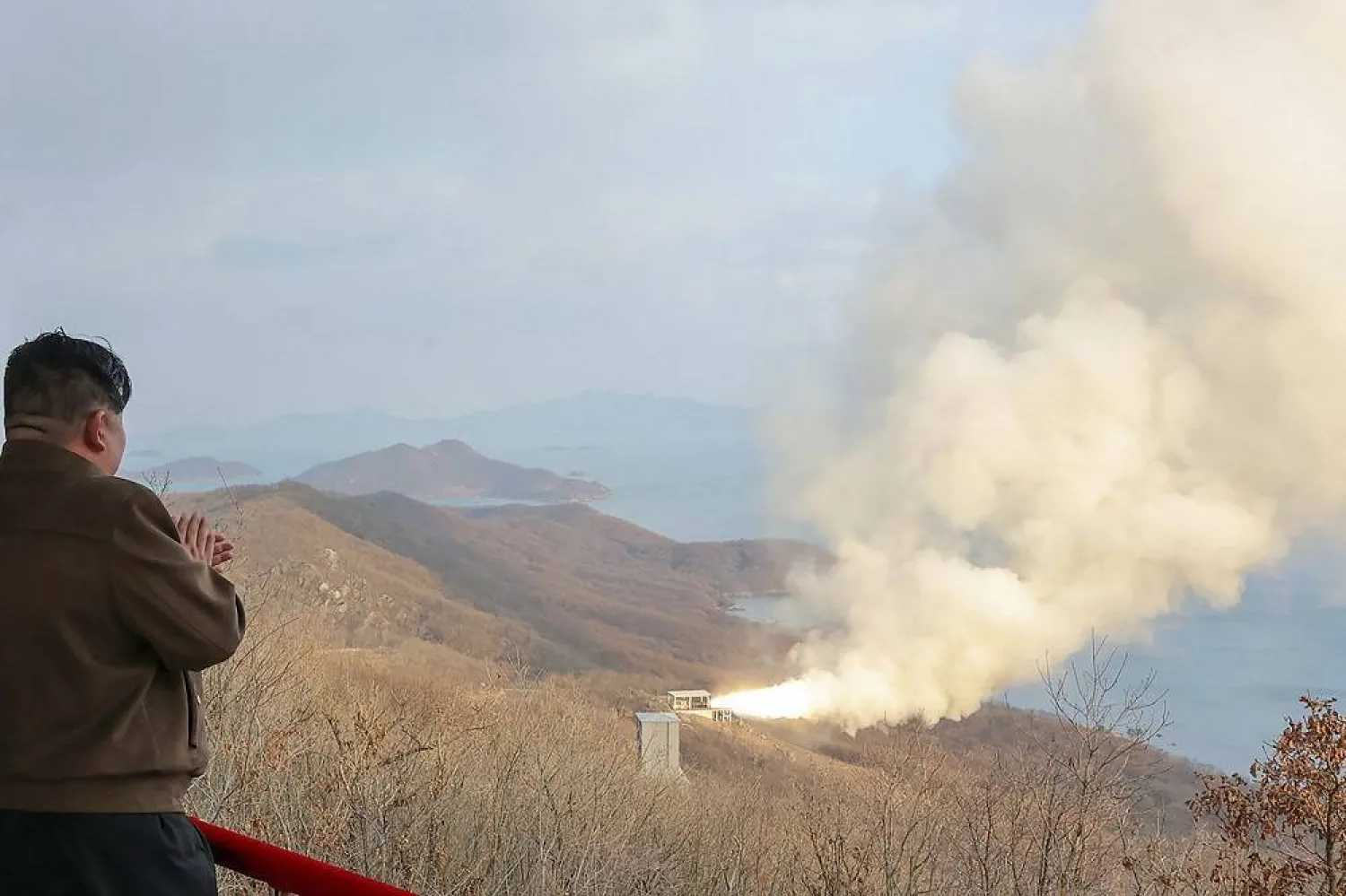
In this photo provided by the North Korean government, North Korean leader Kim Jong Un, left, watches what it says a test of a solid-fuel engine for its new-type intermediate-range hypersonic missile at the Sohae Satellite Launching Ground in North Korea Tuesday, March 19, 2024. (Korean Central News Agency/Korea News Service via AP)
TT

North Korea Claims Progress in Developing a Hypersonic Missile Designed to Strike Distant US Targets 

In this photo provided by the North Korean government, North Korean leader Kim Jong Un, left, watches what it says a test of a solid-fuel engine for its new-type intermediate-range hypersonic missile at the Sohae Satellite Launching Ground in North Korea Tuesday, March 19, 2024. (Korean Central News Agency/Korea News Service via AP)

North Korea successfully tested a solid-fuel engine for its new-type intermediate-range hypersonic missile, state media reported Wednesday, claiming a progress in efforts to develop a more powerful, agile missile designed to strike faraway US targets in the region.

A hypersonic missile is among an array of high-tech weapons systems that North Korean leader Kim Jong Un publicly vowed to introduce in 2021 to cope with what he called deepening US hostility. Outside experts say Kim wants a modernized weapons arsenal to wrest US concessions like sanctions relief when diplomacy resumes.

On Tuesday, Kim guided the ground jet test of the multi-stage solid-fuel engine for the hypersonic missile at the North’s northwestern rocket launch facility, the official Korean Central News Agency reported.

It cited Kim as saying the strategic value of the new missile with an intermediate-range is as important as intercontinental ballistic missiles targeting the US mainland and that “enemies know better about it.” It said that a timetable for completing the development of the new weapons system was “set through the great success in the important test.”

Intermediate-range missiles possessed or pursued by North Korea are the weapons systems primarily aimed at attacking the US Pacific territory of Guam, home to US military bases. Those missile can also reach Alaska, and with a range adjustment they can be used to strike closer targets like US military installations in Japan’s Okinawa island, experts say.

In recent years, North Korea has been pushing to develop more weapons with built-in solid propellants, which make launches harder to detect than liquid-propellant missiles that must be fueled before liftoffs and cannot last long. The North's pursuit of hypersonic weapons is also meant to defeat US and South Korean missile defense systems, but it's unclear the North's hypersonic vehicles proved their desired speed and maneuverability during tests in recent years, analysts say.

In January, North Korea said it flight-tested a new solid-fuel intermediate-range ballistic missile tipped with a hypersonic, maneuverable warhead, in a likely reference to the missile mentioned in Wednesday's KCNA dispatch. In November, North Korea said it had tested engine tests for an intermedia-range missile but didn't say whether it's designed to carry a hypersonic warhead.

While the North's missile test in January was likely related to the development of its first-stage rocket, this week's engine test appeared focused on the development of its second-stage rocket in part of the North's efforts to increase the weapon's flying speed, said Chang Young-keun, a missile expert at South Korea’s Research Institute for National Strategy.

Chang said the latest engine test suggests North Korea could soon test-launch the new hypersonic missile.

After short-range tests with hypersonic weapons, North Korea would want to increase their ranges with maneuverable hypersonic warheads, Lee Choon Geun, an honorary research fellow at South Korea’s Science and Technology Policy Institute, said. He said the capacities of the new missile can be assessed when it's test-flighted.

On Monday, South Korea, the US and Japan said they detected the multiple ballistic missile test-launches by North Korea in what was the country's first missile firings in about a month. The North said Tuesday it performed a live-fire drill of what it called nuclear-capable “super-large” multiple rocket launchers designed to target South Korea’s capital, Seoul. South Korea's military later said it views the North Korean weapons system tested as a ballistic missile.

North Korea has been engaging in a provocative run of missile tests since 2022. The US and South Korea militaries have responded by expanding their bilateral exercises and trilateral drills involving Japan. Observers say North Korea will likely intensify its run of missile tests ahead of the US presidential election in November.



Top Trump Iran Negotiator Says Visits US Aircraft Carrier in Middle East

US Special Envoy Steve Witkoff delivers a press conference upon the signing of the declaration on deploying post-ceasefire force in Ukraine, during the so-called "Coalition of the Willing" summit, at the Elysee Palace in Paris, France, January 6, 2026. (Reuters)
TT

Top Trump Iran Negotiator Says Visits US Aircraft Carrier in Middle East

US Special Envoy Steve Witkoff delivers a press conference upon the signing of the declaration on deploying post-ceasefire force in Ukraine, during the so-called "Coalition of the Willing" summit, at the Elysee Palace in Paris, France, January 6, 2026. (Reuters)

US President Donald Trump's lead Iran negotiator Steve Witkoff on Saturday said he visited the USS Abraham Lincoln aircraft carrier currently in the Arabian Sea, with Washington and Tehran due to hold further talks soon.

"Today, Adm. Brad Cooper, Commander of US Naval Forces Central Command, Jared Kushner, and I met with the brave sailors and Marines aboard the USS Abraham Lincoln, her strike group, and Carrier Air Wing 9 who are keeping us safe and upholding President Trump's message of peace through strength," said Witkoff in a social media post.

Iranian Foreign Minister Abbas Araghchi said on Saturday he hoped talks with the United States would resume soon, while reiterating Tehran's red lines and warning against any American attack.


Israel’s Netanyahu Expected to Meet Trump in US on Wednesday and Discuss Iran

Israeli Prime Minister Benjamin Netanyahu delivers a speech during a special session to mark the 77th anniversary of the Knesset's establishment and the 60th anniversary of the dedication of the current building at the Knesset, the Israeli parliament, in Jerusalem, 02 February 2026. (EPA)
TT

Israel’s Netanyahu Expected to Meet Trump in US on Wednesday and Discuss Iran

Israeli Prime Minister Benjamin Netanyahu delivers a speech during a special session to mark the 77th anniversary of the Knesset's establishment and the 60th anniversary of the dedication of the current building at the Knesset, the Israeli parliament, in Jerusalem, 02 February 2026. (EPA)

Israeli Prime Minister Benjamin Netanyahu is expected to meet US President Donald Trump on Wednesday in Washington, where they will discuss negotiations with Iran, Netanyahu's office said on Saturday.

Iranian and US officials held indirect nuclear ‌talks in the ‌Omani capital ‌Muscat ⁠on Friday. ‌Both sides said more talks were expected to be held again soon.

A regional diplomat briefed by Tehran on the talks told Reuters Iran insisted ⁠on its "right to enrich uranium" ‌during the negotiations with ‍the US, ‍and that Tehran's missile capabilities ‍were not raised in the discussions.

Iranian officials have ruled out putting Iran's missiles - one of the largest such arsenals in the region - up ⁠for discussion, and have said Tehran wants recognition of its right to enrich uranium.

"The Prime Minister believes that any negotiations must include limiting ballistic missiles and halting support for the Iranian axis," Netanyahu's office said in a ‌statement.


Italy FM Rules Out Joining Trump’s ‘Board of Peace’

Italy's Minister for Foreign Affairs Antonio Tajani speaks to the press during the EPP Leaders’ meeting, in Zagreb, Croatia, 30 January 2026. (EPA)
TT

Italy FM Rules Out Joining Trump’s ‘Board of Peace’

Italy's Minister for Foreign Affairs Antonio Tajani speaks to the press during the EPP Leaders’ meeting, in Zagreb, Croatia, 30 January 2026. (EPA)

Italy will not take part in US President Donald Trump's "Board of Peace", Italian Foreign Minister Antonio Tajani said Saturday, citing "insurmountable" constitutional issues.

Trump launched his "Board of Peace" at the World Economic Forum in Davos in January and some 19 countries have signed its founding charter.

But Italy's constitution bars the country from joining an organization led by a single foreign leader.

Prime Minister Giorgia Meloni, a Trump ally, last month noted "constitutional problems" with joining, but suggested Trump could perhaps reopen the framework "to meet the needs not only of Italy, but also of other European countries".

Tajani appeared Saturday to rule that out.

"We cannot participate in the Board of Peace because there is a constitutional limit," he told the ANSA news agency.

"This is insurmountable from a legal standpoint," he said, the day after meeting US Secretary of State Marco Rubio and US Vice President JD Vance at the Olympics in Milan.

Although originally meant to oversee Gaza's rebuilding, the board's charter does not limit its role to the Palestinian territory and appears to want to rival the United Nations.