


UN Security Council Set to Vote on Resolution Demanding Ramadan Gaza Ceasefire

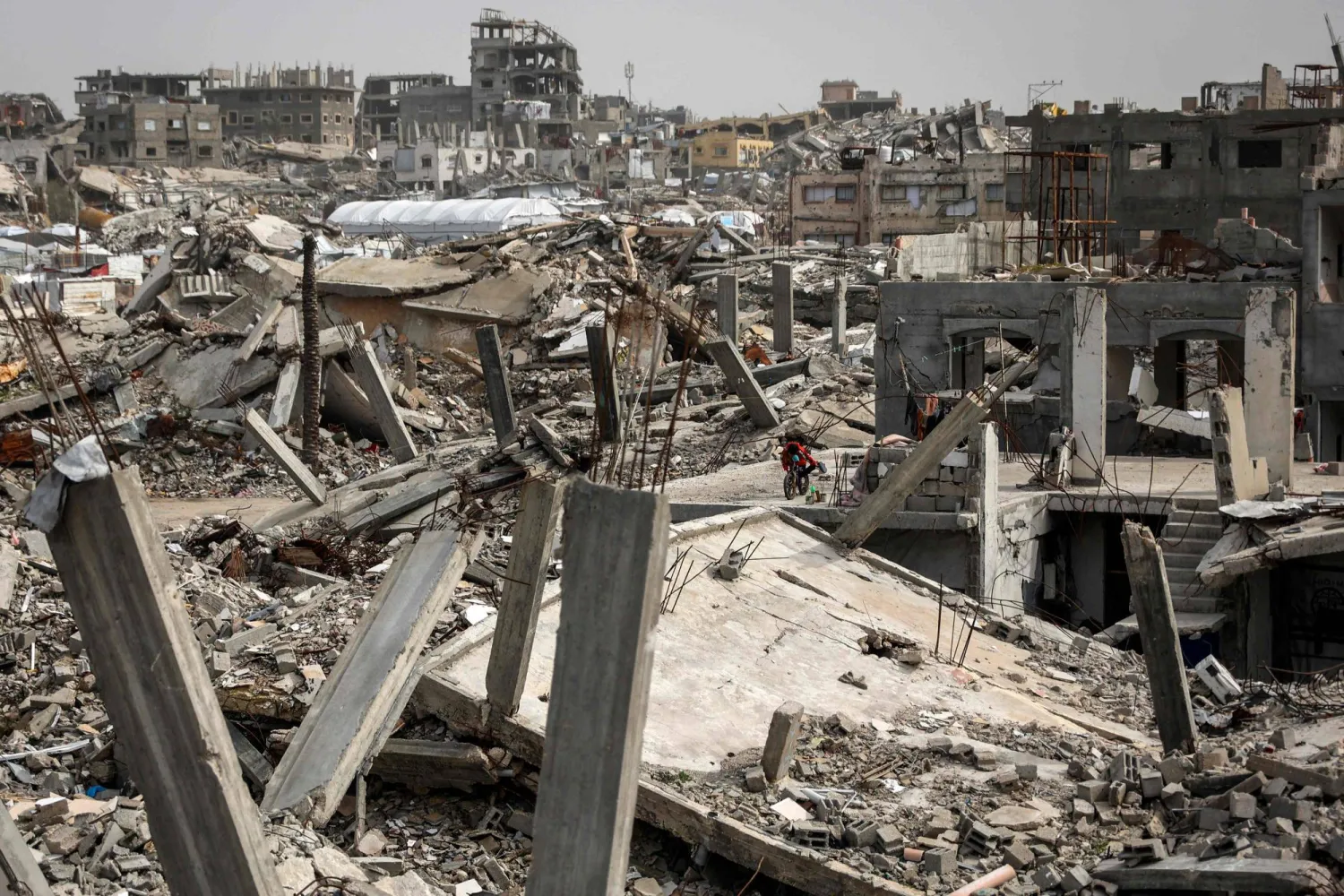
 22 March 2024, Palestinian Territories, Gaza: Men sit on the ruins of buildings destroyed by Israeli bombardment in Jabalia refugee camp. (dpa)
22 March 2024, Palestinian Territories, Gaza: Men sit on the ruins of buildings destroyed by Israeli bombardment in Jabalia refugee camp. (dpa)
TT

UN Security Council Set to Vote on Resolution Demanding Ramadan Gaza Ceasefire

 22 March 2024, Palestinian Territories, Gaza: Men sit on the ruins of buildings destroyed by Israeli bombardment in Jabalia refugee camp. (dpa)
22 March 2024, Palestinian Territories, Gaza: Men sit on the ruins of buildings destroyed by Israeli bombardment in Jabalia refugee camp. (dpa)

The UN Security Council is set to vote on a resolution demanding a humanitarian ceasefire in Gaza during the Muslim holy month of Ramadan, but the United States warned the measure could hurt negotiations to halt Israeli-Hamas hostilities.

The resolution, put forward by the 10 elected council members, is backed by Russia and China, who vetoed a US-sponsored resolution Friday that supported “an immediate and sustained ceasefire” in the Israel-Hamas war in Gaza.

The 22-nation Arab Group at the UN issued a statement Friday night appealing to all 15 council members “to act with unity and urgency" and vote for the resolution "to halt the bloodshed, preserve human lives and avert further human suffering and destruction.”

“It is long past time for a ceasefire," the Arab Group said. Ramadan began March 10 and ends around April 9.

The council is expected to vote on the resolution Monday morning. The vote was earlier scheduled for Saturday morning, but it was delayed early Saturday, according to a UN diplomat.

Many members are hoping that the UN’s most powerful body, which is charged with maintaining international peace and security, will demand an end to the war that began after Gaza's Hamas rulers launched a surprise attack into southern Israel on Oct. 7, killing about 1,200 people and taking some 250 others hostage.

Since then, the Security Council has adopted two resolutions on the worsening humanitarian situation in Gaza, but none has called for a ceasefire.

More than 32,000 Palestinians in Gaza have been killed during the fighting, according to the Gaza Health Ministry. It does not differentiate between civilians and combatants in its count, but says women and children make up two-thirds of the dead.

Gaza also faces a dire humanitarian emergency, with a report from an international authority on hunger warning this week that “famine is imminent” in northern Gaza and that escalation of the war could push half of the territory’s 2.3 million people to the brink of starvation.

The brief resolution scheduled for a vote Monday demands an immediate humanitarian ceasefire for Ramadan “leading to a permanent sustainable ceasefire.” It also demands “the immediate and unconditional release of all hostages” and emphasizes the urgent need to protect civilians and deliver humanitarian aid throughout the Gaza Strip.

US Ambassador Linda Thomas-Greenfield told the council after Friday’s vote that the resolution’s current text “fails to support sensitive diplomacy in the region. Worse, it could actually give Hamas an excuse to walk away from the deal on the table.”

“We should not move forward with any resolution that jeopardizes the ongoing negotiations” being carried out by the United States, Qatar and Egypt, she said, warning that if the diplomacy isn't supported, "we may once again find this council deadlocked.”

“I truly hope that that does not come about,” Thomas-Greenfield said.

The United States has vetoed three resolutions demanding a ceasefire in Gaza, the most recent an Arab-backed measure. That measure was supported by 13 members with one abstention in a Feb. 20 vote.

Russia and China vetoed a US-sponsored resolution in late October calling for pauses in the fighting to deliver aid, the protection of civilians and a halt to arming Hamas. They said it did not reflect global calls for a ceasefire.

They again vetoed the US resolution on Friday, calling it ambiguous and saying it was not the direct demand to end the fighting that much of the world seeks.

A key issue was the unusual language that said the Security Council “determines the imperative of an immediate and sustained ceasefire.” The phrasing was not a straightforward “demand” or “call” to halt hostilities.

The vote in the Security Council became another showdown involving world powers that are locked in tense disputes elsewhere, with the United States taking criticism for not being tough enough against its ally Israel, even as tensions between the two countries rise.

Before the vote, Russia's UN Ambassador Vassily Nebenzia said Moscow supports an immediate ceasefire, but he criticized the diluted language, which he called philosophical wording that does not belong in a UN resolution.

He accused US Secretary of State Antony Blinken and Ambassador Thomas-Greenfield of “deliberately misleading the international community” about calling for a ceasefire.

“This was some kind of an empty rhetorical exercise,” Nebenzia said. “The American product is exceedingly politicized, the sole purpose of which is to help to play to the voters, to throw them a bone in the form of some kind of a mention of a ceasefire in Gaza ... and to ensure the impunity of Israel, whose crimes in the draft are not even assessed.”

China’s UN ambassador, Zhang Jun, said the US proposal set preconditions and fell far short of expectations of council members and the broader international community.

“If the US was serious about a ceasefire, it wouldn’t have vetoed time and again multiple council resolutions,” he said. “It wouldn’t have taken such a detour and played a game of words while being ambiguous and evasive on critical issues.”

The vote in the 15-member council was 11 members in favor and three against, including Algeria, the Arab representative on the council. There was one abstention, from Guyana.

After the vote, Thomas-Greenfield accused Russia and China of vetoing the resolution for “deeply cynical reasons,” saying they could not bring themselves to condemn Hamas’ attacks in southern Israel on Oct. 7, which the resolution would have done for the first time.

A second “petty” reason, she said, is that “Russia and China simply did not want to vote for a resolution that was penned by the United States, because it would rather see us fail than to see this council succeed.” She accused Russia of again putting “politics over progress” and having “the audacity and hypocrisy to throw stones” after launching an unwarranted invasion of Ukraine in February 2022.

The resolution did reflect a shift by the United States, which has found itself at odds with much of the world as even allies of Israel push for an unconditional end to fighting.

In previous resolutions, the US has closely intertwined calls for a ceasefire with demands for the release of Israeli hostages in Gaza. This resolution, using wording that’s open to interpretation, continued to link the two issues, but not as firmly.


Turkish Foreign Minister Urges Kurds Not to Be Obstacle to Syria’s Stability

This handout photograph released by the Turkish Foreign Ministry press service shows Turkish Foreign Minister Hakan Fidan (2nd-L) and Turkish Minister of National Defense Yasar Guler (L) meeting with Syria's Foreign Minister Asaad al-Shaibani (2nd-R) and Syria's Defense Minister Murhaf Abu Qasra (R) in Damascus on December 22, 2025. (Turkish Foreign Ministry Press Service / AFP)
TT

Turkish Foreign Minister Urges Kurds Not to Be Obstacle to Syria’s Stability

This handout photograph released by the Turkish Foreign Ministry press service shows Turkish Foreign Minister Hakan Fidan (2nd-L) and Turkish Minister of National Defense Yasar Guler (L) meeting with Syria's Foreign Minister Asaad al-Shaibani (2nd-R) and Syria's Defense Minister Murhaf Abu Qasra (R) in Damascus on December 22, 2025. (Turkish Foreign Ministry Press Service / AFP)

Visiting Turkish Foreign Minister Hakan Fidan on Monday urged Kurdish-led forces to integrate into Syria's army and not obstruct the country's stability, as the deadline for implementing a deal between Damascus and the Kurds approaches. 

Türkiye and Syria have developed close ties since the toppling of longtime ruler Bashar al-Assad late last year and Ankara, a key supporter of the new authorities, sees the presence of Kurdish forces on its border with Syria as a security threat. 

Fidan, Turkish Defense Minister Yasar Guler and intelligence chief Ibrahim Kalin met with Syrian President Ahmed al-Sharaa, a presidency statement said. 

The visit aimed to address issues including progress on implementing a March 10 agreement between Damascus and the US-backed, Kurdish-led Syrian Democratic Forces (SDF), Türkiye had said. 

Under the deal, the Kurds' civil and military institutions should be integrated into the central government by year end. 

But differences between the sides have held up the deal's implementation despite international pressure, particularly from Washington. 

"It is important that the SDF be integrated into the Syrian administration through dialogue and reconciliation, in a transparent manner, and that it no longer acts as an obstacle to Syria's territorial integrity and long-term stability," Fidan told a press conference with his Syrian counterpart Asaad al-Shaibani. 

Shaibani said Damascus had received a response from the SDF regarding a draft Syrian defense ministry proposal on integrating the Kurdish-led forces into the army. 

"Work is currently underway to study this response and how it responds to the national interest in achieving the integration and achieving a single unified Syrian territory," Shaibani told Monday's press conference. 

Last week, a Kurdish official told AFP on condition of anonymity that Damascus's proposal included splitting the Kurdish-led forces into three divisions and a number of brigades, including one for women. 

The forces would be deployed under Kurdish commanders in areas of northeast Syria currently under SDF control, the official said. 

- Israel - 

It was the first time Damascus had submitted a written proposal to the SDF since the March agreement was signed, the official added, noting "international and regional efforts" to finalize the agreement by the end of the year. 

Last week, Fidan warned the SDF -- which controls vast swathes of Syria's oil-rich northeast -- that patience among key actors was "running out" and advised against further delays to integrate its forces. 

Türkiye shares a 900-kilometer (550-mile) border with Syria and has launched successive offensives to push the SDF from its frontier. 

On Monday, Fidan said the sides also discussed regional security, noting "Syria's stability means Türkiye’s stability". 

He also expressed hope that talks between Syria and neighboring Israel, which has carried out bombings and incursions in Syria since Assad's fall, would "reach a conclusion". 

"For the stability of the region and for Syria's stability, progress in this regard is important," Fidan said, urging Israel to adopt "an approach based on mutual consent and understanding" rather than "pursuing an expansionist policy". 

Shaibani said the talks also addressed "security issues linked to combating terrorism and preventing" a resurgence of the ISIS group in Syria. 

Last week, US forces said they struck dozens of ISIS targets in Syria following a deadly December 13 attack on American personnel in central Syria's Palmyra. 

With support from the coalition, the SDF spearheaded the offensive that led to ISIS's territorial defeat in Syria in 2019, but the extremists still maintain a presence, particularly in the country's vast desert. 

Syria recently joined the international coalition against ISIS. 


Lebanon Says 3 Killed in Israeli Strike on Vehicle Near Sidon

Smoke rises after an Israeli strike on the Haret Saida neighborhood, Sidon, Lebanon, 27 October 2024. (EPA)
TT

Lebanon Says 3 Killed in Israeli Strike on Vehicle Near Sidon

Smoke rises after an Israeli strike on the Haret Saida neighborhood, Sidon, Lebanon, 27 October 2024. (EPA)

Lebanon said three people were killed Monday in a strike near Sidon that Israel said targeted Hezbollah operatives, days ahead of a deadline for Lebanon's army to disarm the group near the border.

Israel has kept up regular strikes on Lebanon, usually saying it is targeting Hezbollah, despite a November 2024 ceasefire that sought to end more than a year of hostilities with the Iran-backed militant group, which it accuses of rearming.

Lebanon's state-run National News Agency said Monday's strike on a vehicle was carried out by an Israeli drone around 10 kilometres (six miles) from the southern coastal city of Sidon and "killed three people who were inside".

The health ministry reported the same toll.

An Israeli military statement said the army "struck several Hezbollah terrorists in the area of Sidon".

Under heavy US pressure and amid fears of expanded Israeli strikes, Lebanon has committed to disarming Hezbollah, starting with the south.

The Lebanese army plans to carry out the task south of the Litani River -- about 30 kilometres from the border with Israel -- by year's end.

The latest strike came after Lebanese and Israeli civilian representatives on Friday took part in a meeting of the ceasefire monitoring committee for a second time, after holding their first direct talks in decades earlier this month, also under the committee's auspices.

The committee comprises representatives from Lebanon, Israel, the United States, France and the United Nations Interim Force in Lebanon (UNIFIL).

Lebanese President Joseph Aoun said Monday that the goal of the negotiations was to "stop the hostilities, achieve Israel's withdrawal, return prisoners held in Israel and return southern residents to their villages".

- 'Days away' -

Israel has also kept troops in five south Lebanon areas that it deems strategic.

"Lebanon awaits positive steps from the Israeli side," Aoun told visiting Italian Defense Minister Guido Crosetto on Monday, a presidency statement said.

In a separate statement, Crosetto said that "even after UNIFIL, Italy will continue to do its part, supporting with conviction the international presence and supporting the capacity development of the Lebanese armed forces".

Asked by AFP if this meant Italy wanted to maintain a military presence in the country, a ministry spokesman confirmed that was the case.

UNIFIL has acted as a buffer between Israel and Lebanon since 1978, but the UN Security Council voted in August to withdraw the peacekeepers in 2027.

Aoun said Lebanon "welcomes the participation of Italy and other European countries in any force that takes the place" of UNIFIL.

On Saturday, Prime Minister Nawaf Salam said the first phase of the plan to restrict weapons to the state south of the Litani River was "days away from completion", according to a statement from his office.

"The state is ready to move to the second phase, north of the Litani River, based on the plan prepared by the Lebanese army," he added.

More than 340 people have been killed by Israeli fire in Lebanon since the ceasefire, according to an AFP tally of Lebanese health ministry reports.

On Sunday, Israeli strikes in south Lebanon near the border killed one person and wounded another, as Israel also said it targeted Hezbollah members.


Italy Says Wants Military to Stay in Lebanon after UN Peacekeepers Leave

A Lebanese army officer and an Italian officer from the UNIFIL force during a joint mission in southern Lebanon (UNIFIL)
TT

Italy Says Wants Military to Stay in Lebanon after UN Peacekeepers Leave

A Lebanese army officer and an Italian officer from the UNIFIL force during a joint mission in southern Lebanon (UNIFIL)

Italy said Monday it intends to keep a military presence in Lebanon even after the UN peacekeeping force it belongs to leaves as planned from December 31, 2026.

"Even after (the peacekeeping force) UNIFIL, Italy will continue to do its part, supporting with conviction the international presence and supporting the capacity development of the Lebanese armed forces," Defencs Minister Guido Crosetto said during a visit to Lebanon, according to a statement.

Asked by AFP if this meant Italy wanted to maintain a military presence in the country, a ministry spokesman confirmed that this was the case.

The United Nations Interim Force in Lebanon (UNIFIL) has acted as a buffer between Israel and Lebanon since 1978, remaining after Israel ended an occupation of southern Lebanon in 2000.

Lebanon had wanted UNIFIL to stay.

But the UN Security Council voted in August to allow only one final extension for UNIFIL after pressure from Israel and its US ally to end the mandate.

UNIFIL is currently led by Italian Major General Diodato Abagnara and numbers 9,923 troops from 49 countries, according to the force's website.

Italy is the second biggest contributing country with 1,099 soldiers deployed after Indonesia which has 1,232 soldiers.

Israel has hailed the termination of UNIFIL and urged the Beirut government to exert its authority after an Israeli military campaign which devastated Iranian-backed militia Hezbollah.

Under a truce between Israel and Hezbollah, the long-fledgling Lebanese national army has been deploying in southern Lebanon and dismantling Hezbollah's infrastructure.

"Support is needed to strengthen the Lebanese armed forces, so that they are in the best possible position to defend the country, ensuring security and respect for its borders," Crosetto said in Monday's statement.

"We will guarantee our presence in multilateral and bilateral contexts," he said.