

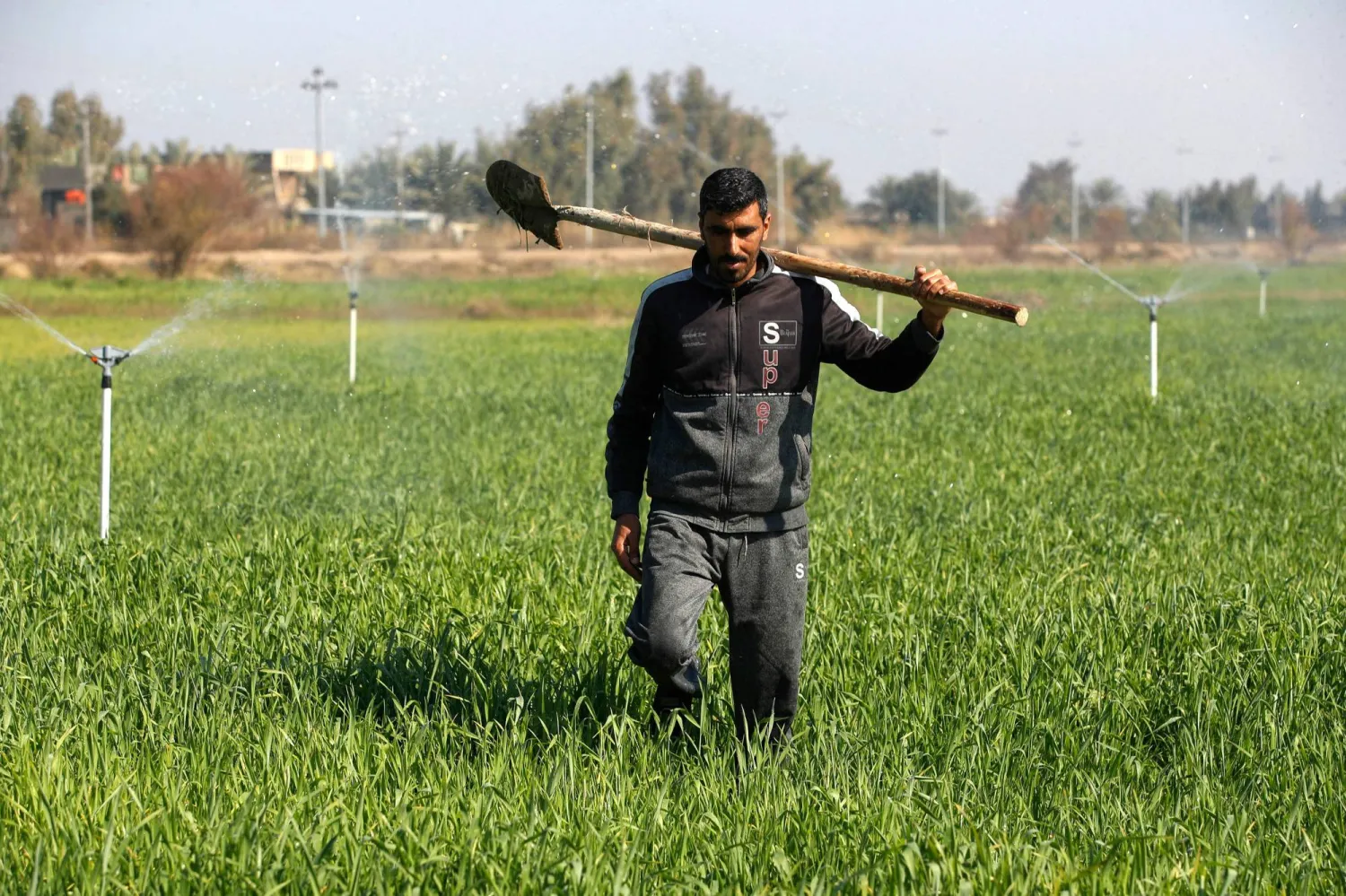

Sprinklers and Drip Irrigation Help Iraqis Beat Drought

A farmer walks next to sprinklers, part of a new water management systems brought by the UN World Food Programme, on his farm in the village of al-Azrakiya, in Iraq's central province of Anbar, on February 22, 2024. (Photo by AHMAD AL-RUBAYE / AFP)
TT

Sprinklers and Drip Irrigation Help Iraqis Beat Drought

A farmer walks next to sprinklers, part of a new water management systems brought by the UN World Food Programme, on his farm in the village of al-Azrakiya, in Iraq's central province of Anbar, on February 22, 2024. (Photo by AHMAD AL-RUBAYE / AFP)

After four years of drought, Iraqi farmer Mohammed Sami was about to abandon his father's parched land, but then a water-saving irrigation system revived his crops and his hopes.

He is among hundreds of farmers in the country battered by heatwaves, scarce rain and depleted rivers to benefit from new water management systems brought by the UN World Food Program, Agence France Presse reported.

The systems use automated sprinklers and drip irrigation to ensure scarce water is used in the most efficient way and is not lost as run-off or evaporated under the blazing sun.

"Since 2019, due to the water scarcity, we have been unable to farm the land," said 38-year-old Sami in his village of Al-Azrakiya in the central province of Anbar.

Crushed by the drought that was turning his 10 donums, or about one hectare, of land into desert, Sami started working in a nearby city as a day laborer several years ago.

"I thought about giving up farming for good," he said.

But then, two years ago, Sami's prospects changed, and his land has flourished again.

The WFP helped with a new automated irrigation system that waters his field for just two hours per day, two to three days a week.

"I now irrigate 10 donums with the same amount of water that I used for one donum before," he said, adding that his wheat harvest had shot up from seven to 12 tons per year.

Last year the WFP project helped more than 1,100 farmers "in areas most affected by climate change and drought," said Khansae Ghazi from the UN agency's Baghdad office.

The new irrigation systems "use 70 percent less water than traditional methods such as flooding" -- the vastly more wasteful method used for millennia.

The modern techniques allow farmers to grow diverse crops year-round, also including barley, cucumber, watermelon and eggplant, and reduce "the reliance on unpredictable rainfall", the WFP said.

- Land of Two Rivers -

Iraq, still recovering from years of war and chaos, is one of the five countries most impacted by some effects of climate change, according to the United Nations.

The site of ancient Mesopotamia, where civilizations flourished on the banks of the mighty Tigris and Euphrates rivers, Iraq now endures extreme water scarcity, worsened by upstream river dams in Iran and Turkey.

"Iraq is the Land of Two Rivers, its more than 7,000-year-old civilization has always relied on farming," said agriculture ministry spokesman Mohammed al-Khazai.

"For decades, the country was afflicted by floods, not drought."

But as rainfall has become more irregular and water more scarce, leaving aquifers depleted, many farmers have abandoned their plots in the new dust-bowl regions.

During the 2021-22 season, the farm sector's productivity plunged by 36 percent from the previous year, said the WFP.

State authorities have restricted water use for agriculture to ensure sufficient drinking water for Iraq's 43 million people.

To fight the problem, the ministry has also started offering sprinkler systems that farmers can pay off over a decade, with the state covering 30 percent of the cost.

"At first, it was difficult for the farmer to switch to modern irrigation," said Khazai.

But now the ministry hopes to boost harvests to more than six million tons of wheat in 2024, from five million last year.

This would exceed Iraq's domestic needs and present a big jump from around two million tons in 2022.

The UN agency warns there are limits to the gains brought by new techniques.

"While modern irrigation systems can significantly improve water efficiency and agricultural practices in Iraq, it may not be sufficient to tackle the complex issue of drought," it said.

But for now, farmers are happy with the gains they are seeing, among them Souad Mehdi in the village of Al-Azrakiya near the Euphrates, who said she has doubled her harvest.

The 40-year-old grows wheat and barley in the winter and corn, tomatoes and eggplant in the summer on her one-hectare plot.

"It used to take us two days to water our crops," she said. Now, she fills a basin with river water then turns on the sprinklers, a task that "doesn't take more than two hours.”



UK Braced for Heavy Snow as Cold Weather Snap in Europe Persists

Lost Earth Adventures' instructor Mick Ellerton climbs a frozen waterfall in Gordale Scar near Malham Cove in the Yorkshire Dales National Park, as ice warnings are in place across the UK ahead of a storm which is set to bring heavy snow later in the week, on Wednesday Jan. 7, 2026. (Danny Lawson/PA via AP)
TT

UK Braced for Heavy Snow as Cold Weather Snap in Europe Persists

Lost Earth Adventures' instructor Mick Ellerton climbs a frozen waterfall in Gordale Scar near Malham Cove in the Yorkshire Dales National Park, as ice warnings are in place across the UK ahead of a storm which is set to bring heavy snow later in the week, on Wednesday Jan. 7, 2026. (Danny Lawson/PA via AP)

Britain, already in the midst of one of its coldest and longest cold snaps in years, is set to endure heavy snowfall and strong winds later Thursday that weather authorities have warned could bring a risk to life.

The brunt of the storm coming in from the Atlantic is set to be felt in central England, with as much as 30 centimeters (12 inches) of snow falling in just a few hours, which inevitably will have potential implications for schools, travel and commerce, particularly in more rural areas.

Storm Goretti, which has been named by the French weather service France Meteo, is expected to leave Britain's shores by late Friday before further impacting other parts of northwest Europe, which have already endured snow, ice and freezing temperatures in recent days.

Neil Armstrong, chief forecaster at the Met Office, Britain's national meteorological service, described Goretti as a “multi-hazard event” with heavy rain, strong winds and snow, The AP news reported.

The Met Office has issued amber warnings for many parts of the UK. These have an “increased likelihood of impacts from severe weather” compared to the lower yellow warnings, meaning there is the possibility of travel delays, road and rail closures, flight cancellations, power cuts and potential risk to life and property.

The snowfall will mean trains and planes could be delayed or cancelled, rural communities may be cut off, and power cuts and disruption to mobile signal are likely.

Amber cold weather health alerts have also been extended by the UK Health Security Agency for all regions of England until Jan. 12, which means severe impacts across health and social care services are expected. Officials expect a rise in deaths, particularly among those aged 65 and over or with health conditions, with impacts also possible on younger age groups.

Many parts of Wales, northern England and Scotland have been blanketed with snow over the past few days that has led to numerous school closures and travel disruption.

In the Netherlands, the bad weather eased on Thursday, helping Amsterdam’s Schiphol Airport, which saw hundreds of flights canceled on each of the first three days of the working week, trying to return to normal. However, it was briefly hit by a power outage in the morning.

Dutch national carrier KLM said there were still long lines of passengers at the airport but added that it was “doing everything possible to ensure departing passengers leave on time.”


Volcano Guides at Mount Etna are Protesting over New Safety Rules

A group of people observes glowing lava emerging from a fissure during ongoing volcanic activity on Mount Etna in Catania, Sicily, Italy, January 3, 2026. REUTERS/Antonio Denti
TT

Volcano Guides at Mount Etna are Protesting over New Safety Rules

A group of people observes glowing lava emerging from a fissure during ongoing volcanic activity on Mount Etna in Catania, Sicily, Italy, January 3, 2026. REUTERS/Antonio Denti

Guides who take tourists to enjoy the striking views of Sicily’s Mount Etna are up in arms over tougher restrictions imposed by local authorities after a round of eruptions at the giant volcano in recent weeks.

Authorities in the city of Catania have suspended or restricted excursions to see the volcano's lava flows, prompting guides to go on strike for the first time in decades and leaving disgruntled tourists with fewer options to see the spectacle up close, The Associated Press reported.

Dozens of the guides demonstrated Wednesday in front of Mount Etna’s lava flow gate, calling the new restrictions excessive and saying the lava flows are slow-moving enough to be viewed safely as has been done in the past.

“These measures effectively nullify the role of guides, stripping them of their skills, function, and professional responsibility,” a statement by the guides’ regional board said.

The lava flows are especially spectacular after sunset, but under the new rules, excursions are allowed only until dusk and can go no closer than 200 meters (660 feet) to the lava flow. Also, a previously existing limit of 10 people per group is being vigorously enforced, including with drones.

Mount Etna is Europe’s most active volcano and the continent’s largest. It attracts hikers and backpackers to its slopes, while less adventurous tourists can take it in from a distance, most stunningly from the Ionian Sea.

At 3,350 meters (almost 10,990 feet) tall and 35 kilometers (21.7 miles) wide, the Sicilian giant frequently offers a front-row seat to nature’s power. Last June, a massive eruption forced tourists to flee the volcano after a plume of high-temperature gases, ash and rock several kilometers high billowed into the air above them.

The latest restrictions were adopted after Mount Etna started a round of eruptions on Christmas Eve.

The most advanced lava front reached 1,360 meters (4,460 feet) above sea level, before stopping and entering a cooling phase after a journey of approximately 3.4 kilometers (about 2 miles), local authorities said. The lava flow poses no danger to nearby residential areas, volcanologists say.

Italy's National Institute of Geophysics and Volcanology confirmed this week that Mount Etna’s eruption is ongoing, but said the lava fronts are cooling and not advancing further.

“This is a lava flow that is descending very slowly on an area that is now also flat or semi-flat,” said Dario Teri, 43, a member of Sicily’s association of alpine and volcano guides who participated in Wednesday’s protest.

The guides, who are expected to continue their strike in the coming days, hope to come to a compromise with authorities that can protect their profession while also ensuring the safety of visitors.

Claudia Mancini, a 32-year-old tourist, said she came from Palermo for an excursion with a guide at Mount Etna.

“Unfortunately, we got the bad news of the cancelling of all activity,” Mancini said, adding that she sympathized with the guides over a situation that “is not making anyone happy.”


Lego Unveils Tech-Filled Smart Bricks

Lego unveils Smart Bricks (AFP)
TT

Lego Unveils Tech-Filled Smart Bricks

Lego unveils Smart Bricks (AFP)

Lego has unveiled Smart Bricks - tech-filled versions of its small building blocks - which it says will bring sets to life with sound, light and reaction to movement, according to the BBC.

However, the new product range has got a mixed reaction from play experts, who said it risks undermining what makes Lego distinct for children in an increasingly digital world.

Announced at the Consumer Electronics Show (CES) 2026 in Las Vegas, the Danish toymaker's Smart Play system introduces new electronic components to the classic plastic blocks.

Lego said its new tech-enabled products, launching in March with a new Star Wars set, are its “most revolutionary innovation” in nearly 50 years.

But Josh Golin, executive director of children's wellbeing group Fairplay, believes Smart Bricks could “undermine what was once great about Legos” - harnessing children's own imagination during play.

He said the toy did not require extra features to generate sounds or other effects.

“As anyone who has ever watched a child play with old-school Legos knows, children's Lego creations already do move and make noises through the power of children's imaginations,” he told the BBC.

Andrew Manches, professor of children and technology at the University of Edinburgh, agreed the beauty of Lego lay in “the freedom to create, re-create, and adapt simple blocks into endless stories powered by children's imagination.”

But he also welcomed Lego's efforts to integrate physical and digital play with tools that react to the way children interact with its Smart Play products.

Julia Goldin, the company's chief product and marketing officer, previously told the BBC it viewed digital technology as an opportunity to “expand physical play and physical building.”

“We don't look at the digital world as a threat,” she said - adding its smart range weaves interactivity “seamlessly” with its physical products.

What are Lego Smart Bricks?

Lego says its Smart Bricks can sense motion, position and distance, allowing the models to respond in various ways during play.

Measuring 2x4, the brick itself contains sensors, lights, a small sound synthesizer, an accelerometer and a custom-made silicon chip enabling it to detect movement and react to it.

But it is designed to be used with Smart Minifigures and Smart Tags tiles - two additional products making up Lego's Smart Play System.

Similarly adapted from existing Lego components, these possess digital identifiers triggering different sounds or reactions when they detect and interact with each other.

For instance, when tried out by the BBC at CES, a Lego birthday cake recognized when its “candles” were blown out - sounding a cheer and a happy birthday song.

Meanwhile, a Lego helicopter made whooshing sounds when moved or rotated, with its Smart Brick lighting up red upon crashing.

Tom Donaldson, head of Lego's Creative Play Lab, said the tech intended to respond to children's actions and complement the way they naturally play.

He said the Smart Brick's reactions to responses would “hopefully inspire and surprise the user to keep them continuing to play.”

“We are building a platform that we want to last for many years,” he said.
Manches told the BBC reduced cost and size of components has “enabled more toymakers to integrate digital technology seamlessly into a range of toys.”

But he added despite exciting innovation, concerns remain about the security and privacy of new and emerging smart toys for children - particularly those which integrate AI.

“The key is to us all to remain critically reflective of the design of these toys, and to pay much attention to how they influence children's everyday lives,” he said.

It is not the first time Lego has dabbled in digital experimentation or sought to appeal to increasingly online audiences.

Since 2017 it has released augmented reality apps and experiences letting people play with computer-generated models layered over their surroundings.

Through collaborations with video game publishers such as Nintendo and Fortnite-maker Epic Games it has also looked to appeal to fans of trending games or new launches - releasing a Super Mario Minifigure in 2020 with a tiny display screen.

Lego chief executive Niels B. Christiansen said in the firm’s 2024 annual report it had accelerated spending on digital technology as a “strategic area” for the company.