


US-Israel Rift Heads For Moment of Truth Over Rafah

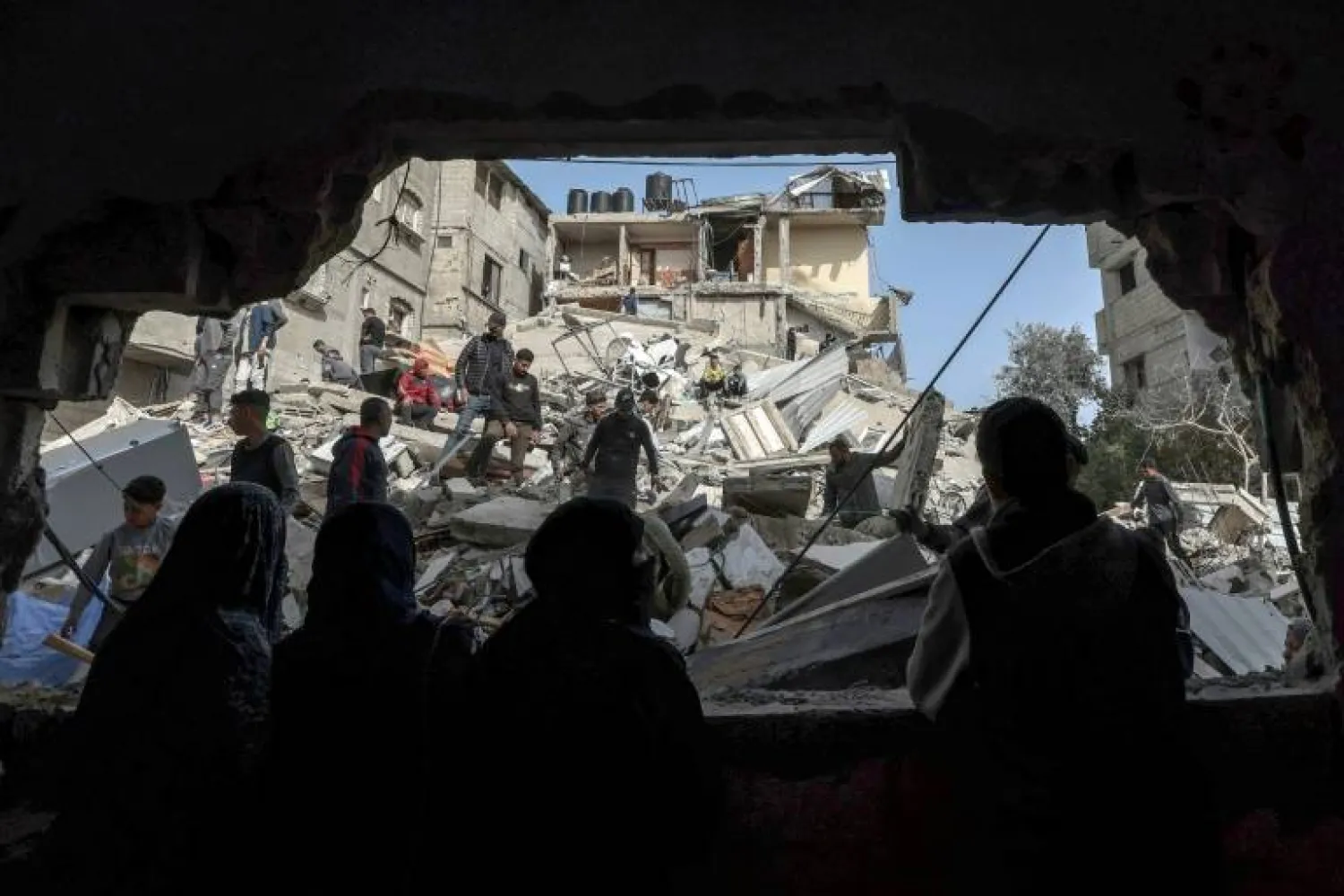
Palestinians check the rubble of buildings that were destroyed following overnight Israeli bombardment in Rafah, in the southern Gaza Strip - AFP
TT

US-Israel Rift Heads For Moment of Truth Over Rafah

Palestinians check the rubble of buildings that were destroyed following overnight Israeli bombardment in Rafah, in the southern Gaza Strip - AFP

The United States has taken a public distance from Israel as never before over the Gaza war but the decisive test will be Rafah and whether Israel heeds US warnings against an offensive in the packed city.

The United States on Monday abstained at the Security Council, allowing a resolution to pass for the first time that called for an immediate ceasefire, infuriating Prime Minister Benjamin Netanyahu who delayed a delegation to Washington to discuss US concerns on Rafah, AFP reported.

But in a stance surely noted by Netanyahu, President Joe Biden has made clear he will not use his key point of leverage -- cutting US military assistance to Israel.

Annelle Sheline, who recently resigned in protest from the State Department, where she had been on a fellowship working on human rights, said the Biden administration may be shifting but that its actions so far -- including the resolution and plans for an emergency pier to bring in aid -- amounted to "PR stunts."

"I can only hope that things are starting to change. Unfortunately, I don't yet see the US actually using its leverage as far as ending or withdrawing support for Israeli military operations, turning off the tap of weapons," she told AFP.

Michael Singh, managing director of the Washington Institute who was a top White House aide on the Middle East under former president George W. Bush, said Biden was responding at the United Nations not just to domestic politics but to calls from US allies to compromise and not keep vetoing resolutions.

A resolution "is a signal, but it doesn't in any tangible way impact Israel's ability to prosecute the conflict," Singh said, while arms restrictions would "come at a much higher cost" strategically and politically.

Israel has been waging a relentless military campaign in Gaza in response to Hamas's surprise attack on October 7 that was the deadliest in Israel in its history.

The United States has repeatedly warned Israel not to attack Rafah, the southern city where more than 1.4 million Palestinians have taken shelter, but Netanyahu last week vowed to press ahead after a direct appeal from visiting Secretary of State Antony Blinken.

US officials say they will present alternatives to the Israeli delegation on Rafah that will focus on striking Hamas targets while limiting civilian casualties.

Stephen Wertheim, a senior fellow at the Carnegie Endowment for International Peace, said that US officials' presentation of alternatives "indicates to me that they believe some sort of military operations will occur and they're trying to limit the damage of that operation."

Singh said the holding pattern on Rafah hurt the United States and Israel as international pressure builds.

"I would say that probably there's a desire in Washington for them to get on with whatever they're going to do one way or the other -- absolutely protect civilians from harm, but this kind of perpetual indecision, I think, is itself harmful," Singh said.

James Ryan, executive director of the Middle East Research and Information Project, said: "You do own it a bit more if you give them plans and they don't go well."

US criticism has been mounting against Netanyahu with Senate Majority Leader Chuck Schumer, a staunch backer of Israel and the highest-level elected American Jew, in a bombshell speech criticizing the conduct of the war and urging new elections.

A Gallup poll released Wednesday said only 36 percent of Americans approved of Israel's actions, down from 50 percent in November.

Biden is a lifelong supporter of Israel who, facing a tough reelection fight in November, is feeling the wrath of the left in his Democratic Party on Gaza, where the United Nations is predicting famine.

Netanyahu, also battling for his political life at the helm of a far-right coalition, is a veteran fighter in Washington who has aligned himself with much of the Republican Party and clashed with three Democratic presidents.

"Both Biden and Netanyahu benefit from having some degree of friction between them," Wertheim said.

"Possibly the one thing that could save Netanyahu government once a new election occurs is for Netanyahu to be able to say to the public, I'm the one figure who was able to stand up to the Americans and also preserve America's support for us," he said.

Biden, in turn, is eager to show he is pushing back against Israeli "brutality" without imposing costs by restricting weapons.

"What we're seeing is a lot of theater that serves the political interests of the leaders," Wertheim said.



Houthis Seize Bab Al-Mandeb and Yemeni Islands in Southern Red Sea

Houthi militants ride a motorbike during a mobilization campaign in Sanaa, Yemen, Thursday, Sept. 10, 2026. (AP)
TT

Houthis Seize Bab Al-Mandeb and Yemeni Islands in Southern Red Sea

Houthi militants ride a motorbike during a mobilization campaign in Sanaa, Yemen, Thursday, Sept. 10, 2026. (AP)

The Iran-backed Houthi group expanded on Friday its control on the western coast of Yemen, reaching wide areas of the Dhubab district, which directly overlooks the Bab al-Mandeb strait. Militants also captured Mayyun Island and the Hanish Islands archipelago and Zuqar Island in the Red Sea.

The developments raise the risks surrounding one of the most important strategic waterways in the world, a day after the Houthis seized Mokha city and its strategic port.

The Houthis seized control of wide areas in Dhubab, including the Bab al-Mandeb area, following heavy shelling against government forces, which were forced to retreat toward the southern outskirts of the district.

With the group's arrival in these areas, its deployment now extends over a wide coastal and island area directly connected to the waterway that separates the Red Sea from the Gulf of Aden.

The Houthis entered Mayyun Island, located in the heart of the Bab al-Mandeb strait, and deployed there without resistance, following the withdrawal of naval military forces from the island, according to field sources.

Warplanes launched raids on Houthi targets in the Mokha district, in an attempt to contain the progress achieved by the group during the past days.

The Yemeni government called for international support. In a statement Friday from a meeting the previous day, its National Defense Council said it was on the front line of defending freedom of navigation and condemned the Houthis’ renewed attacks on Saudi Arabia.

The council stressed that the battle is not about controlling individual positions or districts, but rather about restoring state institutions and its sovereignty, warning against turning the coasts and islands into platforms to threaten Yemen, the countries of the region, and international navigation.

The council said that Yemen, in its defense of Bab al-Mandeb, its coasts, islands, and territorial waters, is not defending itself only, but rather the freedom of navigation, maritime security, and the stability of world trade.

It called on the international community, especially the UN Security Council and countries overlooking the Red Sea, to bear their responsibilities to prevent turning Bab al-Mandeb and Yemeni coasts and islands into leverage for blackmail or platforms of threat to international navigation and trade.


Residents of Southern Lebanon Gather to Watch Israeli Drones Drop Explosives on their Village

People from Mansouri record the smoke billowing from an Israeli-controlled detonation destroying their village, as seen from Hanniyeh village, southern Lebanon, Friday, Sept. 11, 2026. (AP Photo/Hussein Malla)
TT

Residents of Southern Lebanon Gather to Watch Israeli Drones Drop Explosives on their Village

People from Mansouri record the smoke billowing from an Israeli-controlled detonation destroying their village, as seen from Hanniyeh village, southern Lebanon, Friday, Sept. 11, 2026. (AP Photo/Hussein Malla)

A group of men and children gathered Friday at a vantage point overlooking their village in southern Lebanon, watching from a distance as Israeli drones descended, carrying boxes laden with explosives to be dropped on houses.

It has become a daily ritual for residents of Mansouri, who fled the village weeks ago and now are watching its destruction from the neighboring village of Hanniyeh.

Active fighting between Israel and the Iran-backed Lebanese militant group Hezbollah has simmered down since they entered into a truce in June, but the Israeli military now occupies large swaths of southern Lebanon, where it regularly carries out controlled demolitions.

Massive clouds of smoke and dust rise periodically from Mansouri, as the men watching debate which neighbor's house has been destroyed this time and look for signs of their own. Early Friday, the Israeli military detonated the village's public school, Lebanese state media reported.

The Israeli military did not immediately respond to a request for comment about the demolitions.

Villagers decry the Lebanese government's lack of response. Some displaced residents blame the Lebanese government along with Israel, saying that authorities abandoned the village.

Ali Hussein Ghanem, a tobacco farmer from Mansouri, is staying with relatives in Hanniyeh along with his wife and children.

“This is something that should never happen,” he said, watching the smoke rise over his village from a distance. “Isn’t the state supposed to protect our town rather than hand it over to Israel?”

Wissam Khashabi, a beekeeper, also from Mansouri, agreed.

“We are seeing our land being destroyed,” he said. “We have lost our property, our orchards, and all our livelihoods. The state is not really doing anything.”

On Thursday, Israeli officials said they had blown up Hezbollah tunnel networks under the strategic Ali Taher ridge near the town of Nabatiyeh, in a different part of southern Lebanon. The force of the blasts caused the earth to shake in surrounding areas.

The Israeli military said the ridge contained extensive underground military infrastructure built by Hezbollah. It had been the site of clashes between Israeli forces and the militant group in recent weeks, before Israel announced it had taken “operational control” of it.

No political solution in sight Many residents of Mansouri fled when the latest Israel-Hezbollah war began in March, but returned after the truce in June — only to flee again when the Israeli military issued a call to evacuate the village last month and began striking it again.

Israel said at the time that it was responding to ceasefire violations by Hezbollah. But it’s not clear why it has been demolishing the village since then.

Some of the displaced were taken in by relatives, while others are staying in school shelters in the nearby city of Tyre. At the height of the war, some 1.2 million people were displaced in Lebanon. The ceasefire has allowed most of them to return home, but more than 300,000 remain displaced.

With negotiations between Israel and Lebanon — and between the US and Iran — stalled, there is no political solution in sight that would allow them to go home.

The latest conflict between Israel and Hezbollah began on March 2, when the militant group fired rockets across the border two days after Israel and the US launched a war on Iran.

The Lebanese government and Israel reached a framework agreement in June stating Israel will withdraw from Lebanon as Hezbollah is disarmed, but there has been little movement on implementing it.

Lebanese and Israeli officials are expected to meet for another round of talks in Rome later this month.


Israel Says Ready for More Strikes on Hezbollah after Tunnel Detonation

Ali Al-Taher Heights east of the city of Nabatieh in southern Lebanon, with the towns of Kfar Tebnit and Nabatieh al-Fawqa visible below (Al-Sharq Al-Awsat).
TT

Israel Says Ready for More Strikes on Hezbollah after Tunnel Detonation

Ali Al-Taher Heights east of the city of Nabatieh in southern Lebanon, with the towns of Kfar Tebnit and Nabatieh al-Fawqa visible below (Al-Sharq Al-Awsat).

Israel said Friday that it was prepared for more strikes on Hezbollah after demolishing tunnels built by the Iran-backed group in southern Lebanon with a massive explosion.

"We are ready and prepared to continue the campaign, to continue striking Hezbollah and at additional locations," Defense Minister Israel Katz said in a video message, Reuters reported.

Israel late Thursday blew up what it described as a vast network of tunnels under the strategic Ali al-Taher ridge where Hezbollah kept a command center, living quarters and stocks of weapons with which to strike northern Israel and invading Israeli troops.

A huge fireball was seen in the area, with the US Geological Survey recording a tremor equivalent to a 4.1 magnitude earthquake.

The blast came a week after Israeli troops said they had seized the strategic highlands as they solidified control of a "security zone" in southern Lebanon.

"We promised protection to the residents of the north, and we delivered," Katz said in his message, which came on the Jewish new year and weeks ahead of tight elections.

"Now there is a strong security zone, stronger than ever before, which protects the communities from attack and direct fire, and enables us to maintain control and threaten Hezbollah deep inside the area."

Israel said the tunnel network was built over two decades with the help of Hezbollah's patron Iran, whose clerical government has also backed Hamas in the Gaza Strip.

Israel and the United States attacked Iran in late February, sparking the Middle East war.

Hezbollah, founded to oppose an earlier Israeli occupation of southern Lebanon that began in 1982, dragged the country into the wider conflict when it fired rockets at Israel in solidarity with Iran.

Lebanese authorities say Israeli military operations in the country have killed more than 4,300 people since March.

The Israeli army said that the Ali al-Taher network comprised tunnels extending for more than two kilometres that held dozens of Iranian-made rockets, missiles and drones, as well as other weapons.

The ridge lies on the edge of Israel's self-styled security zone just a few kilometres from the UNESCO-listed Beaufort castle, another strategic site that Israel captured in recent months.