King Charles Shakes Hands, Chats with Crowd at Most Significant Public Outing Since Cancer Diagnosis

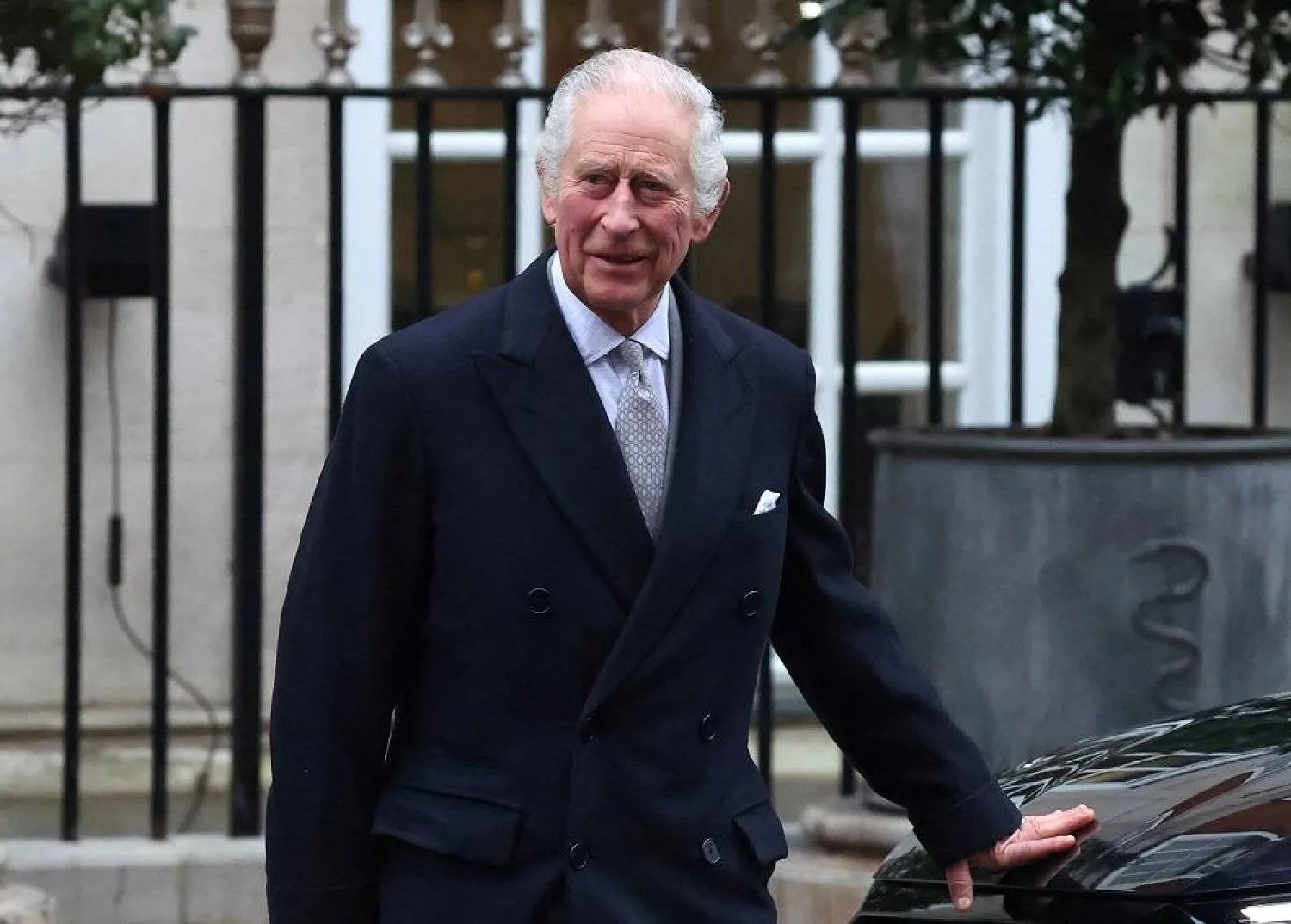
File photo: Britain's King Charles leaves the London Clinic after receiving treatment for an enlarged prostate, in London, Britain January 29, 2024. (Reuters)
TT

King Charles Shakes Hands, Chats with Crowd at Most Significant Public Outing Since Cancer Diagnosis

File photo: Britain's King Charles leaves the London Clinic after receiving treatment for an enlarged prostate, in London, Britain January 29, 2024. (Reuters)

King Charles III shook hands and chatted with onlookers after attending an Easter service at Windsor Castle on Sunday in his most significant public outing since being diagnosed with cancer last month.

The king, dressed in a dark overcoat and shiny blue tie, smiled as he made his way along a rope line outside St. George's Chapel for about five minutes, reaching into the crowd to greet supporters who waved get-well cards and snapped photos on a chilly early spring day.  

“You’re very brave to stand out here in the cold,” Charles told them.

“Keep going strong,” one member of the crowd shouted as Charles and Queen Camilla walked by.

The 75-year-old monarch’s appearance was seen as an effort to reassure the public after Charles stepped back from public duties in early February following an announcement by Buckingham Palace that he was undergoing treatment for an unspecified type of cancer.

The king has continued fulfilling his state duties, such as reviewing government papers and meeting with the prime minister. But his attendance at a traditional royal event like the Easter service is seen as a sign that he is beginning a managed return to public life. British media reported last week that Charles would slowly increase his public appearances after Easter.

The service itself was smaller than usual as Kate, the Princess of Wales, is also being treated for cancer and has paused public duties. The princess, her husband Prince William and their children did not attend.

Kate shock’s announcement that she, too, had cancer was made on March 22, after weeks of speculation about her health and whereabouts following major abdominal surgery in February.

Charles’ enforced absence from public life has been a setback for a man who is eager to put his stamp on the monarchy after waiting almost 74 years — longer than any previous heir — to become king.

When he succeeded his mother, Queen Elizabeth II, Charles faced the daunting task of demonstrating that the 1,000-year-old monarchy remains relevant in a modern nation whose citizens come from all corners of the globe. After less than two years on the throne, the king is still defining himself with the public as he tries to persuade young people and members of minority communities that the royal family can represent them.

“He knows that being seen by the public and having public goodwill is really what's at the core of a successful monarchy,” royal commentator Jennie Bond told the BBC. “He needs to have that interaction and I think he quite enjoys it, actually.”

Although the duties of a constitutional monarch are largely ceremonial, the job of being a royal can be exhausting.

Besides the occasional procession in full royal regalia, there are meetings with political leaders, dedication ceremonies and events honoring the accomplishments of British citizens. That added up to 161 days of royal engagements during Charles’s first year on the throne.

The palace has worked hard to keep the king in the public eye — even as he sought to limit contacts to reduce his risk of infection while receiving treatment. Videos of the king reading get-well cards and an audience with Prime Minister Rishi Sunak were released. He also attended a session of the Privy Council, an assembly of senior advisers.

While he skipped a pre-Easter service on Thursday, Charles released a prerecorded audio message in which he expressed his regret at missing an occasion traditionally attended by the monarch.

The king also reaffirmed his coronation pledge “not to be served, but to serve.”

“That I have always tried to do and continue to do, with my whole heart,” he said.


Rain Further Batters Storm-Hit Portugal, Thousands Evacuated

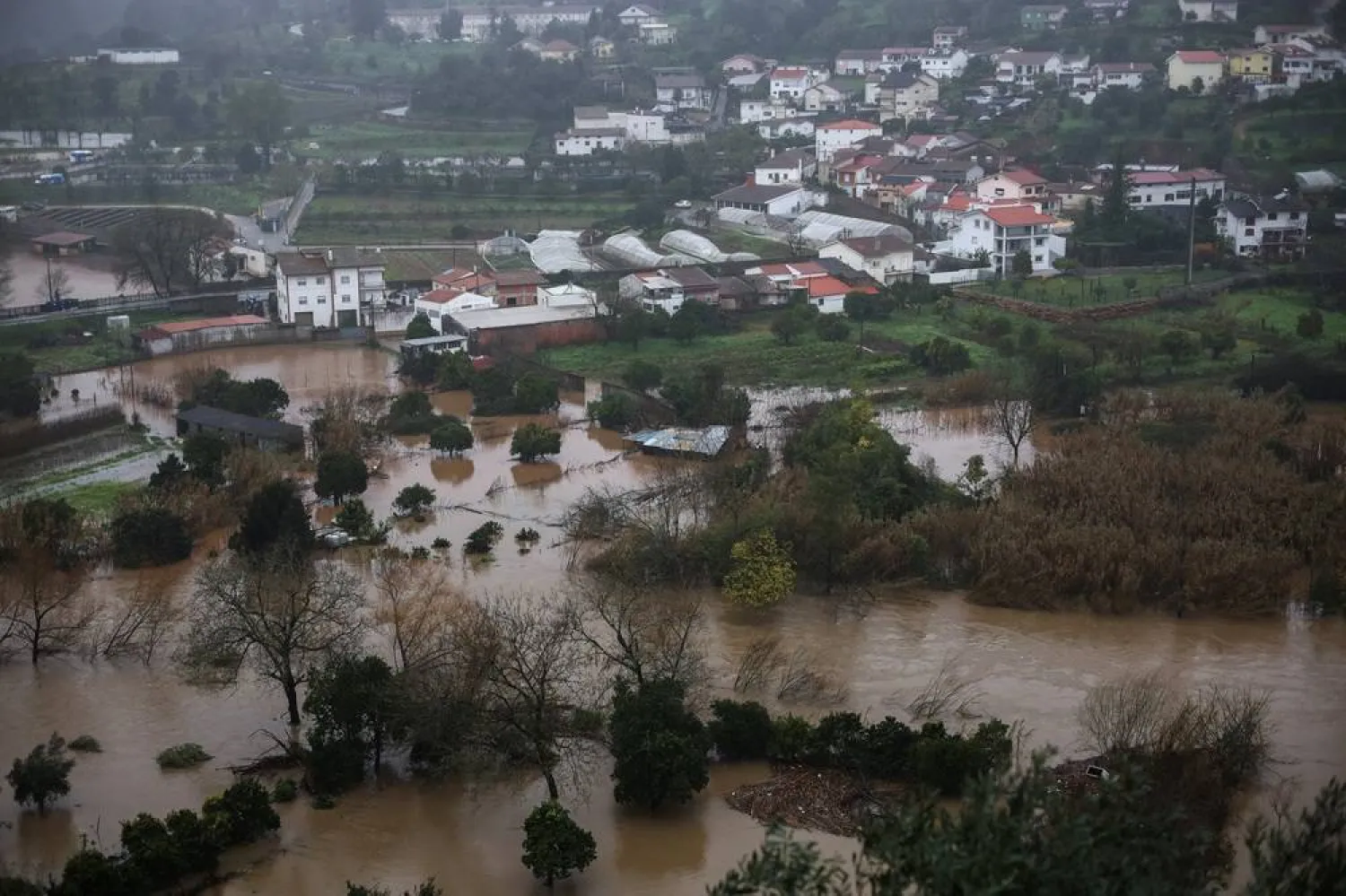
 A flooded area in Ceira, Coimbra, Portugal, February 11, 2026. (Reuters)
A flooded area in Ceira, Coimbra, Portugal, February 11, 2026. (Reuters)
TT

Rain Further Batters Storm-Hit Portugal, Thousands Evacuated

 A flooded area in Ceira, Coimbra, Portugal, February 11, 2026. (Reuters)
A flooded area in Ceira, Coimbra, Portugal, February 11, 2026. (Reuters)

More ‌heavy rain flooded several rural areas in the north of storm-battered Portugal on Wednesday, leaving levees at risk of bursting around the medieval city of Coimbra and forcing authorities to evacuate about 3,000 residents as a precaution.

A succession of deadly storms has hammered mostly central and southern parts of the country since late January, blowing roofs off houses, flooding several towns and leaving hundreds of thousands without electricity for days. At least 15 people have died as a consequence of the storms, including indirect ‌victims.

As the ‌storms let up this week, a weather ‌phenomenon ⁠known as an "atmospheric river" - ⁠a wide corridor of concentrated water vapor carrying massive amounts of moisture from the tropics - brought new downpours, affecting the north to a greater extent.

RISK OF DAM OVERFLOWING

Municipal authorities in Coimbra ordered the precautionary evacuation late on Tuesday of around 3,000 people most at risk from the River Mondego bursting its banks, ⁠and the operation was still under way on ‌Wednesday, with police making door-to-door checks ‌and bussing residents to shelters.

Regional Civil Protection official Carlos Tavares ‌said on Wednesday the situation could worsen between late Wednesday ‌and midday Thursday, as the rain could cause the Aguieira dam, 35 km northeast of Coimbra, "to overflow, sweep away levees and trigger further flooding".

Part of Coimbra's ancient city wall, on a hillside in one ‌of Europe's oldest university towns and a UNESCO World Heritage site, collapsed, shutting the road below ⁠and forcing ⁠the closure of the municipal market, the city hall said.

Prime Minister Luis Montenegro was due in Coimbra to oversee the emergency response after Interior Minister Maria Lucia Amaral resigned following criticism from opposition parties and local communities over what they described as the authorities' slow and failed response to devastating Storm Kristin two weeks ago.

In central Portugal, just across the River Tagus from Lisbon, authorities evacuated the village of Porto Brandao due to the risk of landslides, and around 30 people were removed from their homes after a landslide in the neighboring beachside area of Caparica.


Record Heat and Raging Fires Ring in 2026 Across the Southern Hemisphere 

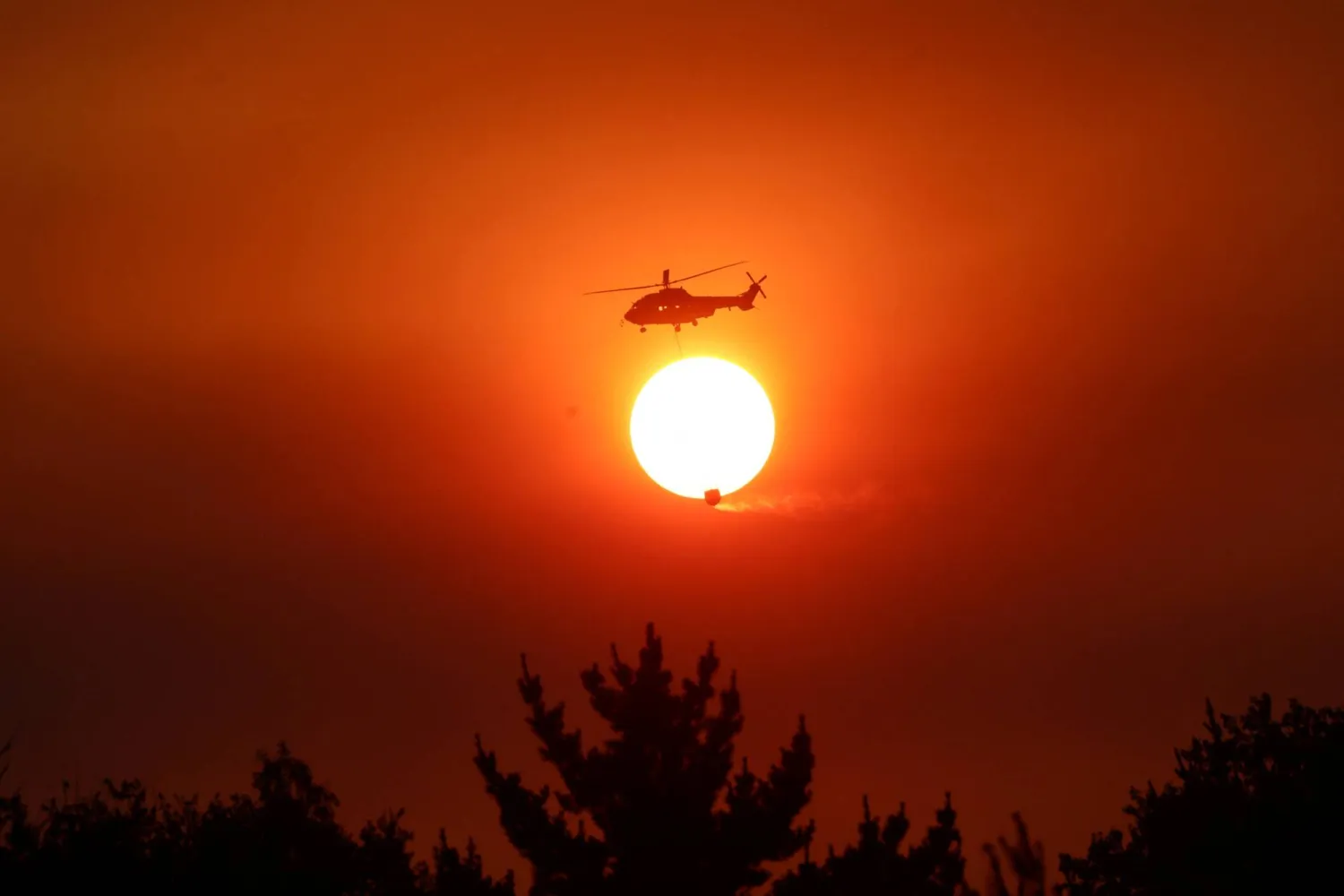
A helicopter battles a forest fire in the Biobio region, where multiple wildfires have prompted emergency evacuations, in Florida, Chile, January 21, 2026. (Reuters)
TT

Record Heat and Raging Fires Ring in 2026 Across the Southern Hemisphere 

A helicopter battles a forest fire in the Biobio region, where multiple wildfires have prompted emergency evacuations, in Florida, Chile, January 21, 2026. (Reuters)

From Argentina to Australia to South Africa, record heat and raging wildfires are rampaging through the Southern Hemisphere at the start of 2026, with scientists predicting that even more extreme temperatures could lie ahead - and possibly another global annual high - after three of the hottest years on record.

In January, a record-setting heat dome enveloped Australia, sending temperatures near 50 degrees C (122 degrees F) while heat and catastrophic wildfires gripped parts of South America, setting remote parts of Argentina's Patagonia ablaze and killing 21 people in coastal towns in Chile. In addition, South Africa has been experiencing its worst wildfires in years.

The extremes are occurring even as the world remains under the cooling influence of a weak La Nina, a climate cycle marked by cooler waters in the central and eastern Pacific that began in December 2024. Despite this moderating factor, temperatures are reaching record highs in various locales.

"This means the effect of human-caused climate change is overwhelming natural variability," said climate scientist Theodore Keeping of Imperial College London and the international research collaboration World Weather Attribution, who specializes in research on wildfires and extreme heat.

"As we transition into a neutral or even El Nino phase, we'll expect the incidence of extreme heat events around the world to be further amplified," Keeping added.

El Nino typically has the opposite effect of La Nina, warming the central and eastern Pacific and boosting global temperatures.

This year is forecast to be about 1.46 degrees C (2.6 degrees F) above pre-industrial levels, which would make it the fourth consecutive year to be higher than 1.4 degrees C (2.5 degrees F) above pre-industrial levels, according to Adam Scaife, head of the long-range prediction at the United Kingdom's national weather ‌and climate service.

The 2015 ‌international climate treaty, known as the Paris Agreement, aimed to keep warming below 1.5 degrees C (2.7 degrees F) above pre-industrial levels.

"If a big ‌El Nino ⁠were to develop ⁠quickly in 2026 then it's still possible 2026 could be a record," Scaife said. The World Meteorological Organization said last month that the past three years were the warmest on record.

FIRE RAGES FROM WOODS TO WATER

While most wildfires are caused by human activity, they are also a natural part of many ecosystems. Persistent heat, drought and extreme temperatures, however, are turning once-manageable fires into increasingly uncontrollable and destructive events.

Many ecosystems are not adapted to such hot, dry conditions, allowing fires to grow larger and more intense, often causing permanent damage, Keeping said.

The fires that burned through Argentina's Los Alerces National Park illustrate the shift, according to meteorologist Carolina Vera of the Center for Ocean and Atmospheric Research at the University of Buenos Aires.

The park, a UNESCO World Heritage site, is home to trees that have lived more than 3,000 years.

Local officials determined that a lightning strike caused the fire. The blaze initially was under control. But Vera said a heat wave and strong winds caused it to spread about 20 km (12 miles) in a single day, making it the worst wildfire there ⁠in two decades.

The region has been drought-stricken since 2008. Temperatures during the first two weeks of January were about 6 degrees C (11 degrees F) above ‌normal.

"These fires used to burn themselves out and form part of the forest's natural dynamics," Vera said.

"This is an example of ‌how climate change can alter a natural fire, because it appeared to be caused by lightning," Vera said.

There are no towns in that remote area.

Fires erupted in the southern part of neighboring Chile later in January and ‌crossed into the greater Concepcion area, the country's third-largest metropolitan region, destroying hundreds of homes and killing 21 people in coastal communities.

Keeping said the blazes mirrored recent disasters in places such as ‌Los Angeles, Athens and the Hawaiian island of Maui.

"Where there's been the greatest loss of life, it almost always comes down to evacuation being difficult or impossible," Keeping said. "That's particularly true in regions affected by strong downslope winds toward the coast."

WHIRLWINDS OF FIRE

About 80% of Punta de Parra, a small coastal town in southern Chile surrounded by hills and forests, was destroyed.

Punta de Parra residents said they had little time to evacuate. Doralisa Silva, 34, said she heard about a fire in a nearby community the night the blaze reached the town.

"Out of nowhere, the forest started burning and all the houses caught fire," Silva said. "The fire was on us in the blink ‌of an eye. There was nothing we could do."

Silva said her family was among the last to try to flee because they had no vehicle. Silva said flames blocked their exit as embers rained down as she and her partner Hermes Barrientos fled with their ⁠2-year-old daughter.

Barrientos said winds of nearly 70 km ⁠per hour (43.5 mph) whipped through the area, creating whirlwinds of fire that spread to the beach and trapped residents. The family and others eventually found refuge in a large dirt field at the center of town, and spent the night watching their community burn.

A FUTURE FILLED WITH FIRES

Record-breaking heat in southeastern Australia has also fueled the country's worst fires since the deadly 2019-2020 season, when 33 people were killed.

In addition, the 2025-2026 fire season has been the most severe in South Africa in a decade, according to officials, killing wildlife and hitting tourist destinations such as Mossel Bay and Franschhoek.

"The hot, dry and windy conditions that drive the most extreme wildfires are becoming more intense and more likely," Keeping said. "And it's happening all around the world."

The Southern Hemisphere has warmed by about 0.15 to 0.17 degrees C (0.27 to 0.30 degrees F) per decade since the 1970s, compared to 0.25 to 0.30 degrees C (0.45 to 0.54 degrees F) in the Northern Hemisphere - largely because its vast oceans absorb heat more slowly and because of Antarctic meltwater.

Still, southern land masses are now warming at similar rates to northern land masses, and contrasts between warming land and cold meltwater can intensify weather patterns, leading to prolonged heat waves, droughts or flooding.

Keeping said adaptation is critical, including authorities managing vegetation near cities and developing effective evacuation plans, and builders using fire-resistant materials. Wildfires are inflicting mounting economic damage. A 2026 report by insurance broker Aon estimated global insured wildfire losses at $42 billion in 2025, up from an average of $4 billion annually between 2000 and 2024. The Los Angeles fires last year were the costliest on record.

Swiss Re, the world's second-largest reinsurer, found that wildfires accounted for about 1% of global insured losses from natural disasters before 2015, but now represent 7%, with economic losses linked to fires rising by about $170 million a year since 1970.

"You actually cannot stop a lot of these really large intense wildfires. They're simply too big," Keeping said.

The most important way forward, Keeping said, is to "have a serious conversation about limiting future climate change to prevent this issue from worsening."



Study: Noisy Humans Harm Birds and Affect Breeding Success

FILE - Birdhouses line a path outside a resident's room at the Ida Culver House Ravenna, a senior independent and assisted living home in Seattle, on May 21, 2020. (AP Photo/Elaine Thompson, File)
TT

Study: Noisy Humans Harm Birds and Affect Breeding Success

FILE - Birdhouses line a path outside a resident's room at the Ida Culver House Ravenna, a senior independent and assisted living home in Seattle, on May 21, 2020. (AP Photo/Elaine Thompson, File)

Noise pollution is affecting bird behavior across the globe, disrupting everything from courtship songs to the ability to find food and avoid predators, a large-scale new analysis showed on Wednesday.

Researchers reviewed nearly four decades of scientific work and found that noises made by humans were interfering with the lives of birds on six continents and having "strong negative effects" on reproduction success.

Previous research on individual species has shown that single sources of anthropogenic noise -- such as planes, traffic and construction -- can affect birds as it does other wildlife.

But for this study, the team performed a wider analysis by pooling data published since 1990 across 160 bird species to see if any broader trends could be established.

The study, published in the journal Proceedings of the Royal Society B, found clear evidence of a "pervasive" impact of noise pollution on birds worldwide.

"We found that noise significantly impacts communication risk behaviors, foraging, aggression and physiology and had a strong effect on habitat use and a negative impact on reproduction," AFP quoted it as saying.

This is because birds rely on acoustic information to survive, making them particularly vulnerable to the modern din produced by cars, machinery and urban life.

"They use song to find mates, calls to warn of predators, and chicks make begging calls to let their parents know they're hungry," Natalie Madden, who led the research while at the University of Michigan, said in a statement.

"So if there's loud noise in the environment, can they still hear signals from their own species?"

In some cases, noise pollution interrupted mating displays, caused males to change their courtship songs, or masked messages between chicks and parents.

The study included many common species such as European robins and starlings, house sparrows, and great tits.

The response varied between species, with birds that nest close to the ground suffering greater reproductive harm, while those using open nests experienced stronger effects on growth.

Birds living in urban areas, meanwhile, tended to have higher levels of stress hormones than those outside of cities.

Some 61 percent of the world's bird species have declining populations, mostly due to habitat loss driven by expanding agriculture and logging, the International Union for Conservation of Nature said in October.

The study authors said that noise pollution was an "underappreciated consequence" of humanity's impact on nature, especially compared to biodiversity loss and climate change.

But some relatively simple fixes could make a big difference for birds, they said.

Madden told AFP that shifting from noisier cars and landscaping tools such as mowers and leaf blowers to electric-powered alternatives was one idea.

Another could be "running machinery outside peak breeding seasons, avoiding activity when birds are migrating through an area, or shifting construction away from habitats that support vulnerable species", she added.

Buildings could also be adapted to muffle sound in the same way they are constructed to improve visibility and minimize bird collisions, said the study's senior author Neil Carter, from the University of Michigan.

"So many of the things we're facing with biodiversity loss just feel inexorable and massive in scale, but we know how to use different materials and how to put things up in different ways to block sound," he said.