


France to Send Old Armored Vehicles, New Missiles to Ukraine

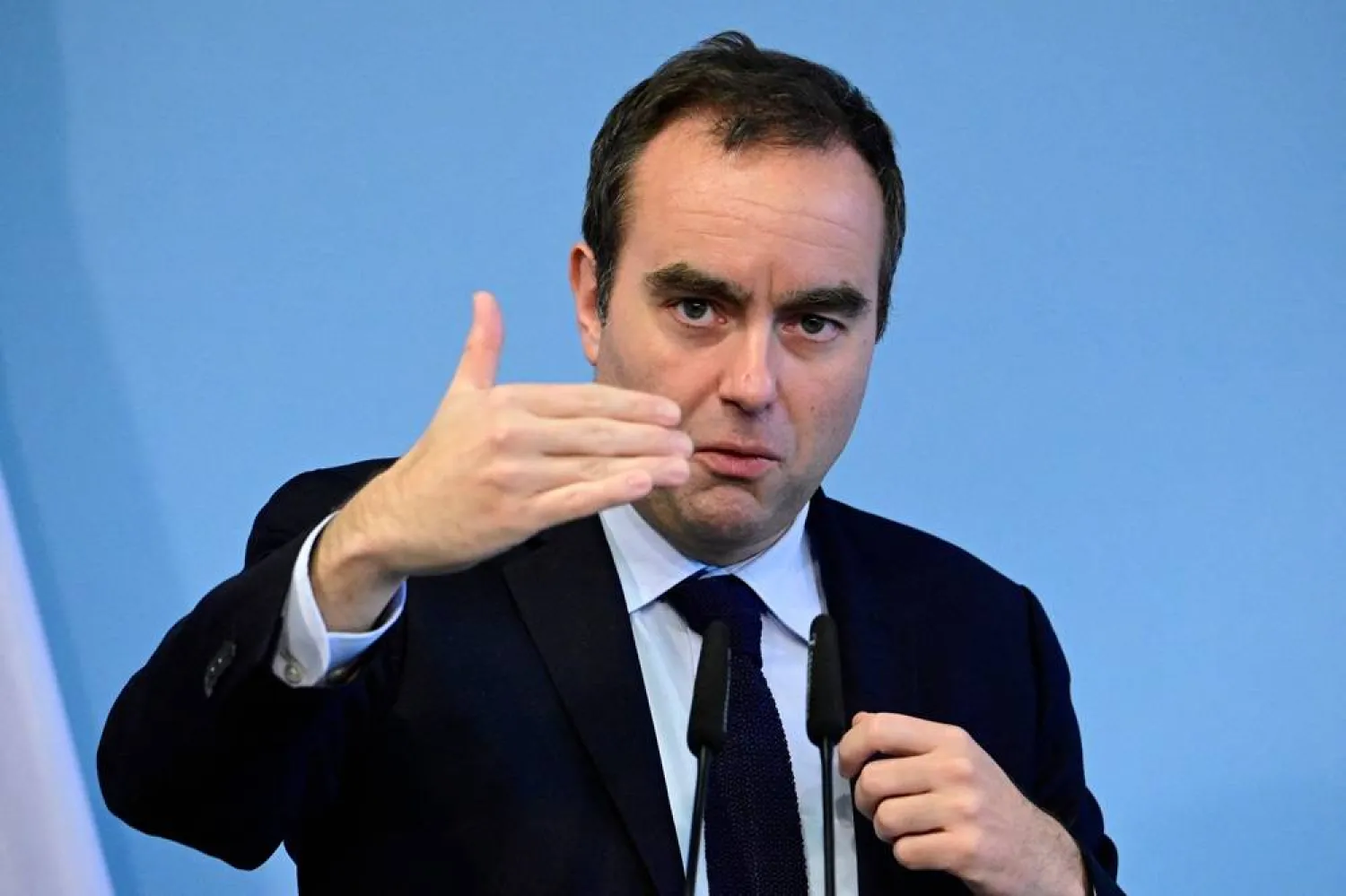
 France's Minister for the Armed Forces Sebastien Lecornu addresses a joint press conference with the German defense minister at the Federal Ministry of Defense in Berlin on March 22, 2024. (AFP)
France's Minister for the Armed Forces Sebastien Lecornu addresses a joint press conference with the German defense minister at the Federal Ministry of Defense in Berlin on March 22, 2024. (AFP)
TT

France to Send Old Armored Vehicles, New Missiles to Ukraine

 France's Minister for the Armed Forces Sebastien Lecornu addresses a joint press conference with the German defense minister at the Federal Ministry of Defense in Berlin on March 22, 2024. (AFP)
France's Minister for the Armed Forces Sebastien Lecornu addresses a joint press conference with the German defense minister at the Federal Ministry of Defense in Berlin on March 22, 2024. (AFP)

France will deliver hundreds of old armored vehicles and new surface-to-air missiles to Ukraine in its war against Russia, French Defense Minister Sebastien Lecornu said on Sunday.

In an interview with La Tribune Dimanche, Lecornu said that President Emmanuel Macron, following talks with Ukrainian President Volodymyr Zelenskiy, had asked him to prepare a new aid package, which will include old but still functional French equipment.

"The Ukrainian army needs to defend a very long front line, which requires armored vehicles; this is absolutely crucial for troop mobility and is part of the Ukrainian requests," he said.

He said France was looking at providing hundreds of VAB (Véhicule de l'Avant Blindé) front-line troop carriers in 2024 and early 2025.

France's army is gradually replacing its thousands of VABs, which first went into operation in the late 1970s, with a new multi-role troop carrier.

Lecornu added that France was also preparing to release a new batch of Aster 30 surface-to-air missiles for the SAMP/T system provided to Kyiv.

The Aster 30 can intercept warplanes, drones and cruise missiles within a range of 120 km.

"Ukraine has an urgent need for better ground-air defense ... Russia is intensifying its strikes, in particular on civilians and civil infrastructure," he said.

Lecornu said he had asked government defense procurement agency DGA (Direction Generale de l'Armement) to make proposals to accelerate production of Aster missiles, manufactured by European group MBDA.

Aster missiles are also being used in the Red Sea, where French frigates defend maritime traffic against attacks from Iranian-backed Houthi militias in Yemen, he said.

Lecornu said last week a decree was published giving the ministry powers to impose stock levels and prioritize contracts.

France is also speeding up the development of remotely operated ammunition for delivery to Ukraine as early as this summer, Lecornu said.

Macron last month suggested the possibility of European nations sending troops to Ukraine, although he cautioned that there was no consensus as allies agreed to ramp up efforts to deliver more munitions to Kyiv.



Macron Says Talks with Trump on Red Sea, Ukraine ‘Constructive’

French President Emmanuel Macron (R) walks with Jerome Bonnafont (L), Permanent Representative of France to the United Nations and France’s Foreign Affairs Minister Jean-Noel Barrot (C) as they arrive at Trump Tower in New York City on September 21, 2026, ahead of a meeting with US President Donald Trump. (AFP)
TT

Macron Says Talks with Trump on Red Sea, Ukraine ‘Constructive’

French President Emmanuel Macron (R) walks with Jerome Bonnafont (L), Permanent Representative of France to the United Nations and France’s Foreign Affairs Minister Jean-Noel Barrot (C) as they arrive at Trump Tower in New York City on September 21, 2026, ahead of a meeting with US President Donald Trump. (AFP)

French President Emmanuel Macron said on Monday he had positive talks with his US counterpart Donald Trump on the conflicts in Ukraine and in the Red Sea. 

"The other issue we talked about was the situation in the Red Sea... It's important for global prices. Then we had a long discussion about Ukraine and Russia," said Macron after their New York meeting. 

"We had a very good discussion. It was very constructive." 

Going into the high-stakes meeting ahead of the United Nations' high-level week, a French official briefed that Macron was prepared to face Trump with "total candor." 

On Ukraine, Macron said he has pressed Trump on the issue of supplying defensive weapons systems to Ukraine. 

They discussed "the need to help our Ukrainian friends faster and more strongly in terms of (missile) interceptors, because that is... a defensive measure," Macron said. 

The French president said Trump was "very amenable and we were able to go into detail on these two conflicts, which are obviously important for peace in the world and for our security." 

The Red Sea has become a key oil shipping route with the Strait of Hormuz blocked, but the takeover of the Strait of Bab al-Mandab by the Iran-backed Houthi militants has complicated shipping operations there. 

The European Union's naval mission in the Red Sea would need more than 10 warships, its foreign policy chief said on Monday, adding ‌that for ‌now there weren’t ‌that ⁠many in the ⁠area.

"When Aspides (the EU military operation) was put in place, then the indication was that ⁠it needs at ‌least ‌10 ships. The situation, ‌I think, is ‌even more grave right now," she told reporters on the sidelines ‌of the annual gathering of world leaders ⁠at ⁠the United Nations.

Kallas last week sent a letter to member states asking them to contribute more naval and air assets in the region, diplomats said.

Macron traveled to New York from Saint Pierre and Miquelon, a small French territory off Canada's Atlantic coast, where he met with Canadian Prime Minister Mark Carney. 

Carney has been embroiled in a war of words with Trump over a failed effort between the US and Canada to strike a trade deal, resulting in tit-for-tat tariffs. 

The French president also plans to meet with Ukrainian President Volodymyr Zelensky on the sidelines of the UN General Assembly. 


Washington Mobilizes Allies in the Arctic

US Secretary of State Marco Rubio speaks to members of the media during a signing ceremony on the sidelines of the 81st United Nations General Assembly in New York City, on September 21, 2026. (AFP)
TT

Washington Mobilizes Allies in the Arctic

US Secretary of State Marco Rubio speaks to members of the media during a signing ceremony on the sidelines of the 81st United Nations General Assembly in New York City, on September 21, 2026. (AFP)

US Secretary of State Marco Rubio on Monday stressed the need for investment in the Arctic while meeting with his counterparts from seven countries in the region, on the eve of signing a security agreement on Greenland.

"Allies agreed that Arctic security requires continued investment to safeguard this vital region and deter strategic competitors," State Department spokesman Tommy Piggott said in a readout of the meeting.

"Discussions focused on taking greater responsibility for Arctic security by developing sovereign military and economic capabilities, ensuring investment security, and funding resilient critical infrastructure that ensures reliable access and supports our shared leadership in the Arctic."

The meeting convened top diplomats from Canada, Denmark, Finland, Iceland, Norway, Sweden, the Faroe Islands and Greenland, at a New York hotel on the sidelines of the United Nations General Assembly.

Greenland, Denmark and the United States are due to sign an agreement regarding the Arctic at the UN on Tuesday, the office of Danish Prime Minister Mette Frederiksen said Monday evening.

The agreement was announced Friday by US President Donald Trump, and has not yet been made publicly available.

But Frederiksen said it recognizes the sovereignty and territorial integrity of Denmark, and the right of self-determination for Greenland's people.

Washington said the agreement paves the way to strengthen US military presence in Greenland while ensuring that China and Russia will not be able to establish bases or carry out sensitive investments there without consent.

Monday's discussions also touched on cooperation to develop a fleet of icebreakers between the US, Canada and Finland.

In October, the United States announced the purchase of 11 icebreakers from Finland for the US Coast Guard to add to its fleet of three aging ships.

European Union foreign policy chief Kaja Kallas said recently that Europe needs icebreakers to strengthen its presence in the Arctic, as global warming draws the interest of major powers to the region.

Vast natural resources are becoming increasingly accessible in the Arctic as ice melts and new maritime routes open up due to climate change.

China, Russia and the United States are reinforcing their presence in the strategic Arctic as a result.


UK Joins Call for Limiting UN Security Council Vetoes

11 September 2026, US, New York: A wide view of the UN Security Council chamber during a UN Security Council meeting marking the 25th anniversary of the 11 September 2001 terrorist attacks and examining the evolving global terrorist threat and international efforts to counter terrorism. (dpa)
TT

UK Joins Call for Limiting UN Security Council Vetoes

11 September 2026, US, New York: A wide view of the UN Security Council chamber during a UN Security Council meeting marking the 25th anniversary of the 11 September 2001 terrorist attacks and examining the evolving global terrorist threat and international efforts to counter terrorism. (dpa)

The United Kingdom has signed on to an initiative urging UN Security Council permanent members to withhold their vetoes on matters concerning mass atrocities, such as genocide, countries leading the push said Monday.

The initiative, first proposed by Mexico and France in 2015, now has a total of 128 countries behind it, French foreign minister Jean-Noel Barrot and Mexican counterpart Roberto Velasco said in a joint statement.

It is now just one country shy of reaching a two-thirds threshold of UN member states.

The Security Council has been paralyzed on many issues in recent years amid deep divisions between the five veto-wielding permanent members: France, UK, Russia, China, and the United States.

"By supporting this political declaration, states are demonstrating their commitment to ensuring that the Security Council can fully exercise its primary responsibility for maintaining international peace and security," said Barrot and Velasco.

In May, a diplomatic source told AFP that France was hoping to reach the two-thirds majority before this year's UN General Assembly, which kicks off this week.

Even if adopted with a two-thirds majority, the resolution would be non-binding.

Officials nonetheless hope to make it more politically difficult for a permanent member to use its veto in cases of such dire emergencies.