


'Hardest Geezer' Completes in Tunisia Epic Run the Full Length of Africa

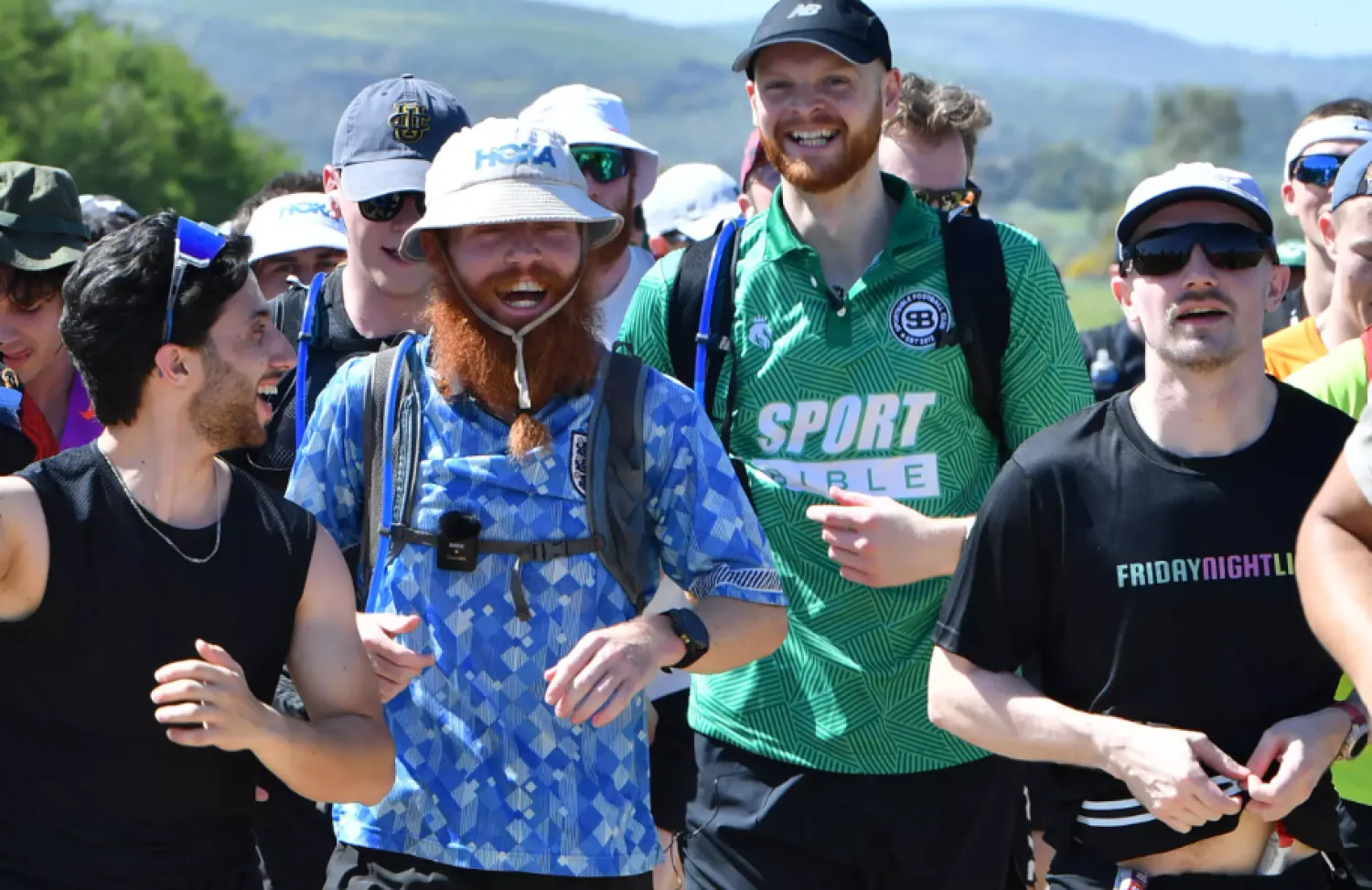
For the final leg of his run Cook was joined by supporters © FETHI BELAID / AFP
TT

'Hardest Geezer' Completes in Tunisia Epic Run the Full Length of Africa

For the final leg of his run Cook was joined by supporters © FETHI BELAID / AFP

Russ Cook on Sunday completed a mammoth quest to run the length of Africa having overcome health scares, visa troubles and even an armed robbery.

The Briton arrived late in the afternoon at Cape Angela in Tunisia, where a sculpture marks the "northernmost point of the African continent".

The epic endeavour saw him live up to his "hardest geezer (man)" nickname to complete the more than 16,000-kilometer (9,900-mile) journey.

Cook believes he is the first person ever to run the entire length of the continent.

The 27-year-old set off from South Africa's most southerly point on April 22 last year.

By the time he crossed the finish line in Tunisia, he had taken more than 19 million steps in 16 countries, running the equivalent of 385 marathons in 351 days.

He crossed mountains, tropical forests and deserts, including the mighty Sahara.

Cook's efforts have raised over £550,000 ($695,000) for the Running Charity and for Sandblast, which raises awareness for the indigenous Saharawis of Western Sahara.

For the final leg of his run, the endurance athlete from Worthing in southern England was joined by supporters.

"Wanted to open up the last day of this project to anyone and everyone who has been watching and supporting," he said on X, formerly Twitter.

"Come and run the last marathon, the last half, 10km, five kilometres, one kilometre. Whatever you fancy," he added.

The end of the challenge was set to be celebrated with a party at a hotel in Bizerte, Africa's northernmost city.

A performance by the rock band Soft Play, formerly known as Slaves, was planned.

"Can't quite believe it but we've managed to pull off Soft Play playing the finish line party in Tunisia," he said.

"Get your daiquiris ready girls and boys this is gonna be mega," he added.

Cook joked throughout his journey that he craved a strawberry daiquiri.

It was not only the running that challenged the extreme runner. In Angola, he and his team were robbed at gunpoint, while Cook's difficulties in obtaining a visa for Algeria nearly derailed the entire project.

In the Sahara, he ran at night to escape the searing heat and scorching sun. In Nigeria, doctors told him to cut back on his daily mileage because of pains he was suffering. Cook still kept going.

Before setting off last year he said his approach to life was to throw "everything and the kitchen sink" at it.

"I'm a totally normal bloke, so if I can do this, hopefully people can apply this to their own lives in whichever way they choose," he said.

"For 99 percent of people, it's not going to be running across Africa, but it might look like chasing their dreams a little bit more," he added.

"We have met incredible people in every single country we've been to that have welcomed us with love and kindness. The human spirit is a beautiful thing," he said.



Scientists May Have Unlocked Key Secret to Long Life

Prof Uri Alon said he hoped the study would inspire further investigation into the genes that affect lifespan (Shutterstock)
TT

Scientists May Have Unlocked Key Secret to Long Life

Prof Uri Alon said he hoped the study would inspire further investigation into the genes that affect lifespan (Shutterstock)

Scientists think they may have unlocked a key secret to long life – quite simply, genetics, according to The Guardian.

Writing in the journal Science, the researchers described how previous studies that had attempted to unpick the genetic component of human lifespan had not taken into account that some lives were cut short by accidents, murders, infectious diseases or other factors arising outside the body. Such “extrinsic mortality” increases with age, as people often become more frail.

Prof Uri Alon and colleagues at the Weizmann Institute of Science in Israel say the true genetic contribution to the variation in human lifespan has been masked.

The team looked at “heritability,” the proportion of change in a characteristic such as height, body weight or lifespan within a population that can be attributed to genetics rather than environmental factors. Previous studies for human lifespan have thrown up a wide range of values – with heritability ranging from 6% of the variation to 33%.

But Alon, who co-authored the research, and his colleagues said such figures were underestimates. “I hope this will inspire researchers to make a deep search for the genes that impact lifespan,” The Guardian quoted Alon as saying. “These genes will tell us the mechanisms that govern our internal clocks.

“These can one day be turned into therapy to slow down the rate of ageing and in that way slow down all age-related disease at once.”

The team created a mathematical model that takes into account extrinsic mortality and the impact of biological ageing, and calibrated it using correlations of lifespan from historical datasets of thousands of pairs of twins in Denmark and Sweden.

They removed the impact of extrinsic mortality to reveal the signal from biological ageing, which is caused by genetics. The results suggest about 50% of the variation in human lifespan is due to genetics – a figure the researchers said was on a par with that seen in wild mice in the laboratory.

The other 50% of variation in human lifespan, they said, was probably explained by factors such as random biological effects and environmental influences.


Berlin Drowning in Potatoes… for Free

Sack of fresh raw potatoes (Shutterstock)
TT

Berlin Drowning in Potatoes… for Free

Sack of fresh raw potatoes (Shutterstock)

A vast stockpile of potatoes is being given away for free by a farm in the German state of Saxony, after a bumper national harvest.

Thousands of tasty tubers have been rolling into the country's capital, Berlin, since mid-January, with residents risking icy streets to bag their share, according to BBC.

Dubbed “the great potato rescue” it is part of a plan to stop about 4 million kg of surplus spuds from going to ruin. Food banks, schools and churches are among the beneficiaries, according to organizers.

However, the enterprise was labelled a “disgusting PR stunt” by the Brandenburg Farmers' Association, which lamented the impact on local markets.

Germany is the European Union's potato-producing capital, and last year's harvest has left the market saturated.

Ultimately it is about “putting the potato in the spotlight as a valuable food,” said Berliner Morgenpost editor, Peter Schink who helped spearhead the plan.

The newspaper teamed up with eco-friendly search engine firm, Ecosia, to co-ordinate and fund the distribution of the spuds.

Not wishing to discard its “magnificent tubers” back into the fields, Osterland Agrar says it's set to have bussed around 500,000kg to Berlin, and other parts of Germany and Ukraine.

"We can store them until the middle of this year," said Hans-Joachim von Massow, Managing Director of Osterland Agrar, the agricultural firm that ended up with all the potatoes, after a customer contract was cancelled and settled.

But not everyone is celebrating.

“Food is and will remain valuable, even if thoughtless do-gooders throw around free potatoes at schools and churches,” said Timo Scheib from the Brandenburg Farmers' Association.


Bezos's Blue Origin to 'Pause' Space Tourism to Focus on Moon Efforts

Jeff Bezos arrives to attend Dior Haute Couture Spring/Summer 2026 show in Paris, France, January 26, 2026. REUTERS/Abdul Saboor
TT

Bezos's Blue Origin to 'Pause' Space Tourism to Focus on Moon Efforts

Jeff Bezos arrives to attend Dior Haute Couture Spring/Summer 2026 show in Paris, France, January 26, 2026. REUTERS/Abdul Saboor

Jeff Bezos's space company Blue Origin said Friday it would temporarily pause flights of its space tourism rocket to focus more resources on its lunar ambitions.

According to AFP, the company said in a statement it would "pause New Shepard flights for no less than two years" in order to "further accelerate development of the company's human lunar capabilities."

"The decision reflects Blue Origin's commitment to the nation's goal of returning to the Moon and establishing a permanent, sustained lunar presence," the statement read.

New Shepard is a reusable rocket that has carried dozens of humans across the Karman line, the internationally recognized boundary of space.

But Blue Origin also aims to compete with Elon Musk's SpaceX in the orbital flight market.

Last year, the company founded by Amazon's Jeff Bezos successfully carried out two uncrewed orbital flights using its massive New Glenn rocket, which is significantly more powerful than New Shepard.

Also last year, NASA said it was opening bids for a planned Moon mission, the third phase of the Artemis program, to compete against rival SpaceX, which the then-chief said was "behind."

Blue Origin currently has the contract for the fifth planned mission of the multibillion-dollar Artemis program.

US President Donald Trump's second term in the White House has seen the administration pile pressure on NASA to accelerate its progress to send a crewed mission to the Moon, as China carries out similar efforts.
